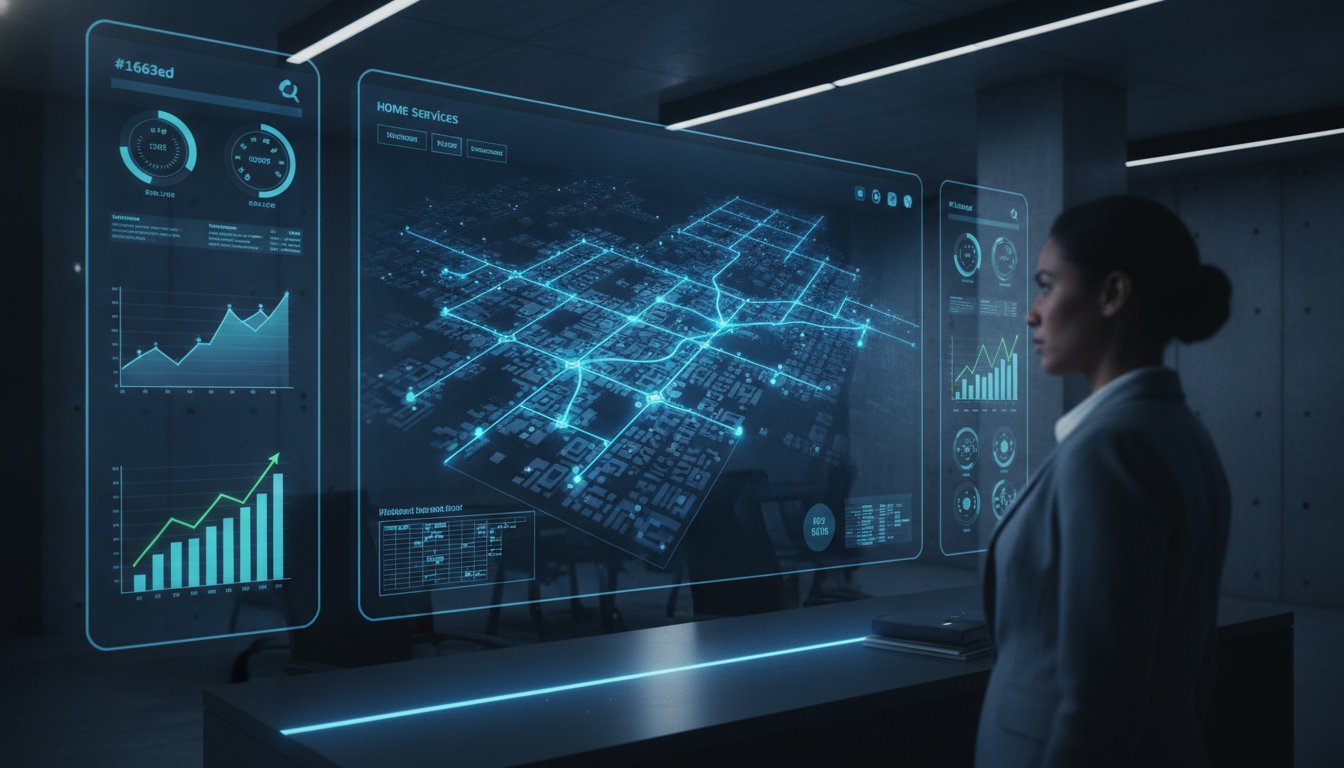
AI Business Management for Home Services: The Strategic Operating System
Recent research indicates that 85% of customers who reach a voicemail instead of a live representative will never call back. For a high-growth enterprise, this is not merely a missed connection; it's a structural revenue leak that compounds across every territory you occupy. Implementing AI business management for home services is no longer a peripheral upgrade for early adopters. It's the foundational requirement for any modern service organization that intends to maintain a competitive edge in an increasingly automated market.
You've likely accepted fragmented data and technician under-utilization as the inevitable friction of doing business at scale. We're here to challenge that assumption. This article demonstrates how an AI-native operating system transforms these operational gaps into predictable profit centers. You'll see how to unify your dispatching, lead capture, and franchise benchmarking into a single, intelligent layer that observes and corrects inefficiencies in real time.
Key Takeaways
- Identify and reclaim the 15% of potential revenue currently lost to systemic inefficiencies and missed lead opportunities.
- Distinguish between superficial AI plugins and a true AI-native architecture for AI business management for home services.
- Optimize technician performance and route density through real-time, intelligent dispatching that eliminates human error.
- Achieve total oversight of multi-location operations with automated benchmarking and executive-level performance dashboards.
- Implement a strategic roadmap to replace fragmented legacy databases with a unified, high-performance operating system.
The Silent Crisis: How Legacy Systems Fuel Revenue Leakage
Most home service executives operate under the illusion of efficiency while losing 15% of their potential revenue before a single technician arrives on site. This isn't a minor rounding error. It's a systemic failure. This leakage occurs in the gaps between missed calls, unoptimized routes, and the "dead air" of manual scheduling. When your infrastructure relies on human memory and manual entry, you aren't managing a business; you're managing chaos.
Traditional CRMs have failed the modern enterprise. They function as passive digital filing cabinets rather than active growth engines. They store customer names and addresses but lack the intelligence to convert a lead or recover a lost opportunity. In high-volume HVAC and plumbing operations, the cost of manual coordination is staggering. Relying on human dispatchers to juggle hundreds of variables in real time is a recipe for under-utilization. Transitioning to AI business management for home services shifts the paradigm from reactive firefighting to proactive opportunity capture.
The Cost of Latency in Customer Response
Speed is the primary currency of the home services market. A five-minute delay in responding to a lead reduces the probability of conversion by 80%. Most traditional answering services fail here. They capture names but lack the technical intent to qualify a high-value emergency call. This delay creates a window for competitors to intercept your hard-earned leads. We define "Zero Latency" as the new standard for home service growth. It's the ability to engage, qualify, and schedule a lead the instant it enters your ecosystem without human intervention.
Fragmented Data: The Enemy of Executive Oversight
Disconnected tools create dangerous blind spots in franchise performance. When your marketing data doesn't talk to your dispatching software, you can't see the true ROI of your spend. There are numerous applications of artificial intelligence that solve this by unifying disparate data points into a single source of truth. Relying on historical reports is like driving by looking only in the rearview mirror. You need real-time operational intelligence to make strategic decisions. Manual data entry remains the primary source of friction, introducing human error that distorts your executive oversight and slows down your ability to scale across multiple locations.
Defining the AI-Native Business Operating System
The industry is currently flooded with "AI-enabled" legacy software. These are traditional platforms that have bolted on a chatbot or a basic text generator to appear modern. This is not innovation; it is a facade. A true AI-native operating system for home services is built from the ground up with intelligence as its core architecture. It doesn't just store data. It interprets it. It doesn't wait for a human to click a button. It executes the next logical step in the customer lifecycle autonomously.
AI Business Management for home services is the integration of autonomous intelligence into the core operational stack to observe, decide, and execute business processes without manual friction. This represents a foundational shift from human-led dispatching to algorithmically optimized routing. In this model, the software understands technician skill sets, traffic patterns, and job profitability simultaneously. It moves beyond simple scheduling to active revenue maximization, ensuring your highest-performing assets are always on the highest-value calls.
The Intelligence Layer vs. The CRM
Your CRM should be a component of your operating system, not the center of it. In a legacy environment, the CRM is a passive database that requires constant human feeding. An AI-native system reverses this relationship. By implementing AI call answering and instant lead response, the system captures and qualifies leads before they even reach your office staff. This unified intelligence layer uses predictive analytics to manage seasonal demand spikes, identifying when to aggressive marketing and when to tighten technician schedules. As you deploy these systems, aligning with frameworks like the AI Risk Management Framework ensures your autonomous operations remain secure and reliable.
Autonomous Operations: The Future of Trade Management
The future of the trades lies in the elimination of administrative "busy work." AI now manages the entire post-service lifecycle, from automated follow-ups to reputation management, without a single keystroke from your team. We are seeing a rapid transition toward automated estimating and precision quoting. These tools analyze job site photos and technical data to generate accurate bids instantly, removing the "quote fatigue" that often plagues busy technicians. This ensures every customer receives a consistent, professional experience governed by automated SOPs. To see how this architecture functions in a live enterprise environment, you can explore the capabilities of a unified AI platform. By removing human error from the equation, you create a business that is not just managed, but engineered for scale.
Precision Ops: Intelligent Technician Dispatching and Estimating
Field efficiency is frequently sabotaged by the inherent limitations of human coordination. A dispatcher, regardless of their tenure, cannot process thousands of shifting variables simultaneously. AI business management for home services replaces this cognitive bottleneck with an algorithmic engine that prioritizes profitability and response speed. By aggressively reducing the "time-to-job" metric, your organization can dominate the local market. You aren't just reaching the customer faster; you're arriving with the right technician for the specific task. This level of precision directly impacts the bottom line by minimizing fuel consumption and vehicle wear, effectively extending the lifecycle of your fleet. Forward-thinking organizations are adopting new models for competing in the age of AI that prioritize these granular operational efficiencies over traditional, high-friction growth strategies.
Dynamic Route Optimization
Dynamic optimization represents a fundamental leap beyond basic GPS navigation. The system observes real-time traffic patterns, technician certification levels, and job priority to make second-by-second adjustments to the schedule. It works relentlessly to reduce "windshield time" to its absolute minimum. The objective is quantifiable: add one extra billable job per technician, per day. When an emergency call disrupts the morning schedule or a last-minute cancellation occurs, the system re-optimizes the entire fleet instantly. This ensures no technician sits idle while high-priority revenue opportunities remain unassigned in your service area.
AI-Driven Quoting and High-Velocity Bidding
Quote fatigue is a silent margin killer. When technicians are rushed or overwhelmed, pricing becomes inconsistent and errors proliferate. AI estimating tools standardize the bidding process across your entire fleet, ensuring every quote protects your margins while remaining competitive. The system also automates the follow-up process for unclosed estimates. It retrieves lost revenue by maintaining persistent, professional contact with the customer until a decision is finalized. AI estimating improves customer trust through transparency by providing data-backed, itemized projections that remove the ambiguity of manual pricing. This high-velocity bidding environment allows your team to close more deals without increasing their administrative burden or sacrificing accuracy.
- Eliminate manual dispatching errors through algorithmic scheduling.
- Increase daily job capacity without adding headcount.
- Protect service margins with standardized, AI-generated quotes.
- Automate estimate follow-ups to maximize lead conversion rates.
Frictionless Finance and Multi-Location Intelligence
Financial friction is the silent killer of operational scale. Many home service enterprises struggle with stagnant cash flow, not because of a lack of work, but because of a fundamental failure to collect. Manual billing processes create a backlog of uncaptured revenue that handicaps your ability to reinvest in growth. AI business management for home services eliminates this bottleneck by automating the entire financial lifecycle from the moment a technician completes a job. By removing the human element from invoicing and payment collection, you ensure that every dollar earned is a dollar accounted for in real time. This is the transition from chasing payments to managing capital.
Executive reporting should provide clarity, not confusion. In a fragmented environment, gathering data from multiple locations takes days of manual effort and results in reports that are obsolete by the time they reach your desk. AI-native systems turn this operational data into strategic growth insights instantly. You no longer need to guess which marketing channels are driving the highest-margin jobs or which territories are underperforming. The system retrieves these answers for you, allowing you to focus on high-level strategy rather than data entry. To see how this unified financial intelligence functions at scale, you can explore the financial automation capabilities of an AI-native platform.
Automated Billing and Payment Velocity
"Unsent invoice" syndrome is a catastrophic operational failure in the trades. Technicians often forget to trigger the final billing, or office staff get buried in paperwork, delaying cash flow by weeks. Automated post-job billing triggers the invoice the instant a job is marked complete. This system goes beyond simple invoicing; it integrates financing options directly into the AI-generated quote, removing price as a barrier to conversion. Managing recurring service memberships also becomes an autonomous background process. The system handles renewals, billing cycles, and retention outreach without human intervention, building a predictable revenue floor that stabilizes your business through seasonal fluctuations.
Enterprise Benchmarking for Multi-Location Growth
Visibility is often the first casualty of multi-location expansion. As you scale into new territories, maintaining a consistent performance standard becomes increasingly difficult without a unified intelligence layer. AI-native platforms standardize KPIs across every franchise location, providing executive leadership with total visibility into regional performance. This allows you to identify specific performance gaps in real time, whether it's a dip in close rates in one city or an escalation in travel times in another. The aggregation of network-wide data provides the strategic leverage necessary to drive enterprise-level decisions with mathematical certainty. Top performers are no longer outliers; they become the benchmark for the entire organization.
Implementing JobOS Pro: The Strategic Shift to AI-Native Ops
Transitioning to an AI-native architecture is not a routine software update; it is a strategic reorganization of your entire enterprise. Most legacy operators are currently trapped in a cycle of managing disparate tools that refuse to communicate. AI business management for home services provides the structural integrity needed to scale without the friction of manual oversight. By deploying JobOS Pro, you replace a collection of fragile plugins with a unified foundation designed specifically for high-growth home service organizations. This roadmap begins with the immediate identification of existing revenue leaks and moves rapidly toward the total automation of your customer lifecycle.
Consolidating the Tech Stack
Subscription bloat is a silent drain on both your budget and your operational focus. JobOS Pro unifies lead capture, dispatching, and financial operations into a single, high-performance environment. We understand that your financial records are the lifeblood of your business; therefore, we integrate seamlessly with QuickBooks. We complement your existing accounting infrastructure by feeding it clean, automated data rather than attempting to replace it. This consolidation extends to customer retention and reputation management. Every successful job automatically triggers a review request and a follow-up sequence, ensuring your brand equity grows alongside your revenue without additional human effort.
The Competitive Advantage of AI-Native Management
The home service market is approaching a definitive tipping point. By 2026, the gap between AI-native enterprises and traditional operators will be insurmountable. Early adopters are currently building the data moats and operational efficiencies that will allow them to dominate their local territories. This shift allows you to scale your business volume exponentially without a corresponding increase in administrative headcount. You are no longer limited by the number of people in your office, but by the number of technicians in the field. This is the ultimate objective of modern leadership: total executive oversight and the reclamation of your strategic time. Future-proofing your business means building on a platform that evolves alongside technological disruption rather than being rendered obsolete by it.
Request your executive demo of JobOS Pro today to observe how an AI-native operating system eliminates revenue leakage and secures your market position.
Engineered for Scale: The Move to AI-Native Operations
The transition from fragmented legacy tools to a unified intelligence layer is no longer a matter of preference; it is a prerequisite for survival in a high-stakes market. We have established that the revenue leaks inherent in traditional systems are a choice that growth-focused executives can no longer afford to make. By implementing AI business management for home services, you replace manual friction with autonomous precision. This shift ensures every lead is captured and every technician is utilized to their maximum capacity.
JobOS Pro delivers the total visibility required to manage complex, multi-location enterprises with mathematical certainty. Through AI-powered lead capture, executive performance dashboards, and multi-location franchise benchmarking, you can finally reclaim your strategic time while the system identifies and retrieves hidden profit centers. The future belongs to those who trade human error for algorithmic efficiency.
Master Your Operations with JobOS Pro
Your organization is ready for its next phase of growth. It is time to implement the operating system that makes that growth inevitable.
Frequently Asked Questions
What is AI business management for home services?
AI business management for home services is the deployment of an autonomous intelligence layer over your core operations. It moves beyond the passive data storage of traditional CRMs to actively manage lead capture, dispatching, and financial workflows. This system observes patterns, retrieves lost opportunities, and executes business processes without the friction of manual human intervention.
How does AI call answering help HVAC and plumbing businesses?
AI call answering eliminates the structural revenue leak caused by missed calls. Since 85% of customers who reach a voicemail won't call back, this technology ensures every lead is engaged instantly. The system qualifies technical intent and schedules emergency service calls in real time, preventing high-value opportunities from migrating to your local competitors.
Can AI really handle technician dispatching better than a human?
Yes, because an algorithmic engine can process thousands of shifting variables that a human dispatcher cannot. The system analyzes real-time traffic patterns, technician skill sets, and job profitability simultaneously to optimize every route. This precision reduces windshield time and allows your fleet to capture more billable hours without adding headcount.
How does JobOS Pro differ from a traditional CRM?
JobOS Pro is an AI-native operating system designed to provide the intelligence that legacy platforms lack. While it handles customer data, its primary function is to act as the active brain of your enterprise. It automates the workflows that traditional databases merely record, turning passive information into proactive operational action.
How does automated estimating improve my close rates?
Automated estimating eliminates quote fatigue and standardizes pricing across your entire fleet. By delivering transparent, data-backed bids instantly, you build immediate trust with the customer. The system then manages the follow-up process autonomously, ensuring that no estimate remains unclosed due to administrative oversight or technician burnout.
What is franchise network benchmarking in home service software?
Benchmarking is the aggregation of real-time performance data across every location in a franchise network. This provides executive leadership with total visibility into regional performance gaps. By identifying the specific strategies used by top-performing territories, you can standardize those high-margin operations across your entire organization with mathematical certainty.
Does JobOS Pro integrate with my accounting software like QuickBooks?
JobOS Pro integrates directly with QuickBooks to ensure your financial data remains clean and accurate. The system automates invoicing and payment collection at the job site, then syncs those records to your accounting stack. This eliminates the need for manual data entry and ensures your cash flow is reflected in real time.
How long does it take to implement an AI-powered operating system?
Implementation is a phased strategic shift designed to ensure zero operational downtime. While high-impact features like AI lead capture can be activated almost immediately, the full integration of the AI-native stack follows a structured roadmap. This methodical approach allows your team to transition from fragmented tools to a unified intelligence layer without disrupting current service cycles.