
AI Dispatching for Fleets: Evaluate, Pilot, and Scale
AI Dispatching for Fleets: Evaluate, Pilot, and Scale
AI dispatching works for most fleets running more than a handful of trucks, and the right move is a shadow-mode pilot on two or three lanes before any wider rollout. Fleets that adopt it typically see fewer empty miles and higher truck utilization within the first few months, because the system ranks loads and assigns routes faster than a dispatcher juggling six screens. If your dispatch desk is drowning in spreadsheets and phone tag, the next step is simple:
- Run a 30 day shadow-mode trial on your busiest lanes
- Keep dispatchers approving every recommendation during the pilot
- Ask any vendor for a demo that shows live load matching, not a slide deck
Key Takeaways
AI dispatching succeeds when fleets pair automated load matching and route optimization with a supervised, shadow-mode rollout that keeps dispatchers approving decisions early on.
| Point | Details |
|---|---|
| Start in shadow mode | Run AI recommendations without live authority for several weeks before expanding autonomy. |
| Track the right KPIs | Watch empty miles, truck utilization, and load acceptance rate from week one. |
| Confirm integrations first | Load boards, ELD, TMS, and accounting connections determine whether the system works well. |
| Keep dispatchers in the loop | Human oversight stays essential for edge cases and complex broker relationships. |
| JobOS Pro for home service fleets | Combines AI-native dispatch with revenue recovery and multi-location intelligence for service businesses. |
Table of Contents
- How AI Dispatching Works
- Tangible Benefits Fleets Can Expect
- Who Benefits Most From Smart Dispatch Software
- Integrations and Data Requirements for Intelligent Fleet Dispatching
- Implementation Best Practices: Rolling Out AI Dispatch Safely
- Pricing Models and Realistic ROI for AI-Powered Dispatch
- How to Evaluate an AI Dispatch Solution on Demo
- Why JobOS Pro Fits Home Service Fleets Running AI-Native Dispatch
- Frequently Asked Questions
- Sources
How AI Dispatching Works
AI dispatching pulls data from your ELD, your load boards, your TMS, and driver availability, then feeds it into ranking and optimization models that recommend the best assignment for each truck. The system doesn’t replace judgment. It compresses the research a dispatcher would otherwise do manually, load board by load board, into a ranked list that updates as conditions change.
The flow looks like this: telemetry and hours-of-service data come in from the ELD, open loads stream in from board integrations, and rate history feeds a scoring model. That model weighs price per mile, deadhead distance, delivery windows, and driver preferences, then surfaces a short list of recommended loads. A dispatcher clicks approve, or overrides it. The system logs the outcome and adjusts.
Core capabilities you’ll find across most platforms include:
- Load matching that scores available freight against truck location, capacity, and driver hours
- Route optimization that recalculates the fastest or cheapest path as traffic and weather shift
- ETA prediction that updates customers automatically instead of waiting on a phone call
- Automated check-calls that ping drivers and log responses without dispatcher involvement
- Document extraction that reads bills of lading and rate confirmations to cut manual entry
- Negotiation support that suggests counteroffers on rate confirmations based on lane history
Enterprise-grade schedulers can weigh hundreds of variables at once and re-optimize the whole board continuously rather than in batches, which is the real technical leap over rule-based dispatch and route optimization software from a decade ago.
Pro Tip: Garbage in, garbage out applies harder to dispatch AI than almost any other system. If your ELD data has gaps, your lane history is inconsistent, or your rate confirmations live in three different formats, fix that before you evaluate a single vendor. A model can’t rank loads well on incomplete inputs.
Tangible Benefits Fleets Can Expect
The measurable payoff shows up in a handful of KPIs worth tracking from week one:
- Time saved per dispatcher, often freeing up hours previously spent scanning load boards
- Load acceptance rate, meaning fewer loads get passed over because nobody had time to evaluate them
- Revenue per truck, which climbs when trucks spend less time empty
- Truck utilization, the percentage of available hours a truck is actually loaded and moving
- Empty miles as a share of total miles, the single clearest efficiency signal on a P&L
Vendor marketing in this category commonly cites route-mile reductions in the 15 to 22 percent range compared with manual planning, alongside better ETA accuracy. Treat those figures as directional claims from sellers, not independent audits, and validate them against your own baseline during a pilot before building them into a budget.
Beyond the headline numbers, fleets report softer gains that add up over a quarter: less time on hold with brokers, faster invoicing because paperwork gets extracted automatically instead of typed in by hand, and a better driver experience when check-calls happen automatically instead of interrupting someone mid-drive.
Who Benefits Most From Smart Dispatch Software
AI dispatching scales down as well as it scales up, but the return looks different depending on fleet size and business model.
- Owner-operators get the most relative lift, since a single person often can’t scan every load board fast enough to catch the best rates
- Small to medium fleets (5 to 50 trucks) typically see the fastest payback because dispatcher time is scarce and expensive
- Mixed 3PL and carrier operations benefit from automated matching across a bigger pool of freight and equipment types
- Brokers use the same load-scoring logic to match carriers to shippers faster
A regional carrier running 12 trucks might use AI-assisted load matching to stop losing backhauls to competitors who see the load first. A mid-size fleet running multi-stop regional routes might lean on real-time re-optimization when a delivery window slips and four other stops need to shift.
Integrations and Data Requirements for Intelligent Fleet Dispatching
None of this works without clean connections into the systems you already run. Before you sign anything, confirm the vendor supports:
- Load board integrations (DAT, Truckstop, and similar)
- TMS or ERP connections for order and rate data
- ELD and telematics feeds for hours-of-service and location
- Carrier portal access for cross-carrier visibility
- Accounting integration, typically QuickBooks or a comparable ERP
- A driver-facing mobile app, since mobile load-board apps with AI dispatch features already exist on both iOS and Android
On the data side, the model needs hours-of-service records, vehicle specifications, lane history, rate confirmations, and live GPS pings to do its job well. Ask vendors directly how they handle API credentials and whether integrations are API-first rather than screen-scraped, since screen-scraped connections break more often and expose more of your data than they should.
Implementation Best Practices: Rolling Out AI Dispatch Safely
The safest path into machine learning dispatch systems is supervised, not automatic. Start in shadow mode, where the system generates recommendations but touches nothing. Dispatchers review and approve every suggestion. Only after a defined stretch of clean performance does the system earn expanded autonomy on low-risk lanes.
A practical pilot checklist:
- Pick two or three representative lanes, not your most complex freight
- Keep dispatchers in the loop on every recommendation during the pilot
- Define success metrics up front (acceptance rate, time saved, error rate)
- Set explicit guardrails for what the system is never allowed to do unsupervised
Industry reporting on AI in trucking consistently notes that AI improves visibility and decision speed but still needs a human at the desk for complex or edge-case calls. That’s not a knock on the technology. It’s how you avoid a bad automated decision costing you a customer relationship.
Pro Tip: Write down your failure modes before launch, not after the first bad assignment. Decide in advance what happens when the system recommends a load that violates a broker relationship or ignores a driver’s home-time request, and who gets notified.
Shadow-mode pilots commonly run 4 to 12 weeks before fleets expand the system’s autonomy, giving it time to learn your specific broker quirks and lane patterns.
Pricing Models and Realistic ROI for AI-Powered Dispatch
Vendors in this space charge in a few standard ways: per-dispatcher seat, per-truck, per-load, or a tiered SaaS structure that bundles features by fleet size. Per-truck pricing tends to favor larger fleets, while per-seat pricing rewards fleets running lean dispatch teams.
Questions worth asking on every demo:
- How long is the free trial, and does it include real data or a sandbox?
- Can you export your data cleanly if you switch vendors later?
- Are integration fees separate from the subscription, and what’s the support SLA?
For a rough payback estimate, take your current empty-mile percentage, apply a conservative 5 to 10 percent improvement, and multiply by your average revenue per mile. Many vendors also promote rapid onboarding windows of 24 to 72 hours to a working pilot, which shortens the time before you have real numbers instead of estimates.
How to Evaluate an AI Dispatch Solution on Demo
Run every vendor through the same checklist so you’re comparing apples to apples:
- Does it integrate with your existing load boards and TMS without custom development?
- Can the vendor explain, in plain terms, how the model ranks loads?
- Does it support shadow mode before requiring live autonomy?
- What’s the actual support SLA, in writing, not marketing language?
- Who owns the data your fleet generates inside the platform?
- How customizable are the ranking weights for your specific lanes and equipment?
- What are the pilot terms, and can you exit without penalty?
- What security certifications and credential-handling practices does it use?
- How does the vendor measure and report ROI after go-live?
- How does the system handle rare or unusual equipment specs it hasn’t seen before?
Ask for a sample case with real metrics, not a general pitch. A vendor who can’t show you a specific before-and-after number on utilization or empty miles is asking you to take their claims on faith, and that’s a red flag worth weighing heavily before you sign.
Running AI Dispatch in Production Changes the Job, Not the Need for It
Dispatchers who work alongside AI systems spend less time on data entry and more time handling exceptions, the load that falls through, the driver who calls in sick, the broker who changes terms mid-route. The desk still needs a person. It just needs a different kind of attention.
Why JobOS Pro Fits Home Service Fleets Running AI-Native Dispatch
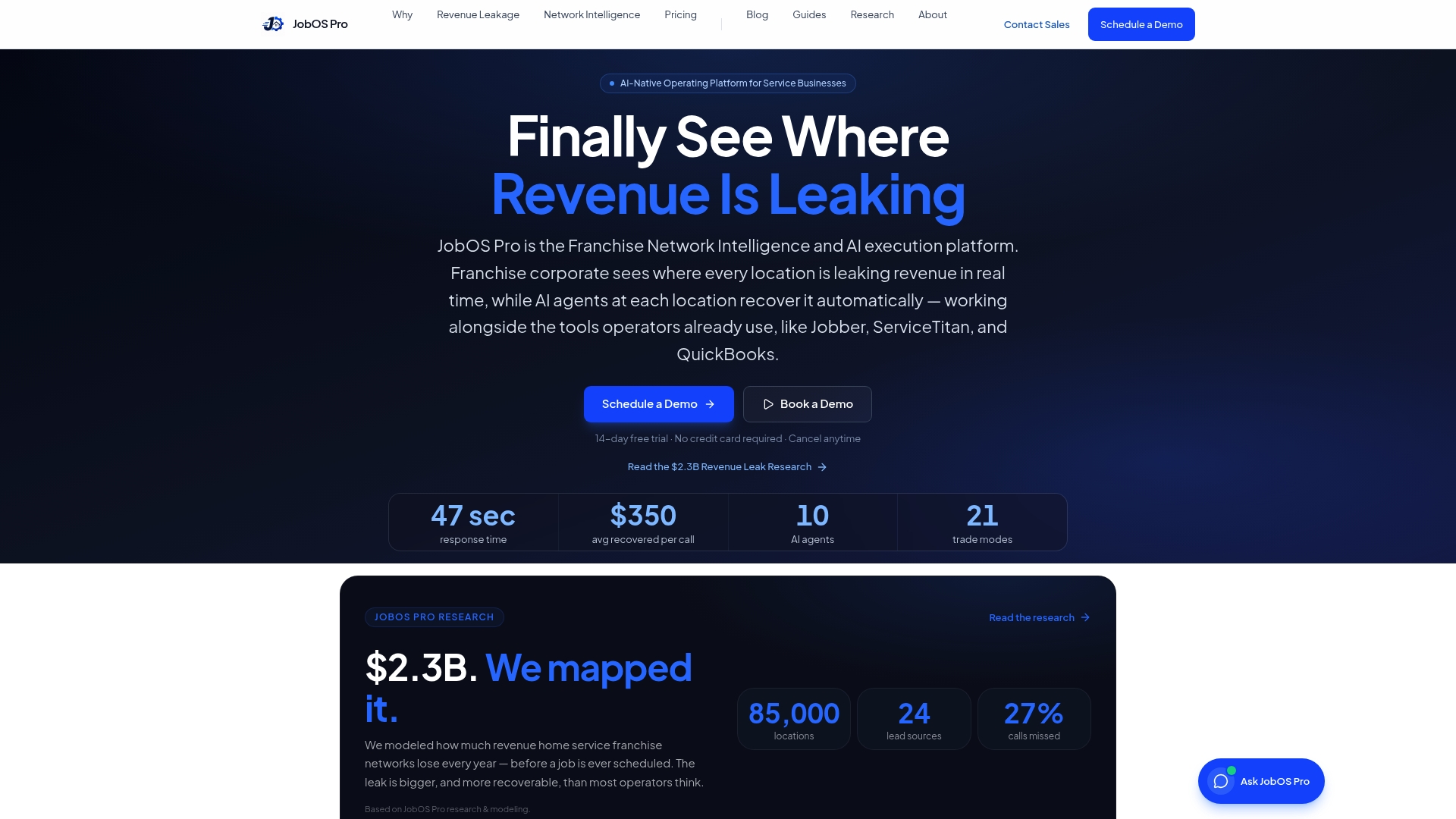
Most AI dispatch tools were built for over-the-road trucking, not for the service trucks running HVAC, plumbing, electrical, or landscaping routes every day. JobOS Pro was built from the ground up for that world, connecting dispatch directly to the revenue side of the business instead of treating scheduling as a standalone problem.
What that means in practice:
- An AI-native dispatch and scheduling board that works alongside tools you already run, including Jobber and QuickBooks
- Route optimization tied to real-time revenue reporting, so a scheduling delay shows up as a dollar figure, not just a gap on a calendar
- Multi-location intelligence for franchise operators who need to compare dispatch performance across every location from one dashboard
- A free trial to test the platform against your own jobs before committing
Franchise leaders in particular get something most dispatch tools don’t offer: a way to see which locations are recovering revenue efficiently and which ones are leaking it through missed calls, uncollected payments, or scheduling delays. If you’re running a multi-location operation, Scout’s network intelligence shows that comparison directly.
If you’re currently piecing together a dispatch board, a separate invoicing tool, and a spreadsheet for tracking technician utilization, the fastest way to see the difference is to start a trial with JobOS Pro’s AI agents and run it against a real week of your own jobs.
Frequently Asked Questions
Will AI dispatching replace human dispatchers? No. It replaces the repetitive parts of the job, scanning boards, logging check-calls, chasing paperwork, but complex negotiations and exception handling still need a person making the call.
How accurate are AI load matching recommendations? Accuracy depends heavily on data quality. Clean ELD feeds and consistent lane history produce sharper recommendations than fleets with fragmented or outdated records.
Is my fleet’s data secure with an AI dispatch platform? Ask specifically about API-first integrations versus credential-based screen scraping, and confirm who owns exported data before signing a contract.
How long does it take to fully adopt AI dispatching? Most fleets run a shadow-mode pilot for four to twelve weeks before expanding autonomy, followed by a gradual rollout across additional lanes.
What size fleet is AI dispatching best suited for? Owner-operators and small to medium fleets often see the fastest relative payback, though larger fleets and 3PLs benefit from scale across more freight and equipment types.