
AI Estimating for HVAC: 2026 Executive Buying Guide
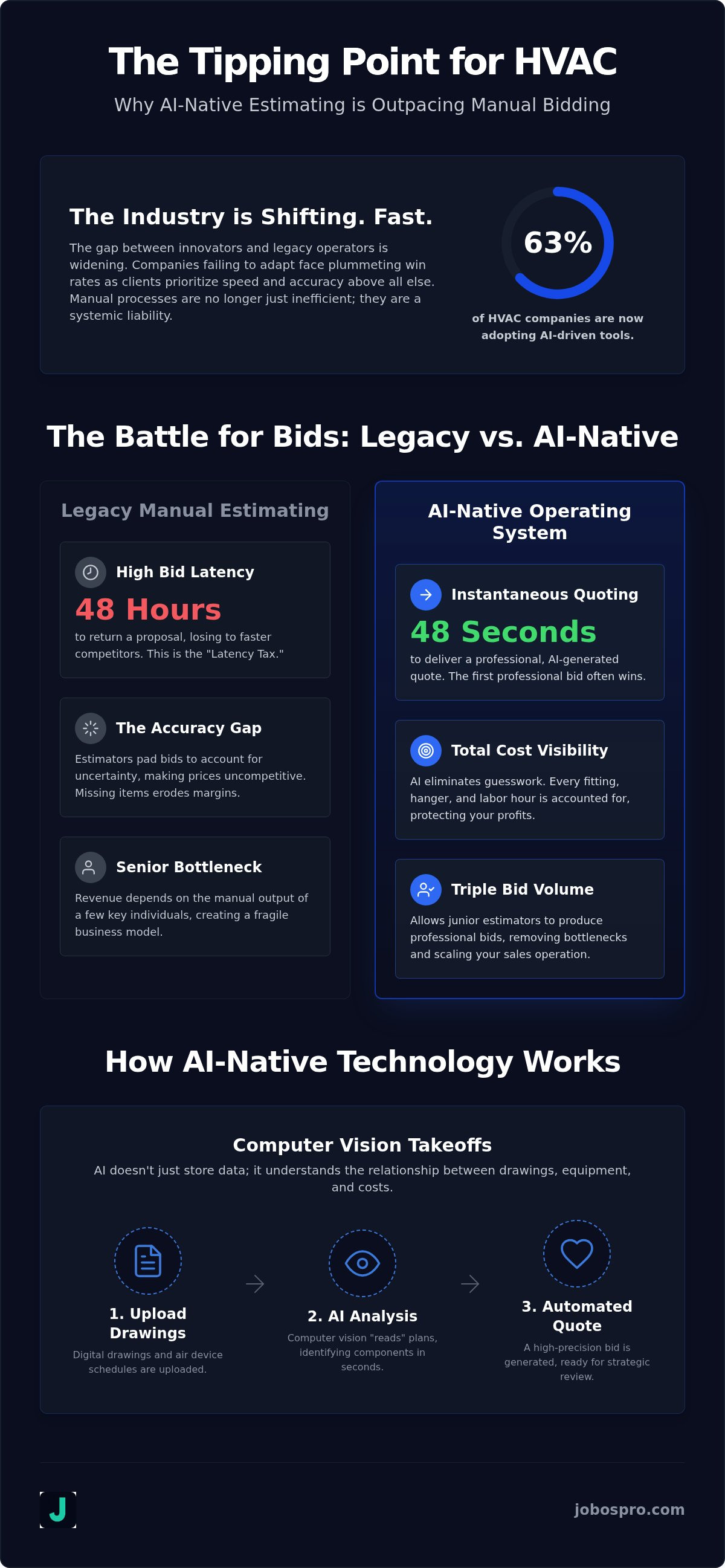
Why is your sales team still waiting forty eight hours for a technical takeoff when your competitors are closing contracts in forty eight seconds? You already recognize that speed is the only differentiator that truly scales in a market defined by 2026 refrigerant transitions and tightening margins. With 63% of HVAC companies now adopting AI-driven tools, the gap between the innovators and the legacy operators is widening. To maintain a competitive edge, your firm must move beyond manual entry and embrace AI estimating software for HVAC that functions as a strategic asset rather than a mere digital calculator.
You likely feel the pressure of high bid latency and the risk of inaccurate takeoffs eroding your hard-earned margins. We promise to show you how to eliminate these systemic inefficiencies and recover the revenue currently leaking through your operations. This executive guide provides a rigorous framework for selecting AI-native tools that can triple your bid volume. We will explore how to reduce technical overhead for junior staff and create a unified, automated flow from the initial estimate directly into dispatch and invoicing.
Key Takeaways
- Identify the specific operational gaps where manual estimating creates high bid latency and directly erodes your net profit margins.
- Understand the technical architecture of computer vision and how it automates complex mechanical takeoffs from digital drawings and air device schedules.
- Evaluate the strategic advantages of a unified AI operating system over fragmented point solutions to ensure seamless data flow from quote to dispatch.
- Discover how high-performance AI estimating software for HVAC allows junior estimators to produce professional bids, effectively tripling your output.
- Learn the two-step implementation framework for auditing your current sales cycle and standardizing pricing logic within an automated AI engine.
Beyond the Spreadsheet: Why Manual HVAC Estimating is Your Biggest Revenue Leak
Manual processes are no longer just inefficient; they are a systemic liability. For decades, the industry relied on tribal knowledge and fragmented spreadsheets to price complex mechanical systems. This legacy approach to manual HVAC estimating creates a ceiling on your growth that no amount of marketing spend can pierce. When your senior estimators are buried in paper plans, they become the primary bottleneck for your entire sales organization. You cannot scale a multi-location enterprise when your revenue depends on the manual output of a few key individuals. This dependency creates a fragile business model where a single resignation can paralyze your bidding capacity.
The transition to AI estimating software for HVAC is not a luxury for the tech-forward few. It is a survival requirement for 2026. Companies that continue to bid reactively are finding their win rates plummeting. Modern clients prioritize response time over almost every other metric. If your team takes forty-eight hours to return a proposal, you have already lost the contract to the competitor who delivered a professional, AI-generated quote within sixty minutes of the lead capture. You must shift from reactive bidding to proactive market capture to remain relevant.
The Latency Tax in Residential and Commercial HVAC
Every hour a lead sits in your queue without a firm price, the probability of conversion drops. This is the Latency Tax. In high-volume residential markets, the first professional bid often wins because it signals operational reliability and technical competence. In the commercial sector, slow bidding cycles disrupt project timelines and frustrate general contractors who require immediate data for their own budgeting. You must identify the leakage points in your current funnel. Are leads stalling at the hand-off from sales to estimating? These gaps represent recovered revenue that is currently being handed to your faster competitors.
The Accuracy Gap in Manual Ductwork Calculations
Precision is often sacrificed for speed in manual workflows. Estimators frequently pad bids by significant percentages to account for uncertainty in sheet metal labor and fitting details. This defensive pricing makes you uncompetitive on tight-margin projects. Conversely, missing critical air devices or underestimating linear footage of ductwork leads to immediate margin erosion during the installation phase. AI eliminates this guesswork. By using computer vision to analyze air device schedules and mechanical drawings, AI estimating software for HVAC provides total cost visibility. It ensures that every fitting, hanger, and labor hour is accounted for before the contract is signed. This level of automated roll-up protects your profits and allows your team to bid with absolute confidence.
The Architecture of AI-Native HVAC Estimating: From Takeoffs to Proposals
True AI-native estimating is not a bolt-on feature. It is a unified architectural shift that transforms raw lead data into high-precision bids through continuous machine learning. While legacy tools require manual input at every stage, AI estimating software for HVAC functions as an intelligent layer that observes and retrieves data autonomously. This technology doesn't just store information; it understands the relationship between mechanical drawings, equipment schedules, and real-world labor costs. It creates a closed-loop system where every proposal is informed by the technical realities of the project and the historical performance of your field teams.
The foundation of this architecture lies in computer vision. Advanced algorithms now "read" mechanical drawings with a level of scrutiny that exceeds human capacity. They identify air device schedules, equipment tags, and complex piping runs in seconds. By adopting these AI Operating Systems, contractors move from tedious manual counting to high-level oversight. This transition allows your most experienced personnel to focus on strategic pricing and complex engineering challenges rather than repetitive data entry. If you are looking to modernize your workflow, exploring an integrated AI platform can reveal hidden efficiencies in your current bidding cycle.
Automated Takeoff and Feature Capture
Precision begins with feature capture. High-performance AI engines now achieve 90%+ accuracy in identifying mechanical components from digital blueprints. This capability eliminates the "missing item" syndrome that frequently leads to margin erosion in commercial projects. By automating the identification of equipment and air devices, the software reduces the cognitive load on junior estimators. They no longer need to be technical experts to produce a viable draft; they simply review the AI-assisted capture, ensuring that your senior talent is only called upon for the final verification of high-stakes bids.
Instant Quote Generation and Dynamic Pricing
Connecting takeoff data to a live pricing database is where the real revenue recovery happens. Modern AI estimating software for HVAC links every identified component to its current market cost and your specific labor assemblies. This ensures that markup control and margin protection remain consistent across every branch and franchise location. AI-native quoting is the definitive bridge that converts a technical takeoff into a legally binding customer signature with zero manual friction. It allows for dynamic adjustments, ensuring that your proposals reflect the most current material costs and labor rates without requiring a total bid rebuild.
Evaluating the HVAC Tech Stack: Point Solutions vs. AI Operating Systems
Executives often mistake a collection of tools for a cohesive strategy. If your estimating software doesn't talk to your dispatch board, and your dispatch board requires manual entry for invoicing, you aren't running a modern business; you're managing a digital paper trail. Point solutions that focus solely on takeoffs create dangerous data silos. These silos hide the very patterns you need to identify to drive profitability. Selecting AI estimating software for HVAC must be viewed through the lens of total system integration rather than isolated feature sets.
A unified AI Operating System eliminates the friction of moving data between disparate platforms. When an estimate is approved, the data should flow automatically into dispatch and eventually into QuickBooks without human intervention. This seamless movement of information is the baseline for enterprise scalability. For multi-location HVAC franchises, this unification allows for real-time benchmarking across the entire network. You can't optimize what you can't observe across every branch simultaneously. Enterprise-level reporting requires a single source of truth that point solutions simply cannot provide.
The Failure of Legacy Field Service Management (FSM)
Most legacy FSM platforms were built in a pre-AI era. They now attempt to stay relevant by "AI-washing" their marketing materials, adding thin layers of automation over rigid, outdated architectures. These legacy systems struggle to incorporate advanced AI estimating software for HVAC because they weren't designed for high-speed data processing or complex computer vision. To understand the shift required for true modernization, read our analysis on AI Business Management for Home Services: The Strategic Operating System. Relying on an outdated CRM to handle modern AI workloads is a recipe for operational gridlock.
Strategic Selection Criteria for HVAC Executives
Effective leadership requires a tech stack that captures every lead before it reaches a competitor. Your selection criteria should prioritize platforms that offer AI call answering and lead capture as part of the core estimating workflow. If a lead is captured by an AI agent and immediately funneled into an automated estimate, you have effectively eliminated the latency that kills conversion rates. This is the only way to maintain a competitive edge in 2026.
Demand depth in your executive reporting. A platform is only as valuable as the visibility it provides. Your dashboards should offer more than just basic revenue totals; they must provide granular performance data and multi-unit franchise network benchmarking. This allows you to identify high-performing locations and replicate their success across your entire organization. Total visibility is the only way to manage a modern HVAC enterprise with precision and confidence.
Strategic Implementation: Transitioning Your HVAC Team to AI-Driven Quoting
Transitioning a legacy operation to an AI-driven workflow is a structural pivot, not a simple software installation. It requires a methodical approach that replaces manual guesswork with high-velocity precision. Your goal is to build a system that scales without a proportional increase in headcount. This transformation allows your organization to move away from the fragility of tribal knowledge toward a resilient, data-driven architecture.
The first step involves a rigorous audit of your current bid-to-win ratios. You must identify exactly where leads are stalling. Is it during the initial takeoff, or are proposals waiting for senior approval? Mapping these latency gaps reveals the immediate revenue potential of AI estimating software for HVAC. Once the bottlenecks are identified, Step 2 requires standardizing your assemblies. Your pricing logic, material costs, and labor rates must be codified within the AI engine. This creates a baseline of accuracy that removes individual estimator bias and ensures consistent margins across every project.
Step 3 focuses on staff evolution. Junior estimators should no longer spend hours measuring drawings; they must become AI Editors who verify the machine's output. This shift allows your team to process a higher volume of bids with greater accuracy. Step 4 bridges the gap between sales and field operations by integrating estimate data with intelligent technician dispatching. This ensures that the technical requirements identified during the bid phase translate directly into field work orders. Finally, Step 5 uses executive dashboards to monitor performance across your entire network, allowing you to optimize for growth based on real-time data.
Overcoming Team Resistance to Automation
Staff often view automation as a threat to their job security. You must reframe this narrative by positioning AI estimating software for HVAC as a tool for supercharging their capabilities. It removes the repetitive, low-value tasks that lead to burnout and allows your personnel to focus on high-level strategy. By creating an AI-First culture, you empower your team to handle three times the bid volume without increasing their stress levels. Celebrate the end of manual entry and the shift toward technical oversight.
Measuring ROI Beyond Time Savings
Time savings are the most obvious benefit, but the true ROI is found in bid accuracy. Reducing human error leads to a direct decrease in change orders that typically erode project margins. When you analyze the impact of faster bid turnarounds, the correlation with total revenue becomes undeniable. AI estimating increases technician utilization by ensuring a fuller, more accurate pipeline. This operational efficiency is the only way to sustain profitability in a competitive market. To begin your transition and recover lost revenue, explore the JobOS Pro enterprise platform today.
JobOS Pro: The Only AI-Native OS for HVAC Growth and Precision
JobOS Pro represents the culmination of the technological shifts required for 2026. It unifies call answering, estimating, and dispatching into a single, cohesive intelligence layer. This isn't a collection of disparate point solutions; it's a foundational architecture designed for total visibility and operational oversight. By implementing this AI estimating software for HVAC, executives eliminate the fragmented data streams that traditionally cause revenue leakage. Every lead is captured, every takeoff is precise, and every technician is dispatched with a full understanding of the project requirements.
The core advantage of an AI-native operating system is the elimination of friction between the back office and the field. Every missed call recovered by the AI agent is instantly converted into a lead. This lead is then automatically processed into a technical estimate, ensuring that your sales team is working on qualified, high-margin opportunities before the competitor even hears the phone ring. This zero-latency model is the only way to manage a modern HVAC enterprise with the speed required by today's market. It moves your business beyond the "Estimator Bottleneck" and into a state of continuous, automated market capture.
A Unified Platform for National Scalability
Scaling a national franchise or a multi-location enterprise requires more than just standard operating procedures. It requires data parity across every branch. JobOS Pro provides sophisticated multi-location benchmarking that allows you to identify top-performing branches and replicate their success across the entire network. You can observe pricing trends, monitor bid-to-win ratios in real-time, and ensure that every location maintains consistent service quality. This level of oversight protects your brand reputation and ensures that your margins remain healthy regardless of local market fluctuations. To see how this automated flow extends to the final bill, consult our Automated Invoicing for Home Services: 2026 Executive Guide.
The JobOS Pro Advantage: Beyond the Bid
Precision in bidding is only valuable if it leads to efficient collection and long-term retention. JobOS Pro automates the entire lifecycle of a job. Once a customer signs an AI-generated proposal, the system handles the transition to a work order, tracks the installation progress, and triggers automated invoicing and payment collection. This reduces the administrative burden on your back office and significantly accelerates your cash flow cycles. You don't have to chase payments when the system is designed to close the loop automatically.
Beyond the immediate transaction, the platform manages your long-term customer relationships. It integrates reputation management and recurring membership tools to ensure that every successful install becomes a source of recurring revenue and positive social proof. It acts as a silent, tireless worker that provides constant oversight of your customer retention strategy. This is the strategic layer your business needs to dominate the 2026 landscape and achieve sustainable growth. Experience the future of HVAC operations with JobOS Pro.
Dominating the 2026 HVAC Market with Operational Precision
Legacy estimating processes are no longer just a bottleneck; they are a systemic risk to your firm's scalability. By transitioning to AI estimating software for HVAC, you replace manual guesswork with a high-velocity engine that captures leads and converts them into professional bids in minutes. This shift is the definitive solution for eliminating bid latency and stopping the revenue leakage that currently erodes your margins. You have the opportunity to transform your sales department from a reactive cost center into a proactive, data-driven revenue generator.
Success in the modern landscape requires more than isolated tools. It demands a unified AI Operating System that bridges the gap between the initial quote and final payment. With JobOS Pro, you gain total visibility through executive dashboards that monitor multi-location performance and integrate AI-native dispatching and invoicing directly into your workflow. The era of fragmented point solutions has ended. It is time to equip your team with the intelligence required to win. Transform your HVAC bidding with JobOS Pro’s AI Operating System and secure your position as the market leader.
Frequently Asked Questions
How does AI estimating software improve HVAC bid accuracy?
AI improves accuracy by eliminating the variability of human judgment during the takeoff process. Computer vision algorithms identify every air device, equipment tag, and linear foot of ductwork directly from digital plans with surgical precision. By applying your standardized pricing logic to these automated counts, the software ensures your bids reflect actual material requirements rather than padded estimates that lead to lost contracts.
Can AI-native software handle both residential and commercial HVAC takeoffs?
Modern AI platforms are designed to scale across both sectors with equal proficiency. They interpret simple residential system replacements and complex commercial mechanical drawings with high-level feature capture. Whether you are counting registers in a single-family home or calculating linear feet of refrigerant piping in a multi-story facility, the AI maintains a consistent level of technical scrutiny.
Does AI estimating replace the need for professional HVAC estimators?
The technology redefines the estimator's role rather than replacing the individual. Your senior estimators transition from manual data entry and counting to high-level strategic oversight and AI output verification. This evolution allows your existing staff to handle three times the bid volume while focusing their expertise on complex engineering challenges and client relationships.
How long does it take to implement AI estimating software in an HVAC business?
Rapid deployment is a hallmark of AI-native platforms compared to legacy enterprise software. Initial configuration of your assemblies and pricing logic typically occurs within a few weeks. Once your data is codified, your team can begin acting as AI editors almost immediately. The transition is designed to be a structural upgrade that doesn't disrupt your current sales cycle.
Will AI estimating software integrate with my existing accounting tools like QuickBooks?
Seamless integration is a baseline requirement for any enterprise-grade platform. High-performance AI estimating software for HVAC pushes approved bid data directly into QuickBooks for instant invoicing. This automated flow prevents manual entry errors and significantly accelerates your cash flow by bridging the gap between the field and the back office.
What is the difference between takeoff software and an AI-native operating system?
Takeoff software is a fragmented point solution that focuses only on measuring drawings. An AI-native operating system unifies lead capture, estimating, dispatching, and billing into a single architectural layer. This unification ensures that data captured during the bidding phase informs every subsequent step of the job, from technician scheduling to final payment collection.
Is AI estimating software secure for confidential project data?
Enterprise platforms utilize advanced encryption and secure cloud infrastructure to protect your proprietary information. Your project data, client lists, and pricing logic are stored in environments that exceed the security protocols of legacy on-premise solutions. This ensures that your technical bids and business intelligence remain confidential and accessible only to authorized personnel.
How much does AI estimating software for HVAC typically cost?
Investment levels depend on the scale of your enterprise and the specific depth of integration your organization requires. Most providers utilize a subscription-based model that scales with your location count and user needs. You should evaluate the cost against the recovered revenue from eliminated bid latency and the increased capacity of your estimating department.