AI for Field Service: A Practical Guide for Operations Leaders
AI for Field Service: A Practical Guide for Operations Leaders
AI for field service turns reactive break-fix teams into proactive, measurable revenue engines. The core payoff: fewer emergency dispatches, higher first-time fix rates (FTFR), and technician capacity that scales without proportional headcount growth. A 2026 survey reported by ServiceTitan found that a significant share of contractors saw a measurable business impact from AI in 2026, up substantially from the previous year. That doubling in one year signals a shift from experimentation to operational reality. Pilot a narrowly scoped use case in 30–90 days and you can validate ROI before committing to a full-scale rollout.
Primary outcomes field service leaders are achieving right now:
- Reduced unplanned downtime through predictive maintenance alerts
- Improved FTFR by pre-staging the right parts and technician skills before dispatch
- Shorter travel distances and fewer truck rolls via AI-optimized routing
- Faster parts availability through demand-driven inventory prediction
- Scaled technician guidance without adding senior headcount
Key Takeaways
AI for field service delivers measurable results when organizations fix their data foundations first, scope pilots tightly, and treat people and process change as the primary investment.
| Point | Details |
|---|---|
| AI adoption is accelerating | 38% of contractors reported measurable AI impact in 2026, up from 17% in 2025, per ServiceTitan’s survey. |
| Prioritize scheduling and copilots first | Intelligent scheduling and GenAI technician copilots offer the fastest time-to-value with the lowest data complexity. |
| Data readiness is the real prerequisite | Complete asset IDs and 18+ months of clean work-order history are required before any AI model produces reliable outputs. |
| Measure FTFR and truck rolls | These two KPIs capture the most direct impact of AI dispatch and predictive maintenance on cost and revenue. |
| Jobospro accelerates the pilot timeline | Jobospro’s AI-native platform connects dispatch, revenue recovery, and multi-location intelligence without requiring a custom data pipeline. |
Table of Contents
- What does “AI in field service” actually mean?
- Which AI use cases should you prioritize for field service?
- What operational benefits and KPIs should you track?
- What data and systems do you need before AI will work reliably?
- How do you implement AI in field service from pilot to scale?
- How an AI-native operations platform accelerates these outcomes
- What should operations leaders actually do first?
- Jobospro gives home-service operators a faster path to AI-native operations
- Sources
What does “AI in field service” actually mean?
The term covers five distinct technologies, each solving a different operational problem. IBM’s guide to AI in field service management identifies machine learning, predictive analytics, NLP, and computer vision as the primary methods moving organizations from reactive to predictive.
- Machine learning (ML): Trains on historical work-order, sensor, and parts data to surface patterns humans miss. Practical outcome: smarter dispatch recommendations and failure-probability scores per asset.
- Predictive analytics: Applies statistical models to equipment telemetry to forecast failure windows. Practical outcome: earlier maintenance scheduling, fewer emergency trips.
- NLP and GenAI copilots: Parse technician notes, manuals, and customer communications to generate step-by-step guidance or draft work orders automatically. Practical outcome: faster diagnostics, reduced cognitive load on the technician.
- Computer vision and visual inspection: Analyzes images or video from mobile devices or fixed cameras to detect defects, wear, or code violations. Practical outcome: remote triage before a truck rolls, and consistent inspection quality.
- Agentic AI (AI agents): Autonomous agents that coordinate across scheduling, dispatch, parts ordering, and invoicing with minimal human intervention. C3 AI describes this as closed-loop orchestration that continuously refines decisions based on job outcomes.
Each technology maps to a specific FSM workstream. ML and predictive analytics own the maintenance and scheduling layer. NLP and GenAI copilots live in the technician’s mobile workflow. Computer vision handles inspection and remote expert assistance. AI agents tie the entire chain together, from work-order creation through payment collection.
Which AI use cases should you prioritize for field service?
BCG’s 2026 executive perspective confirms the focus has shifted from theoretical AI potential to realized value, with applied AI and AI agents capable of delivering meaningful revenue and margin improvements. The use cases below are ranked by speed-to-value and operational ownership.
Predictive maintenance and equipment analytics
Reliability engineers and asset managers own this one. ML models score each asset’s failure probability using IoT telemetry, maintenance history, and environmental data. The primary KPIs: unplanned downtime and mean time to repair (MTTR). One wind-power case documented by Octonomy cut trips per fault from six to three, a 50% reduction in truck rolls, by pre-diagnosing faults before dispatch.
Intelligent scheduling, dispatch, and route optimization
Dispatchers and operations managers own this workstream. AI matches technician skills, location, parts inventory, and traffic data to assign the right person to the right job at the right time. KPIs: travel distance, truck rolls, and schedule utilization. Microsoft WorkLab’s coverage highlights how AI-driven scheduling reduces technician idle time and improves on-time arrival rates.
AI-assisted technician workflows and GenAI copilots
Field supervisors and L&D teams own the rollout. GenAI copilots surface relevant repair procedures, wiring diagrams, and past-job notes directly in the technician’s mobile app. The result is faster diagnostics and a lower skill floor for complex jobs. KPIs: FTFR and average job duration.
Visual inspection and remote expert assistance
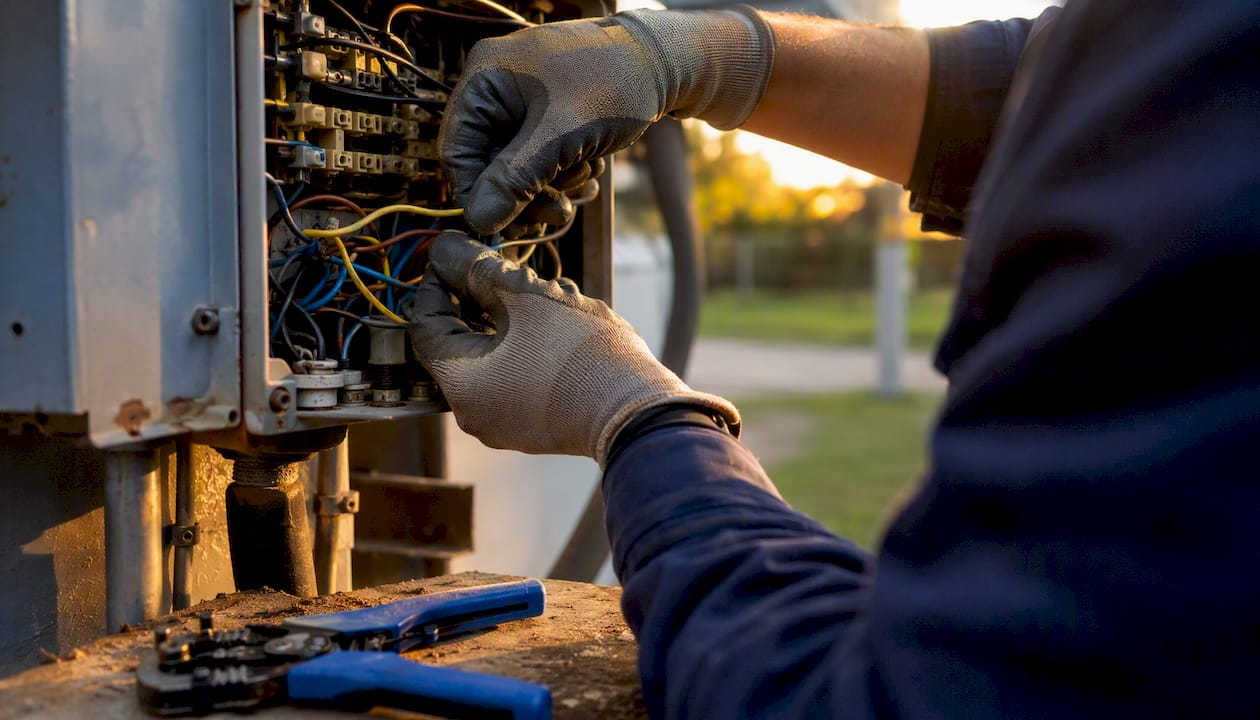
Quality and compliance teams benefit most. Technicians upload photos or live video; computer vision flags anomalies and routes them to a remote expert for real-time guidance. This eliminates a second truck roll for many inspection failures. KPI: re-inspection rate and truck rolls.
Inventory and parts demand prediction
Supply chain and parts managers own this. ML forecasts parts consumption by asset class, region, and season, so the right components sit in the right van or regional depot. KPI: parts availability rate and parts-related job deferrals.
Customer-facing automation and self-service
Customer experience and operations teams own this workstream. AI chatbots handle appointment booking, status updates, and basic troubleshooting around the clock. KPIs: customer satisfaction score (CSAT) and inbound call volume reduction.
Automated work-order generation and triage
Operations and back-office teams own this. NLP parses incoming service requests, classifies urgency, and generates a pre-populated work order with asset history attached. KPI: work-order cycle time and dispatcher workload.
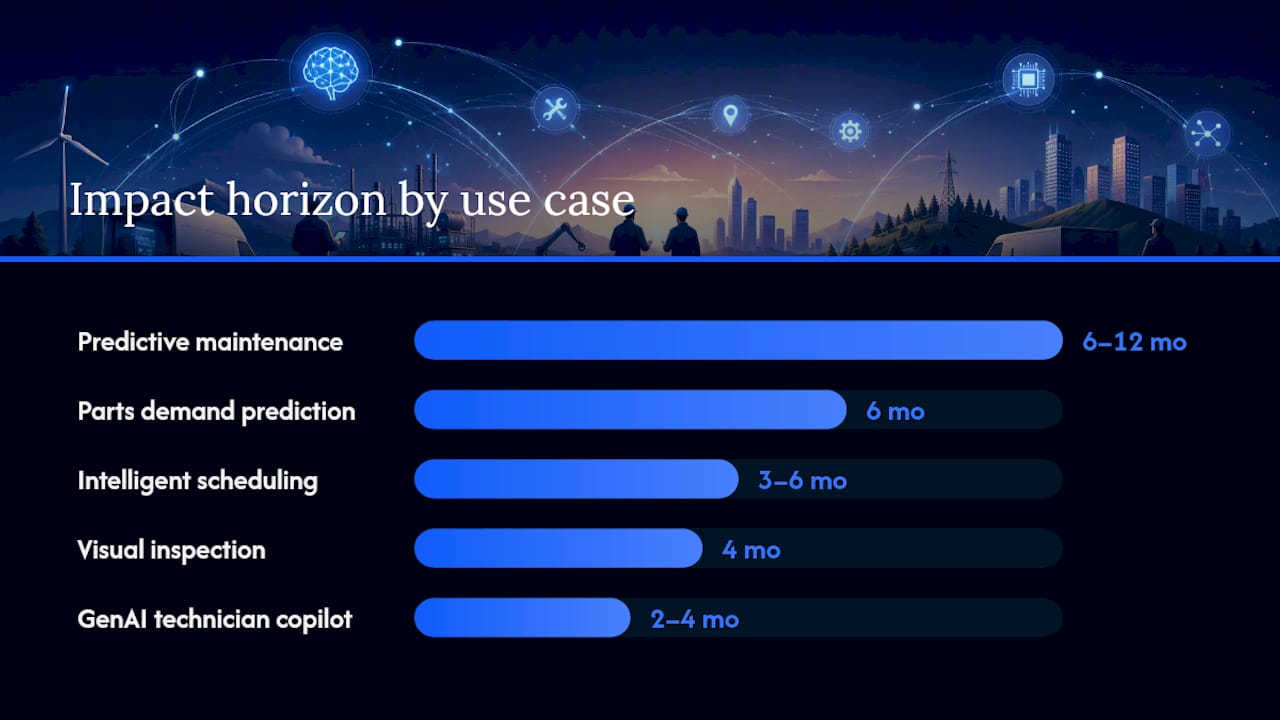
| Use case | Impact horizon | Implementation complexity | First-year ROI signal |
|---|---|---|---|
| Predictive maintenance | 6–12 months | High (IoT + ML pipeline) | Downtime reduction, fewer emergency dispatches |
| Intelligent scheduling | 3–6 months | Medium (FSM integration) | Travel cost, schedule utilization |
| GenAI technician copilot | 2–4 months | Low-medium (knowledge ingestion) | FTFR, job duration |
| Visual inspection | 4 months | Medium (camera + CV model) | Re-inspection rate, truck rolls |
| Parts demand prediction | 6 months | Medium (ERP + ML) | Parts availability, deferrals |
| Customer automation | 1–3 months | Low (chatbot + CRM) | CSAT, call volume |
| Work-order automation | 2–4 months | Low (NLP + FSM) | Cycle time, dispatcher capacity |
What operational benefits and KPIs should you track?
Those figures represent the ceiling, not the average. Set realistic internal targets and measure against your own baseline.
Core KPIs for an AI field service program:
| KPI | Definition | How to measure | Sample improvement target |
|---|---|---|---|
| First-time fix rate (FTFR) | Jobs resolved on the first visit | Closed work orders / total dispatches | a noticeable improvement |
| Mean time to repair (MTTR) | Average time from fault detection to resolution | Job-close timestamp minus fault-open timestamp | a considerable reduction |
| Truck rolls per fault | Dispatches required per unique fault | Total dispatches / unique fault events | 30–50% reduction |
| Travel distance per technician | Miles driven per day per technician | GPS/telematics data | a meaningful reduction |
| Parts availability rate | Jobs with all required parts on first visit | Parts-ready jobs / total jobs | a significant improvement |
| Customer satisfaction (CSAT) | Post-job satisfaction score | Survey or NPS after job close | a moderate increase |
| Revenue recovered | Revenue from proactive service and upsells | Incremental revenue vs. reactive baseline | Varies by service mix |
Which KPIs to prioritize by organizational objective:
- Growth focus: Revenue recovered, CSAT, and FTFR. These directly drive repeat business and referrals.
- Margin focus: Truck rolls per fault, travel distance, and MTTR. Cutting wasted dispatches and repair time drops cost per job.
- Resilience focus: Predictive maintenance coverage rate and parts availability. These reduce exposure to unplanned outages and supply chain gaps.
What data and systems do you need before AI will work reliably?
AI is only as reliable as the data feeding it. IBM’s integration guidance identifies the core data sources required for accurate scheduling, parts predictions, and technician guidance.
Required data sources:
- IoT sensor telemetry (vibration, temperature, pressure, runtime hours)
- EAM/CMMS asset records with complete maintenance histories
- FSM work-order history including fault codes, technician notes, and resolution times
- CRM customer and contract data
- ERP and parts catalogs with real-time inventory levels
- Maps, traffic, and routing data
- Mobile device telemetry (GPS, job-start/stop timestamps)
Common data quality obstacles and how to fix them:
- Incomplete asset IDs: Many organizations have assets with no unique identifier or inconsistent naming across systems. Remediation: run a one-time asset audit and assign canonical IDs before training any model.
- Fragmented ticket histories: Work orders spread across legacy systems, spreadsheets, and paper logs. Remediation: consolidate into a single FSM platform and back-fill at least 18–24 months of history.
- Missing parts mappings: Parts catalogs that don’t link to specific asset models. Remediation: map parts to asset classes manually for your top 20% of assets by failure frequency.
A canonical asset registry, a single source of truth that every system references, is the architectural prerequisite that separates reliable AI outputs from noisy ones.
Data privacy and security note: In the US, field service AI deployments that process customer PII or connected-device data must comply with applicable federal and state privacy laws, including CCPA for California customers, and should apply role-based access controls and data minimization practices to limit exposure.
Pro Tip: Start with a single asset class and keep a human in the loop for every AI recommendation during the first 60 days. Capture technician feedback on each recommendation as labeled training data. That feedback loop accelerates model accuracy faster than any additional data volume alone.
How do you implement AI in field service from pilot to scale?
The roadmap is straightforward: pilot, measure, iterate, scale. The hard part is the operating model change, not the algorithm. BCG’s guidance recommends organizations spend the majority of their effort on people and process redesign rather than on the technology itself.
Phased rollout
- Frame the opportunity and define success metrics. Choose one use case with a clear owner, a measurable baseline KPI, and a realistic 90-day target. Write it down. If you can’t define what success looks like before you start, the pilot will drift.
- Prepare data and systems. Audit asset IDs, consolidate work-order history, and confirm FSM/ERP integration. Assign a data steward who owns quality for the pilot’s asset class.
- Design a small-ticket pilot. Scope to one asset class or one service region. Set a 60–90 day window. Keep the AI in a recommendation-only mode with human approval required.
- Evaluate against pre-set criteria. Measure FTFR, MTTR, and truck rolls against the baseline. If the model’s recommendations are accepted more than 70% of the time and KPIs move in the right direction, proceed.
- Scale with operating model changes. Expand to additional asset classes or regions. Rework dispatcher job designs to incorporate AI recommendations as a standard input, not an optional one. Update incentive structures to reward outcomes the AI optimizes for (FTFR, not just jobs-per-day).
- Run a continuous learning loop. Feed every job outcome back into the model. Capture technician corrections as labeled data. Review model drift quarterly and retrain as needed.
Pilot checklist
- Scope defined: one asset class or one service region
- Baseline KPIs documented (FTFR, MTTR, truck rolls) before day one
- Data readiness confirmed: asset IDs complete, 18+ months of work-order history available
- Named stakeholder owner for the pilot (not a committee)
- Human-in-the-loop approval process documented
- 60–90 day timeline with a mid-point review scheduled
- Frontline technicians briefed and feedback channel open
Red flags that predict pilot failure
- No single named owner accountable for outcomes
- Asset data with less than 12 months of clean history
- Frontline technicians excluded from design and feedback
- ROI expectations set above BCG’s best-case ranges before any baseline is established
- AI deployed in full-automation mode without a human verification step
Change management matters as much as the model. Technicians who feel the AI is judging their performance will route around it. Frame AI recommendations as a tool that makes their job easier, not a performance monitor. Pair the rollout with training, clear incentives tied to FTFR improvement, and a feedback channel that shows technicians their input is improving the system.
How an AI-native operations platform accelerates these outcomes
The mechanics above work faster when the platform is built AI-first rather than retrofitted. An AI-native operations platform connects dispatch, scheduling, revenue recovery, and multi-location intelligence in a single data layer, so the closed-loop learning IBM describes happens automatically rather than requiring manual data pipelines between disconnected tools.
Consider a mid-size HVAC and plumbing operator running 12 locations. Before AI-native dispatch, missed calls went untracked, scheduling gaps created idle technician time, and invoice follow-up was manual. After deploying an AI-native platform:
- An AI receptionist captured after-hours calls and booked appointments automatically, recovering revenue that previously went to voicemail
- AI dispatch matched technician skills and parts inventory to each job before the truck rolled, lifting FTFR
- Automated invoicing and payment follow-up cut days-sales-outstanding without adding back-office headcount
- Multi-location intelligence let the COO compare FTFR and revenue-per-technician across all 12 locations and replicate top-performing behaviors network-wide
Platform capabilities that directly enable these outcomes:
- AI receptionist for 24/7 lead capture and appointment booking
- AI-native dispatch and scheduling board with skill, parts, and route matching
- Automated invoicing, payment collection, and estimate follow-up
- Multi-location benchmarking and performance intelligence
- Integrations with existing FSM tools (Jobber, QuickBooks) so data flows without re-entry
- Closed-loop revenue-recovery workflows that surface missed calls, unpaid invoices, and scheduling gaps in real time
What should operations leaders actually do first?
Fix the data foundation before you buy a single AI tool. That is the single most consistent predictor of whether a field service AI program delivers real value or stalls after the pilot.
Most organizations underestimate how much of their AI budget gets consumed by data remediation rather than model development. The technology is the easy part. Getting dispatchers, technicians, and back-office teams to trust AI recommendations, and to feed their corrections back into the system, is where programs succeed or fail. BCG’s point about people and process deserves more weight than most vendors give it.
My practical priorities for any operations leader starting in 2026:
- Audit your asset data first. If your asset IDs are incomplete or your work-order history is fragmented, no model will produce reliable predictions. Spend 30 days on data remediation before evaluating any AI vendor.
- Pick one high-value use case and own it. Intelligent scheduling or GenAI technician copilots offer the fastest time-to-value with the lowest data complexity. Start there, measure FTFR and truck rolls, and build credibility for the next phase.
- Keep humans in the loop, explicitly. Not as a temporary training measure, but as a permanent governance layer for high-stakes decisions (emergency dispatch, major parts orders). Closed-loop learning works because humans correct the model, not because the model runs unchecked.
The organizations pulling ahead aren’t the ones with the most sophisticated algorithms. They’re the ones that ran a clean 60-day pilot, measured honestly, and scaled what worked.
Jobospro gives home-service operators a faster path to AI-native operations
Most home-service operators don’t have 18 months to build a custom AI stack. Jobospro is built AI-native from the ground up, which means the dispatch board, revenue-recovery workflows, and multi-location intelligence are connected by design, not bolted together after the fact.
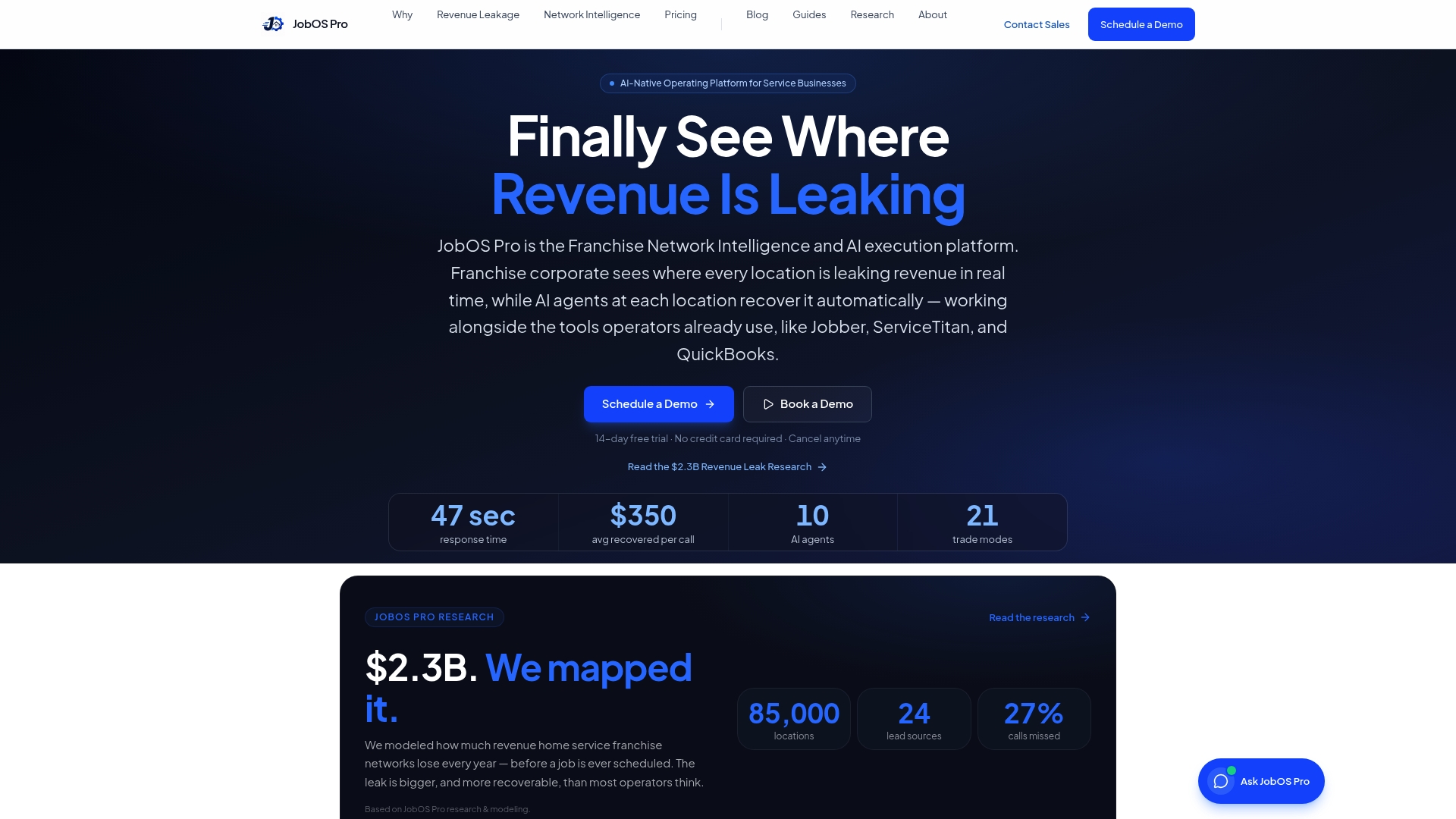
Where a traditional FSM platform requires separate integrations for scheduling, invoicing, and customer communication, Jobospro runs those workflows through a unified AI layer that captures missed calls, flags unpaid invoices, and surfaces scheduling gaps automatically. The AI receptionist answers after-hours calls and books jobs. The dispatch board matches skills, parts, and routes before the truck rolls. Scout, the multi-location intelligence layer, lets franchise COOs benchmark FTFR and revenue-per-technician across every location and replicate what’s working.
Jobospro works alongside your existing tools, including Jobber and QuickBooks, so you don’t have to rip and replace to get started. Download the free AI dispatch guide to see how operators are running scoped pilots in 30–60 days, or explore the full AI agent suite to see which workflows fit your operation. If recovering revenue from missed calls and unpaid invoices is the immediate priority, the increase average ticket playbook is a practical next step.
Sources
- How local contractors and construction companies are using AI | Expert opinion
- The Future of Field Service with Applied AI
- The Guide to AI in Field Service Management | IBM
- How AI can give field service technicians a boost
- C3 AI Field Services