
AI Lead Scoring: A B2B Implementation Guide
AI Lead Scoring: A B2B Implementation Guide
AI lead scoring is a machine-learning system that assigns each prospect a probability-based score, typically on a 0–100 scale, so your sales team focuses time on the leads most likely to convert rather than working every contact equally. Scores update dynamically as behavior changes, which means a lead who downloads a pricing page on Tuesday gets a higher score by Wednesday morning without anyone touching a spreadsheet.
If you’re a sales or marketing leader ready to act, start here:
- Audit your CRM data first. You need historical conversion outcomes, firmographic fields, and behavioral timestamps before any model can learn. Gaps here sink pilots before they start.
- Pick a low-risk pilot cohort. Choose one segment, one persona, or one product line. Limit scope so you can measure cleanly and build internal trust.
- Set success metrics before you train. Agree on lead-to-opportunity conversion rate, top-decile lift, and sales-accepted lead (SAL) rate as your primary signals. Without pre-agreed metrics, every result becomes a debate.
Key Takeaways
AI lead scoring produces the most reliable conversion lifts when data quality, CRM integration, and sales adoption are all in place before the model goes live.
| Point | Details |
|---|---|
| Start with a data audit | You need 200+ labeled conversions and 6–12 months of history before a model generalizes reliably. |
| Integrate scores into CRM workflows | Scores that don’t trigger routing, tasks, or alerts produce no revenue lift regardless of model accuracy. |
| Monitor with lift charts quarterly | Retrain on a rolling 12-month window and check top-decile precision before each new model version goes live. |
| Involve sales in feature design | SDR input on what signals predict conversion builds trust and improves feature quality simultaneously. |
| Jobospro automates lead capture and routing | For home service and franchise businesses, Jobospro’s AI-native platform operationalizes lead prioritization without a custom ML build. |
Table of Contents
- What AI lead scoring actually covers and where it fits in your funnel
- How an AI lead scoring system moves from raw data to a live score
- When rule-based scoring still makes sense and when to move to AI
- The business case for AI lead scoring: where the value actually shows up
- Data you need before training a model, and what to avoid
- Build vs. buy, and the integration checklist that makes scores actionable
- How to evaluate model performance and keep it honest over time
- Turning scores into daily sales and marketing actions
- Common pitfalls and how to avoid them before they cost you a quarter
- A practical pilot walkthrough from week zero to 90 days in production
- What most teams get wrong about AI lead scoring
- Jobospro captures and prioritizes leads automatically for service businesses
- Sources
What AI lead scoring actually covers and where it fits in your funnel
The term “lead scoring” covers three distinct approaches, and conflating them leads to mismatched expectations. Rule-based scoring assigns fixed point values to attributes you define manually: job title gets 10 points, form fill gets 15, competitor domain gets minus 20. Predictive lead scoring uses statistical models trained on historical outcomes to rank leads by conversion likelihood. Full AI driven lead scoring goes further: it selects features automatically, updates weights continuously, and outputs a calibrated probability rather than an arbitrary point total.
The practical difference shows up in maintenance. Rule-based systems require a human to revisit the logic every quarter. Predictive models retrain on new conversion data. AI-native systems can do both automatically.
| Dimension | Rule-based | Predictive | Full AI scoring |
|---|---|---|---|
| Data needed | Low (manual attributes) | Medium (200+ conversions) | High (thousands of labeled outcomes) |
| Update cadence | Manual, quarterly | Scheduled retraining | Continuous or near-real-time |
| Interpretability | High (you wrote the rules) | Medium (feature importance) | Lower (requires explainability layer) |
| Best-fit stage | Early-stage, single persona | Mid-market, multi-segment | Enterprise, high lead volume |
Score outputs in practice: Most systems produce a 0–100 score that maps to three operational buckets. High (80–100) triggers immediate SDR outreach. Medium (50–79) enters an automated nurture sequence with a follow-up task. Low (0–49) gets deprioritized or routed to a long-cycle drip. The buckets themselves are thresholds you set, not outputs the model decides.
How an AI lead scoring system moves from raw data to a live score
The workflow has six distinct phases, and skipping any one of them produces a model that either fails in production or never gets used.
-
Data collection. Pull CRM records with closed-won and closed-lost outcomes, web session logs, email engagement events, product usage signals, third-party intent feeds, and firmographic or technographic enrichment. The richer and more complete this layer, the better every downstream step performs.
-
Data cleaning and labeling. Remove duplicate contacts, resolve conflicting outcome labels, and handle missing values. A lead marked “closed-won” in the CRM but with no activity data is noise, not signal. Label quality matters more than volume.
-
Feature engineering. Transform raw events into model-ready signals: days since last web visit, email open rate over 30 days, number of high-intent page views, company size band, technology stack match. Feature engineering quality often matters more than algorithm choice: domain-specific features built by someone who understands your sales motion will outperform a fancier algorithm fed generic inputs.
-
Model selection and training. For most B2B lead-conversion tasks, gradient boosted trees (XGBoost, LightGBM) deliver the best accuracy on tabular CRM data. Logistic regression serves as an interpretable baseline when data volume is smaller or when sales leadership needs to understand exactly why a lead scored high. Train on 70–80% of your labeled data; hold out the rest for validation.
-
Validation and threshold setting. Evaluate on the holdout set using AUC, precision at the top decile, and calibration. Set score thresholds based on where your conversion rate meaningfully separates across buckets, not on round numbers.
-
Deployment and CRM integration. Push scores to a dedicated field on every contact and company record. Wire automation triggers so a score crossing 80 creates an SDR task immediately. Operational value only appears after scores are wired into CRM workflows; a model sitting in a notebook dashboard helps no one.
-
Continuous retraining. Schedule quarterly retraining on a rolling 12-month window of conversion outcomes. Monitor for score distribution drift between retraining cycles. A model trained in Q1 on last year’s buyer behavior may already be degrading by Q3 if your ICP has shifted.
Common data sources to feed the model:
- CRM events: stage transitions, deal age, activity counts
- Web behavior: page views, time on site, pricing or demo page visits
- Email engagement: open rate, click-through rate, reply rate
- Product usage: feature adoption, login frequency, trial depth
- Third-party intent: topic surge signals from platforms like Bombora or G2
- Firmographics: company size, industry, revenue band
- Technographics: current tech stack, integration compatibility
When rule-based scoring still makes sense and when to move to AI
The honest answer is that rule-based scoring is not obsolete. For an early-stage company with a single buyer persona, fewer than 500 historical conversions, and a sales team of two or three reps, a well-maintained rule set is faster to build, easier to explain, and perfectly adequate. The problem is that most teams keep rule-based systems long past the point where they stop working.
Static rules degrade over time through “manual drift”: the job titles that predicted conversion two years ago may no longer be the ones closing deals today. Buyer behavior shifts, new channels emerge, and the rules never update unless someone manually reviews them. That review rarely happens on schedule.
Signs you’ve outgrown rule-based scoring:
- Lead volume exceeds what your SDR team can manually triage
- You serve more than two distinct buyer personas or segments
- Your sales cycle has lengthened and early behavioral signals matter more than firmographics alone
- Conversion rates have dropped despite no obvious change in lead volume
A hybrid approach works well for mid-market teams: keep a rule-based filter to exclude obviously disqualified leads (wrong geography, wrong company size), then apply a predictive model to rank what remains. This gives you interpretability at the gate and accuracy in the ranking.
Full machine learning for lead scoring makes sense when you have thousands of labeled conversions, multiple channels feeding leads, and an ops team capable of maintaining a model pipeline. An enterprise SaaS firm with 50,000 annual leads and a RevOps function fits this profile. A regional home services franchise with 2,000 annual leads probably does not, at least not yet.

The business case for AI lead scoring: where the value actually shows up
The primary benefit is not that AI scores leads better in the abstract. It’s that your sales team stops spending time on leads that will never convert. Deprioritizing low-probability leads reclaims hours that would otherwise go to cold follow-up, freeing reps to concentrate on the contacts most likely to become revenue.
Primary benefits:
- Higher lead-to-opportunity conversion rates from focused rep attention
- Faster follow-up on high-intent leads, which directly correlates with close rate
- Reduced time waste on low-probability contacts
- Better segmentation for nurture sequences, matching message to intent level
- Cleaner handoff between marketing and sales, with a shared score as the agreed qualification signal
Illustrative benchmark: Published implementation guides report lead-to-opportunity conversion lifts of around 38% in favorable cases where data maturity and process discipline are both present. Treat this as a directional target, not a guarantee, since results depend heavily on your baseline conversion rate and data quality.
Secondary benefits are less obvious but worth tracking. Score distributions reveal which content assets attract high-intent visitors, which ad channels bring in leads that actually convert, and which firmographic segments are underserved. That intelligence feeds content strategy, paid media targeting, and account-based marketing (ABM) tiering without requiring a separate analysis project.
Data you need before training a model, and what to avoid
No model outperforms its training data. Before you commit to a pilot, run a data readiness audit against this checklist.
Must-have inputs:
- CRM outcome labels (closed-won, closed-lost, disqualified) with timestamps
- Firmographic fields: company size, industry, geography, revenue band
- Behavioral session data: page views, form fills, content downloads with timestamps
- Email engagement events: opens, clicks, replies, unsubscribes
- Lead source and channel attribution
Nice-to-have inputs:
- Third-party intent data (topic surge, review site activity)
- Technographic data (current software stack)
- Product usage signals (for product-led growth motions)
- Sales activity logs (call notes sentiment, meeting outcomes)
Sample-size guidance: Practical guides recommend a minimum of around 200 converted leads and a training window of at least 6–12 months for a model that generalizes reliably. Below that threshold, you risk overfitting to noise rather than learning real patterns. HubSpot’s CRM-native AI scoring documents specific minimum contact counts before the system will generate scores, which is a useful reference point for teams using that platform.
Privacy and compliance: Under the California Consumer Privacy Act (CCPA), leads have the right to know what data you hold and how it’s used. Store only consented first-party data, document your data sources and retention periods, and avoid using protected-class attributes (race, gender, age) as model features. For any leads from EU-based contacts, GDPR’s lawful-basis requirements apply even if your business is U.S.-based. Keep a data lineage log so you can respond to transparency requests without scrambling.
What to avoid: Don’t train on a biased outcome set. If your historical closed-won data skews heavily toward one industry or company size because that’s who your sales team called first, the model will learn that bias and reinforce it. Audit your training labels for representation before you start.
Build vs. buy, and the integration checklist that makes scores actionable
The build-vs.-buy decision comes down to five criteria, and most teams answer them wrong by defaulting to “buy” without checking data ownership terms.
Decision criteria:
- Data ownership: Does the vendor retain your training data? Can you export the model? Vendor lock-in on proprietary scoring models is a real operational risk.
- Engineering resources: Building a production ML pipeline requires data engineering, MLOps, and ongoing maintenance. If your team lacks that capacity, buying is faster and cheaper.
- Speed to value: A vendor solution can be live in 4–8 weeks. A custom build typically takes 3–6 months before the first production score.
- Interpretability needs: If sales leadership needs to understand why a lead scored 87, a vendor with built-in explainability features saves significant internal work.
- Cost: Vendor licensing scales with contact volume. Custom builds have higher upfront costs but lower marginal cost at scale.
Pilot template (8–12 weeks):
- Weeks 1–2: Data audit, outcome labeling, feature inventory
- Weeks 3–4: Feature engineering, initial model training, holdout validation
- Weeks 5–6: CRM field mapping, automation trigger setup, threshold calibration
- Weeks 7–8: Soft launch to one SDR team, parallel scoring (old and new)
- Weeks 9–12: Compare SAL rates, top-decile lift, and time-to-contact between scored and unscored cohorts
Integration checklist:
- Map score output to a dedicated CRM field on both contact and company records
- Set automation triggers: score above 80 creates an SDR task within 15 minutes
- Configure alerts for sudden score spikes (a lead jumping from 40 to 85 overnight)
- Add score history tracking so reps can see trend, not just current value
- Wire monitoring hooks to flag score distribution drift between retraining cycles
- Test end-to-end: confirm a simulated high-score lead triggers the correct routing action before going live
Pro Tip: Run parallel scoring for at least four weeks before switching off your old system. This gives sales reps time to build trust in the new scores and gives you a clean comparison dataset to prove lift.
How to evaluate model performance and keep it honest over time
A model that looked good in training can quietly degrade in production. The metrics below tell you whether it’s still working.
Key evaluation metrics:
- AUC (Area Under the ROC Curve): Measures how well the model separates converters from non-converters across all thresholds. For lead-conversion tasks, an AUC above 0.75 is a reasonable target; above 0.85 is strong.
- Precision at top decile (P@10): What percentage of leads in the top 10% of scores actually converted? This is the metric sales cares about most. A well-calibrated model should show conversion rates in the top decile that are multiple times the baseline rate.
- Calibration: A lead scored at 70 should convert roughly 70% of the time. Poor calibration means the scores are relatively ranked correctly but the absolute values mislead reps.
- Lift chart: Plots conversion rate by score decile. If the top decile isn’t meaningfully better than the second decile, the model isn’t discriminating well enough to be operationally useful.
Monitoring cadence:
- Daily: confirm score delivery is running (no pipeline failures, no null scores on new leads)
- Weekly: check score distribution for sudden shifts that might indicate a data feed problem
- Quarterly: retrain on a rolling 12-month window, validate on a fresh holdout set, compare AUC and P@10 to the previous version before promoting to production
Governance checklist:
- Version-control every model artifact (training data snapshot, feature list, hyperparameters, evaluation results)
- Require stakeholder signoff (sales ops, marketing ops, legal) before promoting a new model version
- Maintain an audit trail of score changes for any lead that was routed or rejected based on score
- Document feature definitions so a new team member can reproduce the pipeline without tribal knowledge
Turning scores into daily sales and marketing actions
A score sitting in a CRM field does nothing. The operational value comes from what happens next.
Threshold-to-action mapping:
- 80–100 (High): Assign to SDR immediately, create a call task due within 15 minutes, notify the account executive. These leads have shown strong intent signals and respond best to fast, personalized outreach.
- 50–79 (Medium): Add to a structured nurture sequence with two to three touchpoints over 10 days, then restore. A rep reviews these weekly rather than daily.
- 0–49 (Low): Route to a long-cycle drip or deprioritize entirely. Don’t delete them; a score can spike if behavior changes.
Routing playbook:
- Score above 80 with no prior contact: assign to SDR, send a personalized email template within the first hour
- Score above 80 with prior closed-lost status: route to account executive with a “re-engage” task and a note on the original loss reason
- Score spike of 20+ points in 48 hours: trigger an alert to the assigned rep regardless of absolute score level
- Score drops below 40 after being in nurture: pause active sequences, move to low-frequency drip
Dashboard fields to add to your CRM:
- Current score and score date
- Score trend (7-day and 30-day delta)
- Top three contributing features (why this lead scored high)
- Assigned owner and last activity date
- Bucket label (High/Medium/Low) for quick visual triage
For estimate follow-up and closing behaviors, score-driven routing ensures the right rep contacts the right lead at the right moment, which is where conversion rate improvements actually materialize.
Common pitfalls and how to avoid them before they cost you a quarter
Most AI lead scoring failures are operational, not algorithmic. The model is rarely the problem.
Pitfall list with mitigations:
- Training on biased outcomes: If your sales team historically called enterprise leads first, the model learns enterprise = convert. Mitigation: audit label distribution by segment before training; oversample underrepresented groups.
- Small-sample overfitting: A model trained on 80 conversions will memorize noise. Mitigation: don’t train until you have at least 200 conversions; use cross-validation to detect overfitting early.
- Stale features: A feature built on last year’s product pages becomes meaningless after a site redesign. Mitigation: document every feature’s data source and run a monthly feature validity check.
- Misrouted scores: Scores that don’t trigger automation are ignored. Mitigation: test every routing rule end-to-end in a staging environment before go-live.
- Sales distrust: Reps who don’t understand why a lead scored high will ignore the score. Mitigation: surface the top three contributing features alongside every score; run a monthly joint score review with sales leadership.
- Score inflation from marketing activity: A lead who clicks every email but never buys can score artificially high. Mitigation: weight behavioral signals by their historical correlation with conversion, not just engagement volume.
Bias detection: Run a fairness audit quarterly. Check whether your model’s precision at the top decile varies significantly across company size, industry, or geography. If the model consistently underscores leads from a particular segment, investigate whether that segment is underrepresented in your training labels.
Pro Tip: Schedule a quarterly “score review” meeting with two or three SDRs and your marketing ops lead. Have reps flag leads they worked that scored low but converted, and leads that scored high but went nowhere. These edge cases are your best source of feature improvement ideas and the fastest way to rebuild sales trust in the model.
A practical pilot walkthrough from week zero to 90 days in production
This walkthrough uses a mid-market B2B SaaS firm as the reference profile: 3,000 leads per quarter, two SDRs, a HubSpot CRM, and roughly 300 closed-won deals in the past 12 months.
Timeline:
- Week 0–1: Export 18 months of CRM data. Label outcomes (won/lost/disqualified). Identify missing fields. Set pilot success metrics: top-decile lift, SAL rate, and time-to-first-contact.
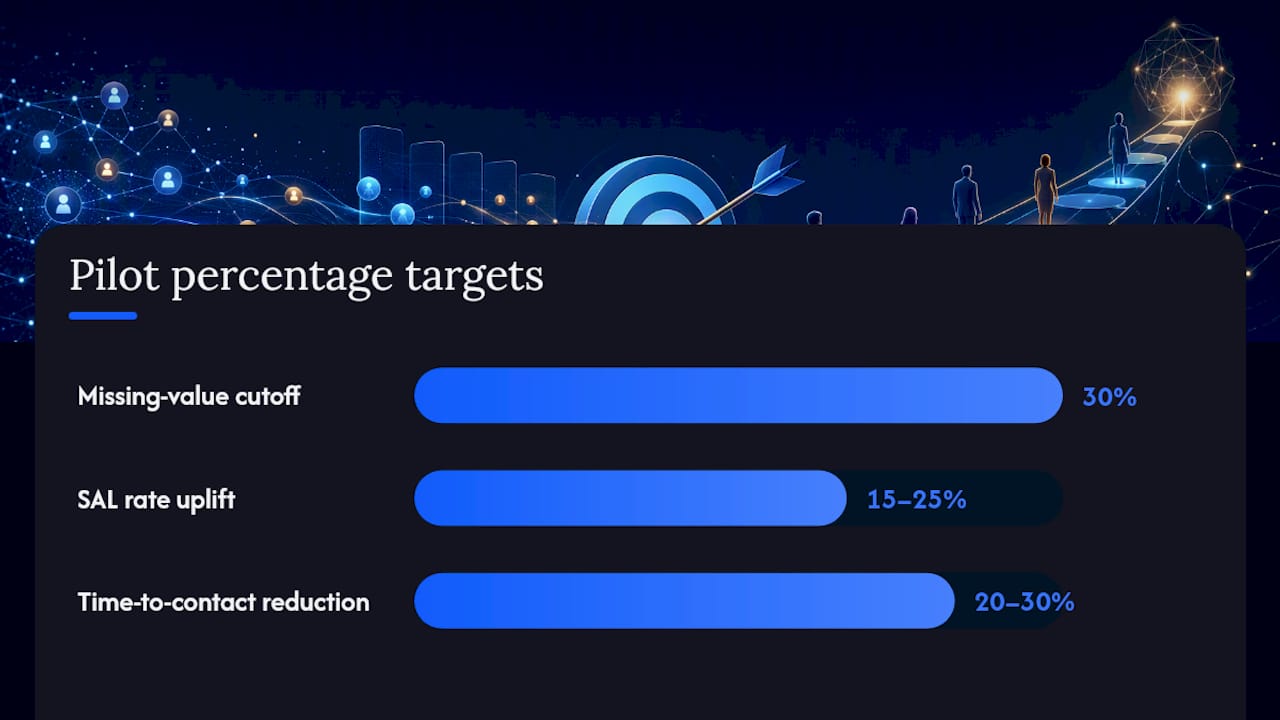
- Week 2–3: Build feature set. Include firmographic fields, email engagement rates, web session counts, and stage-transition timestamps. Remove features with more than 30% missing values.
- Week 4–5: Train a logistic regression baseline and an XGBoost model. Validate on a 20% holdout. Compare AUC and P@10. If XGBoost beats logistic regression by more than 5 AUC points, use XGBoost; otherwise keep logistic regression for interpretability.
- Week 6: Map score output to a HubSpot contact property. Configure workflows: score above 80 creates an SDR task, score above 80 with “pricing page viewed” triggers a priority flag.
- Week 7–8: Soft launch to one SDR. Run parallel scoring. The SDR works their normal queue but also sees the AI score. No routing changes yet.
- Week 9–12: Compare the SDR’s conversion rate on high-scored leads versus their historical baseline. Track time-to-first-contact for scored vs. unscored leads.
Early KPI targets (illustrative, based on published implementation guidance):
- Top-decile lift of 2x–3x the baseline conversion rate is a realistic early signal that the model is discriminating
- SAL rate improvement of 15–25% in the pilot cohort relative to the control group
- Time-to-first-contact reduction of 20–30% as reps prioritize the queue by score
When the pilot shows consistent lift over 4+ weeks, productionize: expand to the full lead flow, set up quarterly retraining, and hand monitoring to marketing ops. For AI conversion optimization at scale, the same scoring logic that worked in the pilot translates directly into nurture segmentation and paid media suppression lists.
Productionization checklist:
- Confirm automated retraining pipeline is scheduled and tested
- Assign a model owner responsible for quarterly validation
- Document the feature pipeline so it survives team turnover
- Set up a Slack or email alert for score delivery failures
What most teams get wrong about AI lead scoring
The conventional wisdom says the hard part is choosing the right algorithm. It isn’t. The hard part is getting sales to trust the output enough to change their behavior.
A model with an AUC of 0.82 that sales ignores produces zero revenue lift. A model with an AUC of 0.71 that every SDR uses religiously will outperform it every quarter. This is the gap that most implementation guides skip over because it’s organizational, not technical.
The fix is not better explainability dashboards, though those help. It’s involving sales in the feature design process before training starts. When an SDR tells you that “demo request within 48 hours of a pricing page visit” is the single strongest signal they’ve seen in their pipeline, and you build that feature into the model, they will trust the score because they recognize their own knowledge in it. That buy-in is worth more than 10 AUC points.
The second thing teams get wrong is treating the pilot as a proof-of-concept rather than a production rehearsal. A pilot that runs in a spreadsheet, disconnected from CRM automation, tells you nothing about whether the system will work at scale. Run the pilot inside your actual CRM, with real routing rules, from day one. The friction you encounter in week two of a CRM-integrated pilot is friction you would have hit in month three of a full rollout, except now you have time to fix it.
Finally, don’t skip the governance layer. A model that no one owns, with no retraining schedule and no audit trail, will degrade silently. Six months after launch, your scores will be stale, your reps will have stopped trusting them, and you’ll be back to manual triage. Assign a model owner, schedule the quarterly retrain, and treat the scoring system like the production infrastructure it is.
Jobospro captures and prioritizes leads automatically for service businesses
Home service businesses face a specific version of the lead scoring problem: a missed call is a lost job, and there’s no CRM-native AI scoring system designed for HVAC dispatch queues or plumbing service windows. Jobospro is built for exactly that gap.
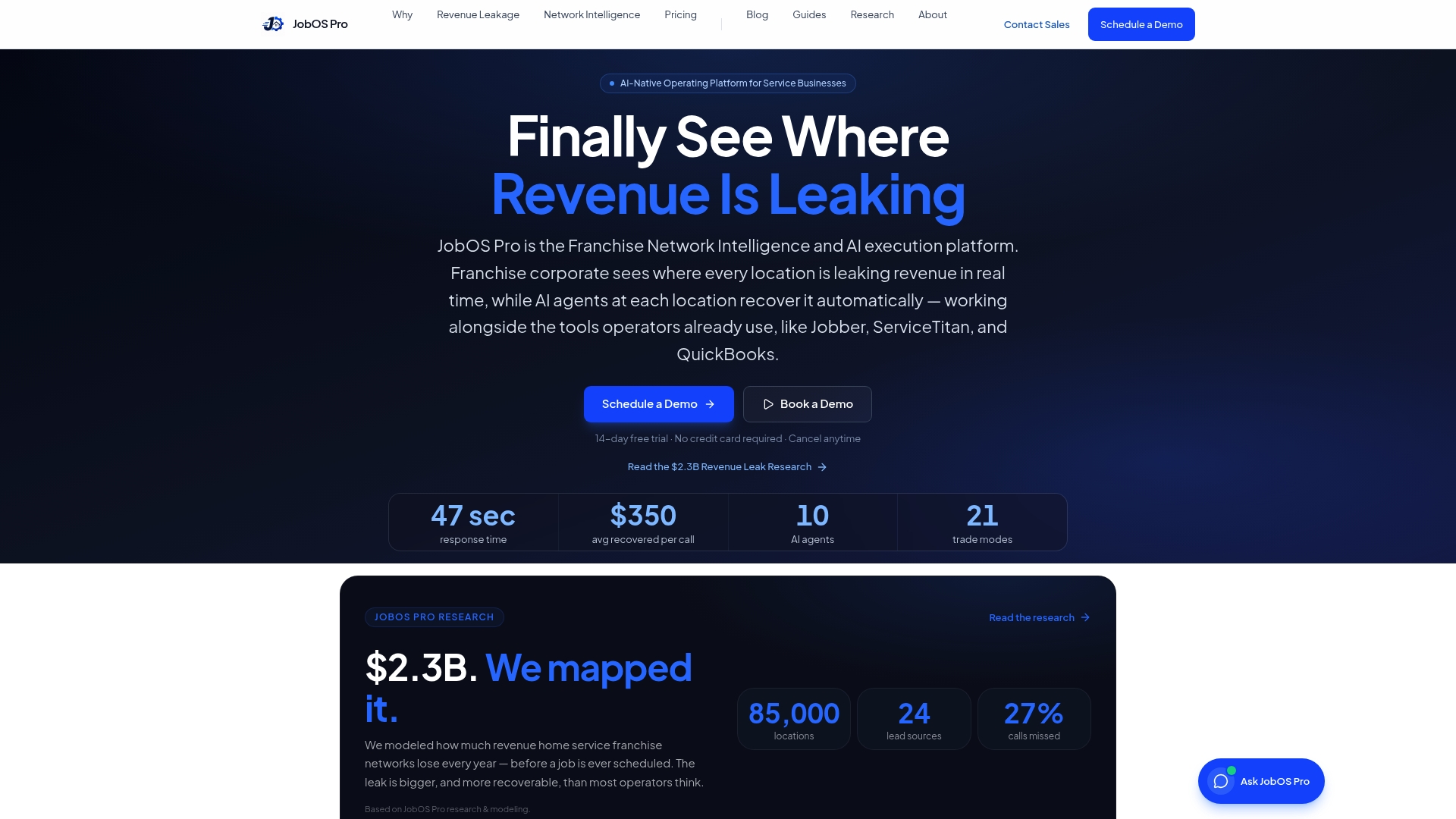
Jobospro’s AI-native platform captures every inbound lead, including missed calls, and routes them based on real-time priority signals, not a rep’s gut feel. The AI receptionist recovers leads that would otherwise fall through the cracks, and the dispatch and scheduling board reflects those priorities automatically. For franchise operators, multi-location intelligence surfaces which locations are converting leads and which are losing them to slow follow-up.
If the integration and routing patterns covered in this guide are what your operations need, Jobospro implements them without requiring a custom ML build. See how the platform works for your service vertical and start a pilot with your actual lead flow.
Sources
- AI Lead Scoring Guide: Definition, Benefits & Implementation
- AI-Powered Lead Scoring: Building a Workflow That Learns From Your Data
- Predictive Lead Scoring for RevOps: How and When — Fairview
- Predictive lead scoring (latentview glossary)