AI that answers calls and books jobs is the technology shift turning missed-call chaos into booked revenue for HVAC, plumbing, electrical, and other home service companies. Specifically, this type of system acts as an always-on virtual receptionist that picks up every inbound call, qualifies the caller, checks live technician availability, and books the appointment, all without a human ever touching the phone. For home service operators, this matters because unanswered calls do not just annoy customers; they quietly dry up future lead flow and word-of-mouth. In the sections below, you will learn exactly how this technology works, what it costs, and how to evaluate it for your own trade business.
What Is AI That Answers Calls and Books Jobs?
Direct answer:
AI that answers calls and books jobs is software that uses conversational artificial intelligence (AI) to answer inbound phone calls, qualify the caller's needs, and schedule the job directly on a live calendar. Unlike a basic answering service, it works around the clock, never puts a caller on hold, and does not require a dispatcher to confirm availability before booking.
Underneath that simple description sits a stack of technical pieces working together. Speech recognition converts the caller's words into text, while natural language processing (NLP), the branch of artificial intelligence that interprets meaning and intent from human language, figures out what the customer actually needs. From there, the system cross-references a live scheduling feed, confirms a workable time, and writes the job straight onto the calendar. As a result, the caller hangs up with a confirmed appointment rather than a promise that "someone will call you back."
The Hidden Cost of Missed Calls for Home Service Companies
Most trade business owners assume they lose jobs to competitors who undercut their price. In reality, the bigger leak is usually internal. Industry analysis of home service operations suggests businesses lose roughly 20 to 30 percent of potential revenue not to rivals, but to their own handoffs: calls that ring out during a busy install, leads that never get a follow-up text, and estimates that go cold after being sent. If you have ever wondered who answers the phone when you're on a job, this is exactly the gap that AI call answering is designed to close.
Data point: Operators in the home service trades can lose an estimated 20 to 30 percent of potential revenue to operational gaps like missed calls and slow follow-up, rather than to outside competition.
Furthermore, the U.S. Bureau of Labor Statistics notes continued demand for skilled trades like HVAC technicians, which means qualified crews stay busy and owners cannot simply hire a full-time dispatcher to sit by the phone. Consequently, every missed ring becomes a job that a faster-answering competitor books instead. A dedicated missed-call recovery system exists specifically to plug that leak before it compounds.
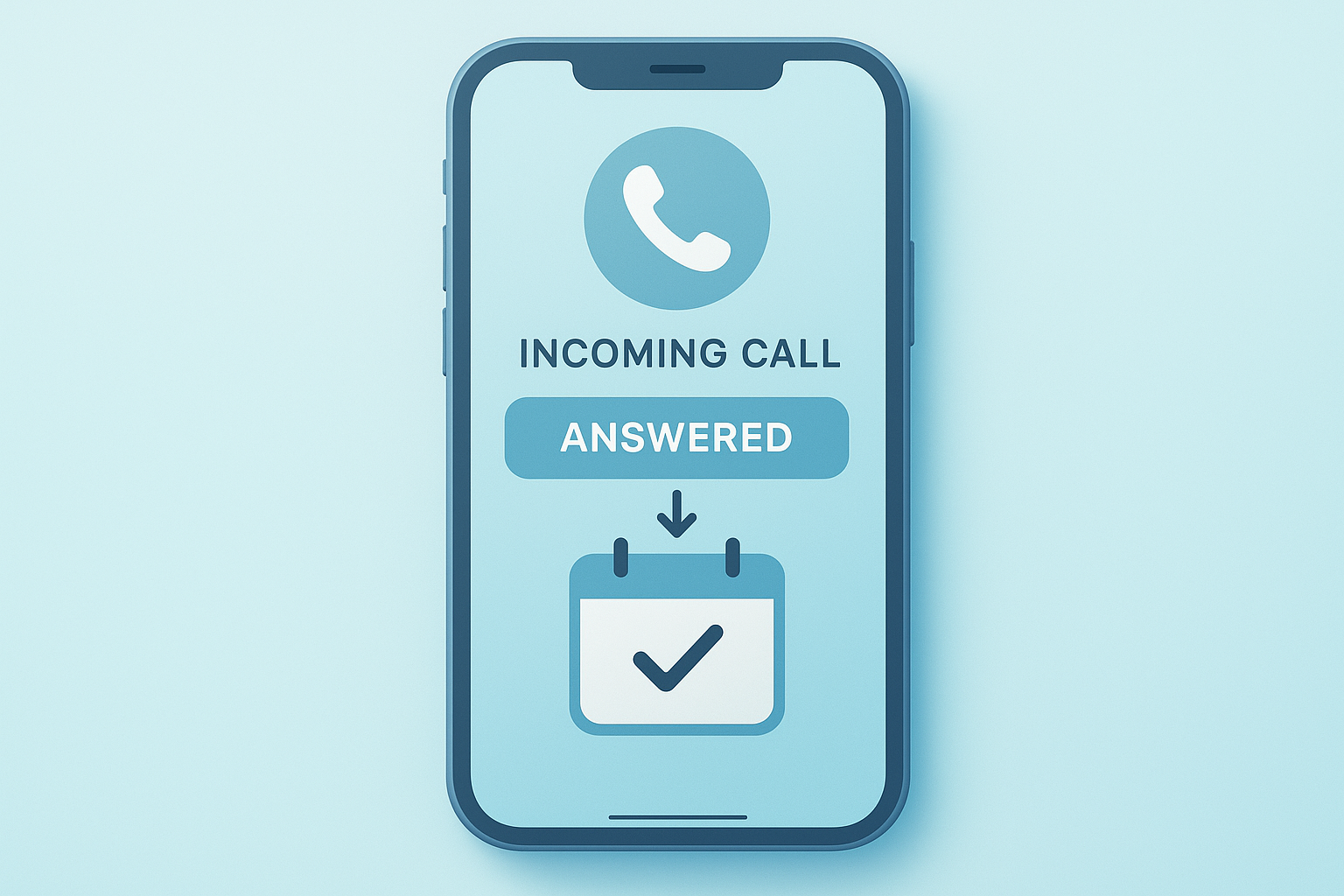
AI that answers calls and books jobs can turn an inbound ring into a confirmed appointment in seconds.
How an AI Receptionist Answers, Qualifies, and Books Every Call
In practice, the process behind an AI receptionist follows a predictable sequence. Below is the typical flow from first ring to confirmed job:
- Call comes in and the AI answers instantly. The receptionist picks up within one or two rings, any time of day, so the caller never reaches voicemail or a busy signal.
- The AI qualifies the caller's needs. It asks a few quick questions about the service needed, the urgency, and the property location before moving forward.
- The AI checks live technician availability. It cross-references real-time calendars and dispatch data to confirm who can realistically reach the job in the caller's preferred window.
- The AI books the appointment on the calendar. Once a slot is confirmed, the job is written directly onto the live schedule and assigned automatically.
- The AI sends a confirmation text and follow-up. The caller gets instant confirmation, and the system can later send reminders or request a review.
Meet Kate: JobOS Pro's AI Phone Answering Service
Within JobOS Pro, this entire flow is handled by Kate, the platform's AI receptionist. Kate answers inbound calls around the clock, qualifies the caller, checks live availability, books the job, and sends a confirmation text, all inside the same system that already runs scheduling, invoicing, and dispatch. Because Kate shares data with the rest of the platform, there is no separate tool to reconcile and no lag between the call ending and the job appearing on a technician's route.
AI Call Booking vs Traditional Answering Services
To put this in context, it helps to compare the common options side by side.
| Option | Answers 24/7 | Books the Job | Cost Scales With Staff |
|---|---|---|---|
| Voicemail | No | No | No |
| Human answering service | Usually | Rarely | Yes, per minute |
| Missed-call text-back | Yes | No | Sometimes |
| AI that answers calls and books jobs | Yes | Yes | Often flat-rate |
Given the ongoing skilled-labor shortage documented by the Bureau of Labor Statistics, hiring a full-time dispatcher purely to answer phones is an expensive and increasingly hard-to-fill role. In contrast, an AI layer handles the repetitive qualifying and booking work, freeing existing staff for jobs that genuinely need a human touch.
What to Look for in Automated Scheduling Software
Not every AI answering tool is built the same way. Before committing, it is worth checking a few specifics:
- Does it integrate with your existing scheduling or dispatch system, rather than forcing a full migration?
- Can it handle trade-specific terminology, for example the difference between a plumbing repair and a drain camera inspection?
- Does pricing stay flat as you add technicians, or does it increase per seat?
- Can it escalate complex calls to a human without losing the caller?
For trades with specific workflows, such as plumbing dispatch or multi-crew scheduling, a purpose-built option like plumbing-specific software tends to handle terminology and job types more accurately than a generic call center script.
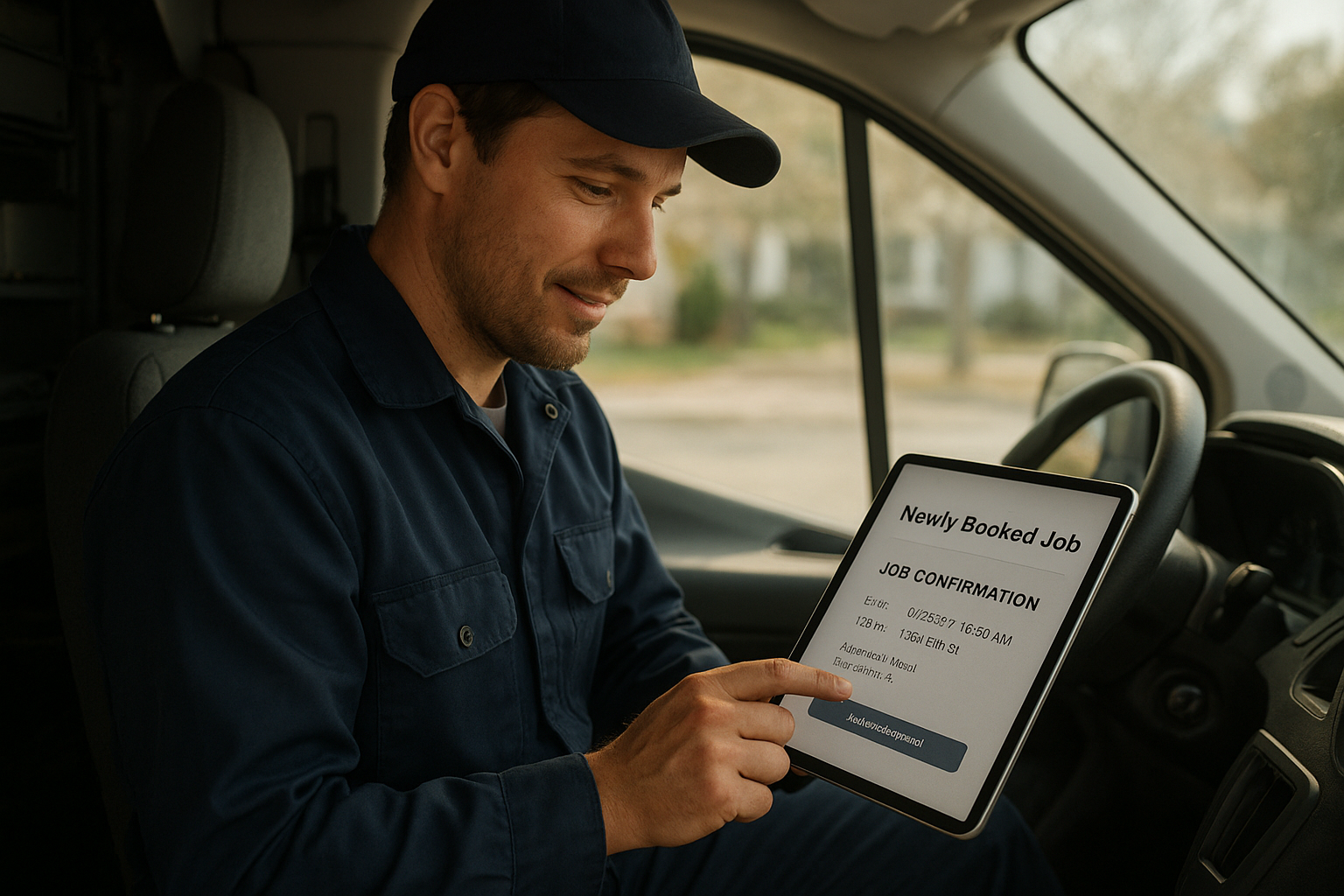
Once the AI books the appointment, the job appears instantly on the technician's schedule.
JobOS Pro Pricing for AI-Powered Call Answering and Booking
Pricing is often the deciding factor, particularly because many platforms charge per technician, which means the software bill grows every time a business hires. JobOS Pro instead publishes three flat monthly tiers: $199, $349, and $549, each including unlimited technicians, dispatchers, and office staff. That structure matters for a growing operator because adding a fourth or fifth truck does not trigger a bigger software invoice. There is also a 30-day free trial with no credit card required, and the platform runs alongside tools you may already use, such as Jobber, ServiceTitan, or QuickBooks, so there is no forced migration to get started.
As the U.S. Small Business Administration notes, staffing costs are among the biggest variables a growing business must manage. Therefore, keeping the software layer flat-rate, rather than tied to headcount, removes one variable from that equation. You can review current plan details directly at JobOS Pro before deciding which tier fits your crew size.
If missed calls are already a known pain point, it is worth reading through practical guidance on how to make sure no customer call goes unanswered, which walks through the operational side of this problem beyond just the technology.
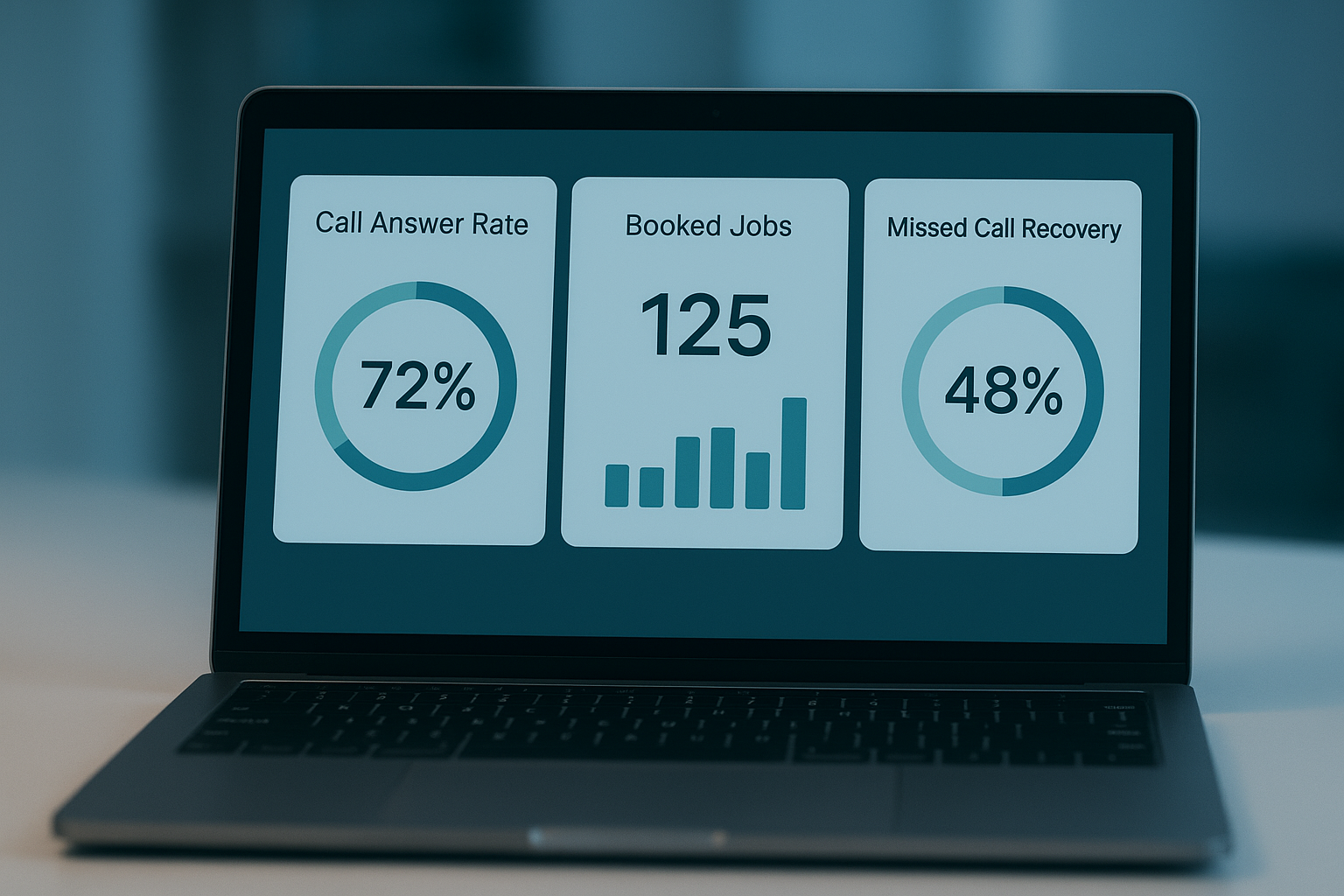
Tracking answer rate and booked jobs side by side shows the real impact of AI call recovery.
Frequently Asked Questions About AI That Answers Calls and Books Jobs
What is AI that answers calls and books jobs?
AI that answers calls and books jobs is software that uses conversational AI to pick up phone calls, qualify the caller, and schedule an appointment directly on a live calendar without human intervention. It typically includes speech recognition, scheduling integration, and automated confirmation texts.
How does an AI receptionist know which technician is available?
The AI connects directly to your scheduling or dispatch software, so it checks real-time technician calendars before offering a time slot to the caller. This prevents double-booking and keeps the AI's offered times accurate.
Can AI answering services really book jobs without any human help?
Yes, for straightforward requests like scheduling a repair or routine maintenance visit, most AI answering platforms can complete the entire booking without staff involvement. More complex or unusual requests can still be routed to a human team member.
How much revenue do home service businesses lose to missed calls?
Industry estimates suggest home service operators lose roughly 20 to 30 percent of potential revenue to operational gaps like missed calls, slow follow-up, and unanswered after-hours inquiries. Much of that loss is preventable with consistent call coverage.
Is AI call answering different from a traditional answering service?
Yes. A traditional answering service relies on a live person to take a message, while AI that answers calls and books jobs completes the entire booking in the same call, without passing anything to a dispatcher afterward.
Does AI call answering work after business hours and on weekends?
Most AI receptionist platforms operate 24 hours a day, including nights, weekends, and holidays, which is often when emergency HVAC and plumbing calls come in. This coverage captures jobs that would otherwise go to a competitor who answers first.
How much does AI phone answering software cost for a small trade business?
Pricing varies by platform, though some all-in-one systems like JobOS Pro offer flat monthly plans starting around $199, with unlimited staff included rather than per-technician fees. That structure keeps costs predictable as a business adds crews.
Will customers know they are talking to an AI instead of a person?
Many modern AI receptionists use natural-sounding conversational voices, and some disclose their AI status depending on company preference and local regulations. The more important factor for most customers is whether their call gets answered and their job gets booked quickly.
What happens if the AI cannot handle a complex customer request?
Well-designed systems recognize when a request falls outside their scope and transfer the caller to a live team member or flag it for a callback. This prevents frustrated customers from getting stuck in an automated loop.
How long does it take to set up an AI receptionist for a home service business?
Setup timelines vary, but many platforms can be configured within days since they are designed to integrate with existing scheduling tools rather than replace them. A full rollout, including staff training, often takes a few weeks.
Can AI call answering integrate with the scheduling software I already use?
Many AI receptionist platforms are built to run alongside existing tools, syncing with calendars and dispatch systems rather than requiring a full migration. This lets a business test the technology without disrupting current workflows.
What is the difference between missed-call text-back and full AI call booking?
Missed-call text-back simply sends an automatic text after a call goes unanswered, asking the customer to respond, while AI that answers calls and books jobs completes the entire conversation and scheduling in real time. The second approach captures far more jobs because it removes the extra step a customer has to take.
Final Thoughts
In the end, AI that answers calls and books jobs is less about replacing people and more about closing the gap between a ringing phone and a confirmed appointment. For HVAC, plumbing, and electrical operators juggling trucks, crews, and a constant stream of inbound calls, that gap is where real revenue quietly disappears. By combining 24/7 answering, instant qualification, and live scheduling in one system, platforms like JobOS Pro and its AI receptionist, Kate, aim to turn every call into a booked job rather than a missed opportunity. Whichever platform you evaluate, prioritize flat, predictable pricing, real integration with your existing tools, and a clear path for complex calls to reach a human when needed.
Ready to see it in action? Explore the AI receptionist and the rest of the platform at JobOS Pro.
