
Recover Revenue by Automating Service Reminders for Home Services
Recover Revenue by Automating Service Reminders for Home Services
Enable automated SMS and email reminders with a built-in confirm or cancel reply, and pair every message with a documented consent record. That single move recovers the appointments most home service businesses lose to forgetfulness rather than dissatisfaction. Expect fewer no-shows and more rebooked slots within the first few weeks, with results stabilizing over two to three months as your team tunes timing and wording.
TL;DR:
- Automated SMS and email reminders significantly reduce no-shows and cancellations, especially when paired with documented consent and reply handling.
- Text messages perform as well as calls at lower cost and are ideal for most appointment confirmations, with email suited for early reminders and voice calls reserved for high-value jobs.
- Effective phrasing, such as emphasizing costs or offering reschedule options, can lower no-show rates by around three percentage points or more.
- Building clear triggers and response workflows into scheduling software is crucial, including appointment booking, prep reminders, and auto-cancellation rules.
- Compliance with FCC regulations requires obtaining explicit consent at booking, maintaining records, and providing easy opt-outs to avoid legal issues.
Table of Contents
- What Are Automated Service Reminders, and Why Do They Matter?
- How Should You Choose SMS, Email, or Voice, and When?
- What Message Wording Actually Reduces No-Shows?
- What Technical Workflows Should You Configure Today?
- What Compliance Rules Apply to Automated Texts?
- What Should You Track, and When Will You See Results?
- How Do You Launch Reminders This Week Without Breaking Anything?
- How Reminders Became a Revenue Signal, Not Just a Convenience
- How Jobospro Automates Reminders and Recovers Lost Revenue
- Sources
- FAQ
What Are Automated Service Reminders, and Why Do They Matter?
Automated service reminders are scheduled messages that fire without a dispatcher lifting a finger. They fall into three buckets, and mixing them up causes most of the confusion when teams first try to automate service reminders. One-off appointment reminders confirm a single scheduled visit, like a plumbing repair booked for Tuesday. Recurring service reminders alert customers to work on a set cadence, such as a quarterly pest control visit or a biannual HVAC tune-up. Booking reminders are a different animal entirely: they nudge a customer who requested a quote or started scheduling but never finished, closer to lead recovery than to appointment management.
The payoff shows up in four places for a typical home service operation:
- Fewer no-shows, since a text 24 hours out catches people who simply lost track of the date.
- Earlier visibility into cancellations, which gives dispatch a real window to rebook the slot instead of eating a dead spot on the schedule.
- Better technician utilization, because a truck that would have driven to an empty house gets rerouted to a job that pays.
- Less time on the phone for office staff, who no longer have to call every customer manually to confirm.
The use cases stack up fast once you look at a service calendar. HVAC companies lean on recurring reminders for seasonal tune-ups. Roofing and home inspection businesses use annual reminder cadences tied to warranty or insurance cycles. Cleaning companies run reminders weekly or biweekly for the same households. Multi-visit projects, like a kitchen remodel with staged plumbing and electrical work, need reminders anchored to each phase rather than one blanket appointment date.
How Should You Choose SMS, Email, or Voice, and When?
Each channel does a different job, and treating them as interchangeable is where most reminder programs go wrong. A randomized trial comparing phone calls to text reminders found text messages performed as well as telephone reminders and cost less to send, which makes SMS the reasonable default channel for most home service appointments.
Email works well as a secondary layer, especially for recurring service reminders sent a week or more in advance, when a customer has time to check a calendar. Voice calls still earn their keep for high-value jobs, like a full system replacement, where a live confirmation reduces the risk of a wasted truck roll on a job worth thousands of dollars.
A workable timing template looks like this:
- 7 days out: Email for recurring maintenance or large-project appointments, giving the customer time to reschedule if needed.
- 48 to 72 hours out: SMS confirmation request with a simple reply option.
- 24 hours out: Final SMS reminder, ideally including the technician’s name and arrival window.
- 1 hour out: Optional “on the way” text, which also functions as a review trigger later.
Cap frequency at three to four touches per appointment. Beyond that, customers start ignoring the channel entirely, which defeats the purpose of automating it in the first place.
Pro Tip: Route voice reminders only to jobs above a dollar threshold you set (say, $500), and let SMS handle everything else. This keeps your team from burning staff time on calls that a text would have solved just as well.

What Message Wording Actually Reduces No-Shows?
Wording is not a cosmetic detail. It is one of the highest-leverage levers you have, and the research backs that up with real numbers. A randomized trial in a UK hospital system found that adding a specific-cost framing to SMS reminders cut no-show rates by roughly three percentage points compared to a plain reminder with no cost mentioned.
A/B testing at scale confirms the pattern. A large health system tested multiple message frames, including emotional appeals, cost framing, and social-norm language, and found that several of these frames significantly reduced no-shows while also increasing advance cancellations rather than same-day no-shows. Advance cancellations matter more for home service businesses than late ones do, since a cancellation with 48 hours of notice can still be filled.
Three templates worth testing against each other:
- Confirmation: “Hi [Name], your HVAC tune-up is set for [Date] at [Time]. Reply YES to confirm or NO to reschedule. A missed visit costs your equipment a full inspection cycle.”
- Cancel/reschedule: “Need to change your appointment? Reply RESCHEDULE and we’ll text you three new time slots within the hour.”
- Recurring reminder: “It’s time for your quarterly pest treatment. Most homes at your service level see fewer issues when treatments stay on schedule. Reply CONFIRM to lock in [Date].”
Run these as an A/B split across a few weeks of volume before committing to one version permanently.
What Technical Workflows Should You Configure Today?
Reminder automation lives or dies on the rules behind it, not the message itself. Build these five triggers into your scheduling or dispatch software as a starting configuration:
- Appointment-booked trigger: Fires an immediate confirmation the moment a job is scheduled, whether booked online or by phone.
- X-days-prior trigger: Set at 7 days and 1 day before the appointment, adjustable per service type.
- Recurring-interval trigger: Fires based on the service cycle (30, 90, or 180 days) rather than a calendar date, so it self-adjusts if a previous visit ran late.
- Confirm/cancel reply handler: Routes a YES reply to a confirmed status and a NO or RESCHEDULE reply to a hold-for-review queue, not an automatic cancellation.
- Auto-cancel threshold: Only cancels a slot automatically if no response arrives within a set window, typically 12 to 24 hours before the visit, giving dispatch time to intervene first.
Before going live, run a testing checklist against real data, not sample records:
- Send test reminders to internal phone numbers and email addresses across every technician time zone you serve.
- Verify multi-tech jobs don’t trigger duplicate reminders to the same customer.
- Confirm that a cancel reply actually opens a slot on the dispatch board rather than just marking a status.
- Check error logs daily for the first two weeks to catch mis-routed replies or failed deliveries before they compound.
Pro Tip: Submit a handful of test leads through your own booking form before opening the system to real customers. The most common failure points are consent capture that never fires and confirm replies that route to nobody’s inbox.
Platforms built for HVAC dispatch and scheduling or plumbing operations typically let you set these triggers without touching code, which matters if your office manager, not a developer, owns this system day to day.

What Compliance Rules Apply to Automated Texts?
The FCC’s rules on automated texting are not optional reading if you plan to send reminders at scale. The FCC’s Second Report and Order confirms that National Do Not Call protections extend to text messages and requires one-to-one prior express written consent before sending automated texts or calls to a customer.
One-to-one consent means a customer agreed to receive messages from your business specifically, not from a list of “partners” or a marketing platform reselling contact data. Consent gathered through a lead-generation form that buries your business among a dozen others does not meet this standard, and it is one of the more common compliance traps home service companies fall into when they buy leads in bulk.
Build these controls into your intake process regardless of which software you use:
- Capture consent at the point of booking, with a timestamp and the exact language the customer agreed to.
- Validate phone numbers at entry to catch typos before they become failed sends or, worse, texts to the wrong person.
- Build automatic opt-out handling so a STOP reply removes the customer from future automated messages immediately.
- Store consent records for as long as your legal counsel recommends, since audits can look back further than most businesses expect.
What Should You Track, and When Will You See Results?
Six numbers tell you whether your reminder system is working: no-show rate, advanced cancellation rate, same-day cancellation rate, rebook rate, technician utilization, and recovered revenue. Track all six from week one, even before you change anything, so you have a real baseline instead of a guess.
Expect early signals within two to four weeks. Recurring bookings will show early swings because they cycle faster. Give the system eight to twelve weeks before drawing firm conclusions, since appointment volume needs time to smooth out random weekly noise.
Predictive targeting adds a layer worth testing once your baseline is solid. Research on no-show reduction suggests prioritizing outreach toward historically higher-risk appointments produces better results than treating every appointment the same way, since a small share of bookings usually account for most missed visits.
To calculate ROI, multiply the number of rebooked slots per month by your average ticket size, then subtract the software cost. A cleaning company rebooking even four extra slots a month at $150 a visit recovers $600, which covers most entry-level automation tools with room to spare.
How Do You Launch Reminders This Week Without Breaking Anything?
Speed matters, but a rushed launch creates more cleanup work than it saves. Follow this order:
- Audit your contact list. Remove duplicates, flag missing phone numbers, and confirm which customers already gave consent versus which need a fresh opt-in request.
- Build your first three templates. Use the confirmation, cancel/reschedule, and recurring-reminder frames from earlier as your starting point.
- Pilot with a small cohort. Choose 50 to 100 upcoming appointments rather than your full customer base, and limit messages to non-marketing, appointment-only content.
- Enable opt-out and consent logging automatically. Do not rely on manual tracking, even during a pilot; the habit needs to be automatic from day one.
- Monitor daily for the first two weeks. Watch delivery failures, reply routing, and any customer complaints closely.
- Scale once the pilot is clean. Expand to full appointment volume, then add recurring-service reminders and voice confirmations for high-value jobs.
How Reminders Became a Revenue Signal, Not Just a Convenience
Most operators think of reminders as a courtesy. Treat them as a signal instead. A cancellation reply that comes in 36 hours before a job is not just an inconvenience. It is an open slot your dispatch board can fill if the system surfaces it fast enough, and most scheduling tools bury that signal in a status field nobody checks in real time.
The businesses that recover the most revenue from reminders are the ones that connect reply data to their broader operations, not just their calendar. A missed confirmation, a pattern of same-day cancellations from one neighborhood, a technician whose reschedules cluster on Mondays: these are operational intelligence, not noise. An AI receptionist paired with automated messaging can catch a missed call the same week a reminder goes unanswered, closing a loop that most standalone reminder tools leave open.
— Tarun
How Jobospro Automates Reminders and Recovers Lost Revenue
Most reminder tools stop at sending a text. Jobospro treats every confirmation, cancellation, and missed call as a revenue event to recover, not just a scheduling update to log. It runs automated SMS and email reminders with built-in confirm and cancel flows, then feeds every response into the same dashboard that tracks missed calls, uncollected payments, and scheduling gaps.
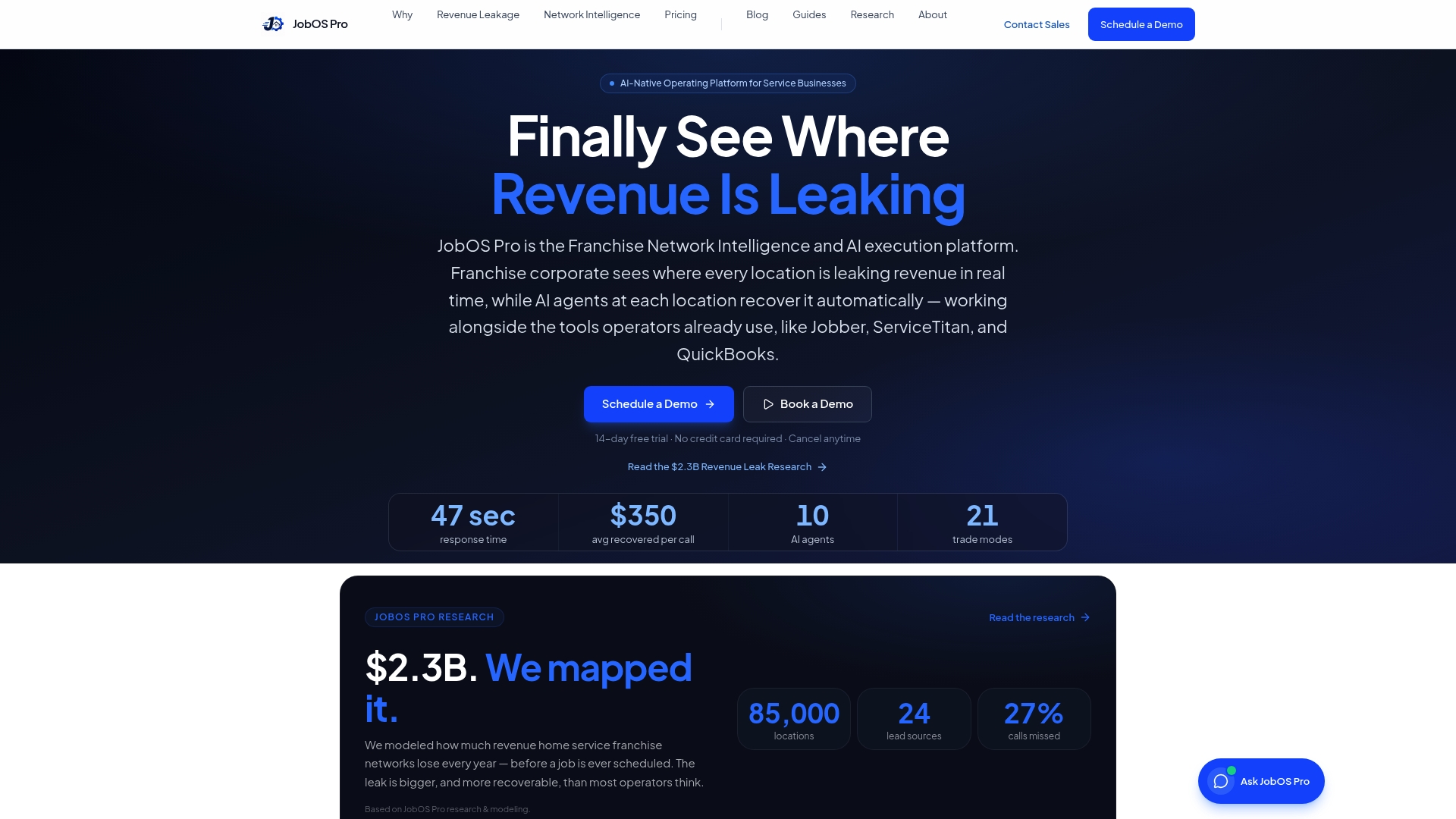
For franchise operators, that visibility scales across locations: corporate leaders can see which sites rebook cancellations fast and which ones let slots go dark, and standardize the behaviors that work. A $2.3 billion revenue leak study shaped how Jobospro’s reminder and recovery workflows are built, and the platform runs alongside tools you already use, like Jobber and QuickBooks, instead of forcing a migration.
Plans start at $199 a month for the Starter tier, with Growth and Pro tiers available as your reminder volume and location count grow. Book a demo to see how confirm/cancel automation and missed-call capture work together on your own schedule.
Sources
Key references include the FCC’s Second Report and Order on TCPA consent rules, the Federal Register’s summary of 2024 robocall rule changes, and peer-reviewed trials on SMS cost framing and message A/B testing published in PLOS One.
- DA-24-910A1.txt
- Stating appointment costs in SMS reminders reduces missed hospital appointments: PLOS One
- Text-messaging versus telephone reminders to reduce missed appointments in an academic primary care clinic | BMC Health Services Research
FAQ
Is there a free way to send automated text reminders?
Some scheduling platforms include limited free tiers for text reminders, but volume caps and missing compliance features usually make them impractical past a handful of appointments a month. Most home service businesses outgrow free tools quickly once they need confirm/cancel flows and consent logging built in. Jobospro offers a free trial rather than a permanent free tier, with paid plans starting at $199 a month.
What counts as an automated reminder?
An automated reminder is a message, sent by text, email, or voice, that fires on a schedule without a person manually sending it each time. It typically triggers off an appointment date, a recurring service interval, or a specific number of days before a visit.
How do I set up automated reminders in Outlook?
Outlook can send calendar-based email reminders through its built-in notification settings, but it lacks confirm/cancel reply handling, SMS delivery, and consent logging that home service scheduling requires. For appointment-based businesses, dedicated scheduling or dispatch software designed for service reminder automation handles these gaps more reliably than a calendar app.
How do I automate text reminders for my business?
Start by choosing a scheduling platform that supports SMS triggers tied to appointment dates or recurring service intervals, then build consent capture into your booking process before sending a single message. Configure reminder timing (commonly 7 days, 48 hours, and 24 hours out), add a confirm/cancel reply option, and test the full flow with internal numbers before rolling it out to customers.