
Automated Billing for Contractors: 2026 Strategic Guide
Most contractors view billing as a back-office chore. They're wrong. In 2026, billing is a strategic lever that determines whether your business scales or simply survives. Implementing automated billing for contractors is no longer a luxury; it's a foundational requirement for any firm looking to eliminate revenue leakage and capture capital at the point of service. Every hour that passes between a technician finishing a job and an invoice being sent represents a direct hit to your liquidity and a missed opportunity for growth.
You've likely accepted administrative latency and paperwork errors as the unavoidable friction of home services. You're tired of technicians struggling with complex forms and your office staff drowning in manual data entry. This guide provides a roadmap to transition your operations to an AI-native billing cycle that accelerates cash flow and provides total visibility into financial performance across all locations. We'll examine how to reduce office overhead through intelligent automation, ensuring your financial infrastructure finally matches the speed of your field operations.
Key Takeaways
- Identify the systemic inefficiencies where manual data entry and administrative latency create significant revenue leakage across your service locations.
- Discover how automated billing for contractors converts field milestones into instant, AI-validated payment triggers to accelerate business liquidity.
- Evaluate the strategic advantages of an operations-first financial layer over traditional, siloed accounting software to avoid the integration trap.
- Learn a definitive framework for auditing your current billing workflow and implementing a self-executing, tech-forward infrastructure.
- See how centralized AI oversight provides real-time visibility into multi-location financial performance and long-term operational scalability.
The Strategic Shift: Why Manual Billing is a Growth Bottleneck
Manual billing is a legacy anchor. It's the silent killer of scale. For high-stakes home service providers, the gap between job completion and payment collection isn't just an administrative delay; it's a structural failure. Every hour an invoice remains ungenerated is an hour your capital remains trapped in the field. Shifting to automated billing for contractors represents more than a software upgrade. It's a strategic pivot from viewing billing as a back-office chore to treating it as a primary engine for liquidity.
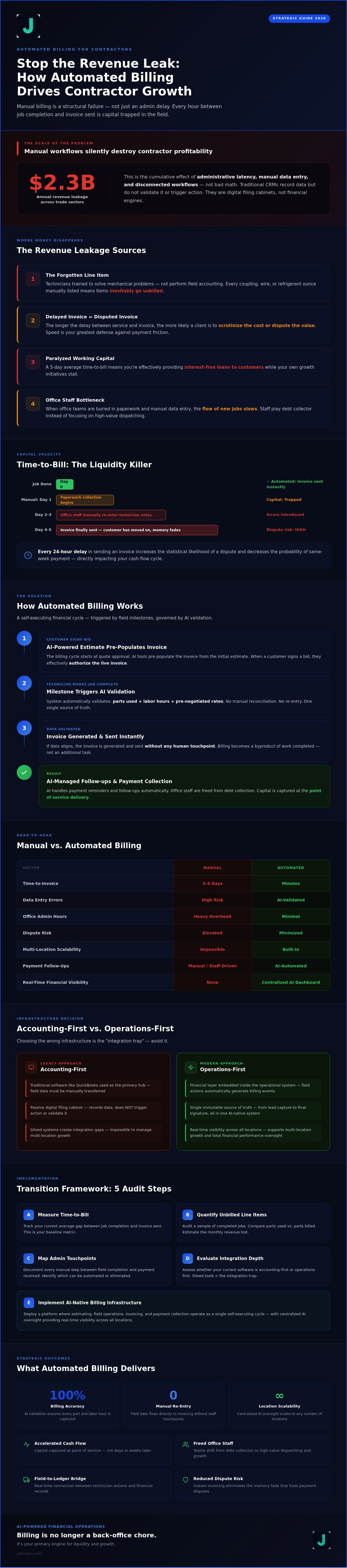
Industry data indicates that manual data entry and disconnected workflows contribute to a staggering $2.3 billion in annual revenue leakage across the trade sectors. This isn't merely a result of bad math. It's the cumulative effect of administrative latency. Traditional CRMs often fail here because they function as passive digital filing cabinets. They record data but do not validate it or trigger action. To scale in 2026, you must move beyond "billing as a task" and establish "billing as a strategic outcome" that occurs automatically as work is performed.
Identifying Revenue Leakage in Your Current Workflow
Revenue leakage often begins with the "forgotten line item." Technicians are trained to solve mechanical problems, not to perform forensic accounting in a driveway. When field staff must manually list every coupling, wire, or refrigerant ounce, items inevitably go unbilled. This oversight is compounded by customer psychology. The longer the delay between service delivery and the invoice, the more likely a client is to scrutinize the cost or dispute the value. Speed is your greatest defense against payment friction. When you eliminate the overhead of manual payment chasing, your office staff can focus on high-value dispatching rather than playing debt collector.
The Hidden Costs of Administrative Latency
Slow billing cycles do more than frustrate your accountant; they paralyze your working capital. If your average time-to-bill is five days, you're effectively providing interest-free loans to your customers while your own growth initiatives sit on hold. This latency creates a direct correlation with technician utilization rates. When the office is bogged down in paperwork, the flow of new jobs slows. Automated billing for contractors solves this by creating a real-time bridge between the field and the ledger. Without this infrastructure, managing multi-location growth becomes impossible. You cannot oversee ten locations if you're still waiting for paper job folders to arrive at the central office for manual processing. Modern scale requires modern speed.
How Automated Billing Works for Modern Trade Businesses
Automated billing is not merely a digital version of a paper invoice. It is a self-executing financial cycle. This cycle is triggered by specific field milestones and governed by AI data validation. For companies adopting AI business management for home services, this creates a single, immutable source of truth. Every interaction, from the initial lead capture to the final signature, feeds into a centralized system that eliminates the need for manual reconciliation.
Modern automated billing for contractors utilizes intelligent triggers to remove human oversight from the equation. When a technician marks a job as complete, the system validates the parts used, labor hours logged, and pre-negotiated rates. If the data aligns, the invoice is generated and sent instantly. This removes the administrative lag that traditionally haunts the trade industries. It ensures that billing is a byproduct of work, not an additional task for the technician or the office staff. Precision is the new standard.
Integrating Field Estimates with Instant Invoicing
The billing cycle begins long before the job is finished. AI-powered estimating tools pre-populate invoices with high accuracy based on the initial quote. This creates a one-tap approval process. When a customer signs a bid, they are effectively authorizing the live invoice. Transitioning to automated billing for contractors allows your team to skip the office re-entry phase. In traditional models, administrative staff spend hours deciphering technician notes and manually typing data into accounting software. By unifying these stages, you ensure the final bill perfectly reflects the work performed. It reduces friction for both the customer and the business.
The Role of AI in Payment Collection and Follow-ups
Collection is where most contractors lose momentum. AI changes this by implementing rhythmic, automated follow-ups that maintain a professional yet persistent cadence. These systems identify high-risk accounts before they become overdue by analyzing historical payment patterns and communication engagement. By integrating specialized contractor payment collection tools, you provide customers with frictionless transaction options. This proactive approach accelerates cash flow without requiring a single phone call from your office team. To see how these systems unify your operations, explore the capabilities of JobOS Pro as your operational backbone.
Evaluating Your Infrastructure: Accounting-First vs. Operations-First
Software architecture dictates your business ceiling. Many contractors mistakenly believe that their accounting software is the center of their digital universe. This "accounting-first" mindset creates significant operational silos. While tools like QuickBooks are essential for bookkeeping, they're fundamentally reactive. They record what happened in the past. They don't drive what's happening in the present. To implement effective automated billing for contractors, you must shift to an "operations-first" infrastructure where the financial cycle is a real-time reflection of field activity.
The "Integration Trap" is the hidden cost of this legacy approach. When you patch together disparate apps for dispatching, CRM, and invoicing, you create a fragile tech stack. Data becomes trapped in transit. Field notes don't sync with line items. Signatures don't attach to invoices. You're left paying for multiple subscriptions while your office staff spends half their day manually reconciling data between systems. An AI-native operating system replaces this chaos with a unified layer that feeds clean, validated data into your accounting software. It's the difference between a filing cabinet and a performance driver.
Why Standalone Accounting Software Falls Short in the Field
Basic invoicing apps lack the necessary context to optimize a service business. They don't have access to intelligent technician dispatching data, which means they can't correlate travel time, job complexity, or material costs in real time. Generic tools are also incapable of managing complex recurring service memberships or retention logic. If your billing software doesn't know when a customer's HVAC maintenance is due, it can't trigger the next revenue event. You end up with a ledger that's accurate but a field operation that's blind. Tracking technician performance through a purely financial lens is equally difficult when the data is disconnected from the actual job site milestones.
The Benefits of a Unified Operating System
A unified operating system provides total visibility. It connects the lead source to technician efficiency and finally to the cleared payment. This vertical integration enables executive-level reporting and benchmarking that standalone tools simply cannot provide. You gain the ability to see which marketing channels produce the highest-margin jobs and which technicians have the fastest time-to-collection. Automated billing for contractors within a unified stack ensures data integrity between the field and the office. It eliminates the "he-said-she-said" discrepancies that lead to customer disputes. By positioning your billing as the final step in a seamless operational flow, you ensure that every dollar earned is a dollar captured.
Step-by-Step: Transition to Automated Billing Cycles
Modernizing your financial infrastructure requires a methodical approach. It begins with a comprehensive audit of your current friction points. You must map every step of your customer journey, from the initial lead capture to the final bank deposit. Identify specifically where data is manually re-entered or where invoices stall in the office. Once you've identified these gaps, select a platform that prioritizes field-to-office automation rather than simple digital bookkeeping. Transitioning to automated billing for contractors requires more than a software swap; it requires a cultural shift in how your team handles operational data.
Standardizing your service catalog is non-negotiable. Without uniform codes and pricing, automated billing for contractors cannot function with the precision required for AI validation. This standardization ensures that every quote is accurate and every invoice is defensible. Automated triggers should be set to execute at the exact moment of job completion. This creates immediate liquidity and eliminates the administrative "dead zone" that traditionally follows service delivery. To begin your transition to a high-velocity financial model, modernize your billing with JobOS Pro.
Training Technicians for Frictionless On-Site Billing
Technicians are your front-line financial officers. The field interface must be so intuitive that billing becomes easier than skipping the paperwork. Use AI to validate job photos and notes as direct billing evidence. This provides indisputable proof of work, which reduces payment disputes and accelerates customer approval. Incentivizing on-site collection is another powerful lever to maximize cash flow. When your field staff has the tools to close the financial loop in the driveway, your office overhead drops significantly. Adoption rates soar when the technology removes the burden of manual reporting.
Setting Up Automated Triggers and Reminders
Designing a sophisticated communication rhythm is essential for maintaining professional standards while accelerating collections. Your system should send automated reminders that balance persistence with a high-touch brand voice. This ensures your business remains the priority for payment without requiring manual intervention from your staff. Automating recurring membership billing is the final step in securing predictable revenue. It converts one-time service calls into long-term, automated assets. Finally, monitor these results through real-time executive dashboards to refine your strategy across all locations. Oversight is the key to sustained performance.
Future-Proofing with JobOS Pro: The AI-Powered Financial Layer
JobOS Pro isn't just another tool in your stack. It's the intelligent layer that unifies your entire operation. While traditional software acts as a static record of what's already happened, this AI-native operating system anticipates what's next. By implementing automated billing for contractors at the core of your business, you transition from reactive bookkeeping to proactive revenue management. You no longer wait for the end of the month to see your numbers. You observe them in real time as they're generated in the field.
For multi-location enterprises and franchise networks, this level of oversight is transformative. Centralized command allows you to observe performance across disparate territories without the need for manual data aggregation. You can identify which regions are lagging and which are setting new benchmarks for efficiency. This visibility ensures that growth never comes at the expense of control. It positions your organization as a sophisticated, data-driven entity rather than a collection of disconnected service hubs.
Real-Time Performance Visibility and Executive Reporting
Executive leadership requires more than just a balance sheet. You need granular data on revenue-per-technician and lead-to-cash metrics to maintain a competitive edge. JobOS Pro provides these insights through real-time dashboards that eliminate the need for manual reporting cycles. The AI doesn't just display current data; it forecasts future cash flow based on your scheduled dispatch volume. This allows you to make strategic decisions about hiring, equipment purchases, and marketing spend with total confidence. By automating financial roll-ups, you reduce office overhead and ensure that your leadership team spends their time on high-level strategy rather than spreadsheets.
Scaling the Network with Confidence
Expansion is a high-stakes endeavor without standardized financial infrastructure. JobOS Pro enables rapid franchise growth by providing a "plug-and-play" financial layer that ensures consistency across every new location. When every branch uses the same automated billing for contractors, you eliminate the variance that typically plagues expanding networks. Financial standardization becomes the foundation of your brand promise. The AI continuously retrieves data from every job site to identify hidden patterns for operational improvement. This constant oversight means your business doesn't just grow; it evolves. You're building a resilient, tech-forward enterprise that is both highly intelligent and fundamentally reliable.
Mastering the High-Velocity Revenue Cycle
Scaling a home service enterprise in 2026 requires more than technical expertise in the field. It demands a sophisticated financial infrastructure that operates at the speed of modern commerce. By transitioning from siloed accounting apps to an AI-native operational suite, you eliminate the administrative friction that traditionally traps working capital. Implementing automated billing for contractors ensures that every job completion triggers an immediate, validated payment cycle. This isn't just about saving time; it's about establishing a zero-latency lead-to-cash workflow that fuels aggressive expansion and stabilizes your liquidity.
You now have the framework to audit your current friction points and deploy a unified operating system. With executive multi-location dashboards, you gain the total visibility necessary to optimize performance across your entire network. The shift from reactive billing to proactive revenue management is the definitive competitive edge for the modern trade business. It's time to stop chasing payments and start capturing growth with a system that works as hard as your technicians do.
Ready to see the future of your operations? Schedule a Strategic Walkthrough of JobOS Pro today and secure your business's financial foundation.
Frequently Asked Questions
How do I automate contractor billing without losing personal touch?
Automation isn't about removing the human element; it's about removing administrative friction. Use customized communication templates that reflect your brand voice while the system handles the timing and delivery. This allows your team to focus on high-value customer interactions rather than sending manual reminders. By eliminating the stress of payment chasing, your staff can provide a more professional, calm, and attentive service experience to every client.
What is the best automated billing software for home services in 2026?
The most effective solution is an AI-native operating system like JobOS Pro that unifies the entire customer lifecycle. Unlike standalone apps, it integrates lead capture, estimating, and dispatching directly into the financial cycle. This provides a single source of truth and eliminates the need for manual data reconciliation. You should prioritize platforms that offer executive-level reporting and multi-location oversight to ensure long-term scalability and operational control.
Does automated billing reduce late payments for HVAC and plumbers?
Yes, by eliminating the gap between job completion and invoice delivery. Automated billing for contractors triggers payment requests the moment a technician closes a work order in the field. This immediacy aligns with the peak of customer satisfaction, which significantly increases the likelihood of instant payment. By removing the administrative lag, you reduce the opportunity for customers to deprioritize or dispute the invoice.
Can I integrate automated billing with QuickBooks or Xero?
Professional-grade systems are designed to integrate seamlessly with QuickBooks rather than replacing it. The software acts as a strategic operational layer that validates field data before pushing clean, reconciled entries into your accounting platform. This ensures your books remain accurate without requiring manual entry from your office staff. It maintains the integrity of your financial records while providing the speed required for field operations.
How does AI improve the accuracy of contractor invoices?
AI validates field data against pre-defined service catalogs and labor rates to prevent human error. It can cross-reference job photos and technician notes to ensure every billable item is captured. This level of oversight eliminates the "forgotten line item" problem and ensures 100% billing accuracy across all service calls. You stop losing revenue from unbilled materials and provide customers with indisputable proof of work performed.
What are the security risks of automated payment collection in the field?
Modern systems mitigate risks by using encrypted, PCI-compliant payment gateways that never store sensitive card data on local devices. By using secure digital links or mobile readers, you eliminate the security liabilities associated with handling cash or physical checks. This protects both your business and your customers' financial information. It's a foundational requirement for any business looking to modernize its field collection strategy safely.
How do I train my technicians to use automated billing software?
Success depends on choosing a platform with an intuitive field interface that simplifies their workflow. Training should focus on how the technology reduces their own paperwork burden. When technicians see that the system automatically handles parts logging and invoice generation, adoption rates increase. It allows them to focus on their technical craft rather than administrative chores, making the technology an asset rather than a hurdle.
Will automated billing help with my franchise's revenue leakage?
Automated billing for contractors is essential for identifying and stopping leakage across a multi-location network. It provides executive oversight into technician performance and ensures standardized pricing is applied at every branch. Centralized dashboards allow you to detect financial anomalies in real time. This ensures that every dollar earned across your entire organization is captured, recorded, and optimized for maximum profitability.