Automated Invoicing for Home Services: 2026 Executive Guide
How much of your hard-earned revenue is currently evaporating through the cracks of your manual billing cycle? For most home service executives, the answer is a silent percentage that erodes the bottom line every single month. You likely recognize the frustration of unbilled work and the systemic drag of slow cash flow. Implementing sophisticated automated invoicing for home services is no longer a luxury for the tech-curious; it's a foundational requirement for any enterprise looking to scale without ballooning its administrative headcount.
This guide provides a strategic roadmap to transform your billing from a back-office chore into an AI-driven revenue engine. You'll discover how to eliminate revenue leakage by connecting field work directly to your accounting software in real time. We will explore the mechanics of instant payment collection at the job site and the architectural shifts required to achieve total visibility over your financial performance. It's time to stop chasing payments and start engineering a frictionless cash flow ecosystem.
Key Takeaways
- Transition from manual data entry to AI-verified job costing to ensure every billable minute is captured and accounted for.
- Identify and eliminate the systemic revenue leakage caused by operational latency in traditional, slow-moving billing cycles.
- Understand why high-performance automated invoicing for home services requires a unified operating system rather than disconnected point solutions.
- Follow a five-step strategic framework to audit your current time-to-cash gaps and integrate automation into your existing accounting stack.
- Achieve a "Zero Latency" financial ecosystem where job completion triggers instant payment collection without increasing administrative headcount.
What is Automated Invoicing for Home Services?
True automated invoicing for home services is a foundational shift in how service revenue is captured and processed. It functions as a silent, tireless layer of oversight that observes technician activity and retrieves job data to generate a billable event instantly. This represents the death of manual data entry. By utilizing AI-verified job costing, the system unifies disparate elements like parts, labor, and travel time into a single, accurate invoice without human intervention. It ensures that the final bill is an exact reflection of the work performed, not a best-guess estimate scribbled at the end of a shift.
For an invoicing system to be truly automated, it must be deeply integrated with intelligent technician dispatching and estimating tools. A siloed billing app is just another manual chore. A sophisticated operating system ensures that the estimate approved by the customer flows directly into the final invoice, with AI verifying any deviations in material or time. This level of field-to-office synchronization is what separates market leaders from those struggling with administrative overhead.
The Evolution of Field Service Billing
The trajectory of field service billing has moved from physical carbon copies to digital PDFs, and finally, to AI-driven automation. Early digital tools were still reliant on human memory; technicians had to manually input data at the end of a long day. This led to "billing amnesia," where small parts and labor adjustments were routinely forgotten. Today, real-time data capture ensures that every billable action is recorded as it happens, facilitating instant payment collection at the door before the technician even leaves the driveway.
Why 'Generic' Invoicing Apps Fail Contractors
Generic invoicing applications are fundamentally ill-equipped for the complexities of the trades. These tools lack the architecture to manage trade-specific line items such as permits, specialized labor rates, or complex change orders. When a technician discovers an unforeseen issue in the field, a generic app often requires a complete restart of the billing process. They also typically fail to synchronize effectively with back-office stacks like QuickBooks; this creates a data silo that forces administrative teams to spend hours on manual reconciliation and data correction.
The High Cost of Manual Billing: Stopping Revenue Leakage
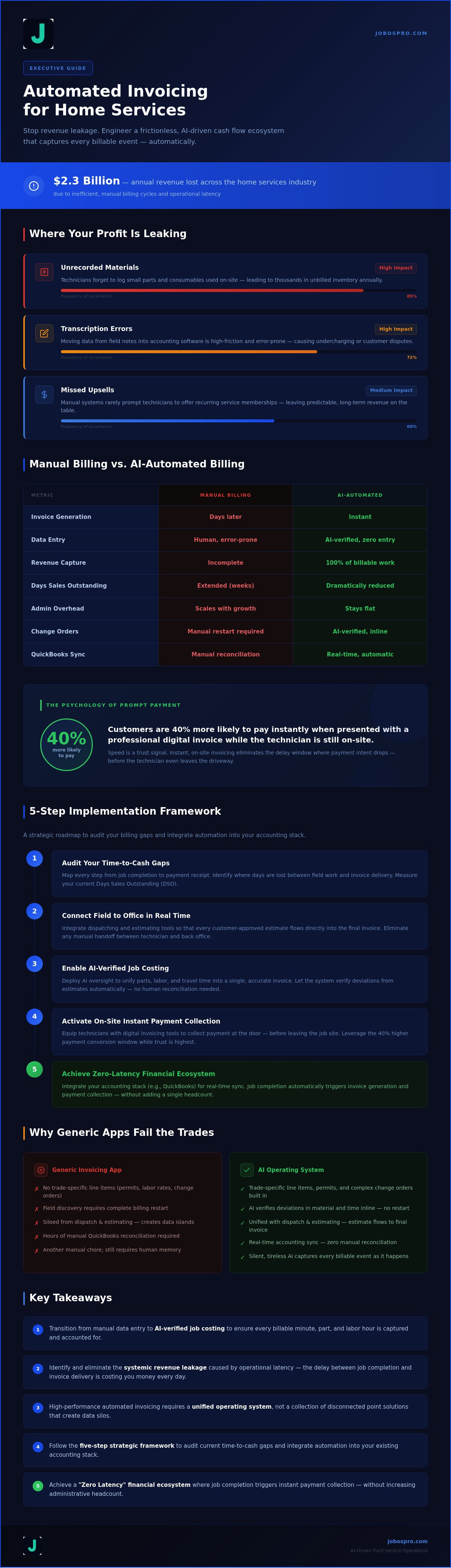
Manual billing is a systemic liability. In the home services sector, inefficient billing cycles contribute to a collective loss often cited as a $2.3B leak across the industry. This is not merely a bookkeeping issue; it is a failure of operational architecture. When your office staff spends days reconciling paper tickets or chasing technicians for job details, you are suffering from operational latency. This delay between work completion and invoice delivery directly erodes your bottom line by extending the DSO (Days Sales Outstanding) and increasing the likelihood of disputes. For a deeper dive into modernizing these workflows, consult the 2026 Strategic Guide on Automated Billing.
The hidden costs of manual follow-ups are equally staggering. Every hour an office manager spends on the phone reminding customers of unpaid balances is an hour stolen from growth-focused activities. These administrative cycles represent a high overhead that scales poorly as your business expands. Implementing automated invoicing for home services eliminates these manual touchpoints, allowing your team to focus on high-value strategy rather than debt collection.
Where Your Profit is Leaking
Revenue disappears in the small gaps of the service lifecycle. Without a unified system, several common points of failure emerge:
- Unrecorded Materials: Technicians often forget to log small parts or consumables used on-site, leading to thousands of dollars in unbilled inventory annually.
- Transcription Errors: Moving data from field notes into accounting software is a high-friction process prone to human error, resulting in undercharging or customer frustration.
- Missed Upsells: Manual systems rarely prompt technicians to offer recurring service memberships, leaving predictable, long-term revenue on the table.
Integrating a strategic operating system like JobOS Pro ensures that these gaps are sealed through real-time data capture and AI oversight.
The Psychology of Prompt Payments
Speed is a trust signal. Data indicates that customers are 40% more likely to pay instantly when presented with a professional digital invoice while the technician is still on the premises. Immediate billing reinforces the value of the service provided while the benefits are still fresh in the customer's mind. Conversely, an invoice that arrives three days later feels like a cold financial demand rather than a professional conclusion to a job well done. Transparent, on-site billing builds authority and reduces the friction of the payment experience. Revenue leakage is the gap between work performed and revenue realized due to manual friction.
Standalone Invoicing Apps vs. AI Operating Systems
Point solutions are a legacy trap. While many contractors adopt standalone apps to digitize their billing, these tools often remain isolated from the rest of the business. They create digital silos that still require manual bridges. True automated invoicing for home services requires a platform that unifies the entire operational stack into a single data layer. JobOS Pro functions as this central nervous system, ensuring that financial data is a live reflection of field activity rather than a delayed report. This shift from a "billing tool" to an AI-native operating system is the difference between surviving and scaling.
The billing engine does not operate in a vacuum. It is fed directly by intelligent technician dispatching, which tracks job progress and resource allocation in real time. When a technician arrives, completes a task, and logs materials, the system retrieves this data to update the invoice instantly. This automation removes the burden of administrative accuracy from the technician and places it on the software. The ROI is immediate; you recover lost labor hours and eliminate the "context switching" costs that plague offices running multiple disconnected apps.
Why Integration is the New Standard
Software silos are a primary cause of operational friction. In a modern enterprise, data must flow without resistance from the moment of AI call answering and lead capture through to the final payment. When your invoicing system "talks" to your estimating and dispatching tools, you eliminate transcription errors and ensure pricing consistency. This integration extends beyond the transaction. Once a payment is secured, the system automatically triggers reputation management workflows to capture customer reviews, turning a successful job into a marketing asset without a single manual click.
Scalability for Multi-Location Enterprises
Multi-location and franchise networks face the unique challenge of inconsistent billing practices. A unified AI operating system standardizes these protocols across every branch, ensuring that pricing logic and collection schedules are followed universally. Executive leadership gains total visibility through real-time reporting dashboards. You can benchmark financial performance across different territories, identifying high-performing units and those suffering from systemic inefficiencies. This level of oversight allows for rapid, data-driven adjustments that are impossible with fragmented standalone apps.
How to Implement Automated Billing in 5 Steps
Deploying a modern billing architecture is a strategic deployment rather than a simple software installation. It requires a systematic overhaul of how data moves from the field to your ledger. To successfully integrate automated invoicing for home services, leadership must follow a disciplined framework that prioritizes data integrity and speed. This transition is about removing the human friction that traditionally slows down the realization of revenue.
Follow these five steps to modernize your financial operations:
- Step 1: Audit your current billing cycle. Forensic analysis of your existing "time-to-cash" gaps is essential. Identify exactly where the process stalls. If it takes forty-eight hours for a technician's notes to reach the office, you have identified a primary source of operational latency.
- Step 2: Choose a unified accounting integration. Your system must sync seamlessly with your existing stack. JobOS Pro integrates directly with QuickBooks, ensuring that field data unifies with your accounting records without manual bridges or transcription.
- Step 3: Standardize your price book. Automation fails if your pricing is subjective. Build a digital price book that allows for instant, automated estimate-to-invoice conversion. This ensures every quote is consistent and professional.
- Step 4: Train your field team. Technicians must be proficient with contractor payment collection tools. Securing payment at the job site is the most effective way to eliminate the need for future debt collection.
- Step 5: Automate the customer lifecycle. Set the system to handle follow-ups and membership renewals automatically. This creates a predictable, recurring revenue stream that requires zero administrative intervention.
Preparing Your Team for Change
Technician adoption is often the most significant hurdle in digital transformation. Overcome resistance by demonstrating how mobile tools reduce their own administrative burden. When technicians realize they no longer need to spend their evenings catching up on paperwork, buy-in increases rapidly. Set clear KPIs for on-site payment collection rates to drive performance. You must insist on data accuracy at the point of service to ensure the AI-driven billing engine has the correct inputs to function at peak efficiency.
Selecting the Right Technology Stack
Your technology stack must be built specifically for the high-stakes environment of the trades. Essential features include AI-native estimating, automated follow-ups, and robust membership management. Security is non-negotiable. Ensure your payment processing meets the highest compliance standards to protect your enterprise. A mobile-first design is critical; your technicians need a reliable interface that works in the field, not a clunky desktop port. Ready to eliminate revenue leakage? Explore how JobOS Pro unifies your operations today.
Frictionless Finance with JobOS Pro
JobOS Pro is the definitive AI business management solution for the modern trade enterprise. It operates on a "Zero Latency" philosophy that eliminates the traditional gap between work completion and revenue capture. By unifying the entire service lifecycle, the platform ensures that automated invoicing for home services is a natural operational outcome rather than a manual back-office chore. From the moment an AI-driven lead is captured to the second an invoice is settled, the system maintains total data integrity. It is a silent, tireless worker that provides constant oversight of your financial health.
Predictable revenue is the foundation of scale. JobOS Pro automates membership and recurring service billing for HVAC, plumbing, and electrical service plans with surgical precision. The system retrieves renewal data, processes payments, and updates service entitlements without a single human touchpoint. This removes the administrative friction that often prevents companies from growing their recurring revenue base. It transforms a complex logistical challenge into a streamlined, automated engine for growth. You no longer have to worry about expiring credit cards or missed renewal windows; the AI manages the lifecycle for you.
Beyond Invoicing: Total Operational Intelligence
True automation goes beyond simple transactions. JobOS Pro utilizes AI to identify hidden revenue opportunities within your existing customer database. It observes patterns in service history and equipment age to suggest proactive outreach, ensuring your technicians are always dispatched to high-value jobs. Once a payment is secured, the system unifies the customer experience by automating "thank you" messages and review requests. This builds your online reputation while your team stays focused on technical performance. For executives, the platform provides a unified data layer that allows for real-time benchmarking across multi-location franchise networks. You gain the power to see exactly which branches are performing and where systemic inefficiencies are eroding your margins.
The Future of Home Service Operations
The industry is shifting toward a model of predictive billing and automated resource allocation. AI-native platforms are the only way to remain competitive in an environment where speed and accuracy are the primary differentiators. Legacy tools cannot keep pace with the real-time demands of a modern field workforce. By implementing a sophisticated operating system, you position your business as a tech-forward leader capable of identifying patterns that human operators might miss. It is time to stop managing spreadsheets and start leading an automated enterprise. Experience the JobOS Pro Operating System and secure your competitive edge in the 2026 market.
Engineering a Frictionless Financial Future
The era of manual billing is over. It is a systemic liability that no high-performance organization can afford to carry. We've established that true efficiency requires more than a digital invoice; it requires a unified data layer that connects every field action to your back-office ledger. Transitioning to automated invoicing for home services is the strategic corrective measure that seals revenue leaks and accelerates your time-to-cash. This shift isn't just about software; it's about reclaiming the profit currently lost to operational latency.
By unifying the lifecycle from AI-powered lead capture to final payment, you eliminate the administrative friction that habitually stalls growth. With seamless QuickBooks integration and sophisticated executive dashboards for multi-location oversight, you gain the total visibility required to lead a modern, data-driven enterprise. This architectural shift provides the oversight necessary to identify hidden patterns and capitalize on every billable event in real time. It's time to move beyond the constraints of legacy systems and embrace a tech-forward operating stack that works as tirelessly as your best technicians.
Scale your home service business with JobOS Pro's AI Operating System. Your path to a leaner, more profitable operation begins with this foundational shift. We're ready to help you engineer a business that scales without limits.
Frequently Asked Questions
How does automated invoicing integrate with my current accounting software?
JobOS Pro integrates directly with QuickBooks to ensure your financial data remains unified without manual entry. This bidirectional sync ensures that every transaction captured through automated invoicing for home services is instantly reflected in your general ledger. You maintain your existing accounting workflows while eliminating the friction of data transcription between the field and the office.
Can my field technicians create and send invoices without office help?
Technicians utilize a mobile-first interface to generate and send professional invoices immediately upon job completion. The system retrieves data from the initial estimate and any AI-verified change orders to ensure line-item accuracy. This empowerment reduces the administrative burden on your office staff and accelerates the payment cycle by securing revenue while the technician is still on the premises.
What happens if a customer refuses to pay on-site?
If a customer is unable or unwilling to pay on-site, the system automatically initiates a digital collection sequence. It sends secure payment links via SMS or email and schedules automated follow-up reminders at strategic intervals. This ensures that unpaid balances don't slip through the cracks and removes the need for manual debt collection calls by your office team.
Is automated billing secure for high-ticket home service jobs?
The platform utilizes enterprise-grade encryption and fully PCI-compliant payment processing to secure high-ticket transactions. Whether you're billing for a minor repair or a complex system installation, the financial data is protected by the same standards used by global financial institutions. This level of security builds customer trust and protects your enterprise from the risks associated with manual payment handling.
How does AI help in creating more accurate estimates and invoices?
AI observes technician activity and retrieves inventory data to verify that every part and labor hour is accounted for on the final invoice. It identifies discrepancies between the initial quote and the work performed, prompting technicians to log adjustments in real time. This corrective oversight eliminates revenue leakage and ensures that your billing is a precise reflection of the value delivered.
Can I manage recurring service memberships through automated invoicing?
Automated billing for recurring service memberships is a core capability of the operating system. The software manages the entire lifecycle of HVAC, plumbing, and electrical service plans by processing renewals and updating customer status automatically. This provides your business with a predictable, recurring revenue stream that requires zero manual intervention from your administrative staff.
What is the typical ROI for switching to an automated billing system?
The ROI of automated invoicing for home services is realized through the immediate recovery of unbilled materials and the reduction of administrative headcount. By eliminating the "time-to-cash" gap, businesses see a significant improvement in liquidity and overall profitability. The system acts as a silent worker that pays for itself by sealing the revenue leaks inherent in manual, paper-based billing cycles.
How does JobOS Pro handle multi-location or franchise billing?
JobOS Pro provides a unified data layer that standardizes billing practices across every branch of a franchise or multi-location enterprise. Executives utilize a central dashboard to monitor real-time cash flow and benchmark financial performance across different territories. This high-level visibility allows for rapid strategic adjustments and ensures that every location adheres to the same rigorous financial standards.