
Stop $2.3B Revenue Loss: Collect Payments in the Field for Service Ops
Stop $2.3B Revenue Loss: Collect Payments in the Field for Service Ops
The fastest ways to collect payment in the field are softPOS tap-to-pay on a phone, an mPOS Bluetooth card reader paired to your app, or a payment link sent by text or email for jobs where the customer isn’t standing there with a card. ACH and manual card entry work as backups. Whichever method you pick, it has to handle PCI security and spotty cell coverage, or you’ll trade uncollected invoices for a different kind of headache.
TL;DR:
- Using tap-to-pay requires NFC-enabled phones and a supporting processor app for swift transactions on-site.
- Bluetooth card readers support multiple card types and work with older devices but add hardware management steps.
- Payment links are ideal for jobs with absent customers or bulk invoicing, enabling remote payment review and approval.
- Offline payment support must encrypt and queue transactions securely, with proper testing to ensure seamless reconciliation later.
- Integration with accounting systems should automate invoice updates and batch reconciliation, reducing manual follow-up and revenue leakage.
Table of Contents
- Which Field Payment Method Fits Your Crew?
- How Do You Set Up Field Payments Correctly?
- What Are the PCI and Security Requirements for Mobile Payments?
- What’s the Best Script for Collecting Payment On-Site?
- How Do You Handle Payments When There’s No Signal?
- How Should Field Payments Sync to Invoicing and Accounting?
- How Does an Integrated Platform Cut Down on Uncollected Payments?
- What Actually Matters When You Roll This Out
- Collect More, Chase Less With Jobospro
- Sources
- FAQ
Which Field Payment Method Fits Your Crew?
Every method trades speed for hardware cost, and fee structure for training time. The right pick usually depends on what your technicians are already carrying and what kind of customer they’re standing in front of.
SoftPOS, also called tap-to-pay, turns the technician’s own phone into the card terminal. No extra hardware, no Bluetooth pairing, no dongle to lose in a truck console. The customer taps their card or phone against the technician’s device, and the payment clears in seconds. The catch: it needs a fairly recent phone (NFC-enabled iOS or Android) and a processor whose app actually supports tap-to-mobile. Older crew phones can be the bottleneck.
mPOS Bluetooth readers pair to your field app and read chip cards, magstripe, and contactless. They’re the more reliable choice when your customer base still carries a mix of card types, or when your techs use older devices that don’t support native tap-to-pay. The tradeoff is one more piece of hardware to charge, carry, and eventually replace.
Payment links sent by text or email solve a different problem entirely: the customer isn’t home, or doesn’t want to pay until they’ve reviewed the invoice. This is the best field service platforms approach for absentee billing, HOA-managed properties, or commercial accounts with a purchasing department.
Manual entry and ACH round out the list. Keyed-in card entry works when a reader fails, but it carries the highest processing rate of any method. ACH costs less per transaction but settles slower, over one to three business days instead of instantly.
- SoftPOS/tap-to-pay: fastest checkout, zero extra hardware, requires NFC-capable phones
- mPOS reader: most reliable EMV/chip support, works with older phones, one more device to manage
- Payment link (text/email): best when the customer is absent or wants to review the invoice first
- Manual entry: highest fee, useful only as a fallback when a reader fails
- ACH: lowest fee, slower settlement, ideal for recurring or larger invoices
Most field service platforms boil this down to three practical entry points: charge the card in-app at the job, send a payment link, or process the charge later from the web dashboard. That third option matters more than owners expect. When a technician can’t get a signal or a reader won’t pair, office staff can still close out the invoice from a desk.
How Do You Set Up Field Payments Correctly?
Deployment goes faster when you sequence it instead of handing every technician a reader and hoping it works. Follow this order and you’ll catch most configuration problems before they cost you a job’s worth of revenue.
- Pick your processor based on device compatibility. Confirm it supports both tap-to-pay and Bluetooth mPOS, since you’ll likely need both across a mixed fleet of phones.
- Configure your merchant account and payout timing. Know whether deposits land next-day or in two to three business days, and set expectations with your bookkeeper accordingly.
- Create individual logins for every technician. Shared credentials make it impossible to trace who processed a disputed charge or who mishandled a device.
- Pair and test hardware on a few devices first. Run test transactions before rolling out to the full crew, not after.
- Turn on invoice and payment-link templates with automatic digital receipts. This removes a manual step technicians tend to skip when they’re rushing to the next job.
- Run a full end-to-end test: charge a card, send a link, process a return, and confirm the money shows up where accounting expects it.
Pro Tip: Run your pilot on the technician with the worst cell coverage on their route, not your best performer. If the system holds up on that route, it will hold up everywhere.
What Are the PCI and Security Requirements for Mobile Payments?
The moment a technician’s phone accepts a card, that phone becomes a point of interaction under PCI Mobile Payment Acceptance Security Guidelines, and PCI obligations follow it. That’s not a technicality you can wave off because a third-party app is doing the processing. Prefer a processor built on validated Point-to-Point Encryption (P2PE) or Mobile Payments on COTS (MPoC), the standard covering software-based tap-to-pay on ordinary phones.
A handful of controls cover most of the risk:
- Enforce operating system updates and restrict which apps technicians can install on payment-enabled phones.
- Require individual logins. No shared PINs, no shared devices passed between crew members.
- Never let card numbers or CVV codes sit in a notes app, text thread, or spreadsheet.
- Use tokenization so a stored card is a token, not the actual number, and mask card digits on printed or emailed receipts.
- Ask any vendor for their P2PE or MPoC attestation documentation before you sign a contract, not after.
Treat every technician phone that touches a payment as part of your Cardholder Data Environment. That means inventorying device identifiers and patching them like you would any other point-of-sale terminal, not like a personal phone.
Dispute handling matters just as much as the technical controls. The CFPB ordered a payments operator to pay $175 million after finding its fraud and dispute resolution processes fell short. Outsourcing your processing to a third party does not outsource your obligation to resolve a customer’s disputed charge quickly and fairly. Small merchants get the same message from the PCI Security Standards Council’s own guidance: route capture through a PCI DSS compliant processor and avoid storing card data locally whenever you can.
What’s the Best Script for Collecting Payment On-Site?
The technician who asks for payment right after finishing the job collects more often than the one who waits for an invoice to go out later. Build the habit into the workflow, not into memory.
- State the total and ask directly. “Your total today is $340. Would you like to pay by card or bank transfer?” No hedging, no apologizing.
- Handle tips separately if your app supports it, so the tip prompt doesn’t confuse the total due.
- Capture a digital receipt on the spot and offer a signature if your process requires one.
- Ask for immediate confirmation that the charge went through before the technician leaves the property.
- If the card declines, try one alternate method immediately (a different card, a payment link, ACH) rather than leaving without payment.
- Document the decline with a timestamp and reason code, and schedule a return visit or send a payment link same-day.
Office staff should own the follow-up. Any disputed or charged-back transaction needs a documented paper trail: job photos, signed work order, and the original receipt.
Pro Tip: Technicians who ask for payment using a specific number (“your total today is $340”) close faster than those who say “I’ll send you an invoice.” Specificity removes the customer’s excuse to defer.
How Do You Handle Payments When There’s No Signal?
Rural service routes and basement job sites are where most uncollected payments actually happen, not from customer refusal but from a dead zone at the worst possible moment. The fix isn’t storing card numbers locally, which is a PCI violation waiting to surface. It’s using a processor that queues an already-encrypted, tokenized transaction on the device and forwards it automatically once connectivity returns.
Stripe Terminal documents this exact pattern: smart readers can hold encrypted payments locally and sync them the moment the device reconnects. Before you trust any vendor’s offline claim, test it yourself.
- Queue a test transaction with the phone in airplane mode.
- Reboot the device while the transaction is still queued.
- Reconnect to the network and confirm the charge syncs and settles.
- Reconcile the batch against your accounting system to confirm nothing dropped silently.
Run that four-step test on your worst-coverage route before you trust the system on your best one.
How Should Field Payments Sync to Invoicing and Accounting?
A payment collected in the field is only half the job. If it doesn’t flow cleanly into your invoicing and books, someone on your team is manually reconciling batches every week, and that’s its own kind of revenue leak.
- A completed field payment should automatically mark the invoice paid and close the job status, no manual toggle required.
- Recurring customers benefit from a card-on-file token, which lets you bill future visits without asking for card details again.
- ACH settles in one to three business days while card payments typically fund faster, so your books should reflect that timing gap rather than treating both as same-day cash.
- Export settled batches to accounting platforms like QuickBooks on a consistent schedule so reconciliation stays a quick check, not an audit.
Card-present transactions also tend to carry lower processing fees than keyed entry, which is one more reason to push technicians toward tap-to-pay or mPOS over typing in a number by hand.
How Does an Integrated Platform Cut Down on Uncollected Payments?
Uncollected field payments usually aren’t a single failure. They’re a missed call that never got returned, an invoice that never synced, and a technician who forgot to ask before driving off. Each one looks small. Together, they add up fast: a $2.3 billion revenue-leak study from Jobospro found exactly that pattern across home service businesses.
Consolidating job data, payment status, and missed-call alerts into one view surfaces those leaks in real time instead of at month-end close. That’s the design behind Jobospro’s operational reporting: reconciliation, missed-revenue alerts, and multi-location benchmarking run automatically alongside tools you already use, including Jobber and QuickBooks, without forcing a system migration. For franchise operators, that same visibility extends across locations, so corporate leadership can see which sites are collecting on-site and which ones are still chasing invoices a week later.

What Actually Matters When You Roll This Out
Get tokenization and offline support right before you worry about which app looks nicest on a technician’s phone. Security and reliability are the load-bearing walls. Everything else, including training and interface polish, can improve after launch. Start with one crew, one route, and a 30-day window. Measure the collection rate before and after. If it climbs, expand. If it doesn’t, you’ve found the actual problem before spending on the whole fleet.
— Tarun
Collect More, Chase Less With Jobospro
Jobospro gives you the automated side of field payments that most standalone card readers can’t: reconciliation, tokenization, missed-revenue alerts, and multi-location dashboards running from one operational view, built alongside the tools you already use instead of replacing them.
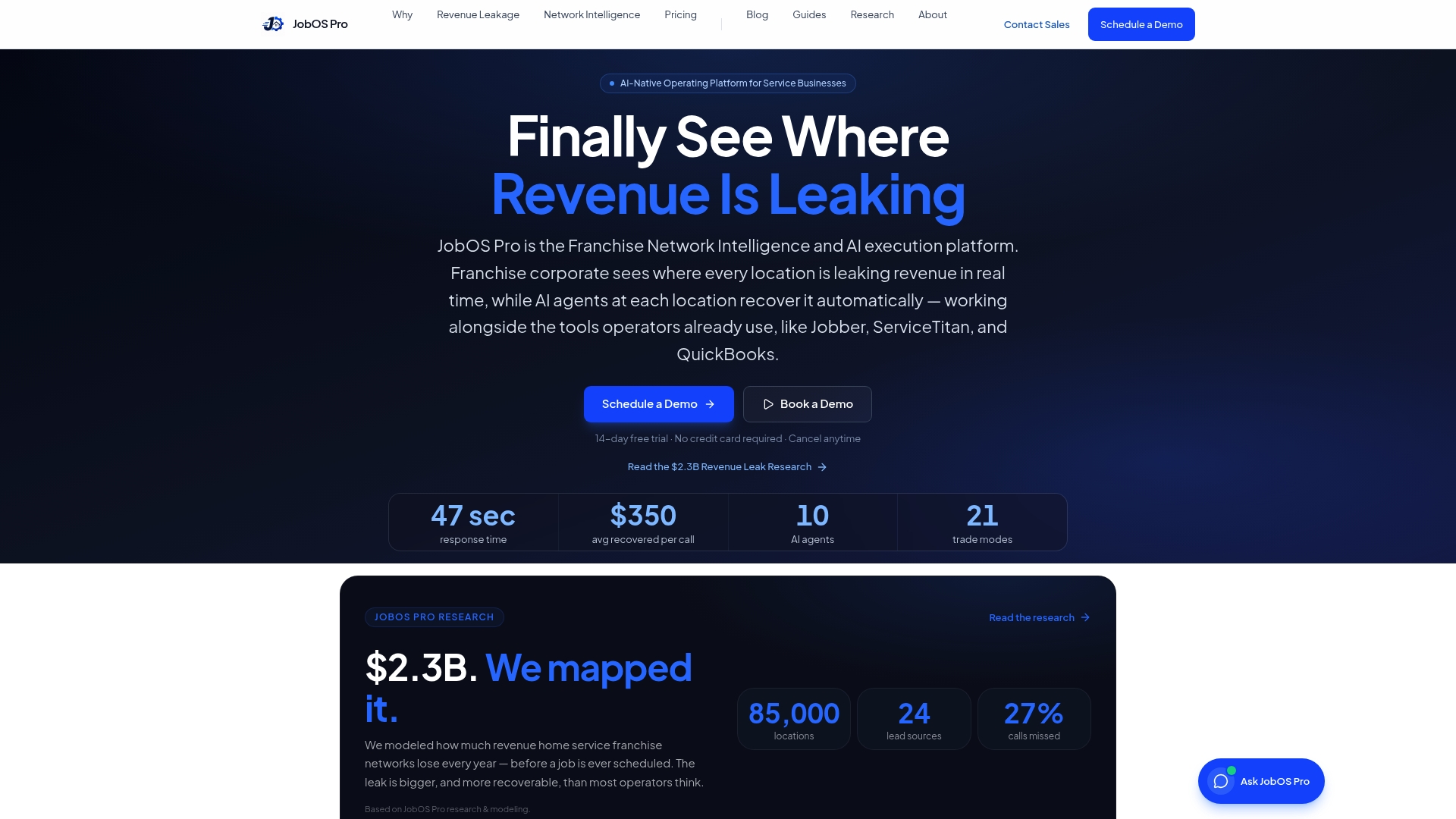
Where a basic mPOS app stops at “charge collected,” Jobospro tracks whether that charge actually posted to the right job, whether a missed call turned into an unpaid estimate, and whether one franchise location is collecting on-site at a lower rate than the rest of the network. It connects to accounting platforms like QuickBooks and works alongside Jobber rather than forcing a rebuild of your existing stack. If a technician’s card reader failed on a job last month, Jobospro is built to flag that gap before it becomes a write-off.
Plans start at $199 a month for Starter, scaling to Growth, Pro, and custom Enterprise tiers for franchise networks. Book a demo to see how it maps to your current collection rate.
Sources
- CFPB orders operator of Cash App to pay $175 million and fix its failures on fraud
- PCI Mobile Payment Acceptance Security Guidelines for Developers v2.0
- Collect a payment while offline — Stripe Terminal docs
- Small merchant guide to safe payments — PCI Security Standards Council
FAQ
What Does “Collect Payment” Mean in a Field Service Context?
Collecting payment in the field means charging a customer on-site, at the moment the job is completed, rather than mailing an invoice and waiting for a check. It typically happens through a tap-to-pay phone, a paired card reader, or a payment link sent while the technician is still on the property.
How Do You Collect Payments From Customers On-Site?
Most crews use one of three methods: tap-to-pay directly on the technician’s phone, a Bluetooth card reader paired to a field app, or a payment link sent by text for customers who aren’t present. Each requires a PCI-aware processor and a way to handle poor cell coverage without storing card data locally.
How Do You Collect Payment for a Scheduled Job or Event?
For scheduled work, send a payment link ahead of time or set up card-on-file so the charge processes automatically once the job or event is confirmed complete. This works especially well for recurring service contracts where you don’t want to ask for card details every visit.
What Is the Best Way to Collect Payments in the Field?
The best approach combines tap-to-pay for fast, present-customer transactions with payment links for absentee billing, backed by a processor that supports offline queueing and tokenization. Jobospro pairs that setup with automated reconciliation, so a collected payment updates the job and the books without manual entry.
How Much Does Jobospro Cost?
Jobospro’s Starter plan is $199 per month, with Growth at $349 and Pro at $549. Enterprise pricing for franchise networks is available on request through the pricing page.