
Turn Contractor Call Tracking Into Booked Jobs With Automated Recovery
Turn Contractor Call Tracking Into Booked Jobs With Automated Recovery
Contractor call tracking assigns tracking numbers to each marketing channel and ties every incoming call back to its source, so you can calculate cost per qualified call and attribute booked jobs to the ad, listing, or truck wrap that generated them. The next move is simple: install dynamic number insertion on your website and assign static numbers to every offline asset. Skip either one and you’re flying blind on half your lead sources.
TL;DR:
- A call tracking setup requires enough dynamic numbers to prevent attribution collisions, with pools of 15 to 20 for small sites and up to 100 for high-traffic sites.
- Offline assets like truck wraps and yard signs need dedicated static numbers to accurately attribute calls from those sources.
- Conversation intelligence becomes cost-effective once a business exceeds about 100 qualified calls monthly, providing insights into call quality and booking likelihood.
- Integrating call data with CRM, Google Ads, and GA4 transforms call logs into actual revenue reports and helps measure cost per booked job by source.
- Proper setup demands validation over a full billing cycle to ensure cold leads and missed calls do not skew attribution and revenue estimates.
Table of Contents
- What Contractor Call Tracking Actually Does
- Core Components Of A Contractor Call Tracking Setup
- How To Connect Call Data To Google Ads And GA4
- How Do You Set Up Contractor Call Tracking Step By Step?
- Common Contractor Call Tracking Mistakes And Fixes
- How JobOS Pro Closes The Loop On Tracked Calls
- When Is Conversation Intelligence Worth Paying For?
- Get Call Tracking That Actually Books The Job
- Key Technical And Compliance References
- Sources
- FAQ
What Contractor Call Tracking Actually Does
Two mechanisms do the heavy lifting. Dynamic number insertion (DNI) is a JavaScript snippet that swaps the phone number displayed on your website based on where the visitor came from, whether that’s a Google Ads click, an organic search, or a Facebook link. Twilio’s own definition of dynamic number insertion makes clear it only operates on your website. It cannot see a homeowner who wrote your number off a truck wrap and dialed later that night.
That’s where static tracking numbers come in. You assign a dedicated, unchanging number to each offline asset, your Google Business Profile, yard signs, direct mail, truck decals, so calls from those sources get attributed even though DNI never touched them.
Every call, whether captured through DNI or a static number, generates metadata worth reviewing:
- Timestamp and call duration
- Recorded audio and, in many platforms, a transcription
- The UTM parameters or gclid tied to the click that preceded it
- Caller number and call outcome, if your platform logs it
Conversation intelligence goes further than a raw call count. Instead of just telling you “42 calls came from Google Ads,” it scores each call for keywords, sentiment, and booking likelihood, separating a homeowner requesting an estimate from a wrong number or a solicitor. Raw call volume tells you traffic showed up. Conversation intelligence tells you whether that traffic turned into work.
Core Components Of A Contractor Call Tracking Setup
A functional setup has four moving parts, and skipping any one of them weakens the whole system.
- DNI script and pool sizing. Your DNI pool needs enough numbers to avoid attribution collisions, where two different visitors get credited to the same source because the pool recycled too fast. Setup guides for contractor sites suggest pools of 15 to 20 numbers for smaller sites, scaling toward 50 to 100 numbers with shorter reuse intervals for sites pulling 1,000 or more daily visitors.
- Static numbers for offline assets. Your Google Business Profile, truck wraps, yard signs, and direct mail pieces each get their own dedicated number. Rotate these only when you retire the asset. A truck wrap number should stay fixed for years, not weeks.
- Recording, transcription, and AI scoring. Base call tracking runs $30 to $50 a month, while full-featured plans with recording and transcription land closer to $100 to $300 a month depending on call volume. Adding AI-powered conversation scoring typically tacks on another $60 to $110 a month, and it tends to pay for itself once you’re clearing 100 calls a month.
- CRM and scheduling integration. This is the piece that turns a call log into a revenue report. Without it, you’re guessing at outcomes based on call duration alone.
Pro Tip: Don’t buy conversation intelligence before you’ve confirmed your calls are even being answered. AI scoring on a foundation of missed calls just measures how much revenue you’re already losing, faster.
How To Connect Call Data To Google Ads And GA4
The integrations that matter most are the ones that turn a call log into a decision-making tool, not just an archive.
Google Ads lets you import phone call conversions directly, mapping each call back to the gclid that generated the click. Relying on Google’s own forwarding numbers instead of your call-tracking platform’s numbers costs you recordings and most CRM integration paths, so route calls through your tracking platform first, then import the conversion data into Ads.
GA4 treats a qualified call as an event, which you can mark as a key conversion alongside form fills and chat starts, giving you a single conversion view instead of two disconnected ones.
CRM mapping closes the loop entirely. A call record on its own tells you someone dialed. A call record linked to a scheduled job in your CRM tells you that call turned into $4,800 of roofing work. Guides on call tracking for home-service businesses consistently point to CRM integration as the differentiator between attribution guesswork and confirmed revenue mapping.
Once those pieces connect, three reports do most of the strategic work:
- Cost per qualified call, broken out by source
- Booked rate by channel (calls that became jobs, not just calls that came in)
- Missed-call heatmaps by hour and day
One number worth planning around: AI conversation scoring tends to pay back once volume crosses 100 calls a month, which is the point where manually listening to every recording stops being realistic.
How Do You Set Up Contractor Call Tracking Step By Step?
Work through this sequence over roughly 30 days, and validate before you scale.
- Scope your channels and size your number pool. List every marketing source, paid search, organic, GBP, print, vehicles, and decide how many numbers each needs.
- Install DNI on your website and test attribution. Click through from a paid ad, check that the displayed number swapped, and confirm the UTM parameters and gclid land in your platform’s dashboard.
- Assign static numbers to offline assets. Put dedicated numbers on your Google Business Profile, yard signs, direct mail, and vehicle wraps before your next print run or wrap installation.
- Turn on recording and transcription, and define what counts as a qualified call. A booked estimate is qualified. A wrong number or a solicitor is not. Write the rule down so your team applies it consistently.
- Integrate with your CRM and configure Google Ads and GA4 import. This is the step most contractors skip, and it’s the one that turns call logs into revenue attribution.
- Run a 30 day validation window. Check whether your pool size caused collisions, whether your reuse interval is too aggressive, and whether your qualified-call rules match what your dispatchers are actually seeing on the phone.
Pro Tip: Run your validation window across a full billing cycle, not just a week. Weekly noise in call volume from weather or seasonal demand will make a properly sized pool look broken when it isn’t.
Common Contractor Call Tracking Mistakes And Fixes
Most tracking setups fail quietly. The dashboard looks fine; the numbers are just wrong.
- Counting rings instead of booked outcomes. A call that rang for eight seconds and hung up counts as “a lead” in plenty of dashboards. Map calls to CRM outcomes or use conversion scoring instead of raw call counts.
- Skipping offline assets entirely. DNI only sees website traffic, so a truck wrap or yard sign without its own number is invisible to your reporting, permanently.
- Undersized number pools. A pool that’s too small for your traffic causes attribution collisions, where one campaign’s calls get credited to another.
- Missed calls leaking revenue. Every unanswered call is a lead that likely dialed a competitor next. Missed-call recovery workflows exist specifically to catch this leak before it becomes lost revenue.
- Recording calls without checking consent rules. State consent laws and the FTC’s Telemarketing Sales Rule both carry recordkeeping and disclosure obligations. Confirm your recording practices with legal counsel before you flip the switch across every line.
One detail that trips up more contractors than it should: call duration alone is a weak proxy for a booked job. Treat it as a placeholder metric only until your CRM mapping is live.
How JobOS Pro Closes The Loop On Tracked Calls
Tracking a call is only half the job. The other half is making sure that call gets answered, logged, and turned into a scheduled visit, automatically, without a dispatcher manually cross-referencing three systems.
An AI-native operating platform for home service businesses means missed-call recovery and revenue attribution are part of the core design, not added later. That distinction shows up in a few concrete ways:
- An AI receptionist answers and qualifies calls around the clock, so a tracked call doesn’t just get logged, it gets handled.
- Missed-call recovery automatically follows up on calls that go unanswered, recovering leads that would otherwise dial a competitor next.
- Franchise operators get multi-location intelligence, letting corporate leadership benchmark booked-call rates across every territory instead of chasing spreadsheets from each shop.
- Real-time reporting connects call data to job outcomes without requiring a separate CRM integration project.
Jobospro’s research on revenue leakage in franchise networks, drawn from a $2.3 billion revenue leak study, found missed calls and uncollected payments among the largest sources of lost income across home-service operators. Closing that gap starts with knowing which calls came in and which ones got answered.
When Is Conversation Intelligence Worth Paying For?
Get source-level tracking and CRM mapping working first. That combination alone tells you which channels produce booked jobs, and it’s the foundation everything else sits on. Adding AI conversation scoring before that foundation is solid just adds cost without adding clarity.
Once you’re clearing roughly 100 qualified calls a month, manually reviewing recordings stops being realistic, and that’s the signal to add scoring and transcription. Before that volume, your dispatcher’s ears are still the cheapest and most accurate tool you own.
— Tarun
Get Call Tracking That Actually Books The Job
Jobospro is the alternative to stitching together a call-tracking tool, a CRM, and a separate answering service. It automates the parts contractors keep dropping: answering calls when your team can’t, matching each one to a job outcome, and flagging revenue leaks in real time instead of at month-end.
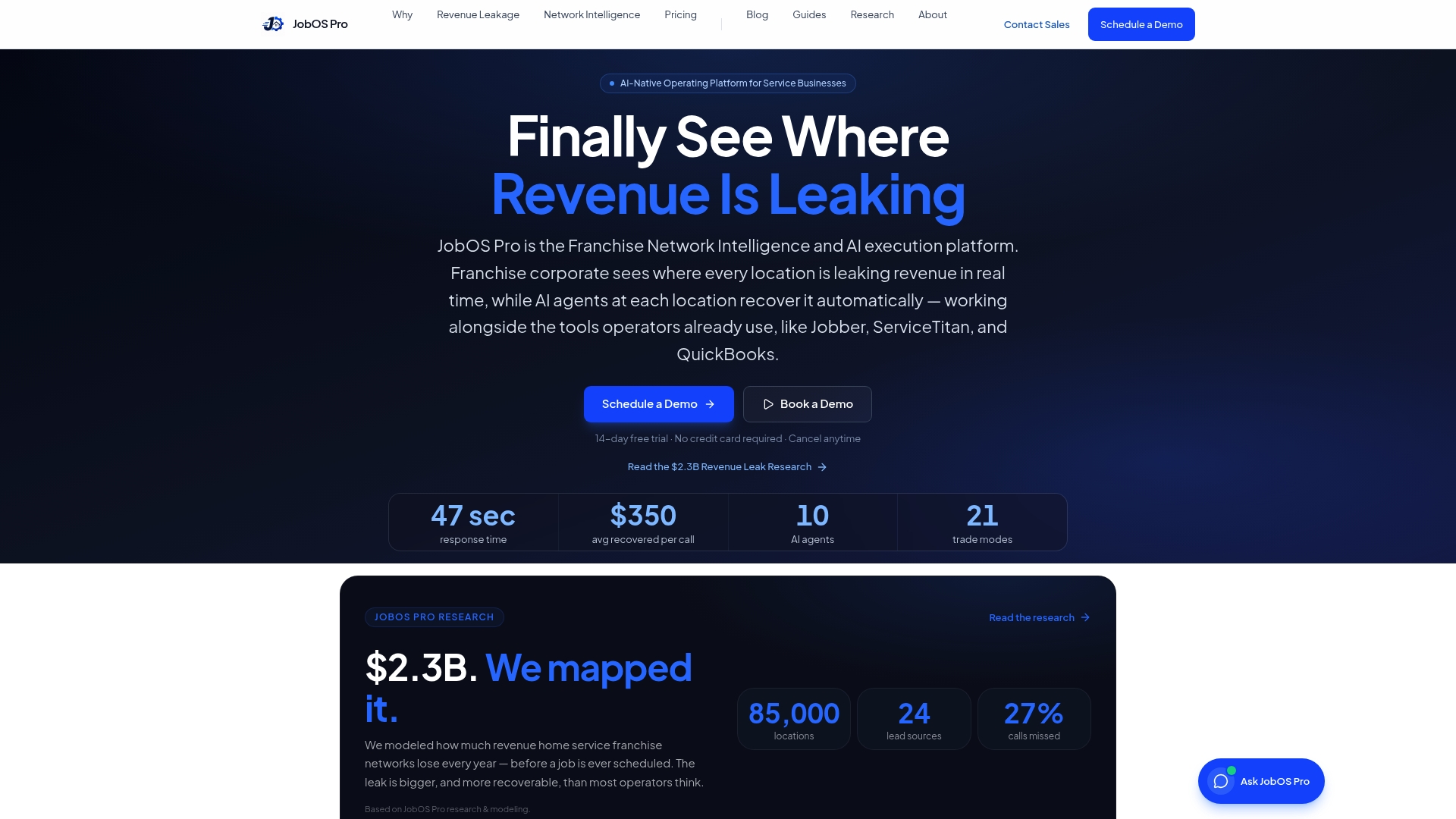
Because an AI-native platform is built from the ground up rather than retrofitted, it can run alongside existing tools, instead of forcing a migration. That means your existing call-tracking numbers and CRM data plug in, and Kate, the platform’s AI receptionist, starts catching missed calls immediately. Franchise operators get the added benefit of multi-location benchmarking, so leadership can see which territories are converting tracked calls into booked revenue and which ones are leaking it.
Plans start at $199 a month for the Starter tier, with Growth at $349 and Pro at $549, scaling by business size and feature needs. If you’d rather see it running against your own call volume first, book a demo and walk through how a tracked call turns into a scheduled job from start to finish.

Key Technical And Compliance References
For setup and compliance, review the FTC’s Telemarketing Sales Rule guidance, Google’s call conversion import docs, Twilio’s DNI explanation, and the National Do Not Call Registry.
Sources
Dynamic number insertion only tracks website visitors, so offline sources need their own dedicated, static phone numbers that never change while the asset is in use. Assign one number to your truck wraps, another to yard signs, and another to your Google Business Profile so each channel’s calls get counted separately.
- Complying with the Telemarketing Sales Rule | Federal Trade Commission
- About importing call conversions — Google Ads Help
- What is dynamic number insertion (DNI)? — Twilio Docs
- Essential contractor call tracking insights for 2026 — PipelineOn
FAQ
How Much Does Call Tracking Cost?
Basic call tracking typically runs $30 to $50 a month, while full-featured platforms with recording, transcription, and CRM integration run $100 to $300 a month. Adding AI conversation scoring adds roughly $60 to $110 a month on top, and it tends to pay back once you’re past 100 calls monthly.
What Is The Best Call Tracking Platform For Contractors?
There’s no single platform that fits every contractor, since the right choice depends on your call volume, existing CRM, and whether you need offline attribution for trucks and yard signs. Prioritize a platform that supports DNI, static numbers for offline assets, and CRM integration, since those three pieces determine whether tracked calls turn into attributed revenue.
What Is The Best App For Contractors To Track Job Progress?
Job progress tracking works best when it’s connected to the same system handling your calls and scheduling, rather than a standalone app that requires manual data entry. Some platforms combine call tracking, dispatch, and job status so a booked call and its job progress live in the same record.
What Is The Best Time Tracker For Contractors?
The most useful time-tracking tools for contractors integrate directly with scheduling and payroll, so field hours automatically tie to specific jobs instead of requiring separate reconciliation. Look for one that connects to your existing dispatch board rather than running as a disconnected app your crew has to remember to open.