
Contractor Lead Capture: Guide to Stopping Revenue Leakage
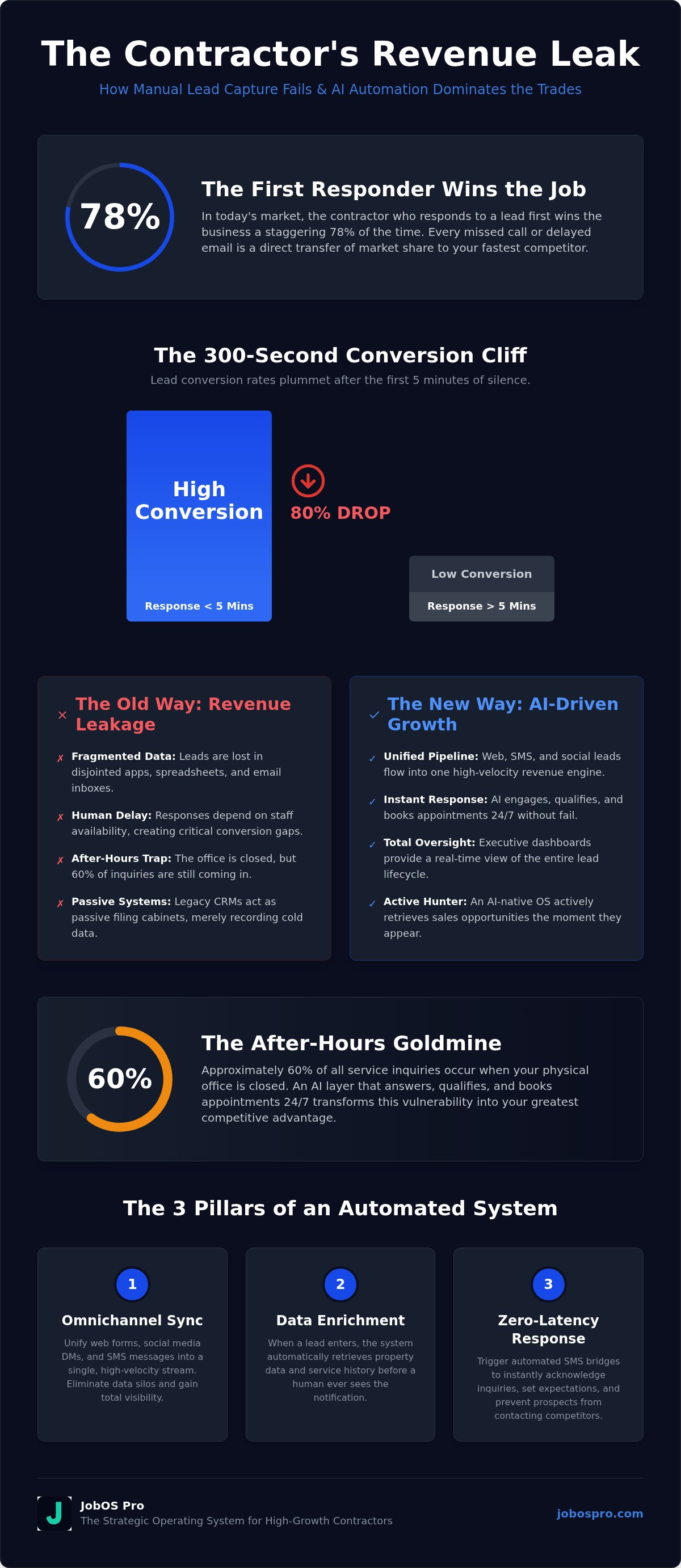
In 2026, the contractor who responds to a lead first wins the job 78% of the time. Every missed call or buried email isn't just a minor oversight; it's a direct transfer of market share to your fastest competitor. Relying on manual processes in a high-stakes market creates systemic revenue leakage that no amount of hard work can overcome. Integrating automated lead capture for contractors is no longer an optional upgrade; it's a foundational requirement for any trade business aiming for market dominance.
You understand that slow response times and disjointed data are the primary barriers to your firm's growth. This guide reveals how AI-driven systems transform these operational gaps into a high-velocity revenue engine. We'll explore the technical shift required to achieve a 100% lead capture rate and ensure an instant response to every inquiry. You'll discover how to unify disparate lead data into a single dashboard, providing the executive oversight needed to eliminate inefficiencies and scale your operations with total confidence.
Key Takeaways
- Stop the 80% conversion drop by mastering the 300-second response window through real-time, zero-latency automated systems.
- Implement automated lead capture for contractors to unify web, SMS, and social inquiries into a single, high-velocity revenue engine.
- Replace static "Contact Us" forms with AI-driven capture tools that intelligently score and prioritize emergency calls for immediate dispatch.
- Recover lost revenue from missed calls by deploying an AI layer that answers, qualifies, and books appointments 24/7 without human intervention.
- Gain total executive oversight of your entire lead pipeline by migrating from disjointed legacy apps to a unified, AI-native operating system.
The Revenue Leakage Crisis: Why Manual Lead Capture Fails the Modern Contractor
Automated lead capture for contractors is a sophisticated, 24/7 operational layer. It functions as a multi-channel system that observes, retrieves, and unifies prospect data across every digital touchpoint without requiring human intervention. In a market defined by instant gratification, manual processes are no longer just inefficient; they're a liability. When your growth relies on a human being to answer every call or check every email, you've built a ceiling over your own revenue potential.
Time is the primary variable in modern conversion. Industry benchmarks confirm that lead conversion rates plummet by 80% after the first 300 seconds of silence. If your office staff is occupied or your technicians are on-site, those five minutes pass unnoticed, but the financial damage is permanent. This "leaky bucket" syndrome drains profitability at the foundational level. When you calculate the average job value against the volume of unrecovered inquiries, the annual revenue leakage often reaches six or seven figures for high-growth firms. For multi-location franchises, manual data entry is the enemy of scale. It creates fragmented data silos that prevent executive oversight and stall momentum.
The Psychology of the Modern Homeowner
Modern homeowners are inherently anxious and demand immediate resolution. They prioritize speed over long-term brand loyalty when an HVAC unit fails or a pipe bursts. Research shows the contractor who responds first wins the contract 78% of the time. This creates a massive strategic vulnerability during the "After-Hours" trap, as approximately 60% of service inquiries occur when your physical office is closed. Effective lead generation requires more than just driving traffic to a website; it requires an immediate, automated bridge to a booked appointment. Lead latency is the total time elapsed between a customer's initial inquiry and your system's automated response.
Legacy CRMs vs. AI-Native Operating Systems
Traditional software serves as a passive filing cabinet. It records information that your team manually inputs, often hours after the initial contact has cooled. This reactive approach is a relic of a slower era. An AI-native operating system acts as an active hunter. It doesn't just store data; it retrieves sales opportunities in real-time by engaging prospects the second they reach out. This represents a fundamental shift from merely recording leads to aggressively recovering every possible revenue stream. Integrating AI business management for home services ensures your enterprise remains responsive and operational while your competitors are still checking their morning voicemails. By deploying automated lead capture for contractors, you replace human hesitation with machine precision.
Beyond the Contact Form: The Three Pillars of Automated Lead Capture
Modern lead capture is an architectural challenge, not a marketing exercise. A static "Contact Us" page is a passive point of failure that relies on customer patience. Sophisticated automated lead capture for contractors requires a unified layer that synchronizes web forms, social media DMs, and SMS into a single, high-velocity stream. This omnichannel synchronization ensures that no prospect is left in a digital silo. It creates total visibility for the executive team, allowing them to observe the entire lifecycle of an inquiry from the first touchpoint to the final invoice.
The second pillar involves real-time data enrichment and instant response. When a lead enters the system, the platform should automatically retrieve property data and service history before a human operator even views the notification. This provides the context necessary for high-stakes decision-making. Finally, the system must maintain a Zero-Latency Response by triggering automated SMS bridges. These messages acknowledge the inquiry and set expectations immediately. This prevents the prospect from continuing their search and contacting your competitors while your team is still processing the data.
AI Call Answering and Missed-Call Recovery
Phone inquiries account for the majority of high-intent leads in the trades. Missing a call is equivalent to discarding revenue. AI call answering handles high-stakes phone inquiries with human-like precision and zero fatigue. Unlike traditional answering services, this technology integrates directly with your dispatch logic. It utilizes an "Instant Callback" mechanism to turn a missed call into a booked appointment in seconds. Implementing HVAC sales automation software allows your business to remain fully operational during peak demand or after-hours surges. This corrective layer ensures that every voice is heard and every opportunity is captured regardless of staff availability.
Smart Web Forms and Interactive Lead Portals
Basic forms are conversion killers. They lack the intelligence to qualify or prioritize. Modern capture requires interactive troubleshooting portals that qualify the lead at the point of entry. Dynamic routing then sends high-value emergency leads to the top of the dispatch queue automatically. This ensures your highest-margin opportunities receive immediate priority. This level of automation allows you to modernize your lead pipeline without increasing administrative overhead. Reputation management tools also play a critical role here. They embed trust signals directly into the capture phase to solidify customer intent and increase the likelihood of a successful booking.
Static Forms vs. AI-Native Capture: Evaluating the Intelligence Gap
Generic form builders are conversion killers. They treat every inquiry as an equal data point; however, in the home services industry, not all leads carry the same weight. AI-native automated lead capture for contractors replaces these passive tools with intelligent intake systems that score inquiries in real-time. This technology distinguishes between a high-stakes "AC Out" emergency and a routine maintenance request. By prioritizing urgent repairs, the system ensures your highest-margin opportunities move to the front of the queue automatically. This level of discernment is impossible with traditional "Contact Us" pages that offer no qualification or context.
Contextual awareness represents the next frontier of lead management. When an inquiry enters an AI-native system, it immediately cross-references the data against your existing customer database. It identifies active memberships, service history, and previous technician notes before a human operator even views the alert. This allows for a highly personalized response that acknowledges the customer's loyalty. Industry experts often emphasize the importance of automated lead capture for maintaining this competitive edge. It unifies disparate data points into a single, actionable profile, allowing your team to step into a conversation that is already half-finished.
The Downfall of Generic Automation
Many firms attempt to build their own systems using "Zapier-only" stacks. These disjointed architectures often break under high volume and lead to fragile data silos. They lack the structural integrity required for multi-location executive reporting and introduce unnecessary security risks by passing sensitive customer data through multiple third-party apps. Native integration is the only way to ensure total visibility. A unified operating system provides the oversight necessary to monitor performance across franchises without the friction of manual data reconciliation.
Predictive Lead Intelligence
Sophisticated capture systems use historical data to predict job value at the moment of contact. This predictive intelligence allows the system to initiate automated estimating, moving the prospect from a lead to a quote without manual intervention. This data then flows directly into your field operations, facilitating intelligent technician dispatching based on specific skill sets and geographic proximity. By matching the right technician to the right job automatically, you optimize your labor costs and maximize the revenue potential of every captured lead. This shift from recording data to predicting outcomes is what separates market leaders from those struggling with legacy processes.
Building a Zero-Latency Response Stack: A Step-by-Step Implementation
Implementation of automated lead capture for contractors is a foundational shift in how your business interacts with the market. It requires a methodical transition from human-dependent workflows to a machine-led architecture. Unlike simple form builders that offer a surface-level fix, a true zero-latency stack unifies your entire operational pipeline. This process begins with identifying systemic vulnerabilities and ends with a unified, high-performance dashboard that provides total visibility into your sales pipeline. You're not just installing software; you're re-engineering the way your firm retrieves and secures revenue.
Mapping the automated workflow is critical for maintaining momentum. The system must be configured to move a prospect from the initial capture point directly to dispatch and eventually to invoicing without manual data re-entry. This requires training the AI layer to reflect your brand's authoritative voice. Every automated SMS and AI call response must project the same level of professionalism and expertise your customers expect from your senior technicians. This customization ensures that while the process is automated, the customer experience remains high-touch and high-trust.
Step 1: The Operational Audit
You cannot fix what you do not measure. The operational audit identifies "Ghost Leads," which are the prospects who call, reach a voicemail, and immediately dial your competitor. Benchmarking your current speed-to-lead across all channels provides the baseline data needed to justify the technological shift. You must observe how many inquiries remain unaddressed during peak hours or after the office has closed. An audit must identify every manual touchpoint in the current sales cycle. This transparency allows you to pinpoint exactly where revenue is leaking and where human hesitation is stalling your growth.
Step 2: Deploying the Automated Hand-off
Once vulnerabilities are identified, you must deploy the AI layer to bridge the gap. This involves configuring instant quoting triggers based on the specific data captured during the initial interaction. Providing instant scheduling links upon capture reduces friction for the customer and secures the booking before they look elsewhere. This seamless transition from capture to dispatch ensures that your revenue engine remains at peak performance. Integrating automated invoicing for home services completes the cycle. It ensures that once the job is captured and dispatched, the billing process remains equally efficient and error-free.
Finally, establish executive dashboards that monitor capture rates and response times in real-time. This oversight allows you to observe performance across multiple locations and make data-driven adjustments to your strategy. You'll have the power to identify which marketing channels are producing the highest-quality leads and which locations are converting them at the highest rate. This level of control is what separates an enterprise-grade operation from a standard trade business. To secure your market position, audit your lead pipeline with an AI-native operating system today.
JobOS Pro: The Strategic Operating System for High-Growth Contractors
JobOS Pro is the only AI-native platform architected specifically for the home service executive. It moves beyond the limitations of legacy CRMs by serving as an active operating system that manages the entire business lifecycle. For high-growth firms, automated lead capture for contractors is the entry point into a broader ecosystem of efficiency. This platform doesn't just record inquiries; it initiates a chain reaction of automated actions that drive revenue without human friction. You're no longer managing a database. You're overseeing a self-optimizing revenue engine.
The system provides total visibility across the entire enterprise. It unifies lead data with intelligent dispatching, automated billing, and long-term retention strategies. By 2026, AI won't be a peripheral advantage; it'll be the foundational layer of every successful trade enterprise. JobOS Pro ensures your business is future-proofed by providing the technical architecture required to dominate a digital-first market. By integrating automated lead capture for contractors into your core operations, you remove the barriers to scale that plague traditional trade businesses.
Executive Oversight and Franchise Intelligence
Scaling a multi-location operation requires centralized intelligence and absolute clarity. JobOS Pro allows you to benchmark network performance across every franchise unit to identify the most effective capture strategies. You'll observe real-time data on response times and conversion rates, allowing for rapid strategic adjustments. This centralized approach eliminates the data silos that typically stall growth in multi-unit businesses. It also integrates seamlessly with recurring service membership software to ensure that every captured lead has the potential to become a lifetime customer through automated follow-up and retention workflows.
The Path to Frictionless Operations
The transition from manual struggle to automated precision is a strategic necessity. A zero-latency lead capture stack provides a long-term ROI that extends far beyond initial job bookings. It reduces administrative overhead, eliminates human error, and maximizes the capacity of your field teams. You've seen the cost of leakage and the power of immediate response. Now's the time to implement a corrective layer that secures your firm's future and establishes a permanent competitive edge. You can secure your revenue with JobOS Pro and transform your lead pipeline into a high-velocity revenue engine today.
Eliminate Revenue Leakage Through Technical Precision
The window for manual lead management has closed. In an industry where speed dictates the winner, relying on human availability is a strategic failure. You've seen how zero-latency response stacks and AI-native intake systems move your business from a passive recorder of data to an active hunter of opportunities. By integrating automated lead capture for contractors, you ensure that every inquiry is retrieved, qualified, and converted without the friction of human hesitation.
This technological shift provides the executive reporting necessary for multi-location growth and franchise scaling. You gain total visibility into your pipeline, utilizing AI-native missed-call recovery and automated customer lifecycle management to drive consistent results. It's time to replace fragmented legacy tools with a unified, high-performance architecture that works silently to secure your market share. You have the tools to stop the leak and build a high-velocity revenue engine that operates 24/7.
Scale your business with the AI-powered JobOS Pro operating system and transform your operational inefficiencies into a permanent competitive advantage. Your path to frictionless growth starts with machine-driven precision.
Frequently Asked Questions
What is automated lead capture for contractors and how does it differ from a standard CRM?
Automated lead capture for contractors is a proactive operational layer that retrieves prospect data across all channels without human intervention. Unlike a standard CRM, which acts as a passive repository for manual entries, this system actively engages prospects the moment they reach out. It ensures that no inquiry remains stagnant in an inbox or voicemail by instantly bridging the gap between contact and conversion.
How does AI call answering help recover missed revenue in HVAC and plumbing?
AI call answering eliminates the revenue leakage caused by missed calls during peak hours or after-hours surges. In high-stakes trades like HVAC and plumbing, customers often dial the next competitor if they reach a voicemail. This technology answers every call with precision, qualifies the emergency, and books the appointment in real-time. It turns potential losses into secured bookings without increasing your office headcount.
Can automated lead capture systems integrate with my existing tools like QuickBooks?
Native integration with tools like QuickBooks is a core feature of a modern business stack. This architecture ensures that data retrieved during the capture phase flows seamlessly into your invoicing and accounting workflows. It eliminates the data silos and manual entry errors that typically stall multi-location operations. Your financial records stay synchronized with your field activity automatically.
Is automated lead response too impersonal for high-ticket home service jobs?
Speed is the highest form of customer service in the modern market. Automated responses provide the immediate acknowledgement homeowners demand during an emergency. You can customize the AI voice to reflect your brand's authoritative tone, ensuring the interaction feels professional rather than generic. It sets the stage for a high-trust relationship by proving your firm's reliability from the first second.
How quickly can a contractor see ROI after implementing automated lead capture?
Many firms observe a return on investment within the first 30 days of implementation. By capturing high-ticket emergency jobs that would have otherwise gone to a competitor, the system pays for itself through recovered revenue. The long-term ROI scales as your administrative overhead decreases and your lead capture rate reaches 100% across all digital and voice channels.
What happens if the AI captures a lead that isn't a good fit for my business?
The system utilizes intelligent lead scoring to evaluate every inquiry based on your specific business criteria. If a lead doesn't meet your service requirements or location parameters, the AI deprioritizes it or routes it to a secondary queue. This ensures your dispatchers and technicians only focus on high-value, relevant opportunities that drive actual profitability.
Does automated lead capture work for multi-location franchises or just small businesses?
Implementing automated lead capture for contractors is a foundational requirement for multi-location franchises looking to scale. It provides executive leadership with centralized data to benchmark performance across different territories. This oversight allows you to identify top-performing strategies and ensure a consistent customer experience across your entire national or regional network.
How does automated lead capture improve technician utilization and scheduling?
Captured data feeds directly into intelligent dispatching logic to optimize your field operations. By automatically identifying the technician with the right skill set and geographic proximity, the system maximizes utilization rates. This reduces unbillable drive time and ensures your most profitable technicians are always assigned to the highest-value jobs available in real-time.