Contractor Payment Collection Tools: The 2026 Strategy for Frictionless Cash Flow
U.S. small businesses are currently owed an average of $17,500 in outstanding invoices, a figure that represents more than just a balance sheet lag; it's a systemic failure of operational oversight. For most home service companies, losing 5% to 10% of annual revenue to unbilled work or forgotten follow-ups has become an accepted cost of doing business. You likely realize that manual data entry between the field and the office is a primary liability, yet high Accounts Receivable balances continue to stifle your scale. Relying on fragmented contractor payment collection tools often creates more friction than it solves, leaving your capital locked in a cycle of administrative delay.
You'll learn how to master the 2026 tech stack required to eliminate revenue leakage and automate your entire payment process. This guide provides a strategic roadmap for implementing next-day funding and professional, automated workflows that mirror the experience of big-box retailers. We will examine how an AI-driven intelligence layer connects field operations directly to your bank account, ensuring that every technician's visit results in immediate, verified revenue and a superior customer experience.
Key Takeaways
- Identify the systemic inefficiencies that cause 5-10% revenue leakage and discover the architectural shift needed to recover lost earnings.
- Benchmark the 2026 toolkit of contractor payment collection tools to transition from manual paper-based hurdles to frictionless mobile point-of-sale systems.
- Master a strategic evaluation checklist to ensure your collection software integrates seamlessly with QuickBooks and prioritizes rapid time-to-funding.
- Optimize your operational workflow by automating payment verification during the AI call-answering phase and leveraging real-time price book updates.
- Explore the impact of an AI-native intelligence layer that unifies the customer lifecycle from lead capture to final bank deposit.
The Anatomy of Revenue Leakage: Why Traditional Collection Fails
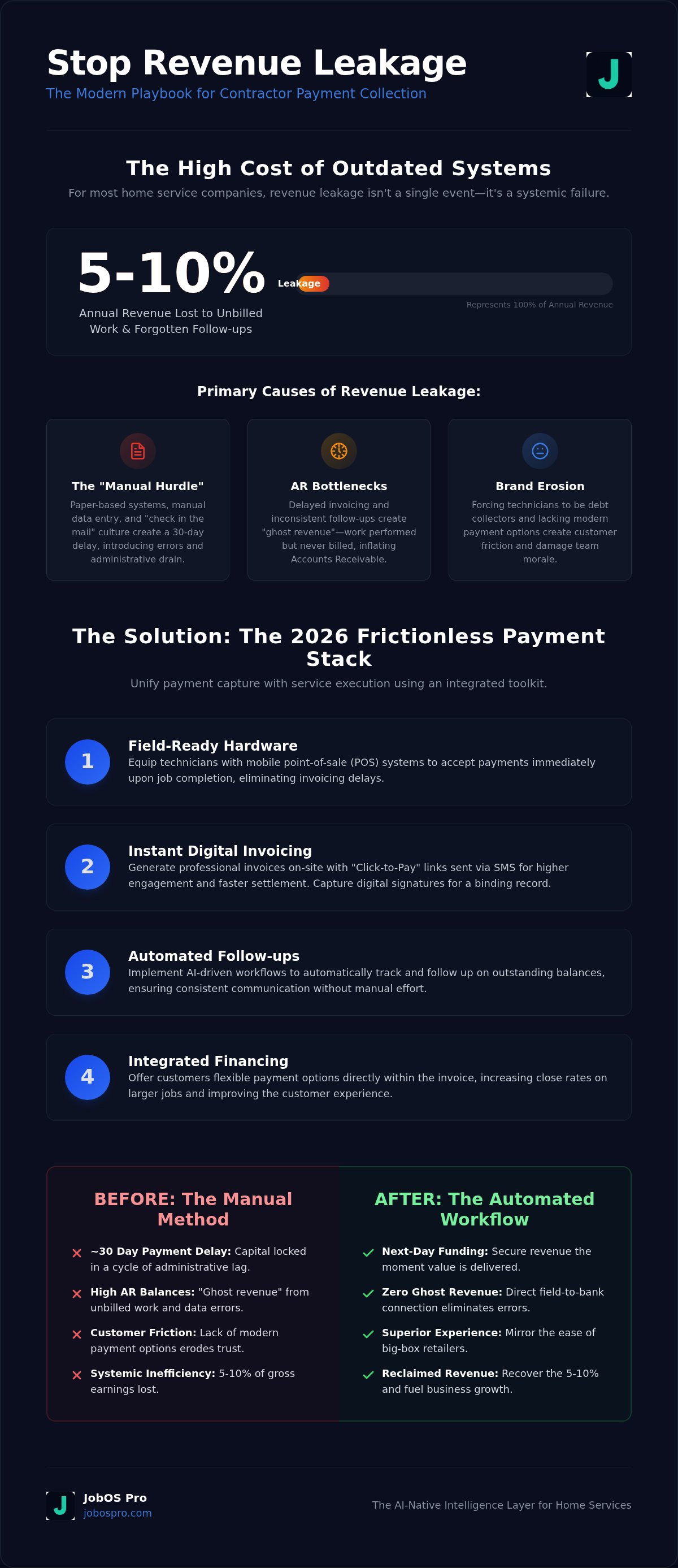
Revenue leakage is the silent killer of service-based margins. In the home services sector, this unintentional loss of capital manifests as unbilled inventory, forgotten labor hours, and misquoted adjustments that never reach the final bill. When field operations rely on analog documentation, you aren't just losing time; you're losing 5% to 10% of your gross earnings to systemic inefficiencies. The "Manual Hurdle" of paper-based systems creates an artificial 30 day delay that separates the value delivered from the payment received. This gap isn't just an accounting lag; it's a structural failure that compromises your liquidity and limits your ability to reinvest in growth.
Frictionless Collection is a proactive operational strategy that unifies payment capture with service execution to ensure revenue is secured the moment value is delivered.
The psychological toll of traditional collection methods is equally damaging to your brand's foundation. Technicians who are forced to act as debt collectors often experience a drop in morale, as the focus shifts from technical excellence to financial confrontation. Simultaneously, customers feel a sense of friction when they can't pay through modern, digital channels. This fragmentation erodes trust and positions your business as a relic of the past rather than a modern service leader.
The High Cost of the "Check in the Mail" Culture
Processing physical checks is an administrative drain that modern enterprises can't afford. Every manual check requires physical handling, manual ledger entry, and a trip to the bank. These steps introduce significant risks, including lost mail, internal theft, or the operational headache of bounced payments. Modern consumers, conditioned by the efficiency of big-box retailers, now demand digital, instant payment options. Transitioning to electronic invoicing systems replaces these manual vulnerabilities with a secure, digital audit trail that meets customer expectations and slashes administrative overhead.
Identifying Your AR Bottlenecks
High Accounts Receivable (AR) balances are often the result of "ghost revenue"-work that was performed but never actually billed due to data entry errors or field-to-office communication gaps. Without integrated contractor payment collection tools, the time-to-invoice expands, which directly correlates to a longer time-to-payment. The further the invoice drifts from the date of service, the less likely you are to collect the full amount without friction. Common bottlenecks include:
- Delayed invoicing cycles that occur days after service completion.
- A lack of mobile point-of-sale hardware in the hands of technicians.
- Inconsistent follow-up on outstanding balances due to manual tracking.
- Data entry errors that occur during the handoff from field notes to office software.
Identifying these gaps is the first step toward reclaiming your lost revenue. By automating the transition from a completed job to a paid invoice, you eliminate the human error that typically drains your bottom line.
The Essential Contractor Payment Collection Toolkit: 4 Key Categories
Modernizing your financial operations requires more than a digital ledger. It demands a sophisticated suite of contractor payment collection tools that operate in real time. The 2026 payment stack is an integrated ecosystem designed for speed. While federal standards like the Prompt Payment Act establish clear timelines for government contracts, private residential service providers must build their own infrastructure to ensure similar discipline. This infrastructure is divided into four critical layers: hardware, digital invoicing, automated follow-ups, and integrated financing.
Field-Ready Digital Invoicing
The moment a technician completes a repair, the window for frictionless payment begins to close. Field-ready invoicing tools allow your team to generate and send professional invoices before they leave the customer's property. Using "Click-to-Pay" links via SMS is no longer optional; it's a requirement for high-velocity cash flow. SMS messages have significantly higher engagement rates than email, leading to faster settlements. Capturing digital signatures on-site is equally vital. It creates a binding record of the work performed, which serves as your primary defense against future payment disputes or chargebacks.
Mobile Payment Hardware and mPOS
Mobile Point-of-Sale (mPOS) systems have evolved beyond bulky card readers. Modern technicians now utilize "Tap-to-Pay" on iPhone or localized QR code payments to facilitate instant transactions. Security remains the highest priority. PCI compliance is non-negotiable for any contractor handling customer data. When evaluating your hardware, consider the transaction costs. In-person transactions often carry lower fees, such as Square's 2.6% plus 15 cents, compared to online processing rates like Stripe's 2.9% plus 30 cents. For high-ticket installations, your toolkit should also support ACH transfers to minimize percentage-based processing overhead.
Integrated Customer Financing Tools
High-ticket emergency repairs in HVAC or plumbing often exceed a customer's immediate liquid cash. Integrated financing tools, often categorized as "Buy Now, Pay Later" (BNPL), bridge this gap by offering instant credit decisions during the quoting phase. This removes the financial barrier to entry and consistently increases average ticket sizes. By automating the financing application within your existing workflow, you ensure that the technician focuses on the technical solution while the software handles the financial underwriting. This seamless integration transforms a potentially lost lead into a scheduled, high-margin installation.
The final layer of the toolkit is the "AI Nudge." These are automated, intelligent reminders that track invoice status and send proactive follow-ups based on customer behavior. This eliminates the need for manual AR chasing and keeps your cash flow predictable without taxing your administrative staff.
The Evaluation Checklist: How to Choose Your Collection Software
Selecting the right contractor payment collection tools isn't a simple procurement task; it's a strategic decision that determines your operational ceiling. If you choose a tool based solely on transaction fees, you risk implementing a fragmented system that creates more administrative work than it saves. High-performance organizations evaluate software through the lens of total visibility and capital velocity. Adhering to SBA contracting guidelines ensures your financial management meets rigorous professional standards, but your tech stack must go further to provide a competitive edge in 2026.
- Step 1: Audit Ledger Compatibility. Verify that the software offers a native, bi-directional sync with QuickBooks. If the data doesn't flow automatically into your general ledger, you're merely trading one manual hurdle for another.
- Step 2: Evaluate Time to Funding. Speed is your primary metric. Analyze how quickly the capital moves from the customer's device to your bank account. Next-day funding is the standard for modern enterprise operations.
- Step 3: Analyze Total Cost of Ownership. Look beyond the percentage fee. Calculate the administrative hours saved through automated reconciliation and reduced data entry errors. A slightly higher fee is often justified by a 20% reduction in back-office labor.
- Step 4: Assess the Technician Interface. Technician adoption is the pivot point of your success. If the mobile UI is cumbersome, your field team will revert to manual workarounds, leading to unbilled work and lost revenue.
- Step 5: Verify Multi-Location Intelligence. For growing franchises, the software must provide unified reporting across disparate locations. You need the ability to benchmark performance and identify revenue leakage at both the local and network levels.
The Integration Requirement: Avoiding Data Silos
Data silos are the enemy of scale. Your payment tool must talk to your intelligent technician dispatching system to ensure that every job dispatched is a job billed. This connectivity allows for the automatic retrieval of job data, parts used, and labor hours, which then populates the invoice instantly. Reducing double-entry isn't just about efficiency; it's about maintaining a single source of truth. When your field service management and general ledger are unified, you eliminate the "ghost revenue" that typically vanishes during manual handoffs.
Security and Compliance Standards for 2026
Trust is a foundational element of the customer experience. In 2026, SOC2 and PCI-DSS compliance are the baseline requirements for any reputable software provider. You must ensure that customer payment methods are stored in encrypted, tokenized environments that protect sensitive data from exposure. This level of security is particularly critical when managing recurring payments or service memberships. Secure, automated billing for maintenance plans provides a predictable revenue stream without increasing your liability profile. It's about building a silent, tireless infrastructure that provides constant oversight of your financial integrity.
Optimizing the Workflow: A Checklist for Frictionless Payments
Frictionless cash flow is the result of a deliberate sequence, not a fortunate event. To achieve consistent next-day funding, your operations must be architected to eliminate financial friction before the technician even arrives. Modern contractor payment collection tools must be embedded into every touchpoint of the customer lifecycle to ensure total visibility. This optimization begins with pre-service verification and extends through automated post-service reconciliation, creating a silent layer of oversight that protects your margins.
- Pre-Service: Utilize AI call-answering to verify customer payment methods during the initial lead capture phase. Securing a card on file before dispatching a vehicle ensures that the intent to pay is established early.
- On-Site: Implement real-time price book updates to ensure technicians always quote accurate, high-margin rates. Instant quote-to-invoice conversion allows the customer to approve and pay for the work the moment it's completed.
- Post-Service: Trigger automated SMS reminders for any remaining outstanding balances. These polite, digital nudges maintain a professional cadence without requiring manual office follow-ups.
AI-driven dispatching reduces billing errors by tracking job duration accurately. This precision ensures that labor hours are never under-reported and that every billable minute is captured in the final invoice.
The Estimate-to-Invoice Bridge
The transition from a quote to an invoice is where most revenue leakage occurs. Automated estimating tools serve as a digital guardrail; they prevent unbilled extras by locking the scope of work to the approved price book. When the final invoice matches the initial quote precisely, customer friction vanishes. Transparency is further reinforced by linking high-resolution photos and job notes directly to the digital invoice. This creates an indisputable record of value that justifies the transaction and accelerates the approval process. Secure your margins by automating your payment lifecycle today.
Automated Retention and Recurring Billing
Membership plans provide the predictable base that stabilizes seasonal fluctuations. However, managing these plans manually is a recipe for administrative collapse. You need a system that handles recurring monthly or annual billing without human intervention. This includes automated "failed payment" recovery workflows that re-attempt transactions and notify customers through secure, self-service links. By utilizing AI business management for home services, leadership can track the real-time profitability of these memberships and adjust pricing based on data-driven insights rather than intuition. This level of automation ensures that your retention strategies contribute to your bottom line rather than draining your office resources.
The Future of Finance: AI-Native Collection with JobOS Pro
The evolution of financial management in home services has reached a definitive turning point. Fragmented contractor payment collection tools that require manual oversight are being replaced by unified, AI-native ecosystems. JobOS Pro represents this shift. It serves as the intelligence layer that synchronizes every stage of the customer journey, from the initial lead capture to the final bank deposit. By automating the transition between dispatch, estimation, and billing, the platform eliminates the structural gaps where capital typically vanishes.
Early data from field operations indicates that transitioning to this automated ecosystem can eliminate up to 15% of revenue leakage. This recovery isn't achieved through aggressive debt collection; it's the result of capturing every unbilled part and every labor minute through real-time data retrieval. When your dispatching software and your payment engine share the same DNA, "ghost revenue" becomes a relic of the past. This level of oversight ensures that your business operates at peak financial performance without increasing administrative headcount.
Total Visibility: Executive Dashboards and Reporting
Strategic leadership requires real-time data to make informed decisions. JobOS Pro provides this through executive reporting dashboards that track AR aging across multiple locations or franchise networks simultaneously. You can benchmark collection performance between individual technicians or entire branches, identifying where friction is highest. This visibility allows you to spot problematic service types or high-risk customer profiles before they impact your overall cash flow. It transforms the back office from a reactive cost center into a proactive intelligence hub.
Transitioning to an AI-Powered Operating System
Migrating from a manual billing culture to an AI-powered workflow is a foundational shift. The roadmap begins with integrating your field service management with your general ledger to ensure data integrity. Training your team is the next critical step. When technicians understand that digital contractor payment collection tools are a value-add for the customer, adoption rates soar. Professional, instant transactions mirror the experience of global retailers, elevating your brand in the eyes of the consumer.
The era of chasing checks is over. You now have the architectural blueprint to automate your revenue cycle and secure your margins. Take control of your cash flow and modernize your operations by partnering with JobOS Pro today.
Architecting Your Future Cash Flow Ecosystem
The transition from manual paper hurdles to integrated, digital workflows is no longer a peripheral upgrade; it's a foundational requirement for operational survival. You've identified the anatomy of revenue leakage and the specific tech stack required to bridge the gap between field work and bank deposits. By implementing contractor payment collection tools that prioritize speed and bi-directional ledger synchronization, you eliminate the "ghost revenue" that historically compromised your liquidity. The strategy is clear: automate the lifecycle, verify the data, and accelerate the funding.
You now possess the roadmap to transform your back office into a high-velocity intelligence hub. It's time to stop the revenue leak and automate your collections with JobOS Pro. Our AI-native operating system unifies automated invoicing with real-time executive reporting for multi-location businesses, ensuring total oversight while maintaining a seamless integration with your standard accounting software. Secure your margins and lead your market with a payment strategy built for the next era of technical excellence. Your path to frictionless cash flow begins today.
Essential Financial Operations FAQ
What is the best way for a small contractor to collect payments?
The most effective method is utilizing mobile point-of-sale (mPOS) systems that integrate directly with your digital invoicing software. This setup allows your team to settle transactions on-site at the peak of value delivery. By unifying the estimate and the invoice into a single digital workflow, you eliminate the data entry errors that typically lead to unbilled work and administrative delays.
How can I reduce my accounts receivable (AR) without hiring an office manager?
You can achieve significant AR reduction by implementing automated invoicing and payment collection workflows. These systems act as a silent, tireless assistant that monitors outstanding balances and triggers intelligent SMS reminders until the debt is settled. Automation removes the need for manual chasing, allowing your existing team to focus on high-level operational performance rather than administrative recovery.
Are digital payment tools worth the transaction fees for home service businesses?
Digital contractor payment collection tools are a strategic investment because the cost of administrative labor and revenue leakage far exceeds standard processing fees. Processing a manual check involves staff time, physical handling, and bank trips that often cost more than a 2.9% transaction fee. Automated systems also accelerate cash velocity, providing your business with the liquidity needed for rapid scale.
How do I handle customers who refuse to pay via digital methods?
Offer ACH transfers as a professional, secure alternative for customers who are hesitant to use credit cards. ACH provides the benefits of digital reconciliation and security while satisfying preferences for bank-to-bank transactions. Standardizing your operational workflow around digital-first options reduces the administrative exceptions that create bottlenecks in your back office and slow down your overall time-to-funding.
Can I integrate my payment collection tool with QuickBooks?
Yes, a native, bi-directional integration with QuickBooks is a foundational requirement for any modern financial tech stack. This connectivity ensures that every payment captured in the field is automatically reconciled within your general ledger in real time. It maintains absolute accounting integrity and eliminates the need for double-entry, which is the primary source of human error in traditional contractor billing.
What happens if a technician forgets to collect payment on-site?
Automated post-service workflows serve as a fail-safe by triggering a "Click-to-Pay" SMS the moment a technician marks a job as complete. This system retrieves the job data and sends the invoice to the customer instantly, ensuring that the window for payment remains open. Immediate digital delivery prevents the invoice from aging and reduces the likelihood of the customer forgetting the details of the service.
What is the most secure way to store customer credit card information?
Utilize tokenized, PCI-compliant environments provided by enterprise-grade software platforms to ensure maximum security. This architecture ensures that sensitive financial data never resides on your local devices or servers, significantly reducing your liability profile. Secure storage is essential for managing recurring payments and service memberships, providing a predictable revenue stream without compromising customer trust or data integrity.
How does customer financing help with payment collection?
Integrated customer financing removes the immediate capital barrier for high-ticket installations and emergency repairs. By providing "Buy Now, Pay Later" options directly within the quoting phase, you increase your average ticket size and secure job approvals faster. This strategy shifts the financial risk to the lender while ensuring your business receives the full contract value upfront, stabilizing your cash flow immediately.