
Recover Revenue: 3-Message Customer Reactivation for Home Services
Recover Revenue: 3-Message Customer Reactivation for Home Services
Customer reactivation campaigns pay off fastest when you start with email, segment by recency and reason for lapsing, and measure success by reactivation rate rather than open rate. Reactivation typically costs less than new-customer acquisition when a lapsed customer’s remaining lifetime value clears your cost to win them back. Layer in SMS and retargeting ads for urgency, then run a small, measurable test before scaling.
TL;DR:
- Reactivation campaigns are most effective when starting with email, segmenting by recency and churn reason, and measuring success through reactivation rate.
- Timing should be based on business-specific signals like failed payments or seasonal gaps, with short series for recent lapses and longer nurturing for older absences.
- Personalization, segmentation, and clear offers tailored to churn reasons improve results, while operational data quality and compliance are critical to avoid deliverability issues.
- Measuring reactivation success relies on reactivation rates, cost per reactivation, and post-recovery customer lifetime value, with cohort analysis for accuracy.
- Automating workflows with tools like JobOS Pro reduces manual effort, capturing missed calls and follow-ups to turn operational gaps into reactivation opportunities.
Table of Contents
- What customer reactivation campaigns are and when to use them
- Why reactivation matters: business impact and common challenges
- When to run reactivation campaigns and how to choose timing and segments
- Core tactics and channels: how to orchestrate email, SMS, push, direct mail, and paid ads
- Segmentation, personalization, and the data you need
- Offer design and incentive strategies that protect margin
- Measurement and KPIs: reactivation rate, cost-per-reactivation, and cohort analysis
- Templates and real-world campaign examples
- How JobOS Pro helps service businesses recover lost revenue
- Customer feedback and survey integration for reactivation
- Strategic checklist and three common pitfalls to avoid
- JobOS Pro: an option to implement and scale reactivation workflows
- Sources
- FAQ
What customer reactivation campaigns are and when to use them
A customer reactivation campaign is targeted outreach to dormant or lapsed customers designed to bring them back to a purchase or an active relationship with your business. It differs from general retention marketing because the customer has already gone quiet: the message has to re-earn attention, not just maintain it.
Before you launch one, check three things. First, does the math work: is the customer’s likely remaining value higher than what it costs to win them back? Second, how long has it been since their last purchase or interaction, since a 45-day gap and a 14-month gap call for different messages. Third, do you know why they went quiet?
Common dormancy causes worth diagnosing before you write a single word of copy:
- Price sensitivity, where a competitor or a promotion pulled them away.
- A service or product experience that fell short of expectations.
- Simple forgetfulness, especially for infrequent-purchase categories.
- A life or business change that made the product temporarily irrelevant.
Why reactivation matters: business impact and common challenges
Retention and reactivation programs typically cost less than acquiring new customers and can raise lifetime value meaningfully when targeting is accurate, according to Harvard Business Review. Reactivation campaigns generally cost less per recovered customer than paid acquisition, which is why marketers treat a clean lapsed-customer list as a standing asset rather than dead weight.
The obstacles are rarely creative. They’re operational: stale contact data, missing suppression lists, and marketing and sales teams that don’t share the same definition of “inactive.” Deliverability suffers when you email addresses that haven’t opened anything in years, and compliance risk grows if your program ignores opt-out requests. Under the CAN-SPAM Act, every commercial email needs a working opt-out mechanism and your business’s valid postal address, and you must honor opt-out requests within 10 business days. Build that into your reactivation workflow from day one, not as an afterthought.

When to run reactivation campaigns and how to choose timing and segments
Timing depends on your business model. A transactional retailer might treat 60 to 90 days without a purchase as the trigger point, while a subscription business watches for a failed payment or a downgrade. Local service businesses, from HVAC to landscaping, often see dormancy tied to seasonal gaps or a missed appointment that was never rebooked.
- Set a recency threshold based on your normal repurchase cycle, not an arbitrary calendar date.
- Trigger on events, not just time: a failed payment, a canceled appointment, or a quiet season are all better signals than a flat 90-day rule.
- Run a short win-back series (three to five touches over two to three weeks) for recently lapsed customers, and a longer nurture track for customers who have been gone six months or more.
Core tactics and channels: how to orchestrate email, SMS, push, direct mail, and paid ads
Email remains the foundation for reactivation because it supports longer messages, offers, and personalization at low cost. SMS and push notifications work best for time-sensitive windows, like a limited offer expiring in 48 hours or an appointment slot opening up. Paid ads, especially retargeting, catch customers who ignore email but still browse. Direct mail earns its cost for high-ticket purchases or local services where a physical reminder in a mailbox carries more weight than another inbox message.
A dependable sequence archetype looks like this:
- Message one: re-educate. Remind them what you do and why it mattered to them, no offer yet.
- Message two: make the offer. Tie it to a reason they’re likely to respond to, not a blanket discount.
- Message three: add social proof. A review, a before-and-after, or a specific result.
- Message four: create a deadline. Scarcity or expiration drives the final decision.
Subject lines that tend to perform: “We miss having you around,” “Your account still has [X] in credit,” or “One thing changed since you left.” Practitioner write-ups on win-back programs consistently find that a value-first message followed by an incentive outperforms leading with a discount.
Pro Tip: Send the re-education message from a named person on your team, not a no-reply address. It reads as a check-in, not a blast.
Segmentation, personalization, and the data you need
Reactivation results improve sharply once you segment beyond “everyone who hasn’t bought in 90 days.” The segments worth building are:
- Recency and frequency: how long they’ve been gone and how often they used to buy.
- Monetary value: what they spent historically, so your offer budget matches their worth.
- Churn reason: price, experience, or simple inactivity, each needing different creative.
- Product affinity: what they bought before, so your recommendation isn’t generic.
Personalization works best when it’s concrete: reference their last order, recommend a related product, or use a dynamic content block that swaps creative by segment automatically. None of this works without clean data. Maintain a real suppression list, honor every opt-out within the window the CAN-SPAM Act requires, and cap message frequency so a win-back series doesn’t turn into harassment. Consent records matter here too: a customer who opted out of marketing six months ago should never resurface in a reactivation send.
Offer design and incentive strategies that protect margin
Not every lapsed customer needs a discount. The right offer depends on why they left. Price-sensitive customers respond to a percentage discount or a fixed credit. Customers who left over a bad experience often respond better to a free add-on or an apology paired with a concrete fix than to money off. Customers who simply forgot about you may need nothing more than a well-timed reminder or a small extension on a trial or membership.
Useful offer types to keep in rotation:
- Percent discounts for clearly price-driven churn.
- Fixed-dollar credits that feel more generous than a percentage on lower-cost items.
- Free add-ons or upgrades for experience-driven churn.
- Trial or subscription extensions for customers who lapsed passively.
- Value-first content, like a guide or checklist, when no discount is warranted at all.
Protect margin with controls: limit the offer window to create urgency, set eligibility rules so your best customers aren’t training themselves to wait for a discount, and tier offers by customer value so your highest-LTV segment gets a stronger incentive than an occasional low-spend buyer.
Measurement and KPIs: reactivation rate, cost-per-reactivation, and cohort analysis
Judge a reactivation campaign by reactivation rate (the share of targeted lapsed customers who take a qualifying action), cost-per-reactivation, and the LTV of reactivated customers compared to your average customer. Use a holdout group that receives no campaign so you can separate the effect of your outreach from customers who would have come back anyway.
| Metric | What it measures | Typical window |
|---|---|---|
| Reactivation rate | Percent of targeted lapsed customers who purchase or engage again | 30 to 90 days |
| Cost-per-reactivation | Campaign spend divided by number reactivated | Per campaign cycle |
| Reactivated LTV | Value of customers post-reactivation versus pre-lapse | 180 days |
| Retention after reactivation | Whether reactivated customers stay active | 90 to 180 days |
Report on a consistent cadence, monthly at minimum, and be honest about attribution: a customer who saw an ad, got an email, and then bought isn’t purely an “email win.” Cohort-based reporting, grouped by the month they lapsed and the month they reactivated, gives a cleaner read than lumping every reactivation into one aggregate number.
Templates and real-world campaign examples
A simple three-message template works across most business types, with the details changed to fit the category.
- Message one, day one: subject line “It’s been a while, here’s what’s new.” No offer. Reintroduce the value.
- Message two, day five: subject line “A little something to bring you back.” Offer tied to churn reason.
- Message three, day nine: subject line “This ends Friday.” Deadline plus a short reminder of the offer.
For subscription businesses, swap message two for a discounted reactivation month or a feature update they missed. For one-time retail purchases, lean on a product they browsed but never bought. For local services, message two often works best as a direct offer to rebook an appointment, paired with availability for the coming week.
Segmented, behaviorally targeted win-back sequences that lead with value and follow with an incentive consistently outperform blanket discount blasts. MarTech
Anonymized patterns from practitioner reporting show the biggest lifts come from pairing a personalized re-education message with a segment-specific offer rather than a single generic blast, since the generic version tends to train customers to wait for discounts instead of re-engaging on the merits.
How JobOS Pro helps service businesses recover lost revenue
Home service businesses lose a meaningful share of reactivation opportunity before a campaign even starts, when a missed call or an unanswered estimate follow-up never makes it into a marketing list at all. JobOS Pro is built to close that gap by connecting the tools a service business already runs.
- Missed-call capture that logs and follows up on calls that would otherwise disappear.
- Automated follow-ups for estimates and unpaid invoices, so lapsed leads get a nudge without manual tracking.
- AI leak detection that flags revenue gaps like scheduling delays or uncollected payments in real time.
- Multi-location benchmarking for franchise operators comparing reactivation performance across territories.
These capabilities feed the segments and sequences described earlier directly, turning an operational gap into a measurable reactivation trigger instead of a lost opportunity that never gets a second chance.
Customer feedback and survey integration for reactivation
A short survey sent to a lapsed customer often tells you more than three months of guessing. Asking “what changed” at the moment someone stops buying gives you the churn reason you need to pick the right offer, instead of applying a discount to a customer who actually left over a service issue.
Keep the survey short: one or two questions, sent within the first outreach message rather than buried in a follow-up. A simple multiple-choice question (“What’s the main reason you haven’t ordered recently?”) with an open text field captures both the pattern and the detail. Route the answers back into your segmentation so “left due to price” and “left due to a bad experience” get different messages going forward, not the same generic win-back email.

Feedback loops also catch problems before they cost you more customers. If several lapsed customers cite the same service issue, that’s an operational fix, not a marketing one, and no discount will solve it. Treat survey responses as a live input to your reactivation program rather than a one-time research exercise, and revisit the aggregate answers quarterly to see whether your churn reasons are shifting.
Strategic checklist and three common pitfalls to avoid
Before launch, confirm five things: clean segmented data, a tool that can trigger on events (not just calendar dates), creative built around churn reason, legal sign-off on your opt-out and suppression handling, and a measurement plan with a holdout group already carved out.
Three mistakes show up repeatedly:
- Discount inflation, where every campaign escalates the offer until margin disappears.
- Ignoring suppression lists, which damages deliverability and invites compliance risk.
- Weak measurement, where teams celebrate opens instead of tracking reactivation rate and reactivated LTV.
Assign one owner for the program, review results monthly, and hand off winning sequences to an always-on automation rather than rebuilding the campaign from scratch each quarter.
Pro Tip: Set your holdout group before you launch, not after you’re curious about the results. A holdout added retroactively tells you nothing.
— Tarun
JobOS Pro: an option to implement and scale reactivation workflows
Running the playbook above by hand across email, SMS, and follow-up calls takes a lot of manual tracking, and most of it happens while you’re also running the business. JobOS Pro connects missed-call capture, invoice follow-up, and multi-location reporting in one place, so reactivation triggers fire automatically instead of depending on someone remembering to check a list.
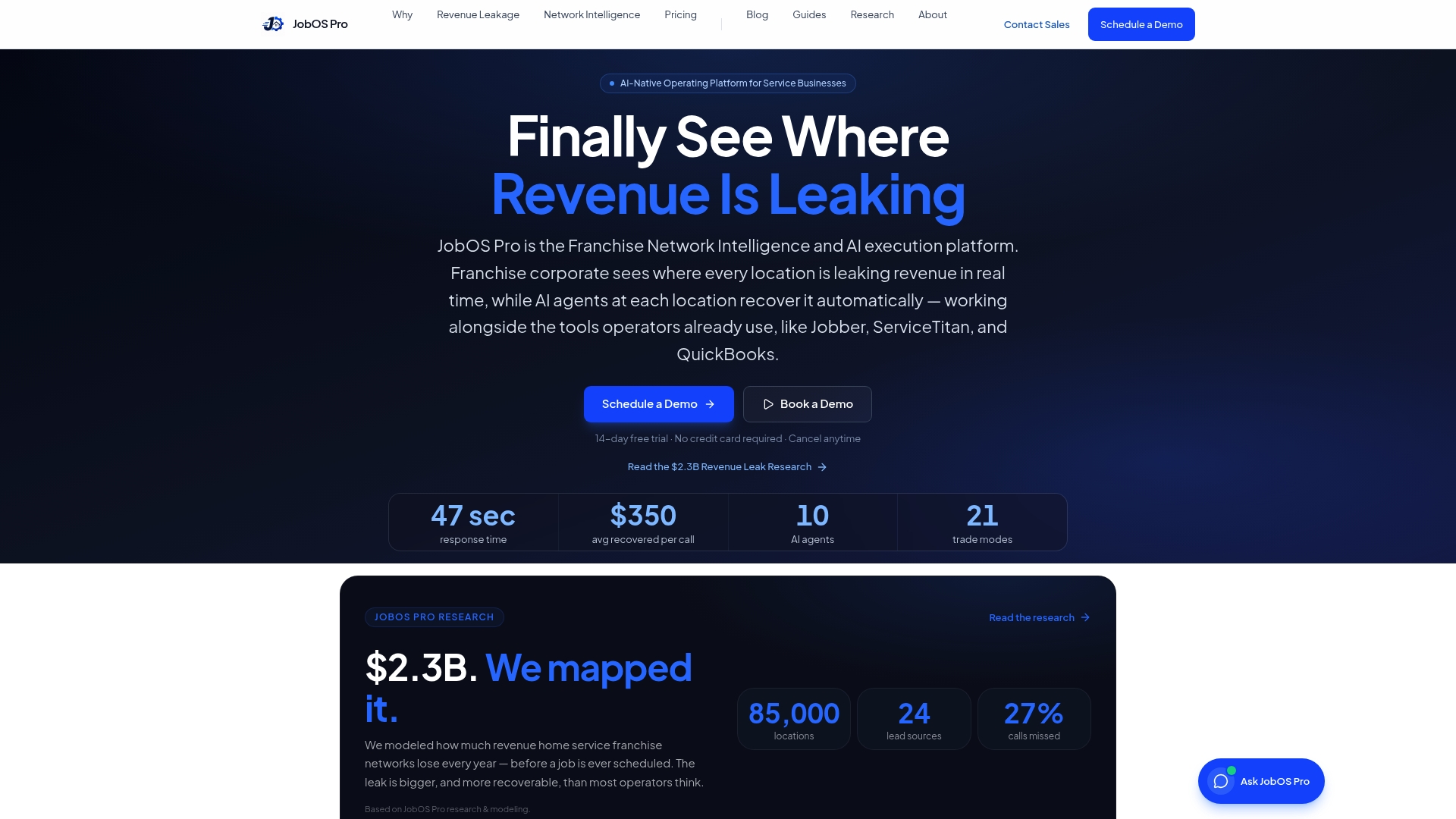
If you run a home service business and want to see how automated recovery fits your operation, review the pricing plans, starting at $199 per month for the Starter plan, or book a demo to walk through your specific revenue leaks.
Sources
- CAN-SPAM Act: A Compliance Guide for Business | Federal Trade Commission
- The value of keeping the right customers | Harvard Business Review
FAQ
What is a reactivation campaign?
A reactivation campaign is targeted outreach, usually email-led with SMS or ads in support, aimed at bringing dormant customers back to an active purchase or relationship with your business. It typically segments customers by recency and reason for lapsing before sending a re-education message followed by a tailored offer.
What is the 3-3-3 rule for marketing?
There’s no single agreed definition of a “3-3-3 rule” in marketing, and it isn’t a standard covered by the sources behind this article. If you’ve seen it referenced elsewhere, treat it as one practitioner’s shorthand rather than an established framework.
What are the four C’s of customer centricity?
Definitions of the “four C’s” vary across marketing sources, and no single authoritative version applies universally. Rather than repeat an unverified framework, focus on the reactivation fundamentals covered here: recency, churn reason, personalization, and measurement.
What are some examples of reactivation campaigns?
Common examples include a three-message email series (re-educate, offer, deadline) for retail customers, a failed-payment recovery flow for subscription businesses, and a missed-appointment follow-up paired with a rebooking offer for local service businesses. Each works best when the offer matches the specific reason the customer went quiet.
How do you measure a reactivation campaign’s success?
Track reactivation rate, cost-per-reactivation, and the lifetime value of customers after they come back, ideally against a holdout group that received no campaign. Reporting in 30, 90, and 180-day windows gives a clearer picture than a single aggregate number.