
Dispatcher Training Topics: AI, 30 Day, KPI Driven for Home Service
Dispatcher Training Topics: AI, 30 Day, KPI Driven for Home Service
Dispatcher training must cover phone intake, job-to-tech matching, route optimization, emergency triage, QA and metrics, and tool training. These six areas protect revenue and depend on a structured 30-day onboarding program followed by a 90 to 120-day ramp to full productivity. Skip any one of them and missed calls, blown time windows, or mismatched jobs start eating into margin fast.
TL;DR:
- Effective dispatcher training requires a structured 30-day program focused on phone intake, technician matching, route planning, emergency triage, and QA metrics, with full productivity achievable in 90 to 120 days.
- New hires should master the five essential call checkpoints and emergency decision trees, reinforced by laminated reference cards and weekly call reviews to develop consistency and confidence.
- Hiring assessments must evaluate both phone demeanor and scheduling judgment through scenario-based tests, ensuring candidates can handle pressure and complex routing simultaneously.
- Monitoring core metrics such as answer rate, booking conversion, and first-call resolution from day one allows targeted coaching, with regular call reviews to identify and fix specific performance gaps.
- Integrating AI tools like JobOS Pro enhances training and real-time performance tracking by flagging missed calls and routing errors, supporting continuous improvement and benchmarking across teams.
Table of Contents
- The Essential Dispatcher Training Topics and What to Teach for Each
- Building a 30-Day Dispatcher Training Program
- Hiring and Assessment: Finding Dispatchers Who Have Both Skills
- Metrics and QA That Prove Training Is Working
- Where Technology and AI Fit Into the Training Plan
- Call Recording and the Weekly Review Process
- Training Timeline: Why the 30-Day Structure Matters
- Legal and Compliance Considerations in Dispatching
- Communication Protocols and Scripting for Consistent Messaging
- Safety Protocols for Dispatchers and Technicians
- Crisis Management and Escalation Procedures
- What Most Training Programs Get Wrong
- How JobOS Pro Fits Into Your Dispatcher Training Program
- Sources
- FAQ
The Essential Dispatcher Training Topics and What to Teach for Each
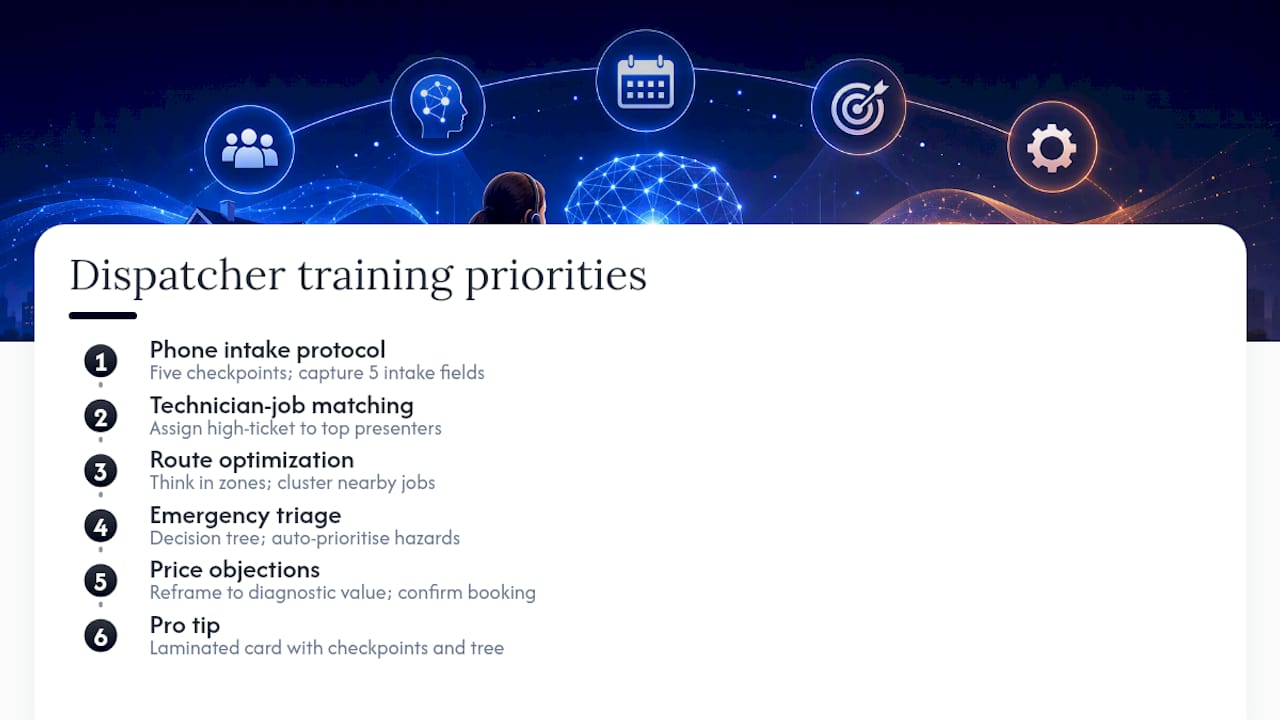
Every dispatcher training curriculum should be built around a handful of skills that directly touch revenue, not generic customer service tips. Here’s the priority list, in the order most home-service owners should teach it.
Phone intake protocol. The strongest phone protocols follow five checkpoints: a confident greeting, rapid problem identification, address and coverage confirmation, urgency calibration, and a clear booking close. Train dispatchers to hit every checkpoint without sounding like they’re reading a script. During intake, they need to capture the exact fields that drive first-call resolution: service address, equipment type or symptom, urgency level, preferred time window, and any access restrictions (locked gate, dog on-site, tenant vs. owner). Missing any one of these fields turns a booked job into a callback.
Technician-to-job matching. Assign high-ticket jobs to your best presenters, routine repairs to your most efficient technicians, and emergencies to whoever can arrive fastest, regardless of specialty fit. A replacement quote for a $12,000 HVAC system should never go to the newest hire, even if he’s available first.
Route optimization and geographic clustering. Teach dispatchers to think in zones, not individual addresses. Grouping three jobs in the same neighborhood into one technician’s afternoon beats sending three different trucks across town, and it’s one of the core skills dispatch playbooks treat as non-negotiable.
Emergency triage and same-day booking. Give dispatchers a decision tree: no heat in freezing weather, active water leak, or electrical hazard jumps the queue automatically. For non-emergencies, train them to present two time windows instead of asking “when works for you,” which stalls the call and invites hesitation.
Price objections and confirmations. Every dispatcher needs a rehearsed response to “how much will this cost” that doesn’t quote a number but reframes toward diagnostic value, then closes with a confirmed appointment and a recap of address, time, and technician name.
Pro Tip: Print the five intake checkpoints and the emergency decision tree on a laminated card next to every dispatcher’s monitor. New hires reach for it constantly in weeks one and two, and it cuts hesitation on live calls.
Building a 30-Day Dispatcher Training Program
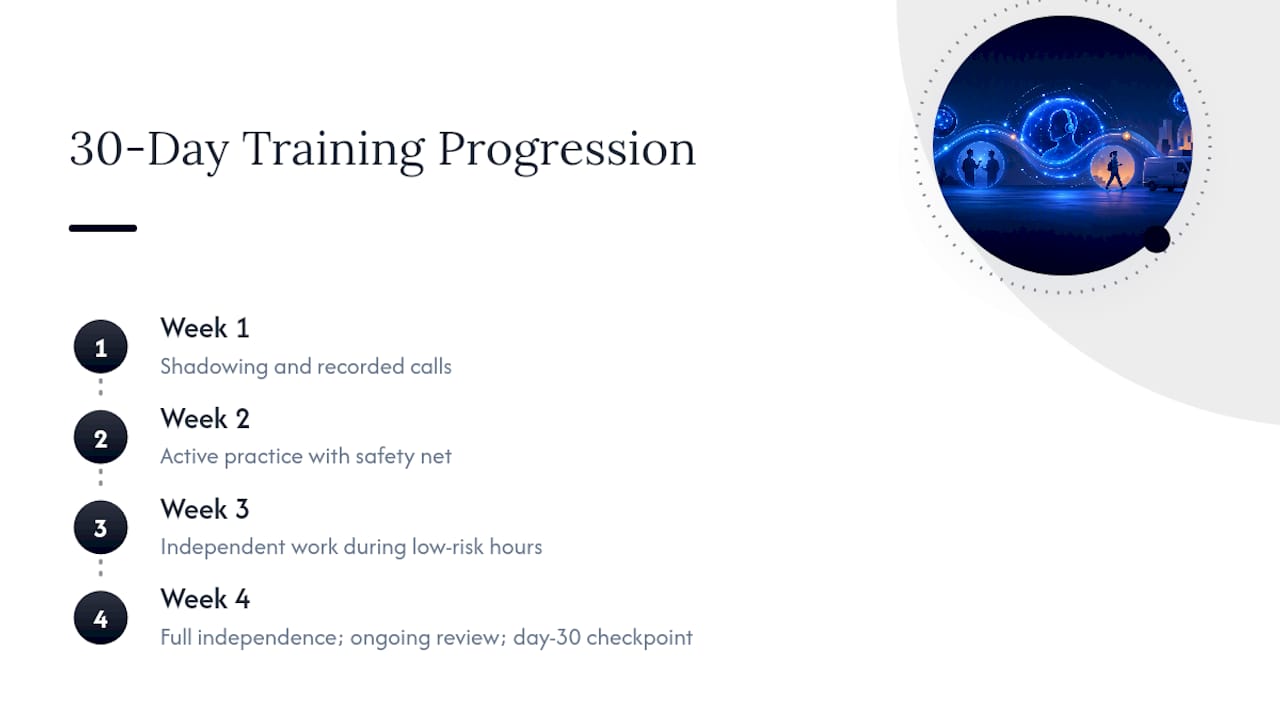
A structured 30-day progression turns theory into instinct. Here’s a week-by-week framework that works across HVAC, plumbing, electrical, and cleaning operations.
- Week 1: Foundation. New hires shadow experienced dispatchers, learn the software, and listen to a batch of recorded calls to hear what “good” sounds like.
- Week 2: Supervised practice. Trainees start handling live calls with a supervisor listening in and coaching immediately after each one, focused on booking practice and script fluency.
- Week 3: Independent handling, low stakes. Dispatchers work calls solo during non-peak hours, with supervised dispatching for anything complex or urgent.
- Week 4: Solo board management. Trainees run the board independently during off-peak windows, with end-of-day reviews and role-play drills covering escalation scenarios like a full board with an emergency call coming in.
Set daily micro-goals throughout: a target number of calls answered, appointments booked, and role-plays completed, so weak performance surfaces in days, not weeks. By day 30, a dispatcher should book independently during slow periods and handle standard escalations without help. Full productivity, including peak-hour complexity and franchise-level judgment calls, typically takes 90 to 120 days even with a strong 30-day foundation. Plan staffing and coverage around that longer timeline, not the shorter one.
Hiring and Assessment: Finding Dispatchers Who Have Both Skills
Most hiring processes test phone warmth or scheduling judgment, never both, and that gap is why some new dispatchers sound great on calls but consistently double-book technicians or misjudge urgency. Hiring guidance for dispatch roles recommends scenario-based assessments that force candidates to demonstrate both at once.
Screen for these traits specifically:
- Composure under pressure, tested with a scenario where the board is full and an emergency call comes in.
- Scheduling logic, tested by asking the candidate to slot three hypothetical jobs (one emergency, one high-ticket, one routine) into a half-full schedule and explain their reasoning out loud.
- Objection handling, tested with a mock price objection call.
- Attention to detail, tested by having them repeat back a complex intake scenario with multiple access notes.
Run a one-way recorded call exercise, a live scheduling exercise, and a short real-time triage scenario before making an offer. Score each candidate on a simple rubric: weight scheduling judgment and phone demeanor roughly equally, since a warm voice with poor routing instincts still costs you money. Pair new hires with a mentor for the first two weeks; it shortens the ramp noticeably.
Metrics and QA That Prove Training Is Working
Training only matters if it shows up in the numbers. Track four core metrics from day one:
- Answer rate (percentage of calls picked up before voicemail)
- Booking conversion per dispatcher (calls that become confirmed appointments)
- Average handle time
- First-call resolution (issue diagnosed and scheduled without a callback)
Set thresholds early. If booking conversion sits meaningfully below your team average after week two, that’s a coaching flag, not a firing decision. Recorded call review paired with role-play during onboarding accelerates competence faster than lecture-style training alone, so build weekly review into the calendar from week one, not week four.
A sample QA scorecard should check: did the dispatcher hit all five intake checkpoints, confirm the address and access notes, calibrate urgency correctly, and close with a clear recap? Turn every miss into a specific coaching note, not a general reminder. Track ramp progress against the 90 to 120-day window and expect answer rate and conversion to climb steadily, not instantly.
Where Technology and AI Fit Into the Training Plan
Modern dispatch training now includes the software stack, and skipping this leaves new hires guessing at tools instead of mastering them. Dispatch playbooks increasingly cover guided intake flows, automated triage suggestions, GPS technician tracking, and integrated customer history as core training material, not optional extras.
Build these into the curriculum directly:
- Train on guided intake flows so dispatchers capture the right fields automatically instead of relying on memory.
- Include 24/7 AI answering, similar to what 42Voice’s AI receptionist provides, in the training script so dispatchers know exactly how AI-handled calls get flagged and handed off.
- Teach when to accept an AI routing or triage suggestion and when a human override is required, especially for high-ticket jobs or unusual access situations.
- Review tool telemetry weekly to catch recurring intake or routing errors and fold them into coaching.
Pro Tip: Use Max, JobOS Pro’s AI dispatch optimizer, and The Home Service Owner’s Guide to AI Dispatch as literal classroom material. Walk new hires through a real optimized route or intake flow instead of describing it in the abstract.
Call Recording and the Weekly Review Process
Call recording review is the single highest-leverage habit in dispatcher training, and most operators underuse it after the first month. Every recorded call should get reviewed against the same checklist: did the dispatcher hit the five intake checkpoints, calibrate urgency correctly, and close with a clear time window?
During onboarding, review calls daily for the first two weeks, then shift to a structured weekly session once a dispatcher is handling calls independently. Pull three to five calls per dispatcher each week: one routine booking, one objection or difficult caller, and one edge case like an emergency or a scheduling conflict. Play the recording as a group when it’s useful, since hearing peers handle a tricky call teaches faster than a written script ever will.
Document findings in the same scorecard format every week so patterns become visible over time. A dispatcher who consistently skips address confirmation, for example, needs a different coaching conversation than one who struggles with price objections. Keep the review process short and specific: fifteen minutes per dispatcher, one or two concrete action items, not a general performance discussion. This weekly cadence is what turns a 30-day training program into a permanent quality standard instead of a one-time onboarding event.
Training Timeline: Why the 30-Day Structure Matters
A structured 30-day progression works because it matches skill complexity to readiness, rather than throwing new hires onto a live board on day one. Week 1 builds passive familiarity through shadowing and recorded calls. Week 2 adds active practice with a safety net. Week 3 removes the safety net during low-risk hours. Week 4 tests full independence with a review loop still in place.
Owners often try to compress this into two weeks to save training hours, and it usually backfires: dispatchers rushed through week 3 tend to make routing errors that surface weeks later as customer complaints or missed time windows. The 30-day structure isn’t about slowing things down. It’s about sequencing exposure so mistakes happen in supervised, low-stakes moments instead of live, high-stakes ones.
Expect the 30-day mark to represent competence, not mastery. A trainee should handle standard calls and non-peak scheduling solo by day 30, but full productivity, including peak-season volume, multi-technician coordination, and franchise-level judgment, arrives closer to the 90 to 120-day mark. Build your staffing plan and your patience around that longer number, and treat day 30 as a checkpoint rather than a graduation.
Legal and Compliance Considerations in Dispatching
Dispatchers handle information that carries real legal weight, and training needs to address it directly rather than leaving compliance to guesswork. Recording customer calls for training and QA purposes requires disclosure in many jurisdictions, so scripts should include a brief recording notice at the start of every call where required.
Scheduling practices carry their own exposure. Dispatchers who quote firm arrival windows and then miss them repeatedly can create consumer protection issues in some states, particularly for licensed trades like electrical and HVAC work. Train dispatchers to quote realistic windows rather than optimistic ones, and to communicate delays proactively instead of letting a customer wait past a promised time.
Data handling matters too. Dispatchers routinely collect addresses, access codes, and sometimes payment details over the phone. They need clear rules on what gets written down, where it’s stored, and who can access it, especially for franchise operations where customer data may cross multiple location systems. Any dispatcher training curriculum for a licensed trade should also cover basic awareness of local permitting and licensing disclosure requirements, since customers sometimes ask dispatchers directly whether a technician is licensed or insured. Dispatchers don’t need to be experts, but they need a scripted, accurate answer rather than an improvised one.
Communication Protocols and Scripting for Consistent Messaging
Consistency across dispatchers is what makes a brand feel reliable, and it comes down to shared scripting rather than individual style. Every dispatcher should use the same core language for the same situations: how to greet a caller, how to explain a delay, how to present pricing ranges, and how to close a booking.
Scripts work best as frameworks, not word-for-word recitations. A dispatcher who sounds robotic loses trust just as fast as one who’s inconsistent. Train the checkpoints, not the exact phrasing, and let dispatchers develop their own natural delivery around them. This is the same principle behind the five-element phone protocol covered earlier: structure guides the call, but the dispatcher’s voice makes it feel human.
Written communication needs the same consistency. Confirmation texts, appointment reminders, and follow-up messages should use approved templates so a customer gets the same tone whether they booked with dispatcher A or dispatcher C. Internal communication protocols matter just as much: dispatchers need a clear, fast channel to flag issues to technicians and supervisors, whether that’s a shared dispatch board note, a group message, or a direct call for anything urgent. Ambiguity here is where jobs get double-booked or technicians show up without the right information.
Safety Protocols for Dispatchers and Technicians
Dispatchers are often the last line of defense for technician safety, and training should treat that responsibility seriously. Before confirming any appointment, dispatchers need to flag known risk factors: aggressive pets, unstable structures, hostile customers from prior visits, or locations with a history of incidents.
Build a simple flagging system into the dispatch software so any technician pulling up a job sees safety notes immediately, not buried in call history. Dispatchers should also know the protocol for a technician who doesn’t check in as expected: how long to wait before calling, who to escalate to, and when to contact local authorities. This matters even more for technicians working alone in landscaping, electrical, or pest control roles where job sites can be isolated.
Weather and hazard awareness belongs in training too. Dispatchers scheduling outdoor work need basic judgment about when conditions (extreme heat, lightning, ice) warrant rescheduling rather than pushing a technician to complete a job on time. The same safety-first mindset that governs field crews should extend to the dispatch chair: a dispatcher who prioritizes a schedule over a technician’s safety is a training gap, not an individual failure.
Crisis Management and Escalation Procedures
Every dispatcher will eventually face a call that a standard script can’t handle: an angry customer threatening legal action, a technician reporting an on-site injury, or a service failure that’s about to become a public complaint. Training needs a clear escalation ladder so dispatchers never have to improvise in the moment.
Define exactly which situations get escalated immediately versus handled at the dispatcher level. A billing dispute might stay with the dispatcher; a safety incident or a threat of harm goes straight to a supervisor, no exceptions. Give dispatchers a short script for de-escalating an irate caller: acknowledge the frustration specifically, avoid defensive language, and offer a concrete next step rather than a vague apology.
Role-play these scenarios during the 30-day program rather than waiting for a real crisis to be the first test. A dispatcher who has practiced calming an angry caller in training handles the real version with noticeably more composure. Document every escalation afterward, even minor ones, so patterns become visible; if the same type of complaint keeps surfacing, that’s a signal for a process fix upstream, not just a coaching note for the dispatcher who happened to answer that call.
What Most Training Programs Get Wrong
Most dispatcher training treats phone skills as the whole job and scheduling judgment as something that develops naturally. It doesn’t. A dispatcher who sounds warm and confident but consistently mismatches technicians to jobs will quietly cost you more than one who’s a little awkward on the phone but routes accurately every time. Weigh both from day one, in hiring and in coaching.
The other common mistake is expecting instant productivity after a strong 30-day program. Thirty days builds competence, not mastery; plan staffing and patience around the longer 90 to 120-day ramp. What separates teams that improve steadily from teams that stall is repetition: daily call review, recurring role-play, and a laminated reference card that turns theory into muscle memory. Nothing fancy. Just consistent.
— Tarun
How JobOS Pro Fits Into Your Dispatcher Training Program
Everything covered above, phone intake, job matching, routing, QA, still requires a system that catches what a dispatcher misses on a busy Tuesday. JobOS Pro is built for exactly that gap: it’s an AI-native platform, not a bolt-on AI feature, so it flags missed calls, uncollected payments, and scheduling delays in real time instead of surfacing them in next month’s report.

Use it as both a training supplement and a live monitoring dashboard. New dispatchers can walk through actual optimized routes generated by Max, JobOS Pro’s AI dispatch optimizer, rather than a hypothetical example, and supervisors can pull real telemetry to see exactly where intake or routing errors keep repeating. For franchise operators managing multiple locations, that same data rolls up into benchmarking across the network, so corporate leaders can see which locations are actually applying the training and which need another coaching pass.
If you want a guided look at how it fits your team’s workflow, book a demo or check pricing plans starting at $199 per month to see which tier matches your dispatch volume.
Sources
- Dispatcher training: phone protocol that converts callers (CallJolt)
- The modern dispatch and scheduling playbook for contractors (Clockwork)
- Plumbing CSR & dispatcher training: book more jobs from every call (Plumbing Profit Partner, 2025)
- New hire time to productivity (Umbrex)
FAQ
What Are the Most Important Dispatcher Training Topics?
Phone intake protocol, technician-to-job matching, route optimization, emergency triage, QA and metrics tracking, and software or AI tool training are the six essential topics. Each one directly affects booking conversion and revenue, which is why they anchor most dispatch training playbooks.
How Long Does Dispatcher Training Take?
A structured onboarding program typically runs 30 days, moving from shadowing to supervised calls to independent solo work. Full productivity, including peak-hour complexity, generally takes 90 to 120 days even with strong initial training.
What Should a Dispatcher Phone Script Include?
An effective script covers five checkpoints: a confident greeting, rapid problem identification, address and coverage confirmation, urgency calibration, and a clear booking close. These five elements should guide the conversation as a framework, not a word-for-word recitation.
How Do You Measure Dispatcher Training Success?
Track answer rate, booking conversion per dispatcher, average handle time, and first-call resolution from week one onward. Weekly recorded call reviews paired with a QA scorecard turn these numbers into specific coaching actions rather than vague performance talk.
Does JobOS Pro Help With Dispatcher Training?
JobOS Pro supports training by surfacing real-time data on missed calls, scheduling delays, and dispatcher performance that supervisors can use in coaching sessions. Its AI dispatch optimizer, Max, and its AI dispatch guide also double as practical classroom material during onboarding.