
4–8 Week Pilot: Dynamic Scheduling Cuts Drive Time for Home Services
4–8 Week Pilot: Dynamic Scheduling Cuts Drive Time for Home Services
Dynamic scheduling automatically adjusts technician assignments, routes, and time windows as conditions change throughout the day, instead of locking a plan in place at 7 a.m. and hoping it holds. For home service operators, the payoff is straightforward: more completed jobs with fewer drive hours per technician. The sections below cover how it works, what to measure, and how to roll it out without breaking your team’s trust in the schedule.
TL;DR:
- Dynamic scheduling significantly benefits highly volatile businesses by automatically adjusting for cancellations, delays, and demand spikes, unlike static schedules that struggle with unpredictability.
- Real-time triggers, skill and certification matching, and route optimization are essential features to ensure the system adapts seamlessly to changing conditions and adheres to compliance requirements.
- Measuring improvements through weekly KPIs such as completed jobs per technician, drive time, ETA adherence, and cancellation rates provides a clearer picture of the system’s impact than daily metrics.
- Successful adoption requires digitized jobs, GPS-enabled technician mobility, and a pilot phase focused on moderate unpredictability, with a defined testing period and clear before-and-after comparisons.
- Proper integration with existing CRM, billing, and field management tools is critical, along with vendor capabilities like automatic updates and manual override options, to ensure reliable and trustworthy dynamic scheduling deployment.
Table of Contents
- Dynamic vs static scheduling: what actually changes
- How dynamic scheduling works: the mechanics behind the board
- What dynamic scheduling actually improves, and how to measure it
- When to adopt dynamic scheduling: readiness signals and a quick checklist
- Features and vendor evaluation criteria worth insisting on
- Rolling out dynamic scheduling: a phased plan that actually sticks
- Connecting dynamic scheduling to the systems you already run
- Where AI and machine learning actually earn their place
- What adoption looks like across different home service trades
- Where dynamic scheduling rollouts go wrong
- Putting dynamic scheduling into production with JobOS Pro
- Sources
- FAQ
Dynamic vs static scheduling: what actually changes
Static scheduling assigns every job a fixed slot the night before or the morning of, based on assumptions that rarely survive contact with reality. A technician calls in sick, a job runs long, a customer cancels at 9 a.m., and the whole board needs manual rework by hand.
Dynamic scheduling systems make rescheduling decisions automatically, factoring in staff availability, skills, and same-day disruptions as they happen, which cuts down the manual scrambling that static boards demand from dispatchers (background context on dynamic scheduling capabilities). Instead of a dispatcher redrawing the day’s plan in a spreadsheet, the system recalculates assignments in real time and pushes updated routes to technicians in the field.
The distinction matters most in businesses where job duration is unpredictable and demand spikes without warning. Static scheduling holds up reasonably well for a business with five recurring maintenance contracts and almost no same-day calls. It breaks down fast for:
- HVAC and plumbing operators fielding emergency calls that must slot into an already-full day.
- Multi-technician cleaning or landscaping crews where one late job cascades delays across the rest of the route.
- Any operator running seasonal demand spikes, like storm response or holiday scheduling, where call volume can double overnight.
The common thread is volatility. The more a business depends on same-day or next-day bookings, the more a fixed schedule becomes a liability rather than a plan. Dynamic scheduling treats the day’s plan as a living document, not a printout.
How dynamic scheduling works: the mechanics behind the board
Dynamic scheduling systems run on a loop: watch for changes, re-evaluate priorities, reassign work, and notify everyone affected. Understanding each piece helps you judge whether a vendor’s system is doing real optimization or just relabeling a static calendar.
Real-time triggers. The system watches for cancellations, technician delays, traffic conditions, and status updates from the field, and recalculates the plan whenever one of those inputs shifts. Real-time visibility and GPS tracking are the foundational data sources that make this possible (industry capability overviews), since the system needs to know where every technician actually is, not just where they were assigned to be.
Job prioritization and SLA rules. Not every job carries equal weight. A no-heat emergency call outranks a routine filter change, and the system needs rules that encode that, whether it is a hard SLA commitment or a simple urgency tag. Good systems let you set these priority rules once and trust the engine to apply them consistently, rather than relying on a dispatcher’s judgment call every time.
Skill and equipment matching. Assigning a job to the nearest available technician only works if that technician actually has the right certification, tool, or parts inventory for the job. Credential and skill matching is treated as a hard requirement in regulated fields like home health, where compliance with working-hour and qualification constraints is built into the scheduling logic itself. The same principle applies to licensed trades: a system that ignores certification requirements will happily book an uncertified technician into a job that legally requires one.
Route optimization and time-window assignment. This is where the harder math lives. Academic work on next-day service routing shows that a stochastic lookahead approach, one that samples likely future requests before locking in today’s time windows, can increase the number of customers served without penalizing those in less convenient locations. In plain terms: the system holds a little flexibility in reserve instead of packing the schedule tight the moment a booking comes in, which lets it fit in more next-day jobs without pushing anyone to the edge of the service area. Operations research on field-service routing more broadly confirms that algorithmic route optimization measurably reduces drive time and raises utilization when applied to real routing problems, not just simulated ones.
Notifications and execution. Once the engine recalculates a plan, technicians and customers both need to know. Automated ETA messages to customers and updated route pushes to technician mobile apps close the loop, so the schedule reflects reality on both ends, not just on the dispatcher’s screen.

What dynamic scheduling actually improves, and how to measure it
The operational case for dynamic scheduling comes down to four things: more jobs completed per technician per day, faster response to urgent calls, less time spent driving between stops, and fewer missed appointments.
Route optimization and smarter scheduling reduce travel time and raise technician utilization when applied to real field-service routing problems, according to operations research on service scheduling. Fewer miles between jobs means more slots available for paying work in the same shift, without adding headcount.
Customer experience improves for a related reason: tighter, more reliable time windows. The stochastic lookahead research referenced earlier found that smaller customer time windows are feasible without cutting daily throughput when the system retains enough flexibility to plan ahead. That means you can promise a 2-hour window instead of an all-day wait, and still fit the same number of jobs into the day.
During a pilot, track these KPIs weekly rather than waiting for a monthly rollup:
- Completed jobs per technician per day, compared against your current baseline.
- Average drive time per job, which should trend down as routing improves.
- Customer ETA adherence, the share of jobs completed inside the promised window.
- First-time cancellation and no-show rate, which often drops once scheduling responds faster to changes.
Workforce rostering literature is a useful check here too: scheduling changes affect worker welfare and service reliability together, so a pilot that only tracks completed jobs and ignores technician burnout or overtime creep is measuring half the picture.
When to adopt dynamic scheduling: readiness signals and a quick checklist
Not every home service business needs dynamic scheduling today. The signal to watch for is volatility, not size.
You are likely ready if you see high same-day cancellation rates, growth targets that your current dispatcher cannot keep pace with manually, or technician utilization that sits noticeably below what your capacity should allow.
Before you pilot anything, confirm three prerequisites are in place:
- Jobs are digitized. Paper job tickets or a spreadsheet calendar cannot feed a real-time engine.
- GPS and mobile access exist for technicians. The system needs live location data, and your team needs a phone or tablet to receive updated routes. GPS punch clocks and geofencing tools, like those offered by Clock-Me, are a practical way to get location telemetry flowing if your current setup lacks it.
- A pilot cohort is identifiable. Pick a route or territory with medium unpredictability, not your calmest route (too little to gain) or your most chaotic one (too hard to measure cleanly).
Run the pilot for a defined window, typically 4 to 8 weeks, with a clear before-and-after comparison rather than an open-ended trial that never gets evaluated.
Features and vendor evaluation criteria worth insisting on
Not every product marketed as “dynamic scheduling” does real-time optimization. Some just offer drag-and-drop rescheduling with a nicer interface. When evaluating vendors, insist on proof of the following rather than taking a sales deck’s word for it.
- Real-time updates that trigger automatically, not just a manual refresh button dispatchers have to remember to click.
- Skill and certification matching built into the assignment logic, especially for licensed trades or regulated fields.
- Route optimization with live traffic and location data, not a static route calculated once at the start of the day.
- A mobile app technicians will actually use, since a system nobody opens in the field is not doing real-time anything.
- Automated customer ETA messaging, so customers get proactive updates instead of calling in to ask where their technician is.
Beyond feature checkboxes, look at operational controls: can a dispatcher manually override an automated assignment when judgment says otherwise, can you set blackout windows for training or maintenance days, and can the system enforce policy rules like maximum daily drive time per technician. Integration capabilities matter just as much: check whether the platform offers open APIs or native connections to your existing CRM, accounting, and field service management tools, rather than asking you to abandon what already works.
Pricing models vary from per-technician seats to flat tiers, so map the ROI levers, reduced drive time, higher completed-job counts, fewer missed appointments, against the subscription cost before committing.
Pro Tip: Ask any vendor to show you a real reassignment happening live during a demo, not a screenshot of a finished schedule.
Rolling out dynamic scheduling: a phased plan that actually sticks
A phased rollout protects you from the two most common failure modes: over-automating before your data is clean, and under-training your team before go-live.
- Prepare. Clean up job records, confirm every technician has mobile access, and select a pilot cohort with medium day-to-day unpredictability. This is also when you connect existing tools rather than ripping them out. JobOS Pro is built to run alongside systems like Jobber and QuickBooks during this phase, so preparation does not require a forced migration.
- Pilot. Run the test for 4 to 8 weeks, tracking utilization, completed jobs per technician, average drive time, and customer ETA adherence weekly. AI-assisted dispatch tools, including JobOS Pro’s automated dispatch and scheduling board, can handle the reassignment logic during this phase while your team monitors outcomes and keeps a manual override available.
- Scale. Train the broader team on the new workflow, set governance rules for overrides and blackout windows, and roll results up across locations. For franchise networks, JobOS Pro’s multi-location intelligence lets corporate leaders benchmark performance and standardize what worked in the pilot across every site.
**A field-service study found significant revenue leakage across the industry, finding that missed calls, uncollected payments, and scheduling delays are common, quantifiable sources of lost revenue for home service operators, which is exactly the gap a phased dynamic scheduling rollout is designed to close.
Report results on a rolling 7-day average rather than raw daily numbers, since single bad days from weather or one absent technician can distort a daily view. A simple weekly dashboard covering completed jobs, drive time, and ETA adherence is enough to judge whether the pilot is working before you commit to a wider rollout.
Connecting dynamic scheduling to the systems you already run
Dynamic scheduling rarely works well as an island. It needs to read customer history from your CRM, write completed job data back to your accounting system, and stay in sync with whatever field service management platform your technicians already use day to day.
The practical integration points are customer data, job history, and billing. A scheduling engine that cannot pull existing customer preferences or service history from your CRM will make worse assignment decisions, and one that cannot push completed job data to your accounting platform creates double entry work for your office staff. This is why an operator evaluating a new scheduling tool should ask specifically how it connects to the CRM, accounting, and FSM tools currently in place, rather than assuming compatibility.
JobOS Pro takes the position that a scheduling and operations platform should run alongside tools like Jobber and QuickBooks rather than forcing a replacement, connecting disconnected systems into one operational view instead of adding another silo. For operators already invested in a field service management platform, that distinction, augment versus replace, is often the deciding factor in whether a dynamic scheduling rollout gets internal buy-in or gets shelved after month one.
Skill and certification data is another integration point worth confirming early, particularly for regulated trades or home health contexts where compliance with credentialing and working-hour rules needs to sync automatically between your workforce records and the scheduling engine, not get checked manually after the fact.
Where AI and machine learning actually earn their place
AI’s real contribution to dynamic scheduling is speed and pattern recognition at a scale no dispatcher can match manually. Instead of a person weighing technician location, skill match, job priority, and traffic conditions one variable at a time, a machine learning model can weigh all of them simultaneously and recalculate the moment any input changes.
The stochastic lookahead method described in the operations research on time-window assignment is a good example of what this looks like in practice: rather than locking in a time window the instant a customer books, the system samples likely future demand and holds strategic flexibility in reserve, which is a computation a human dispatcher simply cannot run in their head fast enough to matter. Linear relaxation techniques make it possible to evaluate these trade-offs in something close to real time, which is what turns the theory into something usable on a live dispatch board.
None of this replaces dispatcher judgment entirely. AI models are only as good as the data feeding them, and a model trained on messy job records or an incomplete technician roster will make confident, wrong decisions just as easily as a dispatcher working from bad information. The safest deployment pattern treats AI as the engine that proposes assignments and flags conflicts, with a person retaining the ability to override before anything goes final. That balance, automation for speed, human oversight for judgment calls, is what separates a system that earns trust from one that gets quietly ignored after two bad reassignments.
What adoption looks like across different home service trades
Adoption patterns differ by trade, largely based on how unpredictable the day-to-day job mix is. HVAC and plumbing operators tend to see the fastest impact because emergency calls are frequent and must be slotted into an already-committed day without blowing up every other appointment. A no-heat call at 10 a.m. has to displace something, and a system that can find the least disruptive place to put it saves a dispatcher from making that trade-off by gut feel.
Cleaning and landscaping operations see a different benefit: route density. Because these jobs cluster geographically and run on tighter margins per visit, small improvements in routing translate directly into completed jobs per technician per day, since route optimization has been shown to reduce drive time and raise utilization in field-service routing research.
Franchise networks face a related version of the problem: coordinating winning scheduling practices across locations instead of leaving each site to reinvent its own dispatch logic. This is where multi-location benchmarking, the kind that lets a corporate operations lead see which location’s scheduling approach is producing the fewest missed appointments and replicate it elsewhere, adds value beyond what any single-location pilot could show. Read more operational examples on the JobOS Pro blog.
Where dynamic scheduling rollouts go wrong
Three mistakes show up again and again. Operators automate before cleaning up job data, skip the manual override option and lose staff trust, or measure only completed jobs while ignoring technician workload. Tighter time windows can boost throughput, but only if the system keeps enough fleet flexibility in reserve. One clear win: a well-run pilot on a single volatile route, measured against a comparable baseline, is usually enough to prove or disprove the case.
— Tarun
Putting dynamic scheduling into production with JobOS Pro
Everything covered above, real-time reassignment, skill matching, route optimization, ETA messaging, requires a platform built to run all of it together rather than bolted on after the fact. An AI-native operations platform built from the ground up can run alongside existing tools instead of forcing a migration before you can start.
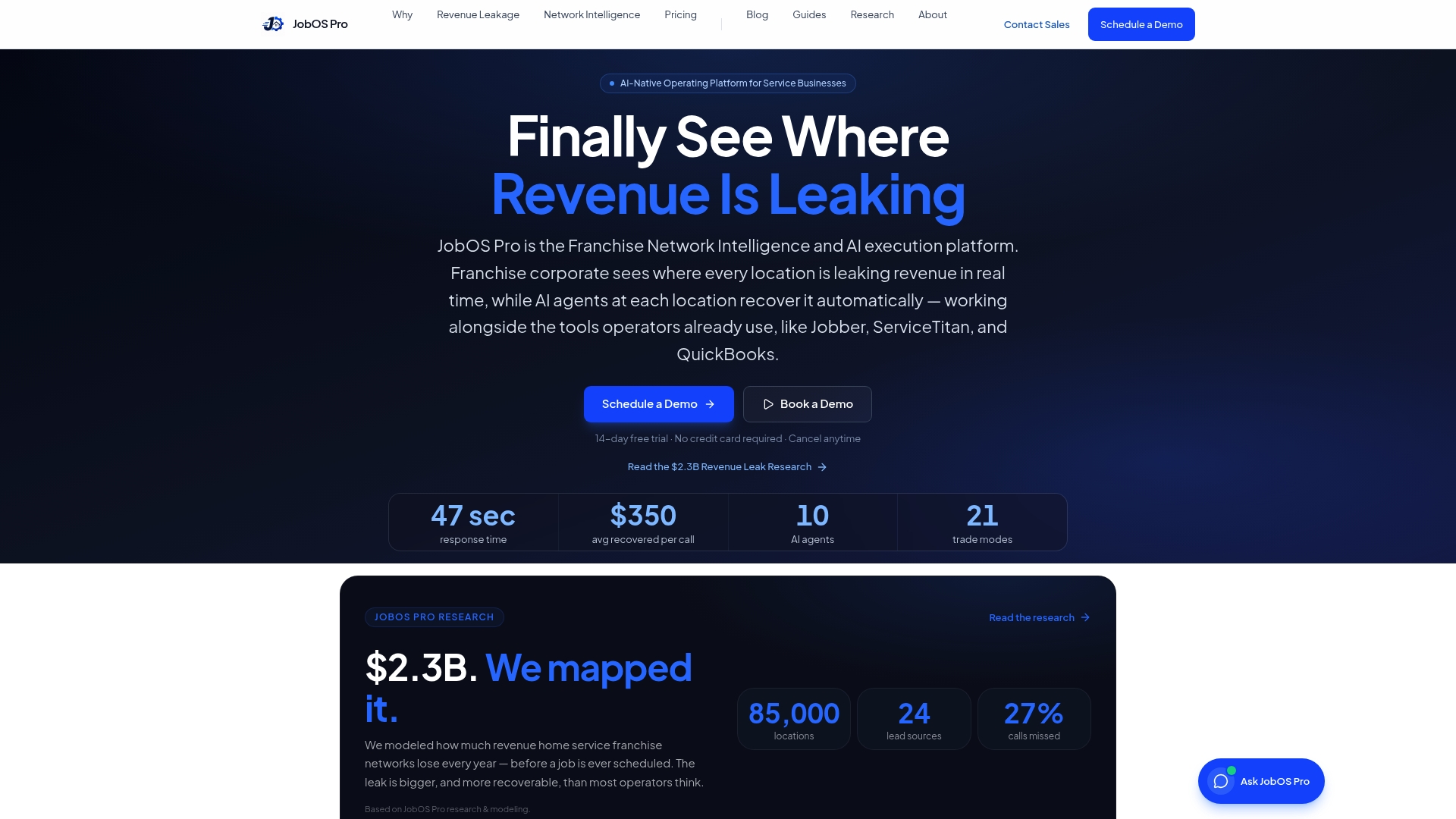
A dispatch and scheduling board can handle real-time reassignment as conditions change, while automatic revenue recovery flags missed calls, uncollected payments, and scheduling delays. For franchise operators, multi-location intelligence provides corporate leaders a way to benchmark performance and standardize scheduling approaches across multiple sites.
If you want the operational detail before committing to anything, The Home Service Owner’s Guide to AI Dispatch walks through how AI-assisted dispatch fits into a day-to-day operation. If you run an HVAC business specifically, the HVAC software page covers the scheduling workflows built for that trade, and plumbing operators can find the equivalent on the plumbing software page.
Plans start with Starter at $199 per month, scaling up to Growth at $349 per month and Pro at $549 per month, with Enterprise pricing available on request for franchise networks. The fastest way to see how it handles your actual job mix is to book a demo and walk through a live reassignment on your own data.
Sources
- Dynamic Time Window Assignment for Next-Day Service Routing
- Operations research literature on service routing and scheduling
- Use home health - Microsoft Learn
- Rostering and workforce scheduling literature review (PMC)
FAQ
What is dynamic scheduling?
Dynamic scheduling is a system that automatically adjusts job assignments, routes, and time windows in real time based on staff availability, skills, and same-day changes like cancellations or delays. It replaces a fixed daily plan with one that updates itself as conditions change, cutting down the manual rework dispatchers otherwise handle by hand.
What is the best scheduling software for home services?
There is no single best option for every home service business, since the right fit depends on trade, fleet size, and which systems you already run. Look for real-time reassignment, skill and certification matching, route optimization, and open integrations with your existing CRM and accounting tools rather than choosing on brand name alone; platforms like JobOS Pro are built to run alongside tools like Jobber and QuickBooks instead of replacing them outright.
What is the best scheduling software for caregivers in home care?
Home care scheduling has stricter requirements than most trades, since credential and skill matching and compliance with working-hour constraints are treated as non-negotiable in home health scheduling guidance. Any system evaluated for this setting should enforce those constraints automatically rather than leaving compliance checks to a coordinator’s memory.
What is the best scheduling service?
The right scheduling service depends on the volatility of your job mix and how it integrates with your existing tools, not a single universal answer. Prioritize real-time updates, skill matching, route optimization, and manual override controls, and confirm the vendor supports the CRM and field service systems you already rely on before switching.