Executive Dashboards for Home Services: Strategic Guide
Is your home service enterprise actually growing, or are you simply outrunning a 15% revenue leak that you can't see? Most executives rely on financial reports that arrive weeks too late; they document systemic failures only after the capital has already vanished. You likely feel the friction of inconsistent performance across different territories but lack the granular data to diagnose the source. Implementing advanced executive dashboards for home services is no longer a luxury for the tech-curious. It is the strategic layer of a modern operating system designed to eliminate operational latency and secure your margins.
We understand that true oversight requires more than a rearview mirror. This guide will teach you to master the real-time metrics that drive enterprise value and capture every dollar currently lost to missed calls or inefficient dispatching. You'll learn how to build a framework for benchmarking multiple locations and unify disparate data into a single, authoritative source of truth. We're moving beyond basic reporting to provide a blueprint for total visibility. This article outlines the specific path to maximizing your operational efficiency and positioning your business for a high-value exit or acquisition.
Key Takeaways
- Eliminate operational latency by transitioning from month-end financial reports to a real-time command center that identifies systemic failures instantly.
- Master the four high-leverage KPI pillars of Lead Capture, Production, Financial, and Retention required to drive enterprise value and EBITDA growth.
- Leverage executive dashboards for home services to implement network benchmarking; this allows you to isolate and replicate the performance of your most profitable locations.
- Establish a tiered architecture of oversight that aligns your entire organization through customized visibility for executives, managers, and field technicians.
- Capture leaked revenue by integrating AI-powered call answering directly into your data stream for immediate recovery of missed opportunities.
Beyond the P&L: Why Home Service Leaders Require Real-Time Executive Dashboards
A Profit and Loss statement is an autopsy. It tells you what happened last month, but it offers zero utility for changing the outcome of today. For trade business leaders, relying solely on lagging financial reports is a high-stakes gamble. Modern executive dashboards for home services function as a real-time command center, providing the visibility required to intervene before a bad afternoon becomes a catastrophic quarter. This is the fundamental shift from reactive management to total operational oversight.
The core problem in most home service enterprises is Operational Latency. This is the invisible gap between a failure, such as a missed high-value service call, and the moment an executive becomes aware of it. In a legacy environment, that gap can span weeks. By the time you see the dip in your P&L, the marketing spend is already wasted and the lead has contacted a competitor. An AI-native operating system eliminates this latency by unifying live data streams into a single, actionable interface. It transforms your data from a historical record into a predictive tool.
The High Cost of Information Delay
Delayed data is the primary driver of revenue leakage in HVAC, plumbing, and electrical services. When information lags, your ability to correct course vanishes. Month-end reviews are inherently too late to salvage failing marketing campaigns or declining technician conversion rates. Beyond the financial impact, there is a psychological cost to data delays. Real-time visibility creates a culture of immediate accountability. When performance is visible instantly, technicians and managers understand that their output is observed; this leads to a natural, sustained lift in operational standards.
Dashboards vs. Standard Reports
Static PDF reports are administrative artifacts. They are difficult to digest and impossible to drill into. High-performance executive dashboards for home services are dynamic environments that allow you to move from a high-level network overview down to a specific technician's performance in seconds. These systems unify disparate data from your call center, dispatch board, and accounting software into a cohesive narrative. By leveraging AI business management for home services, leaders can strip away the noise and focus on the signals that actually move the needle on enterprise value. The goal is not just to have more data. It is to achieve a level of clarity that makes the next strategic move obvious.
The Anatomy of a High-Performance Dashboard: 4 Critical KPI Pillars
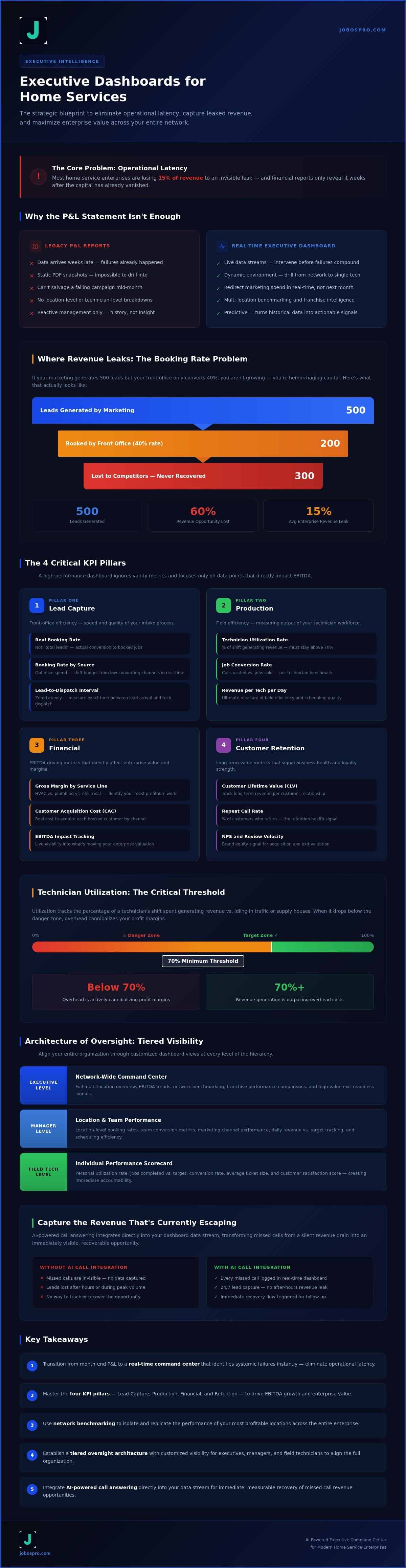
A dashboard is only as effective as the logic underpinning it. To build enterprise value, you must ignore vanity metrics and focus on high-leverage data points that directly impact EBITDA. Effective executive dashboards for home services categorize intelligence into four essential pillars: Lead Capture, Production, Financial, and Customer Retention. This structure allows leadership to isolate friction points within the business stack immediately. It transforms a chaotic stream of information into a focused strategic tool.
Many organizations fail by tracking "Total Lead Count," a metric that often masks profound call center inefficiencies. You should prioritize "Real Booking Rate" instead. If your marketing generates 500 leads but your front office only converts 40%, you aren't growing; you're hemorrhaging capital. Similarly, "Technician Utilization" serves as the ultimate measure of field efficiency. It tracks the percentage of a technician’s shift spent generating revenue versus idling in traffic or supply houses. If utilization drops below 70%, your overhead is cannibalizing your profit margins.
Lead Capture and Front-Office Efficiency
The first pillar focuses on the speed and quality of your intake. Every second a lead sits unaddressed increases the probability of a competitor winning the job. "Zero Latency" management requires measuring the precise interval between lead arrival and technician dispatch. By identifying the "Booking Rate by Source," you can optimize marketing spend in real-time, shifting budget away from low-converting channels before the month ends. This level of oversight is why modern firms centralize their operations through AI-native platforms.
Production and Field Performance Metrics
Field performance metrics provide a window into your revenue engine. You must track "Average Ticket Value" (ATV) and "Conversion Rate" at the individual technician level to identify training gaps or top performers. These production KPIs are significantly influenced by intelligent technician dispatching, which ensures the right skill set is matched to the right opportunity. High-performance executive dashboards for home services provide the visibility needed to adjust these assignments on the fly. For plumbing and electrical firms, monitoring the "Effective Billing Rate" (EBR) is also critical. This metric reveals the actual revenue generated per man-hour, exposing whether your pricing models truly align with your operational costs.
Scaling the Network: Multi-Location Benchmarking and Franchise Intelligence
Managing a single location is an operational challenge. Managing a franchise network or a multi-unit enterprise is a data crisis. Without centralized intelligence, your brand standards quickly dissolve into local preferences and inconsistent results. Advanced executive dashboards for home services enable a transition from subjective oversight to objective network benchmarking. This process involves comparing location performance in real-time to identify systemic outliers before they erode your bottom line. It allows you to move beyond the chaos of individual branch management into a sophisticated model of multi-location growth.
The primary benefit of this visibility is the ability to practice Management by Exception. Instead of micromanaging every location, executives only intervene when a specific unit falls below the network average or historical baseline. This preserves leadership bandwidth for high-impact strategic initiatives. Standardized reporting is also a foundational requirement for building a "PE-Ready" brand. Private equity firms and potential acquirers demand clean, unified data that proves your model is scalable and resistant to local market fluctuations. Industry data indicates that revenue leakage in home service franchises often reaches 15% due to these visibility gaps. A unified dashboard acts as the corrective layer that captures this lost capital.
Standardizing Success Across the Franchise
Dashboards serve as the digital enforcer of "The Brand Way." By visualizing every customer interaction, you ensure that the Phoenix branch follows the same high-conversion protocols as the Atlanta branch. You can utilize leaderboards to foster healthy competition between locations, driving performance through transparency rather than mandates. This automated approach also reduces the administrative burden on individual franchise owners. They no longer need to manually compile reports; they can focus entirely on local execution while the system handles the intelligence gathering.
Identifying and Replicating Top-Performer DNA
Data reveals the specific operational habits that separate your highest-margin locations from the rest of the pack. Executive dashboards for home services allow you to isolate the variables behind a top performer’s success, such as their technician follow-up sequence or their booking script. You can then create a feedback loop to train underperforming units based on these proven network leaders. A critical cross-location indicator to monitor is "Membership Penetration." This metric tracks how effectively each location secures recurring revenue through service plans. High membership penetration is a primary driver of enterprise value, and tracking it across the network ensures your long-term stability is never left to chance.
Architecture of Oversight: Best Practices for Dashboard Implementation
A strategic deployment of executive dashboards for home services requires a tiered architecture. You cannot overwhelm a field technician with EBITDA projections, nor should an executive wade through individual dispatch timestamps. Effective implementation relies on role-based visibility. The "Executive View" focuses on enterprise value and network-wide trends. The "Manager View" highlights operational bottlenecks and team performance. Finally, the "Technician View" provides the individual with a clear scoreboard for their own conversion rates and ticket averages. This segmentation ensures that every member of the organization sees only the data that empowers their specific actions.
Transparency drives culture. Implementing a "TV in the Office" strategy, where key performance indicators are broadcasted in real-time within the dispatch center, creates immediate alignment. It eliminates ambiguity and fosters a results-oriented environment. For the executive on the move, mobile-first dashboards are non-negotiable. You need the ability to monitor high-level health from a smartphone without sacrificing the depth of the data. However, you must remain vigilant against "Metric Fatigue." Tracking fifty vanity numbers is a recipe for paralysis. Focus on the core pillars that drive growth and ignore the noise that doesn't influence your bottom line.
Data Integrity and Integration
Your dashboard is only as reliable as the data streams feeding it. If your field technicians enter inaccurate information, your strategic decisions will be flawed. AI plays a critical role here by automatically cleaning and categorizing field data, removing the human error inherent in manual entry. Deep integration with your accounting software, specifically QuickBooks, and your field service tools is a baseline requirement. Without this unified stack, you're looking at fragmented snapshots rather than a coherent picture. To secure your data integrity, deploy an AI-native operating system designed for trades.
Frequency of Review: Daily, Weekly, Monthly
Intelligence has an expiration date. You must categorize KPIs by their necessary frequency of review. Leads and dispatch efficiency require live monitoring to prevent revenue leakage. Conversely, production costs and technician conversion rates are better suited for a weekly deep dive. Structure your 15-minute "Morning Stand-up" around the live dashboard to address immediate obstacles. This disciplined rhythm facilitates a transition from managing people to managing systems through data. It allows the system to identify the problems so you can focus on the solutions.
JobOS Pro: The AI-Powered Executive Command Center for Modern Trades
Fragmentation is the enemy of scale. Most home service enterprises operate across a patchwork of legacy CRMs, disconnected call tracking software, and manual spreadsheets. This fractured architecture creates blind spots that no amount of manual reporting can bridge. JobOS Pro replaces this inefficiency with a unified, AI-native operating system. It is designed specifically to consolidate every operational signal into high-performance executive dashboards for home services. When your data is unified at the source, your oversight becomes absolute.
Our "Zero Latency" philosophy dictates that every field action must be instantly visible in the executive suite. This real-time visibility starts at the point of lead ingestion. JobOS Pro utilizes AI call answering and missed-call recovery as primary data feeds for the dashboard. This ensures that no lead remains invisible to leadership. By automating multi-location benchmarking, the platform identifies performance gaps the moment they occur. You no longer wait for a manager's monthly summary to discover that a specific branch is failing to capture high-value service requests. The system retrieves this intelligence automatically, allowing for immediate corrective action.
Unifying the Customer Lifecycle
JobOS Pro provides total visibility by tracking the entire journey from the initial AI lead capture to automated payment collection. This creates a single source of truth for your revenue, reputation, and retention metrics. You can observe how a lead captured by AI is dispatched, quoted, and invoiced without ever leaving the command center. This level of integration eliminates the data silos that typically hide revenue leakage. To see how this unified architecture can transform your operations, request a demo of the JobOS Pro executive command center.
Built for Scale and Enterprise Value
Technological superiority is the primary differentiator in the 2026 home service market. JobOS Pro is the preferred choice for private equity-backed platforms because it directly influences the metrics that drive valuation. By automating complex reporting tasks, the platform significantly reduces administrative overhead and increases net margins. It provides the standardized, clean data that sophisticated investors require during due diligence. Implementing executive dashboards for home services through JobOS Pro does more than just organize your data; it builds a resilient, scalable enterprise designed for a high-value exit. Stop managing through the rearview mirror and start leading with a real-time command center built for the future of the trades.
Securing Your Operational Future with Data
The transition from legacy field software to a unified AI command center is the defining shift for modern trades. You've seen how real-time visibility eliminates the 15% revenue leakage common in franchise networks and multi-unit enterprises. By mastering the four KPI pillars and implementing a tiered architecture of oversight, you move beyond simple reporting into true strategic management. High-performance executive dashboards for home services are the only way to maintain brand standards at scale while maximizing enterprise value in a competitive market.
JobOS Pro provides the AI-native multi-location intelligence required to outperform the market. With instant missed-call recovery data and enterprise-grade franchise benchmarking, you gain the clarity needed to lead with absolute confidence. It's time to stop guessing and start observing your business in high definition. The tools for total visibility are available; your next move determines your trajectory toward scale or stagnation.
Eliminate revenue leakage and gain total oversight with JobOS Pro
The path to a PE-ready, highly efficient home service business is clearer than ever. Take command of your data today.
Intelligence for the Modern Trade Executive
What are the most important KPIs for an HVAC or plumbing executive dashboard?
Focus on high-leverage metrics that directly influence EBITDA and enterprise value. You must prioritize real booking rates, technician utilization, average ticket value, and membership penetration. These pillars provide a clear view of your revenue engine and operational efficiency. Tracking these variables allows you to identify training gaps and isolate top performers across your entire network.
How do executive dashboards help prevent revenue leakage in home services?
Dashboards eliminate the gap between an operational failure and executive awareness. By providing real-time visibility into missed calls and unbooked leads, they allow for immediate intervention. This proactive oversight captures the 15% of revenue typically lost to systemic inefficiencies in franchise operations. You stop guessing where money is disappearing and start observing exactly where the leak occurs.
Can I integrate my existing CRM with an executive dashboard software?
Yes, deep integration with your current CRM and accounting tools like QuickBooks is a non-negotiable requirement for data integrity. Modern executive dashboards for home services are designed to act as a unified layer over your existing tech stack. This ensures that field data and financial numbers flow automatically into a single, authoritative command center without manual entry errors.
How often should a home service business owner review their performance dashboard?
Review live metrics such as lead volume and dispatch efficiency daily; conduct deeper analysis on production and margins weekly. This disciplined cadence prevents minor operational friction from compounding into significant monthly losses. A daily 15-minute stand-up centered on live data ensures your team remains aligned with your strategic objectives.
What is the difference between an operational dashboard and a financial report?
An operational dashboard is a real-time tool for proactive management, while a financial report is a lagging document used for historical analysis. Financial reports document what has already happened; executive dashboards for home services show you what is happening right now. One serves as a historical record, the other functions as an active command center for your business.
How does AI improve the accuracy of home service business reporting?
AI removes human error by automatically retrieving, cleaning, and categorizing data from the field. It identifies complex patterns in lead conversion and technician performance that manual reporting inevitably misses. This technology provides a level of data integrity that allows you to make high-stakes decisions with absolute confidence.
Is an executive dashboard necessary for a single-location home service company?
Total visibility is essential for any business owner who intends to scale or maximize profitability. Even in a single-location operation, revenue leakage and poor technician utilization can quietly cannibalize your margins. Implementing an executive dashboard early establishes the systems-based management required to build significant enterprise value for a future exit.
How do dashboards improve technician accountability in the field?
Dashboards create a culture of transparency by making individual performance metrics visible to leadership in real-time. When technicians understand that their conversion rates and ticket averages are observed, they naturally maintain higher standards of execution. This visibility allows you to reward top talent and provide targeted training to those falling below the network average.