
Webhook-First FSM-CRM Integration: 5-Stage Pipeline for Ops and IT
Webhook-First FSM-CRM Integration: 5-Stage Pipeline for Ops and IT
The best default approach is a webhook-first real-time integration with API enrichment and an idempotent merge layer that preserves a single customer timeline and avoids duplicate records. Done right, you get unified customer history, faster invoicing and review requests, and far fewer manual exports. Budget real engineering time for retries, rate limits, and testing. This is not a weekend project, but it pays off fast.
TL;DR:
- Document field mappings before coding; map job type, labor hours, parts, and technician notes to invoice lines, preserving tax codes and discount rules.
- Assign every customer a deterministic external ID and enforce uniqueness across both systems; names and addresses alone fail when formatting differs.
- Queue validated webhooks durably, fetch full records when payloads contain only IDs, honor rate limit headers, and rotate tenant specific tokens proactively.
- Choose bidirectional synchronization only when both teams need to edit shared records; add reconciliation and human review for conflicting changes.
- Version field mappings, check live schemas nightly, and retain replayable audit logs to catch renamed fields before they disrupt invoicing.
Table of Contents
- Why integrating FSM and CRM matters for ops and IT
- Integration patterns and when to choose each
- Technical checklist and schema mapping you must document first
- Implementation steps: build a robust webhook → enrichment → upsert pipeline
- Common pitfalls in production and pragmatic fixes
- Production example: FieldRoutes → CRM pipeline (concrete flow and code-level notes)
- Security and privacy considerations when integrating FSM and CRM systems
- Handling data synchronization conflicts and reconciliation strategies
- Best practices for maintaining data integrity across systems over time
- Author perspective: buy, middleware, or build—how to decide
- How JobOS Pro supports FSM-CRM workflows
- FAQ
- Sources
Why integrating FSM and CRM matters for ops and IT
When field service management and customer relationship management systems run apart, every job creates a fork in the data. Dispatch sees the work order. Sales sees the lead. Finance sees neither until someone exports a spreadsheet. Integrating the two closes that gap and gives everyone, from the technician in the truck to the controller closing the books, the same view of the customer.
The operational payoff shows up in the numbers teams already track:
- SLA adherence improves because dispatch and sales share real-time status instead of waiting on manual updates.
- First-time fix rates rise when technicians arrive with full job and customer history instead of a bare work order.
- Days sales outstanding (DSO) drops because invoices fire the moment a job closes instead of sitting in a queue.
- Review conversion climbs when review requests go out automatically while the job is still fresh in the customer’s mind.
Four groups need a seat at the table before you build anything: dispatch, finance, marketing, and whoever owns security and IT governance for customer data.
Integration patterns and when to choose each
Four architectures cover almost every FSM-CRM project, and each comes with its own failure mode:
- One-way push. Data flows from FSM to CRM only, with no feedback loop. Choose this when sales just needs visibility into service history and never needs to edit it. Simple to build, but it creates stale data the moment someone updates a record on the CRM side.
- Bidirectional sync with reconciliation. Both systems write and read, with a periodic reconciliation job to catch drift. Choose this when both teams genuinely need to edit shared records. The trade-off is real: you now own conflict resolution logic, not just data transport.
- Embedded UI. The CRM renders FSM data inside an iframe or widget rather than copying it. Choose this when you want a single pane of glass without owning a sync pipeline at all. Latency is low because there’s no copy, but you’re locked into both vendors’ embed capabilities.
- Webhook plus idempotent merge. FSM events trigger webhooks, your service enriches the partial payload through an API call, then merges the result into the CRM using a deduplication key. This is the modern default according to a practical breakdown of patterns that actually work, because it keeps latency low without the full reconciliation burden of bidirectional sync.
Complexity rises roughly in that order, but so does control. Most ops teams outgrow one-way push within a year.
Technical checklist and schema mapping you must document first
Before anyone writes integration code, map the fields. The riskiest translation is work order to invoice, because the two systems rarely agree on what a line item even means.
- Work order to invoice: map job type, labor hours, parts used, and technician notes to invoice line items; the common pitfall is losing tax codes or discount logic in the translation.
- Customer dedupe: build a deterministic external_id for every customer record rather than relying on name-and-address matching, which breaks the moment someone types “St.” instead of “Street.”
- Item and SKU mapping: new parts or service codes should queue for accounting review rather than auto-create a new CRM item, since silent auto-creation is how catalogs end up with twelve versions of “service call.”
- Sales tax: compute tax before pushing invoices, or hand the job to a tax engine. QuickBooks Online expects a tax code on every invoice line and enforces limits on class and location combinations, which a QuickBooks-FSM integration pattern review flags as one of the four recurring failure points.
A mapping table makes the translation concrete instead of implicit:
| FSM field | CRM/accounting field | Note |
|---|---|---|
| Job type | Invoice line item | Confirm tax code mapping per line |
| Labor hours | Billable hours line | Rounding rules must match payroll |
| Parts used | Inventory line item | New SKUs route to review queue |
| Technician notes | Activity log entry | Strip internal-only notes before sync |
| Customer address | Billing address | Normalize before dedupe matching |
Document this mapping as a versioned artifact, not a comment in code. You will change it, and you will need to know what changed and when.
Implementation steps: build a robust webhook → enrichment → upsert pipeline
A production-grade pipeline follows the same five stages regardless of which FSM or CRM you’re connecting:
- Build a secure webhook endpoint. Validate the shared secret on every inbound request and log the raw payload before processing anything, so you have a record to replay if logic downstream fails.
- Enqueue to a durable queue. Push validated events into a queue like SQS or RabbitMQ rather than processing inline. This protects you from downstream throttling and centralizes retry logic, a pattern laid out in this guide to the Retry-After header.
- Enrich via API when payloads are partial. Many webhook notifications carry only an ID and event type. Call the source API to fetch the full record before you merge anything.
- Compute a deterministic dedupe key and upsert. Hash the upstream ID into an external_id, enforce a unique constraint on it in your CRM storage, and upsert contacts and activities against that key so retries never create duplicates, following the approach in guidance on handling integration rate limits.
- Handle auth and rollout carefully. Store OAuth tokens per tenant or realm, rotate them before expiry, and respect Retry-After headers on 429 responses. Roll out changes through a canary group before a full deployment, and keep audit logs with replay capability so a bad merge can be undone.
Pro Tip: Log every raw webhook payload before you touch it. The five minutes it takes to add logging saves you hours of guessing when a merge goes wrong six weeks later.
Common pitfalls in production and pragmatic fixes
Most FSM-CRM integrations break in the same four places.
- The CRM behaves like adversarial input. Fields go missing, column sets shift, and a single call can hit field limits. A two-step fetch (pull IDs through a view, then batch-GET full records) with a narrow, curated field list keeps payloads predictable, an approach detailed in one engineer’s account of reverse-engineering a CRM sync.
- Webhook retries create duplicate records. Enforce a unique constraint on your dedupe key so a retried event updates the existing row instead of inserting a new one.
- OAuth tokens expire mid-sync. Store token state per realm and rotate proactively rather than waiting for a 401 to tell you.
- Schema drift breaks mappings silently. Version your mapping artifact and run a nightly check against the live schema so a renamed field shows up as an alert, not a missing column in production.
Production example: FieldRoutes → CRM pipeline (concrete flow and code-level notes)
FieldRoutes sends trigger-rule webhooks on job events, but those payloads are often partial, which means you call the tenant-scoped API to fill in missing fields before anything touches your CRM, a pattern confirmed in FieldRoutes API documentation on CRM syncing.
- Trigger and enrich: the webhook fires on job completion, then a worker calls the FieldRoutes API for the full job and customer record.
- Dedupe key: hash the FieldRoutes ID as
sha1('fr:' + id)and store it as the external_id with a unique index, so a retried webhook updates rather than duplicates. - Scheduling reminders and reviews: enqueue scheduled sends in a Postgres table and run a worker every minute to send through Twilio or an ESP, recording outcomes and deduping by the same key.
- Operational notes: respect tenant-scoped rate limits, monitor queue depth, and keep replay capability for any batch that fails partway through.
This same shape works for other FSM platforms. The specifics change; the webhook-enrich-dedupe sequence doesn’t.
Security and privacy considerations when integrating FSM and CRM systems
Connecting two systems that both hold customer data means doubling your attack surface unless you design for it deliberately. Every webhook endpoint needs shared-secret validation at minimum, and ideally signature verification, so an attacker can’t spoof job-completion events to trigger fraudulent invoices or data pulls.
Store OAuth tokens encrypted at rest, scoped to the minimum permissions each integration actually needs. A sync job that only reads job status has no business holding a token with write access to billing.
Treat customer PII, especially addresses, phone numbers, and payment references, with field-level care. Log payloads for debugging, but redact sensitive fields before they hit a log file that a wider engineering team can read. Multi-tenant setups add another layer: a bug that routes tenant A’s webhook into tenant B’s CRM instance is not a hypothetical, it’s a routing key typo. Validate tenant context on every enrichment call, not just on the initial webhook receipt.
Finally, build a data retention policy before you need one. If a customer requests deletion, you need to know every system that holds a copy of their record, which means your mapping artifact should double as a data lineage map.

Handling data synchronization conflicts and reconciliation strategies
Conflicts happen the moment two systems can both write to the same field. A technician updates a customer’s phone number in the FSM while sales updates the same field in the CRM minutes earlier. Without a rule, one write silently overwrites the other.
The simplest fix is a clear source-of-truth assignment per field. Let FSM own service-related fields like job history and technician notes; let CRM own sales-related fields like lead source and deal stage. Fields both systems touch, like contact phone number, need a last-write-wins timestamp comparison at minimum, and ideally a merge rule that flags conflicting writes for human review instead of resolving them silently.
Bidirectional sync setups need a periodic reconciliation job on top of real-time sync, scanning for records that drifted out of agreement and logging them rather than auto-correcting blindly. A webhook-first architecture with a single idempotent merge layer avoids most of this by design, since there’s one write path instead of two competing ones. That’s the strongest argument for choosing it over true bidirectional sync unless both teams genuinely need write access to the same records.

Best practices for maintaining data integrity across systems over time
Integrations rot. A mapping that worked at launch drifts as both vendors ship updates, rename fields, or change API versions. Treat your schema mapping as a living artifact with version history, not a one-time setup task.
Run nightly schema checks that compare the live API response shape against your documented mapping, and alert when they diverge. This catches a renamed field before it silently breaks invoicing three weeks later rather than during a frantic debugging session.
Keep audit logs with replay capability for every merge operation. When a bad batch gets through, you want to roll it back by replaying from the log, not by manually hunting through CRM records.
Date-chunked pagination matters for any backfill or full resync, since most CRM APIs cap records per view, and silently truncating a dataset at 2,000 records is worse than a slow backfill. Finally, schedule a quarterly review of your dedupe logic and field mappings with whoever owns dispatch, finance, and IT, because the fastest way to lose trust in an integration is a billing error that nobody notices until a customer complains.
Author perspective: buy, middleware, or build—how to decide
Building your own webhook pipeline gives you the most control and the lowest long-term cost per sync, but it demands real engineering time up front and ongoing maintenance when either vendor changes their API. Middleware trades some of that control for faster time-to-value, which makes sense for a team without dedicated engineering capacity. Buying an integrated platform makes sense when the recurring manual work (exports, rekeying, chasing invoices) costs more than the subscription. AI-native orchestration tools absorb that recurring work automatically, which is where the calculus shifts for smaller operations teams.
— Tarun
How JobOS Pro supports FSM-CRM workflows
We built an AI-native operating platform specifically for home service businesses, which means we designed revenue recovery and operational intelligence into the product from the ground up rather than bolting AI onto an older system. For operations teams weighing the build-versus-buy decision above, we give you a third path: orchestration that runs alongside your existing FSM and CRM, including common accounting tools like QuickBooks, without forcing a migration.
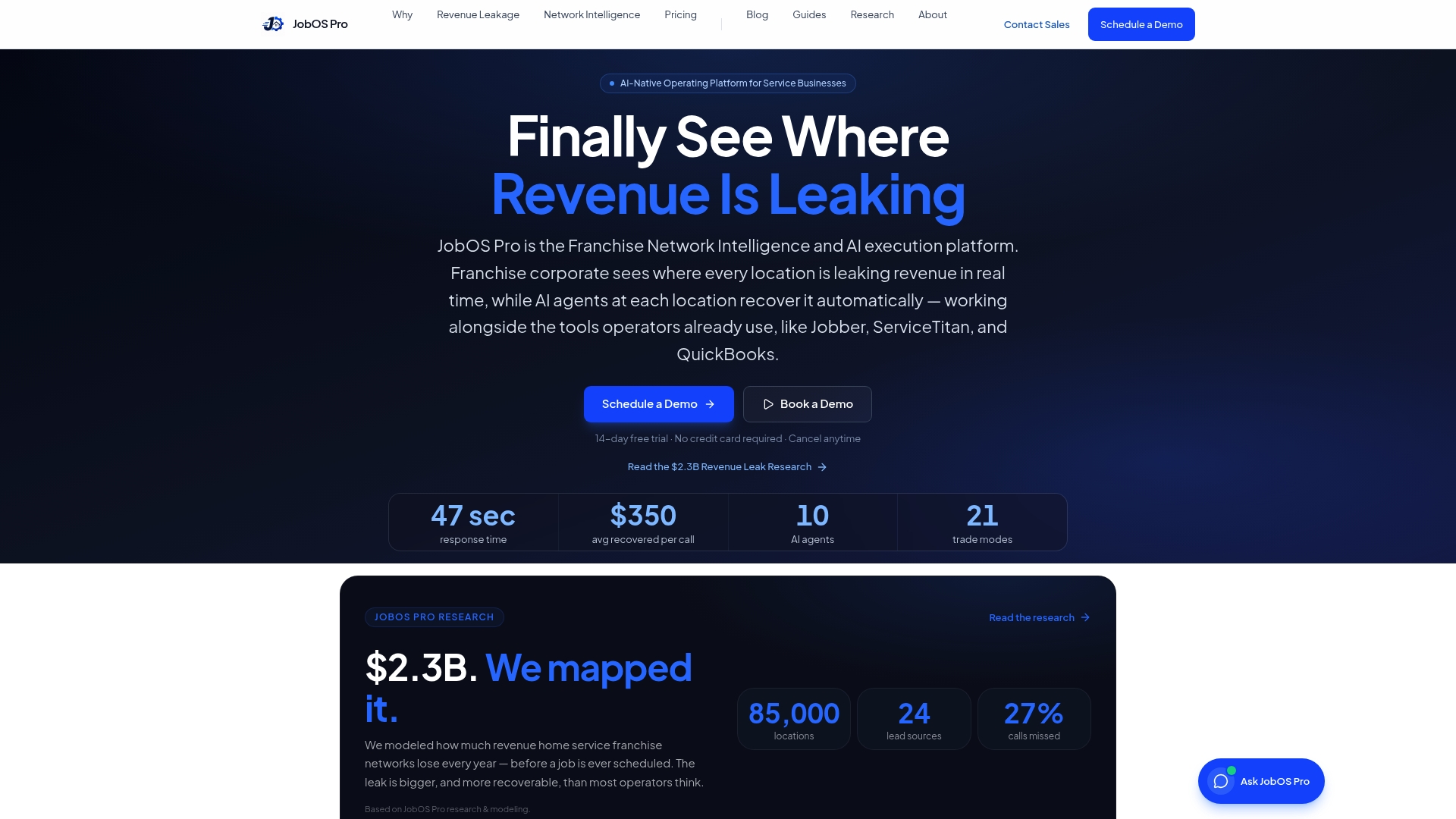
What that looks like in practice:
- We surface revenue leaks like missed calls, uncollected payments, and scheduling delays in real time instead of waiting for periodic reports.
- We connect to your existing stack rather than requiring replacement, so the webhook and mapping work you’ve already invested in keeps its value.
- Operators can access multi-location benchmarking, so corporate leaders can compare performance across locations and standardize what’s working.
If your team is deciding between building a custom pipeline and buying orchestration that handles the recurring work for you, see how it fits your stack on our features page or book a demo to walk through your specific FSM and CRM setup.
FAQ
What’s the difference between CRM and FSM?
A CRM manages customer relationships, sales pipelines, and communication history, while FSM (field service management) software manages dispatch, scheduling, and on-site job execution. They track different halves of the same customer relationship, which is exactly why integrating them matters.
What are the four types of CRM?
CRM platforms are commonly grouped into operational, analytical, collaborative, and strategic types, based on whether they focus on day-to-day processes, data analysis, cross-team communication, or long-term customer strategy. Most field service businesses use an operational CRM, since it directly supports sales and service workflows.
Can I integrate my CRM with VoIP?
Yes, many CRMs support VoIP integration so calls log automatically against customer records, which is especially useful for tracking missed calls and follow-up speed. The setup typically uses the VoIP provider’s API or a webhook similar to the patterns described above for FSM events.
What is CSM and FSM in ServiceNow?
In ServiceNow, CSM refers to Customer Service Management, which handles customer-facing support cases, while FSM refers to Field Service Management, which handles dispatch and on-site work tied to those cases. The two modules are designed to work together within the same platform, similar in concept to integrating a standalone FSM tool with an external CRM.
Sources
- FieldRoutes API documentation: How to Sync Your CRM | Rex Automaton
- QuickBooks + FSM integration: the patterns that actually work | Motomtech
- The CRM sync engine I had to reverse‑engineer: two‑step fetches, 50‑field limits, and a mapper that refuses to drift