Recover Missed Calls Across Franchises in 30/60/90 Days
Recover Missed Calls Across Franchises in 30/60/90 Days
The fastest way to recover missed calls is to answer more of them live, send an instant text-back on every miss, and run an automated follow-up cadence for the rest. Start by measuring how many calls you’re actually missing this week. Then use a system backed by findings from a $2.3 billion revenue-leak study to close the gap automatically.
TL;DR:
- Responding to missed calls within 60 seconds with automated text-backs significantly increases the chance of converting leads before competitors respond.
- Industry data shows missed-call rates often exceed 50 to 60 percent during peak seasons, with most voicemails left unreturned and unrecovered.
- Automating a three-layer system—answer routing, instant reply, and multi-touch follow-up—can recover about 15 percent of missed revenue, which could amount to thousands monthly.
- Tools must detect every missed call, trigger adaptive SMS replies, create lead records automatically, and escalate responses to humans for urgent cases to be effective.
- Standardizing this process across multiple locations lets franchises benchmark recovery performance and unveil high-leak, low-recovery outlets for targeted improvements.
Table of Contents
- How Big Is the Missed-Call Problem for Home Service Businesses?
- The Three-Layer System for Recovering Missed Calls
- What Technology Stack Makes This Repeatable Across Locations?
- How Do You Measure Recovered Revenue From Missed Calls?
- Your 30/60/90-Day Rollout Plan
- Why Franchises Win When They Standardize This
- Turning This Playbook Into an Automated System
- Sources
- FAQ
How Big Is the Missed-Call Problem for Home Service Businesses?
Most home-service operators are losing more money to unanswered phones than they realize. Aggregated call-tracking data shows missed-call rates for the industry frequently run above 50 to 60 percent during peak seasons, and most people who reach voicemail do not leave messages. That means a missed call is often just gone, not deferred.
Speed compounds the damage. Harvard Business Review’s research on the “five-minute rule” found that contacting a lead within five minutes of first contact dramatically increases the odds of qualifying them, compared to waiting even 30 minutes. A caller who hits your voicemail at 2 p.m. and hears nothing back until 4 p.m. has probably already called your competitor.
Run the math on your own numbers:
- missed calls monthly, typical booking rate if reached, and average ticket value
- That’s roughly $4,200 a month sitting in unanswered calls
- After-hours and emergency calls skew even higher value, since HVAC no-cool and plumbing leak calls rarely wait for business hours
Missed calls aren’t a phone problem. They’re a revenue problem wearing a phone problem’s disguise.
The Three-Layer System for Recovering Missed Calls
Recovering missed calls reliably takes three layers working together, not one clever fix. Analysis of home-service lead follow-up confirms that speed, cadence, and win-back are key levers that move the needle, and each one needs its own design.
- Answer and overflow routing. Staff your inbound lines realistically, then set overflow rules so calls beyond capacity route to a live answering service or AI receptionist instead of ringing out.
- Instant missed-call text-back. Fire an automatic SMS within 60 seconds of any miss, branch the message by urgency (“emergency” keywords route differently than “quote request”), and always allow two-way replies so the customer can respond in text.
- Documented multi-touch cadence. Call and text within minutes, follow with a same-day email, a day-one call, a day-two text, a value-add message in week one, and a win-back sequence if nothing lands.
Every layer needs a named owner. If a missed call gets a text-back but no one is assigned to watch for the reply, you’ve automated the miss instead of fixing it. Build escalation rules so unanswered text-backs after 15 minutes bump to a manager, not a void.
Pro Tip: *Write your text-back templates before you turn on automation. A generic “Sorry we missed you” reads as robotic.
What Technology Stack Makes This Repeatable Across Locations?
A missed-call recovery system only scales if the tools underneath it do five things without human intervention: detect the miss, trigger the text, create a lead record with the call recording attached, route urgent replies to the right person, and feed a reporting dashboard. Skip any one of those and the system breaks down the first busy week.
An AI receptionist earns its place here by collecting caller details, triaging urgency, and drafting the outbound message so a human only steps in when judgment is actually required. JobOS Pro’s AI receptionist, Kate, was built for exactly that role in franchise environments where call volume varies wildly by location.
The most common failure mode isn’t a missing feature. It’s an automated reply with no human escalation behind it, or a lead record that never syncs to the CRM the office actually works from.
Before rolling out anywhere, check for:
- A VoIP or call-tracking platform that logs every inbound call and its outcome
- An SMS provider capable of branching logic, not just a single canned reply
- A CRM or field-service platform that receives the lead automatically, no manual entry
- A reporting layer that shows missed-call volume and recovery rate by location
How Do You Measure Recovered Revenue From Missed Calls?
You need a baseline before you can prove anything worked. Invoca’s research on call outcomes makes the same point: without a measured starting point per location, you can’t prioritize staffing, routing, or automation spend with any confidence.
Track five numbers weekly: missed-call rate, response time, reply rate, recovered bookings, and revenue recovered.
| Metric | What it tells you |
|---|---|
| Missed-call rate | Share of inbound calls not answered live |
| Response time | Minutes between miss and first text-back |
| Reply rate | Percent of text-backs that get a customer response |
| Recovered bookings | Jobs booked from a call that was originally missed |
| Revenue recovered | Recovered bookings × average ticket |
A simple ROI formula: monthly missed calls times a conservative recovery rate times average ticket equals monthly revenue recovered. At a typical missed call count, recovery rate, and ticket value, hundreds to thousands of dollars could be recovered monthly, a figure worth watching against your actual text-back reply data rather than assuming.
Franchise networks should segment every one of these by location and by marketing source. A location with a high missed-call rate but strong recovery is different from one with low misses but weak follow-through, and corporate should be able to see the difference in one dashboard.

Your 30/60/90-Day Rollout Plan
Turning this from theory into a running system takes roughly a quarter if you sequence it right.
- Days 1 to 30: Baseline your missed-call volume, turn on instant text-back with a first-draft template, assign a callback owner for every shift, and set a hard escalation window (15 minutes, no reply, escalate).
- Days 31 to 60: Integrate your CRM or field-service platform so recovered leads sync automatically, automate the full multi-touch cadence, and configure after-hours routing with urgent-keyword escalation for emergencies.
- Days 61 to 90: Measure revenue recovered against your baseline, refine message wording based on reply rates, train staff on the escalation rules, and document a playbook to roll out to additional locations.
Pro Tip: Single-location operators can compress this to 45 days since there’s no rollout coordination required. Franchise networks should treat the first location as a pilot, then copy the exact configuration rather than reinventing it site by site.
Why Franchises Win When They Standardize This
Every location that runs missed-call recovery differently is a location you can’t benchmark. Once the playbook is standardized, a recurring revenue leak turns into a repeatable growth lever, because corporate can finally compare apples to apples across the network.
That’s the real payoff of multi-location intelligence: spotting the outlet with a 40 percent recovery rate next to one stuck at 10 percent, then rolling out what the first one does differently. The $2.3 billion revenue-leak figure isn’t an abstraction. It’s the sum of exactly this kind of inconsistency, multiplied across thousands of locations that never standardized their response.
— Tarun
Turning This Playbook Into an Automated System
Everything in the three-layer system above, detection, instant text-back, cadence, and reporting, can be run automatically without stitching together five separate tools yourself. Missed-call detection triggers the SMS instantly, an AI receptionist handles urgency triage and drafts the first reply, and every recovered lead syncs straight into your CRM or field-service platform without manual entry.
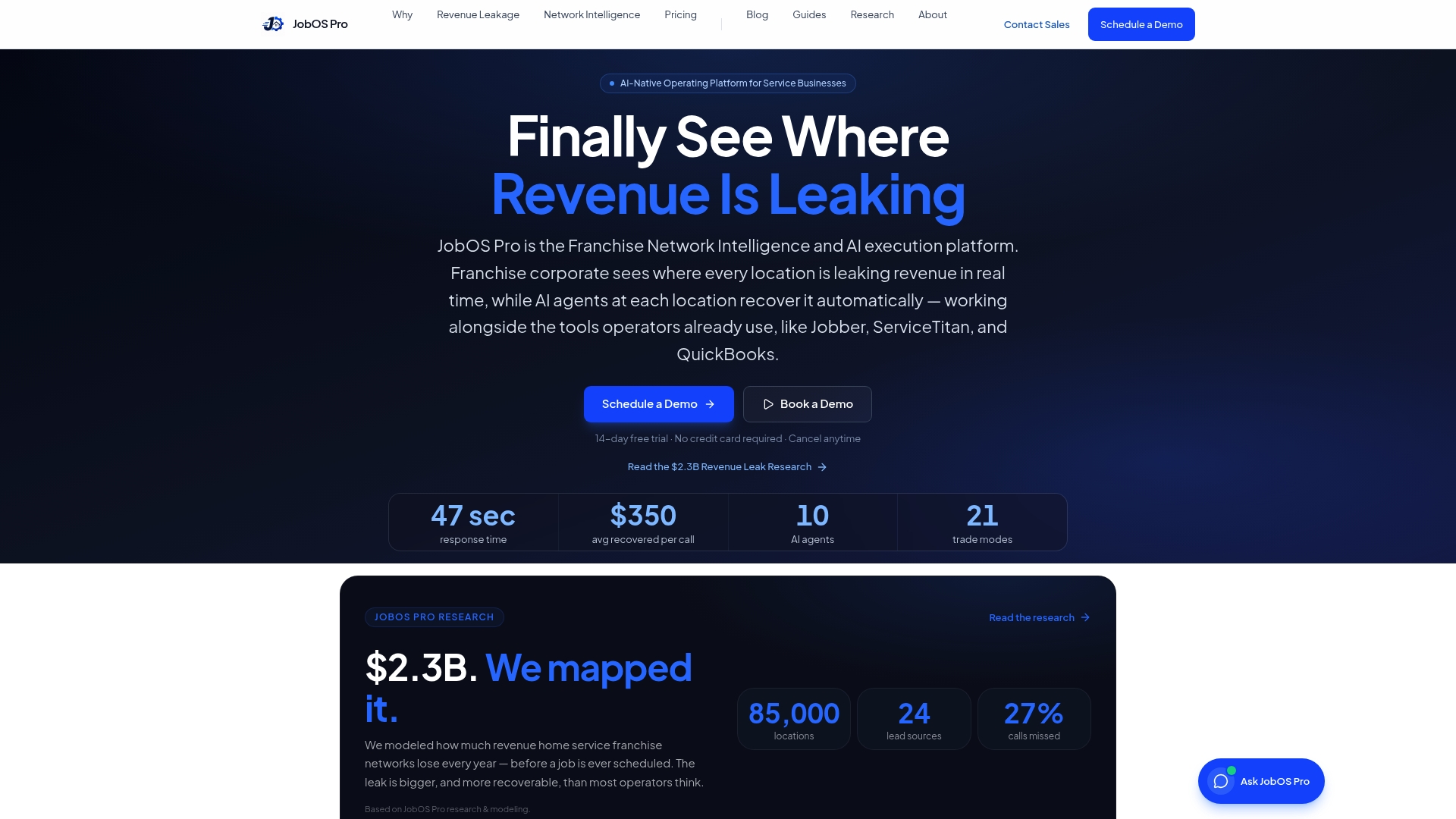
Franchise operators prefer an AI-native platform over a patchwork of point solutions for multi-location reporting that shows which outlets are recovering revenue and which ones are leaking it, in one dashboard instead of multiple. If you run a single location or a fifty-location network, the math from the revenue-leak report applies the same way, just at a different scale.
See what your own missed-call number is actually costing you, then book a demo to walk through how JobOS Pro’s missed-call recovery tools would run in your business.
Sources
- How much missed sales calls cost home services businesses — Invoca
- The short life of online sales leads — Harvard Business Review
- Missed call statistics for home service businesses — CallJolt
- Lead follow-up for home service businesses — MadeForBuilders
FAQ
How Fast Should a Missed-Call Text-Back Go Out?
Within 60 seconds of the missed call, ideally sooner, since delay is the single biggest reason a text-back fails to convert a still-active caller.
What’s a Realistic Recovery Rate for Missed Calls?
Start with a conservative 15 percent recovery assumption when calculating ROI, then adjust upward once your actual reply-rate data comes in.
Can an AI Receptionist Replace My Front Desk Staff?
Not entirely. An AI receptionist handles intake, triage, and drafting replies during overflow or after hours, but urgent or complex calls still need human escalation.
How Do I Know Which Location Is Leaking the Most Revenue?
Track missed-call rate, response time, and recovered bookings by location, then compare against your network average using a multi-location dashboard.