
Cut Missed Windows 36%: Scheduling Conflicts Fix for Home Services
Cut Missed Windows 36%: Scheduling Conflicts Fix for Home Services
The fastest way to resolve a scheduling conflict is to confirm the facts, reassign the job to the next available qualified technician, and notify the customer within minutes, not hours. JobOS Pro builds this triage into its dispatch workflow because research on time-window violation risk shows that conflicts compound fast once a technician falls behind, and the first ten minutes decide whether you keep the job or lose it.
TL;DR:
- Fixing scheduling conflicts quickly involves verifying booking details, reassigning to qualified nearby technicians, and notifying customers within minutes.
- Root causes include inaccurate job duration estimates, traffic delays, overlapping bookings, and technician capacity overloads, which can be identified through data audits.
- Setting time windows based on historical duration percentiles and limiting daily technician loads helps reduce recurring conflicts proactively.
- AI-native optimizers that jointly plan routing and time windows significantly cut violations with minimal additional travel time.
- Running small pilots to measure improvements in missed-window and reschedule rates can validate the effectiveness of automated scheduling solutions like JobOS Pro.
Table of Contents
- Same-day triage: what to do when a double-book hits your board
- Root-cause checklist: what data to inspect and the conflict types you’ll uncover
- Repeatable scheduling rules and team practices that reduce conflicts over time
- Technology approaches that actually prevent and resolve conflicts
- How JobOS Pro approaches scheduling conflicts
- Low-friction priorities when you can’t hire more technicians
- Next steps if you want a supported, scalable fix
- Sources
- FAQ
Same-day triage: what to do when a double-book hits your board
When two jobs collide on one technician’s schedule, speed matters more than perfection. Dispatchers who move fast usually save the appointment; those who wait for a cleaner answer usually lose it.
- Verify the facts. Pull the booking timestamp, promised time window, the technician’s current GPS location and ETA, and whether required parts are on the truck.
- Choose the lowest-impact fix available right now. That might mean swapping a nearby technician with matching qualifications, calling a trusted subcontractor, or offering the customer the next available window with a credit.
- Notify the customer immediately with a consistent script, confirm the new plan in writing, and log the incident for review later that week.
- Record the outcome. Note any discount, credit, or lost revenue tied to the conflict so you can see the pattern later, not just the fire you put out today.
Skill-match and parts availability override convenience every time: a technician who is closer but unqualified, or who has the wrong part, is not actually the faster fix.
Pro Tip: Keep a one-page “swap script” at every dispatcher’s desk so customer notifications sound the same no matter who is on shift.
Root-cause checklist: what data to inspect and the conflict types you’ll uncover
Same-day fixes stop the bleeding, but recurring double-books usually trace back to a handful of root causes:
- Stochastic service durations: jobs that run longer than estimated because repair work is inherently variable.
- Traffic and time-dependent travel: ETAs that assume free-flowing roads instead of real conditions at that hour.
- Overlapping or ambiguous time windows: two customers booked into windows that were never meant to coexist.
- Duplicate or manual-entry bookings: the same job entered twice across different channels.
- Qualification mismatches: a technician assigned to work outside their certification or experience.
- Capacity overload: too many jobs stacked on too few qualified technicians for that day.
To find which of these is driving your conflicts, audit your dispatch board’s change log, booking timestamps, historical job durations by job type, GPS and ETA history, your same-day reschedule rate, and your no-show or no-answer rate.
One figure worth calculating: take your last 90 days of job durations for a single job type, find the 85th percentile duration, and compare it against your current scheduled slot length. Research on stochastic technician routing shows that planning around fixed, optimistic durations instead of historical distributions is a primary driver of missed windows and overtime, so this gap is your early warning signal.
Repeatable scheduling rules and team practices that reduce conflicts over time
Fixing today’s conflict is reactive. Lowering tomorrow’s conflict rate takes policy.
- Set time windows from duration percentiles, not averages, and add a contingency allowance by job type so a long repair does not eat into the next customer’s slot.
- Gate assignments by skill and cap daily load per technician so no one is scheduled past what their certification or realistic capacity supports.
- Require parts verification before booking any long job, since a missing part is one of the most preventable causes of a blown window.
- Sequence routes deliberately: group nearby jobs, protect hard time-window commitments first, and never stack two risky long jobs back to back without a buffer.
- Define booking governance: decide who can override a time window, what approval that requires, and what the escalation path looks like when a dispatcher needs a fast answer.
Review every recovery offer, credit, or rescheduled appointment monthly and track whether it correlates with repeat business or churn. That review is where you learn whether your recovery policy is actually working or just expensive.
Pro Tip: Treat contingency time like insurance: a 15-minute buffer on long jobs costs little most days and saves the whole afternoon on the days it matters.
Technology approaches that actually prevent and resolve conflicts
Not every scheduling tool solves the same problem, and picking the wrong category often creates new friction instead of removing it.
- Basic field apps handle job assignment and status updates but leave routing and timing decisions to the dispatcher’s judgment.
- Advanced dispatch boards add visual scheduling and drag-and-drop reassignment, which helps with same-day triage but does not prevent the conflict from forming.
- Real-time reschedulers watch for delays as they happen and suggest adjustments before a window is missed.
- AI-native optimizers jointly solve routing and time-window assignment instead of treating them as separate steps.
That joint approach has measurable backing. Research on robust vehicle routing with time-window assignment found that optimizing routes and time windows together reduced time-window violations by about 36%, while total travel time rose by only about 4.3%, a trade-off worth making for any business where missed windows mean lost revenue.
For instances with hundreds of technicians and thousands of jobs, solving this optimization problem gets computationally hard fast. Recent decomposition research found that Logic-Based Benders Decomposition achieved significantly smaller average optimality gaps compared to standard branch-and-cut methods, on large technician-routing instances, which is why this class of algorithm underpins the newer generation of field-service optimizers.
Before piloting any of these, confirm the integration basics: live GPS feeds, two-way technician messaging, inventory or parts sync, and calendar blocking that actually talks to your booking channels with AI scheduling and field ops tracking. Start small, with one region or one job type, and compare before-and-after numbers on the metrics below.
| Metric | Why it matters |
|---|---|
| Time-window violation rate | Shows whether jointly optimized routing is actually reducing missed windows |
| Average travel-time overhead | Confirms the trade-off stays small, in line with the roughly 4.3% increase found in optimization research |
| Same-day reschedule rate | Flags whether conflicts are being caught earlier in the process |
| Optimality gap on large instances | Relevant if you are evaluating solvers for big multi-technician fleets |
How JobOS Pro approaches scheduling conflicts
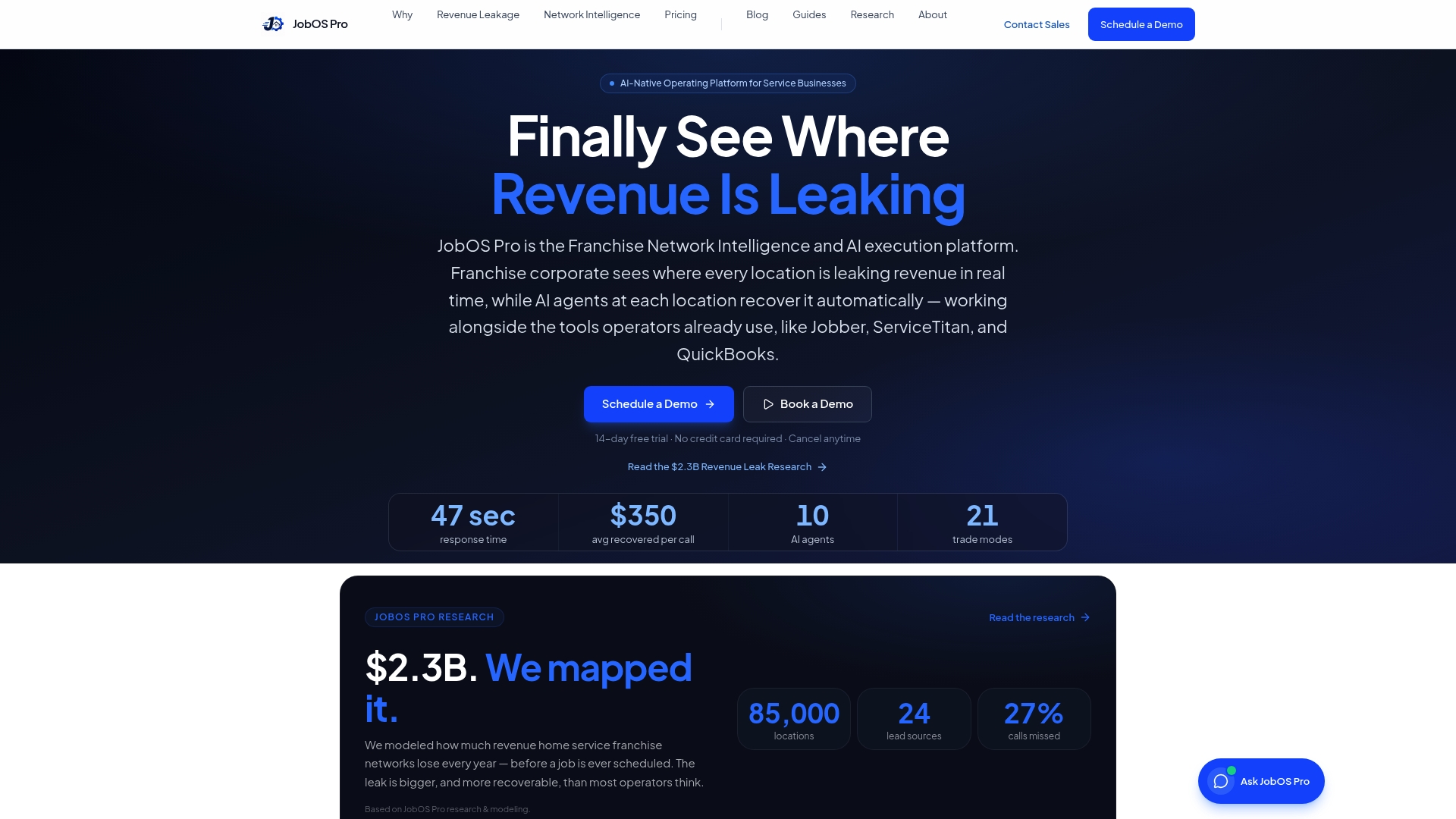
JobOS Pro is built AI-native, meaning the scheduling intelligence was designed into the platform from the start rather than bolted onto an older system afterward. It connects the tools you already run, including Jobber and QuickBooks, and surfaces revenue leaks such as missed calls, uncollected payments, and scheduling delays in one place instead of three separate dashboards.
For HVAC operators and other field-service businesses, that means automated rescheduling when a job runs long, dispatch alerts before a window is actually missed, and multi-location intelligence that lets franchise leaders compare performance and standardize what is working across sites.
A practical way to test it: run a 30-day pilot on one crew or one region, track your same-day reschedule rate and missed-window rate before and after, and let those two numbers decide whether to expand the rollout.

Low-friction priorities when you can’t hire more technicians
If headcount is fixed, the highest-leverage fixes are policy, not people. Contingency time buffers, tighter booking permissions, and automated customer confirmations consistently cut missed jobs more than squeezing every technician’s utilization rate does. Chasing utilization numbers looks productive on a dashboard, but it is schedule reliability that keeps revenue from leaking out the side door. Run a small, controlled pilot before committing to any platform change, and measure it honestly.
— Tarun
Next steps if you want a supported, scalable fix
An AI-native platform does the detection and recovery work automatically, flagging a scheduling delay before it becomes a missed job and running alongside the field-service and accounting tools you already use. That is the practical difference between a dispatch board you have to watch constantly and one that watches for you.
- Run a 30-day pilot on one crew and track your missed-window rate against your baseline.
- Compare your same-day recovery rate before and after adding automated rescheduling.
- Review JobOS Pro’s pricing, with plans from a moderate starting price on the Starter tier up to higher-priced options on the Pro tier, and custom Enterprise pricing for franchise networks.
If you would rather talk it through first, you can book a demo and walk through your current dispatch setup with the team.
Sources
FAQ
What is the fastest way to resolve a scheduling conflict?
Confirm the booking details, technician location, and parts status first, then reassign to the nearest qualified technician or offer the next available window. Notify the customer immediately with a consistent message so the fix feels proactive rather than apologetic.
What usually causes double-booked technicians?
The most common causes are underestimated job durations, overlapping time windows, duplicate manual entries, and assigning technicians outside their qualifications. Reviewing your dispatch board’s audit trail and historical job durations usually reveals which cause is driving most of your conflicts.
How can scheduling software prevent conflicts instead of just fixing them?
Platforms that jointly optimize routing and time windows, rather than handling them separately, have been shown to meaningfully reduce time-window violations for a modest increase in travel time. AI-native platforms like JobOS Pro add automated detection on top of that, flagging a likely delay before the appointment window is actually missed.
What metrics should I track to catch scheduling conflicts early?
Track your same-day reschedule rate, missed-window rate, and no-show or no-answer rate on a weekly basis. A rising trend in any of these usually points to a root cause worth investigating before it becomes a pattern of lost revenue.