
Recover Unbilled Revenue: Audit First Leak Analysis for Home Services
Recover Unbilled Revenue: Audit First Leak Analysis for Home Services
Revenue leak analysis is a focused audit that measures the dollars your business should have earned against what was actually billed and collected, then prioritizes recoveries. The deliverable is not a vague warning, it is a quantified gap and a ranked list of fixes. Stripe frames leakage as a detectable, preventable process failure rather than an accounting mystery, and that framing is the foundation of everything below.
TL;DR:
- Small process gaps, such as billing errors and missed renewals, are the main sources of revenue leakage rather than single catastrophic failures.
- Regular reconciliation of contracts, work logs, and sales data helps quantify and prioritize leakage for targeted fixes.
- Short-term actions like retro-billing and tightening collections can recover cash within weeks, while automation and integration prevent future leaks.
- Cross-functional collaboration across finance, operations, and sales is essential to diagnose and address leakage effectively.
- Using connected systems like JobOS Pro can automatically catch missed calls, unbilled jobs, and payment issues, reducing ongoing revenue loss.
Table of Contents
- What revenue leakage is and how to calculate it
- Common causes of revenue leakage with concrete examples
- How to identify and calculate leakage across your business
- How to prevent and fix revenue leakage with controls and automation
- Where leakage shows up across services, medical practices, and home businesses
- Why an audit-first, cross-functional approach is essential
- How JobOS Pro helps you find and recover lost revenue
- Sources
- FAQ
What revenue leakage is and how to calculate it
Revenue leakage is the gap between the revenue your contracts, price lists, or completed work entitle you to and the amount you actually invoice, recognize, or collect. Think of it as a pipe with small holes: the water leaving the source and the water reaching the tank rarely match, and the difference disappears quietly instead of showing up as an alarming event. Stripe’s explainer ties leakage to specific causes like billing errors, underpricing, and missed renewals rather than a single systemic flaw.
The core formula is simple: potential revenue minus actual billed or collected revenue equals leakage. Potential revenue comes from real records, not assumptions.
- Signed contracts and rate cards showing the agreed price.
- Time logs and job tickets showing work actually delivered.
- Current price files, discount rules, and usage data.
When leakage stems from an external event, such as a breach of contract or a lost customer relationship, the calculation shifts into lost-profits territory. That requires a defensible “but-for” projection and deduction of avoided costs, a distinct and more rigorous exercise than an internal operations audit, as PICPA’s guidance makes clear.
Common causes of revenue leakage with concrete examples
Leakage rarely comes from one dramatic failure. It comes from a dozen small process gaps that compound over a fiscal year. Mapping your own systems against this list is the fastest way to find where money is quietly disappearing.
- Billing and integration errors: a job management system and an accounting platform that do not sync cleanly, so line items get dropped or duplicated.
- Uncaptured billable work: technicians or consultants who complete work but never log the hours or materials against an invoice.
- Inaccurate price files: outdated rate cards that undercharge for a service the market has since repriced.
- Contract mismanagement: missed renewal dates, unenforced escalation clauses, or penalty terms nobody tracks.
- Failed payments and disputes: expired cards, bounced ACH transfers, or chargebacks that get written off instead of chased.
- Operational friction: missed calls that never become booked jobs, scheduling delays that push out billable work, and scope creep that goes unbilled.
Each of these has a distinct signature in your data. Billing errors show up as reconciliation mismatches between delivery records and invoices. Missed calls show up as a gap between inbound lead volume and booked appointments. Recognizing the signature narrows the audit fast.
How to identify and calculate leakage across your business
A useful audit starts with scope, not spreadsheets. Decide which revenue streams you are examining (recurring contracts, one-time project work, product sales), which systems hold the relevant data, and which stakeholders from finance, operations, and sales need a seat at the table before you pull a single report.
From there, the reconciliation workflow follows three checkpoints: what was sold or delivered, what was invoiced, and what was actually collected. Any drop between those checkpoints is leakage, and the size of the drop tells you where to dig first.
- For contracts, compare the agreed rate schedule against what invoices actually charged over the same period.
- For time-based work, compare logged hours or job tickets against billed hours.
- For product or inventory sales, compare units shipped or installed against units invoiced.
A handful of KPIs turn this from a one-time exercise into an ongoing measurement:
- Leakage as a percentage of total revenue.
- Days sales outstanding (DSO), tracking how long collections take.
- Invoice recovery rate, tracking what portion of disputed or corrected invoices actually gets collected.
- Billable-capture rate, tracking what share of delivered work makes it onto an invoice at all.
- Missed-call rate, tracking inbound leads that never convert into a booked job.
Reserve Banks recovered 110.6 percent of total priced-services costs in 2024, a reminder that even payment infrastructure with heavy oversight runs a formal cost-recovery calculation rather than assuming revenue and cost naturally balance.
Once you have sized the gaps, prioritize by plotting each finding on an impact-versus-effort matrix. A high-impact, low-effort fix, like re-invoicing a batch of unbilled jobs from the last quarter, jumps to the top. A high-impact, high-effort fix, like rebuilding a broken integration between your field system and your accounting platform, becomes a funded project rather than a task on someone’s list.
How to prevent and fix revenue leakage with controls and automation
Fixing leakage works in three time horizons, and treating them as one project is why so many recovery efforts stall.
Short-term fixes recover cash within weeks: retro-billing any completed-but-unbilled work you find in the audit, tightening your collection cadence for overdue invoices, and triaging disputed charges instead of letting them age into write-offs.
Medium-term changes close the gaps that created the leak: mandatory charge-capture rules so no job closes without a corresponding invoice line, scheduled price-file reconciliation against your actual rate cards, and automated renewal triggers so contracts never lapse silently.
Long-term investments prevent the leak from reopening: deeper system integrations between field operations and accounting, anomaly detection that flags invoices outside expected ranges, and automated payment retries for failed transactions.
- Retro-bill unbilled work found in the audit within the first two weeks.
- Set a recurring monthly reconciliation between price files and issued invoices.
- Automate renewal alerts 60 to 90 days ahead of contract end dates.
Governance holds all of this together. Assign a named owner for leakage monitoring, set service-level agreements for how fast a flagged discrepancy gets resolved, and train frontline staff, dispatchers, technicians, account managers, on why charge-capture discipline matters. A recurring maintenance billing example from the field-service sector, detailed in this billing guide, shows how clear recurring-invoice rules reduce the same kind of missed charges that plague one-off service work.
Pro Tip: Run your first reconciliation on the highest-dollar contract or client segment, not the easiest one. The biggest leaks are usually hiding in your most complex accounts.

Where leakage shows up across services, medical practices, and home businesses
The mechanics of leakage shift by industry, but the pattern of “delivered but not billed” repeats everywhere.
- Professional services: consultants under-log billable hours, projects close out weeks after the final invoice should have gone out, and scope changes get delivered without a change order.
- Medical practices: coding errors and charge-capture gaps at the point of care, payer denials that never get reworked, and patient balances that go uncollected after insurance pays its share.
- Home services: missed calls that never become booked estimates, jobs marked complete in the field but never invoiced, and parts or materials used on a job that never make it onto the bill.
Why an audit-first, cross-functional approach is essential
The mistake most businesses make is starting a leakage investigation inside the finance team alone. Accounts receivable shows you the symptom, a missing or late payment, but the cause almost always lives upstream in operations: a missed call, a dispatch delay, a job closed without a charge attached. Chasing the AR number without joining it to operational logs means fixing the same leak every quarter without ever closing it.
The better approach pulls finance, operations, and frontline management into one investigation from day one, with a 30-day milestone to size the gap and a 90-day milestone to fund the highest-priority fix. Once that first recovery pays for itself, and it usually does quickly, the case for medium-term automation investment makes itself.
— Tarun
How JobOS Pro helps you find and recover lost revenue
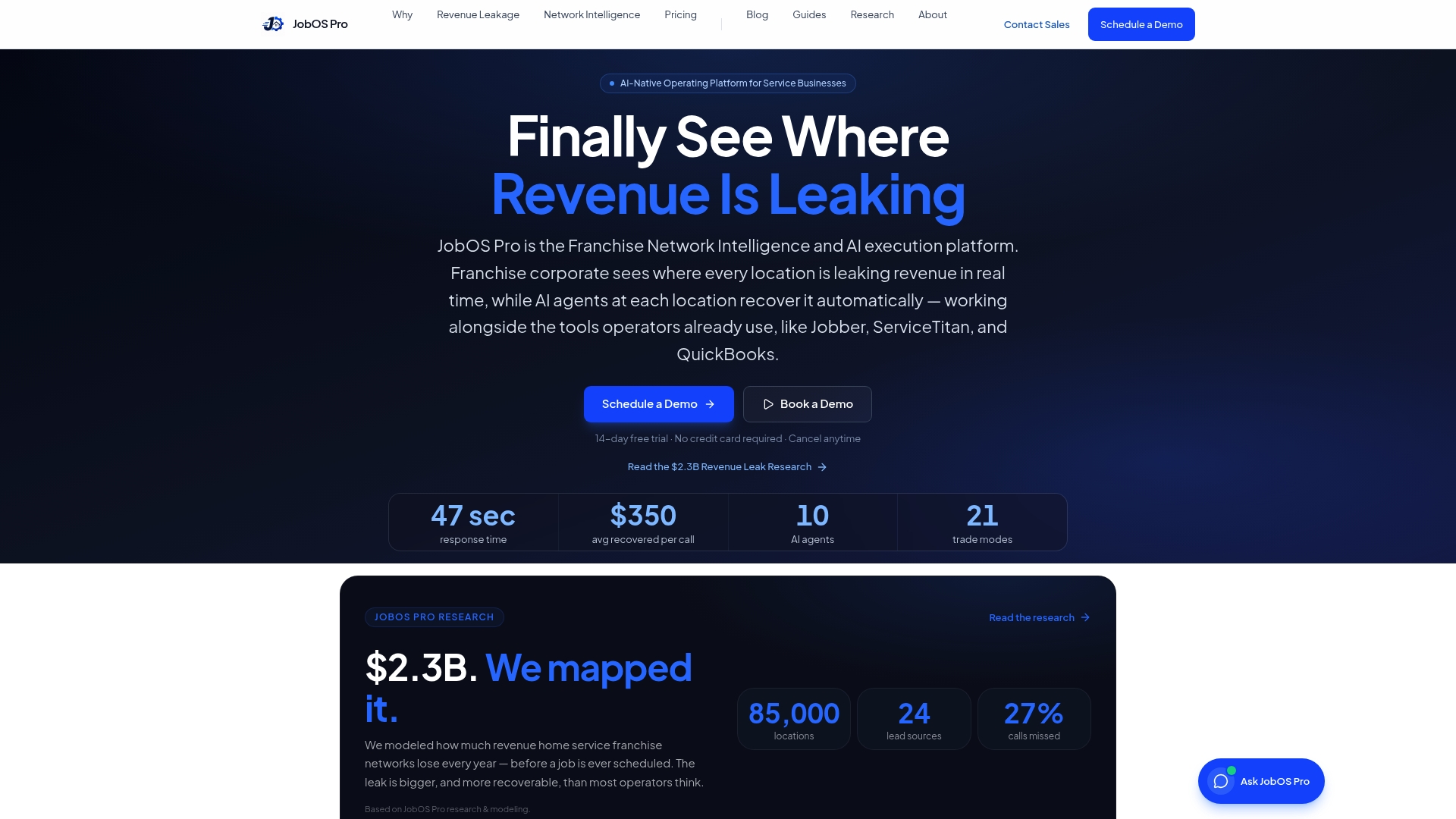
Everything in an audit-first playbook, missed-call capture, unbilled-job detection, invoice reconciliation, DSO tracking, points to the same conclusion: leakage is easiest to close when operations and billing data live in one system instead of five disconnected ones. That is the specific problem JobOS Pro is built to solve for home service businesses, connecting dispatch, invoicing, and payments so leaks get caught automatically instead of during a quarterly scramble.
- Capture missed calls and turn them into booked estimates instead of lost leads.
- Flag completed-but-unbilled jobs before they age into a write-off.
- Automate invoicing and payment retries to reduce DSO.
- Follow up on open estimates so quoted work actually converts.
JobOS Pro’s own $2.3 billion revenue leak study looked specifically at where home service franchise networks lose money, and the platform runs alongside tools like Jobber and QuickBooks rather than forcing a migration. If you want to see where your own leaks are hiding, book a demo or check the Starter, Growth, and Pro plans starting at $199 a month.
Sources
For deeper methodology, see Stripe’s leakage detection guide, PICPA’s lost-revenue calculation standards, and the lost-profits estimation paper for litigation-grade models.
- What is revenue leakage? Here’s how to detect it and prevent it — Stripe
- Calculating lost revenues in profit damages claims — PICPA
- Payment system and reserve bank oversight — Federal Reserve 2024 annual report
FAQ
What is revenue leakage?
Revenue leakage is the gap between the revenue a business should have earned under its contracts, prices, or usage terms and the amount actually billed, recognized, or collected. Common causes include billing errors, underpricing, and missed renewals.
How to stop revenue leakage?
Stopping leakage starts with an audit that reconciles delivered work against invoiced and collected amounts, then fixes the specific process gap each discrepancy points to. Short-term retro-billing and tighter collections handle the immediate cash, while mandatory charge-capture rules and system integrations prevent the same gap from reopening.
What does revenue leakage mean in the context of banks?
In banking and payment systems, revenue leakage relates to whether priced services recover their full operating costs, a distinction regulators track closely. The Federal Reserve’s 2024 oversight report shows Reserve Banks recovering slightly above their total priced-services costs that year, illustrating how cost-recovery percentages are formally measured at the institutional level.
How is a revenue leak different from a lost-profits claim?
A revenue leak is typically an internal process failure you can fix through better billing and reconciliation. A lost-profits claim requires a defensible “but-for” projection of what revenue would have been absent a specific external event, following PICPA’s more rigorous documentation standards.