
Scaling Beyond Human Limits: The Strategic Case for a Contractor Growth Platform AI in 2026
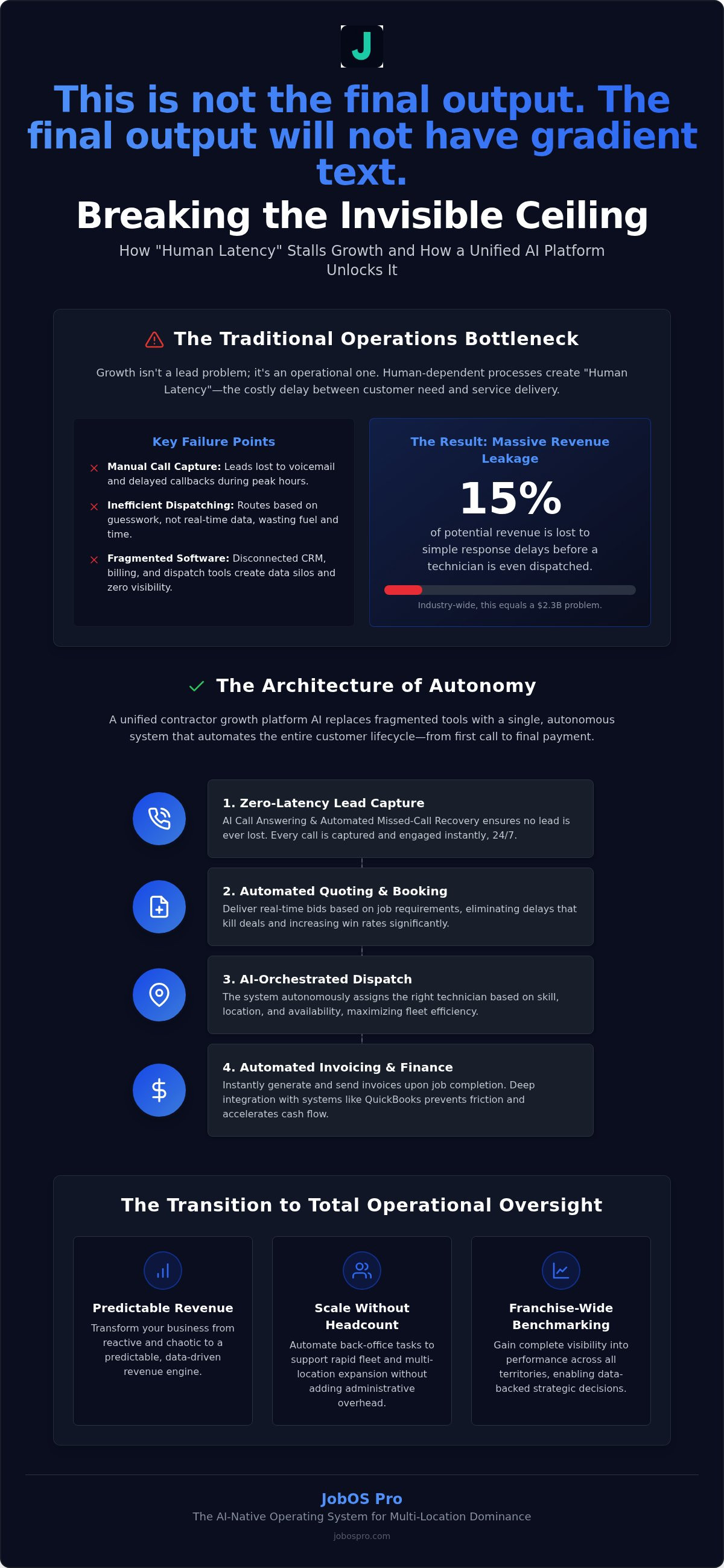
Human intuition is no longer a viable strategy for managing a multi-location home service enterprise. In 2026, the gap between market leaders and those struggling to survive is defined by operational latency. If your business relies on manual dispatching and human-led call capture, you're likely losing 15% of your potential revenue to simple response delays. Transitioning to a unified contractor growth platform AI isn't just a software upgrade. It's a foundational shift in how service businesses capture value and scale without adding headcount.
You've likely felt the frustration of watching high-quality leads vanish because a technician was misrouted or a call went to voicemail during a peak window. This is a systemic failure that traditional CRMs simply cannot fix. This article will demonstrate how an AI-native operating system eliminates these bottlenecks to drive exponential growth. We'll explore the transition from reactive management to total operational oversight, focusing on automated customer lifecycles and the predictable revenue models that define the next era of home services.
Key Takeaways
- Identify the specific "Human Latency" gaps in call capture and dispatch that prevent home service enterprises from scaling past their current operational limits.
- Discover why a unified contractor growth platform AI is required to replace fragmented point solutions with a single, autonomous business operating system.
- Analyze the strategic transition from manual field operations to AI-orchestrated dispatching through a real-world case study of rapid fleet expansion.
- Master a strategic evaluation framework for enterprise AI that prioritizes deep integration with legacy financial systems like QuickBooks over simple replacement.
- Learn how to leverage AI-native intelligence for franchise-wide benchmarking and total operational oversight across multi-location territories.
The Invisible Ceiling: Why Traditional Field Software Stalls Contractor Growth
Growth is not a lead generation problem. It's an operational bottleneck. Most home service enterprises fail to scale because they hit an invisible ceiling built on human-dependent processes. You can double your marketing spend, but if your intake and dispatch systems rely on manual intervention, you're merely accelerating your revenue leakage. This "Human Latency" gap represents the time lost between a customer's need and a technician's arrival. In 2026, this delay is the primary driver of customer churn. Adopting a unified contractor growth platform AI is the only way to break through this ceiling. It replaces passive databases with active, autonomous intelligence that observes and corrects inefficiencies in real time.
For multi-location enterprises, the cost of fragmented tool stacks is catastrophic. When your call center, dispatch board, and billing software don't communicate, visibility vanishes. Leadership is left guessing about technician utilization and lead conversion rates. This lack of oversight creates a systemic drag on performance. True scalability requires Business process automation (BPA) to unify these disparate elements into a single, high-velocity engine. Without this architectural foundation, your business remains limited by the speed of human coordination.
The $2.3B Revenue Leakage Problem
Home service companies lose roughly 15% of their potential revenue before a technician ever reaches the job site. This leakage stems from missed calls and delayed follow-ups. Modern consumers operate on a zero-latency expectation. If an HVAC or plumbing provider doesn't respond within seconds, the lead moves to the next competitor. The psychological impact of a "we'll call you back" message is a lost booking. Manual scheduling errors compound this issue. When dispatchers rely on memory or static maps, technician routes are never truly optimized. This inefficiency translates into billions in lost opportunities across the industry every year.
Legacy Debt: The Failure of Passive CRM Systems
Your current residential service business software was likely designed as a digital filing cabinet. It requires humans to input data, move status bars, and send manual invoices. This is legacy debt. Modern growth requires a shift toward automated operational intelligence. Instead of a tool that simply records what happened, you need an engine that makes things happen. Manual invoicing and billing create friction that slows your cash flow and frustrates customers. A contractor growth platform AI removes these hurdles, transforming your back office from a passive cost center into a proactive growth driver.
The Architecture of Autonomy: How a Unified AI Platform Orchestrates Growth
A contractor growth platform AI is not a collection of disconnected tools. It is a unified, AI-native operating system that automates the entire lifecycle of a home service job. While legacy systems rely on human operators to bridge the gap between a phone call and a scheduled appointment, an autonomous architecture removes this friction entirely. We are seeing a move beyond fragmented point solutions toward integrated systems that observe, retrieve, and act without manual intervention. This shift aligns with guidance from the U.S. Small Business Administration regarding the use of AI to compensate for labor shortages and increase operational efficiency. By unifying lead capture, dispatch, and estimating, enterprises can maintain a high-velocity growth trajectory that is impossible to sustain with human-led processes.
Zero Latency Lead Capture
Capture is the first point of failure for most enterprises. AI call answering ensures that every lead is met with an instant, expert-level response, regardless of volume. This is a revenue protection strategy. Automated missed-call recovery identifies and retrieves leads that would otherwise vanish into a competitor's funnel. Once captured, the system moves immediately to automated quoting. By delivering bids in real time, you increase win rates and eliminate the latency that kills deals. Businesses looking to implement these high-stakes automations should consider how JobOS Pro integrates these disparate elements into a single source of truth.
Intelligent Resource Allocation
True autonomy extends into the field through intelligent technician dispatching. In 2026, manual scheduling is an obsolete practice that creates unnecessary overhead. Dynamic route optimization uses real-time data to maximize technician utilization while minimizing drive time between calls. The system doesn't just look at proximity. It matches specific technician skill sets to job requirements automatically. This ensures the right person is on the right job every time, reducing callbacks and increasing first-time fix rates. This level of orchestration is the hallmark of a mature contractor growth platform AI. It transforms field operations from a logistical headache into a predictable, scalable engine of revenue.
Case Study: Transforming Operational Intelligence into Exponential Revenue
Scaling a home service enterprise from 5 to 50 trucks is not a linear progression. It is a structural transformation. For one multi-location HVAC firm, the transition from manual coordination to a unified contractor growth platform AI was the primary catalyst for this ten-fold expansion. They recognized that human-led dispatching and intake couldn't maintain the pace required for market dominance. By shifting to an AI-orchestrated model, they replaced logistical friction with a silent, high-performance engine of operational oversight. This allowed leadership to focus on strategic acquisition rather than daily firefighting.
The impact on bottom-line profitability was immediate. By automating invoicing and payment collection, the firm eliminated the traditional "cash flow drag" associated with manual billing cycles. They leveraged executive reporting to identify high-performing franchise benchmarks, allowing them to replicate the success of their top territory across the entire network. This data-driven approach transformed their field operations from a cost center into a predictable, scalable revenue driver.
Phase 1: Plugging the Leaks
The enterprise first addressed the systemic revenue leakage that plagues most growing contractors. Industry research confirms that home service companies typically lose 15% of their potential revenue to missed calls and slow follow-ups. By implementing AI call answering, the firm captured every lead, including high-value weekend and after-hours opportunities that previously went to competitors. They standardized response times across all service locations, ensuring that every customer received an instant, expert-level reply. This shift drastically reduced administrative overhead. It freed office staff from the burden of initial customer intake, allowing them to focus on high-stakes customer service issues instead.
Phase 2: Optimizing the Field
The second phase involved a total overhaul of field logistics. Manual scheduling often results in low technician utilization and excessive drive times. By deploying AI-driven scheduling, the firm achieved a 20% increase in technician utilization within the first quarter. The contractor growth platform AI matched specific technician skill sets to job requirements and optimized routes in real time. Automated estimating further accelerated the sales cycle, reducing the bid-to-close period by an average of 48 hours. This speed, combined with automated reputation management, created a self-sustaining referral engine that sustained their aggressive growth targets through 2026.
Evaluating Enterprise AI: A Strategic Framework for Home Service Leaders
Selecting a contractor growth platform AI requires a fundamental shift in executive perspective. You aren't simply purchasing a new tool for your technicians. You're investing in a foundational architecture that will dictate your ability to scale across multiple territories. The most critical requirement for any enterprise-grade system is its ability to integrate with your existing financial stack. Your AI must play nice with QuickBooks to ensure that automated billing and payment data flows seamlessly into your accounting records without manual entry. It shouldn't attempt to replace your financial truth. It should accelerate it through total data visibility.
Scalability is the next major hurdle. For multi-location franchises, the platform must provide robust benchmarking capabilities. You need to see how performance varies across different operational hubs or service regions regarding technician utilization and lead conversion. Executive reporting requirements for trade businesses in 2026 demand more than just surface-level metrics. You need deep, real-time insights into operational latency and revenue leakage patterns. Data security is equally paramount. As AI systems observe more of your business operations, ensuring that this data is siloed and protected is a non-negotiable strategic requirement.
AI-Native vs. AI-Added: The Critical Distinction
Many legacy CRMs have recently introduced "bolt-on" AI features to keep pace with the market. These features often fail because they don't solve the problem of deep operational silos. An AI-native system is built from the ground up on a unified data model. This architecture is essential for accurate cross-location reporting. If the AI isn't part of the core engine, it can't effectively manage complex tasks like recurring service memberships or membership retention sequences. Evaluating a platform’s ability to orchestrate these high-stakes lifecycles is the only way to ensure long-term growth.
The ROI of Operational Automation
The return on investment for a contractor growth platform AI is found in the compression of your operational cycles. You must calculate the return on automated invoicing and billing by looking at your reduced "days sales outstanding" (DSO). Faster payment collection directly improves your liquidity. Furthermore, reducing technician churn through better scheduling and route optimization saves thousands in recruitment and training costs. The long-term value of automated customer follow-up sequences cannot be overstated. By maintaining constant, automated contact with your client base, you build a self-sustaining revenue stream that requires zero manual intervention. Schedule a strategic consultation to see how JobOS Pro unifies your enterprise operations.
JobOS Pro: The AI-Native Operating System for Multi-Location Dominance
Scaling a multi-location enterprise requires more than just increased headcount. It requires a central nervous system. JobOS Pro stands as the definitive AI business management for home services, designed specifically to eliminate the operational gaps that stall growth. By unifying lead capture, intelligent dispatching, and automated financial workflows into a single high-stakes platform, JobOS Pro provides the total visibility required to manage complex territories. It is no longer enough to react to data after the fact. This contractor growth platform AI observes every interaction in real time, retrieving lost opportunities and correcting inefficiencies before they impact your bottom line.
The strategic advantage of JobOS Pro lies in its 100% automated customer lifecycle oversight. From the moment a lead is captured via AI call answering to the final payment collection, the system maintains total control. This level of orchestration ensures that no lead is dropped and no technician is underutilized. Multi-location enterprises gain a decisive edge through real-time executive dashboards that provide a granular view of performance across the entire network. This isn't just software. It's a strategic operating system built for those who refuse to be limited by human operational capacity.
Built for the Modern Trade Business
Leaders in the HVAC, plumbing, and electrical sectors choose JobOS Pro because it's built for the unique demands of high-volume trade services. Scaling to 50 or 100 trucks requires standardized excellence. JobOS Pro leverages franchise benchmarking to drive network-wide performance, allowing you to identify and replicate the exact operational patterns of your top-performing branches. The system matches technician skill sets to job requirements with surgical precision, ensuring that first-time fix rates remain high even as you expand. The future of autonomous field service management starts with a platform that can handle the complexity of a modern, multi-location enterprise without breaking a sweat.
Next Steps for Strategic Growth
The transition from operational chaos to tech-driven assurance begins with a decision to abandon legacy debt. If your current systems require manual handoffs and constant human intervention, you're already falling behind. Transitioning to an AI-native operating system allows you to recapture the 15% of revenue typically lost to operational latency. You'll gain the ability to scale your revenue without a proportional increase in administrative costs. The architecture of 2026 demands a unified approach to growth. Stop managing silos and start orchestrating an autonomous enterprise. Experience the future of contractor growth with JobOS Pro.
The Future of Autonomous Scale
In 2026, the distinction between market leaders and stagnant enterprises is their approach to operational latency. You've seen how human-dependent processes create an invisible ceiling that throttles growth and permits 15% revenue leakage through missed opportunities. Moving beyond legacy debt requires a foundational shift toward a unified contractor growth platform AI. This isn't just about adding features. It's about deploying a central nervous system that observes and corrects your entire operational lifecycle in real time.
True multi-location dominance relies on total visibility and automated action. By integrating an AI-native operational suite, you replace operational chaos with tech-driven assurance. You gain the power of executive franchise benchmarking and automated revenue protection that scales with your ambition. The era of manual coordination is ending. The era of autonomous field service is here. It's time to reclaim your lost revenue and build a predictable, high-velocity enterprise. Your competitors are already automating. Don't let your growth be limited by the speed of human intuition.
Scale your home service enterprise with JobOS Pro
Frequently Asked Questions
What is a contractor growth platform AI?
A contractor growth platform AI is a unified, AI-native operating system designed to orchestrate the entire lifecycle of a home service business. Unlike traditional software that acts as a passive database, this platform serves as an active engine that automates lead capture, technician dispatching, and financial workflows. It eliminates the operational silos that typically stall growth in HVAC, plumbing, and electrical enterprises.
How does AI call answering prevent revenue leakage for contractors?
AI call answering provides an instant, expert-level response to every incoming lead, ensuring zero missed opportunities. By capturing leads that would otherwise go to voicemail or a competitor, it retrieves the 15% of revenue typically lost to human latency. This system identifies high-value leads in real time and moves them directly into the scheduling funnel without manual intervention.
Can AI-native platforms integrate with my existing accounting software like QuickBooks?
Yes. A sophisticated contractor growth platform AI is designed to play nice with your existing financial stack. It automates invoicing and payment collection while ensuring that all data flows seamlessly into QuickBooks. This integration maintains your financial truth while removing the friction of manual data entry and reducing your days sales outstanding.
How does intelligent dispatching improve technician utilization?
Intelligent dispatching uses real-time data to match specific technician skill sets with job requirements while simultaneously optimizing routes. It minimizes drive time and maximizes billable hours by reacting to traffic patterns and job progress instantly. This level of orchestration ensures your most skilled technicians are always on the highest-stakes jobs, directly increasing your overall fleet efficiency.
Is an AI platform suitable for multi-location or franchise home service businesses?
It's specifically engineered for them. These platforms provide the executive reporting and franchise-wide benchmarking required to manage multiple territories with total visibility. Leadership can observe performance patterns across all locations from a single dashboard, allowing them to replicate the success of high-performing branches across the entire network.
What is the difference between a standard field service CRM and an AI-native operating system?
A standard CRM is a digital filing cabinet that requires constant human input to remain useful. An AI-native operating system is an autonomous layer that sits at the core of your business stack. It doesn't just record what happened. It observes, retrieves, and corrects operational gaps automatically to ensure the business continues to scale beyond human limits.
How does automated estimating help win more bids for HVAC and plumbing jobs?
Automated estimating eliminates the latency that kills deals. By providing instant, accurate quotes during or immediately after a site visit, you capture the customer's intent at its highest point. This speed prevents prospects from shopping your bid with competitors and has been shown to reduce the bid-to-close cycle by as much as 48 hours in some enterprises.
What are the security implications of using AI for home service business management?
Enterprise-grade contractor growth platform AI systems prioritize data siloing and high-level encryption. These platforms are built to meet the rigorous security requirements of modern trade businesses, ensuring that sensitive customer data and financial records remain protected. This tech-forward approach provides the oversight needed for growth without compromising the integrity of your business data.