
Stop Chasing Payments: 5 Habits for Service Payment Collection Teams
Stop Chasing Payments: 5 Habits for Service Payment Collection Teams
Service payment collection is the set of processes a business uses to turn completed work into cleared cash: invoicing, payment acceptance, reminders, and reconciliation. The single highest-leverage move is pairing immediate, itemized invoicing with a frictionless online payment link and automated follow-up. Businesses that do this consistently cut days sales outstanding and stop leaking revenue to forgotten balances.
TL;DR:
- Automated, immediate invoicing combined with easy online payment links significantly reduce the time between job completion and cash collection.
- Systems that sync payments instantly with accounting software eliminate reconciliation delays, decreasing days sales outstanding.
- Using multi-channel payment acceptance, including card and ACH, along with automated, staged reminders improves recovery rates and customer experience.
- Maintaining daily reconciliation and a disciplined follow-up process helps brands identify and resolve issues before they escalate, avoiding revenue leakage.
- Compliance with FDCPA and PCI DSS standards is essential for lawful, secure collection practices within US regulations.
Table of Contents
- What Does Service Payment Collection Actually Involve?
- What Capabilities Should a Modern Collection System Have?
- How Do You Build a Collections Process That Actually Works?
- What Compliance and Security Rules Apply to US Collections?
- How Do You Choose the Right Payment Collection Approach?
- How JobOS Pro Turns Collection Gaps Into Recovered Revenue
- Preserving Relationships While Recovering Revenue
- Ready to Stop Chasing Payments Manually?
- Sources
- FAQ
What Does Service Payment Collection Actually Involve?
Payment collection isn’t one task. It’s a chain of five linked steps, and a break in any link costs you money.
Invoicing starts the clock. The invoice needs to go out the moment work is done, not three days later when the technician finally submits a paper ticket. Payment acceptance rails come next: credit and debit cards, ACH bank transfers, and increasingly digital wallets. Self-service portals let customers view balances and pay without calling anyone. Automated reminders nudge people before and after a due date. Reconciliation matches every incoming payment to its invoice so your books are accurate in real time. Escalation handles the balances that reminders don’t resolve.
The typical flow looks like this: an estimate gets approved, a job gets scheduled and completed, an invoice generates automatically from the job record, a payment link goes out by text or email, the customer pays, and the payment posts back to the invoice and syncs to the accounting system. When that chain runs cleanly, most invoices close within days.
Most service businesses lose money at three predictable points:
- Manual data entry between the field, the office, and the accounting system, which introduces delays and errors.
- Missing or buried payment links, forcing customers to call in or mail a check because there was never a one-tap way to pay.
- Reconciliation lag, where payments sit unmatched for days or weeks, hiding the true state of accounts receivable and making follow-up on genuinely overdue accounts harder.
A payment collection process that closes these three gaps typically shortens the entire cycle from job completion to cleared cash by days, not weeks. That difference compounds fast across hundreds of jobs a month.
What Capabilities Should a Modern Collection System Have?
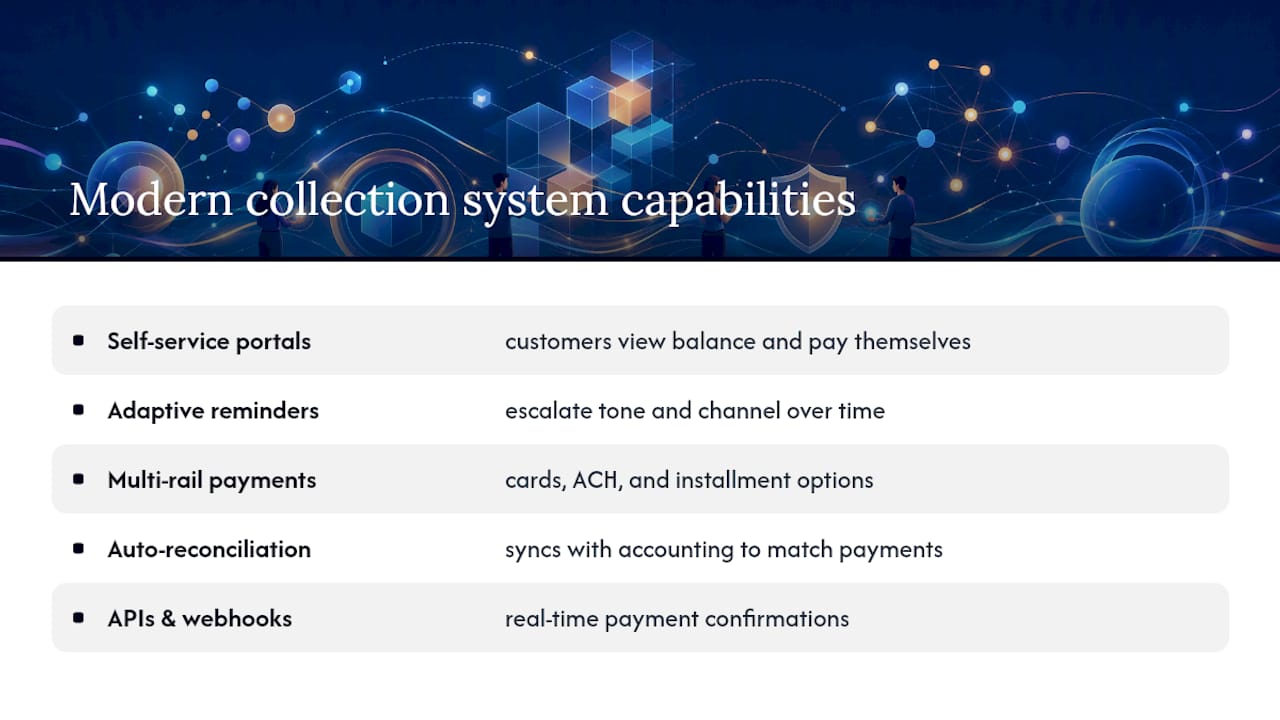
The technology behind payment collection has moved well past “email an invoice and hope.” Systems built for service businesses in 2026 share a common set of capabilities, and any gap in this list is a gap in your cash flow.
Self-service portals and payment links top the list. Customers increasingly expect to view a balance and pay it themselves, on their schedule, without a phone call. Industry analysis of agency-grade collection systems confirms this shift: self-service portals and configurable workflows now drive most of the efficiency gains agencies see, because they cut the manual work required to close a single balance (Tratta).
Automated, adaptive reminders matter almost as much. A good system doesn’t blast the same message on day one and day sixty. It escalates tone and channel over time, starting with a friendly email and moving toward text or a phone call only as a balance ages.
Multi-rail acceptance removes friction on the customer’s end. Cards and ACH transfers should both be available, and for larger service tickets, an installment or payment-plan option keeps a big balance from becoming a stalled one.
Auto-reconciliation is where the real time savings hide. Matching incoming payments to invoices manually is tedious and error-prone at any real volume. Systems that sync with accounting software like QuickBooks eliminate that bottleneck entirely, and the operational impact is well documented: automated reconciliation removes a common administrative chokepoint for service businesses processing dozens or hundreds of invoices a month (Method).
APIs, webhooks, and reporting round out the list. Webhook-based payment confirmation, in particular, is one of the fastest, highest-impact changes a field-service company can make, because it matches settlements to invoice numbers the moment money moves rather than hours or days later (Atradius Collections).
Pro Tip: Ask any vendor demo to show you the reconciliation dashboard first, not the invoicing screen. Invoicing is the easy part. Reconciliation is where most systems quietly fail at scale.
A dashboard tracking DSO, aging buckets, and recovery rate by technician or crew turns collections from a monthly fire drill into a metric you manage weekly.
How Do You Build a Collections Process That Actually Works?
Good collections practice is mostly discipline, applied consistently, across five habits.
- Invoice the same day, every time. An invoice sent within hours of job completion gets paid faster than one sent three days later, simply because the work is still fresh in the customer’s mind.
- Put the payment link everywhere. Email, SMS, and the estimate follow-up message should all carry a direct pay link. Every extra click a customer has to make to find how to pay is a chance for the payment to get postponed indefinitely.
- Offer payment plans for larger tickets, with consent documented. A written or digitally signed agreement on the schedule and amounts protects both sides if a dispute comes up later.
- Design a staged outreach sequence, not a single reminder. Specialists in collection operations consistently recommend a mix of letters, email, SMS, and calls, paired with clear payment-plan offers, as the pattern that recovers the most while generating the fewest complaints (Atradius Collections).
- Reconcile daily, and flag exceptions immediately. A short daily routine, ten or fifteen minutes, where someone matches payments to invoices and flags anything unmatched, catches problems while they’re still small.
Staff training matters as much as the software. The people making follow-up calls need to understand that a respectful, consistent process outperforms an aggressive one. Agencies that blend digital outreach with human contact, using what one major agency calls an empathy-first, multi-channel model, report higher recovery rates alongside lower complaint volumes (IC System). That’s not a soft trade-off. It’s the more profitable approach.
Keep an audit trail of every touchpoint: what was sent, when, and how the customer responded. That record protects you in a dispute and tells you which parts of your sequence are actually working.
Set up payment reminders that recover unpaid invoices around this same staged logic, and you’ll spend far less time chasing balances that a well-timed nudge would have closed on its own.
What Compliance and Security Rules Apply to US Collections?
Any organization collecting service payments in the United States operates inside a real regulatory framework, not a set of best-practice suggestions.
Once outreach starts, communications must respect the Fair Debt Collection Practices Act (FDCPA) and its newer companion rule, Regulation F. The FTC hosts the FDCPA text and related guidance, which defines what counts as unlawful contact, including harassment, misleading statements, and contact at unreasonable hours. The Federal Reserve also publishes fair-debt guidance that’s useful for documenting how disputes and communications should be recorded. The CFPB’s annual FDCPA report tracks enforcement trends and the compliance mistakes regulators flag most often.
On the payment-processing side, any business handling card data needs to account for PCI DSS, the Payment Card Industry Data Security Standard. The Council’s PCI DSS v4.0.1 update changed validation requirements for card-data environments, which means vendors and in-house teams both need to confirm they’re working from the current version, not an outdated checklist.
Practical compliance essentials:
- Confirm any collections vendor holds current PCI DSS certification for card processing and a SOC 2 report for data handling, since together they cover the operational and security controls that matter most in US collections (IC System).
- Never contact a customer at a time or frequency the FDCPA would flag as harassment, even if the balance is small.
- Log every communication attempt, including date, channel, and outcome.
- Give customers a clear, documented process to dispute a charge, and pause escalation while a dispute is genuinely under review.
How Do You Choose the Right Payment Collection Approach?
The right approach depends on three things: how many invoices you process, how complex your billing is, and how much of this you want to run in house versus hand off.
A business invoicing a few dozen jobs a month can usually run automated reminders and payment links from its own field service software. A business processing hundreds of invoices across multiple crews or locations needs deeper integration and, often, a tiered escalation path that includes a third-party recovery service for the oldest balances.
When evaluating a vendor or a platform upgrade, weigh these criteria:
- Integration depth with your existing scheduling, invoicing, and accounting tools, not a standalone system that requires duplicate data entry.
- Reconciliation speed, ideally near real time through webhooks rather than a batch process that runs once a day.
- Security and compliance posture, meaning current PCI DSS validation and a recent SOC 2 report on file.
- Settlement timing, since some processors hold funds for days before they land in your account.
- Pricing transparency, especially around per-transaction fees and any contingency percentage on recovered balances.
Bring these questions to any vendor conversation or formal RFP:
- What systems do you integrate with out of the box, and what requires custom development?
- How fast does a payment reconcile against an invoice after it clears?
- Can you provide current PCI DSS and SOC 2 documentation?
- What’s your SLA for responding to and resolving a customer dispute?
- Is pricing flat, tiered, or contingency-based, and how is that disclosed upfront?
Watch for two red flags: vague answers about data security certifications, and contingency structures with no staged option. A staged model, letters-only outreach first, contingency-based escalation only after, lets you test recovery throughput before committing to a fee on every dollar recovered.
How JobOS Pro Turns Collection Gaps Into Recovered Revenue
Most of the capabilities that separate a strong collections process from a leaky one, self-service payment links, automated escalation, real-time reconciliation, aren’t features you bolt onto existing software. They work best when they’re built into the same system that runs your scheduling and dispatch, because that’s where the revenue actually starts leaking.
JobOS Pro is built AI-native for exactly that reason. It connects to tools you likely already run, like Jobber and QuickBooks, and layers automated recovery on top rather than asking you to replace your stack. That matters because the biggest leaks, missed calls that never became invoices, payments that sat unreconciled for weeks, follow-ups nobody sent, tend to hide between systems rather than inside any single one of them.
A revenue leak study covering $2.3 billion in service business revenue found these gaps recurring across companies of every size, which is part of why JobOS Pro’s AI agents focus on catching them automatically instead of relying on a staff member to notice.
For teams evaluating whether an AI-native approach fits their operation, a short pilot should track key metrics like days sales outstanding, reconciliation speed, and recovery of missed or unbilled jobs through automated capture.
Franchise operators get an added layer: multi-location intelligence that lets corporate leadership see which locations collect fastest and standardize that behavior across the network, using the franchise operations platform.
Preserving Relationships While Recovering Revenue
The instinct in a lot of finance departments is to treat collections as a binary: be aggressive and get paid, or be gentle and get paid late. That instinct is wrong, and the data backs up why.
Agencies that lean into consumer-friendly, multi-channel outreach, blending digital touchpoints with real human contact, consistently report both higher recovery rates and lower complaint volumes than agencies running a single aggressive script. The lesson generalizes past collections agencies to any service business running follow-up sequences: the customer who feels respected during a payment conversation is far more likely to book your next job.
The operational fix isn’t complicated. It’s staged, well-timed communication backed by an accurate, reconciled ledger, so nobody ever gets a follow-up call about a balance they already paid. That single mistake, chasing a paid invoice, does more damage to customer trust than almost anything else in a collections sequence.
For deeper implementation detail beyond what a single guide can cover, the JobOS Pro blog walks through more of these operational patterns in practice.
— Tarun
Ready to Stop Chasing Payments Manually?
Every process described above, invoicing the moment a job closes, payment links on every message, daily reconciliation, staged follow-up, works. But running it manually across dozens of jobs a week is a full-time job nobody budgeted for. The platform is designed to run that entire sequence automatically, connected to existing scheduling and job data, so a completed job becomes an invoice and a payment link within minutes instead of days.
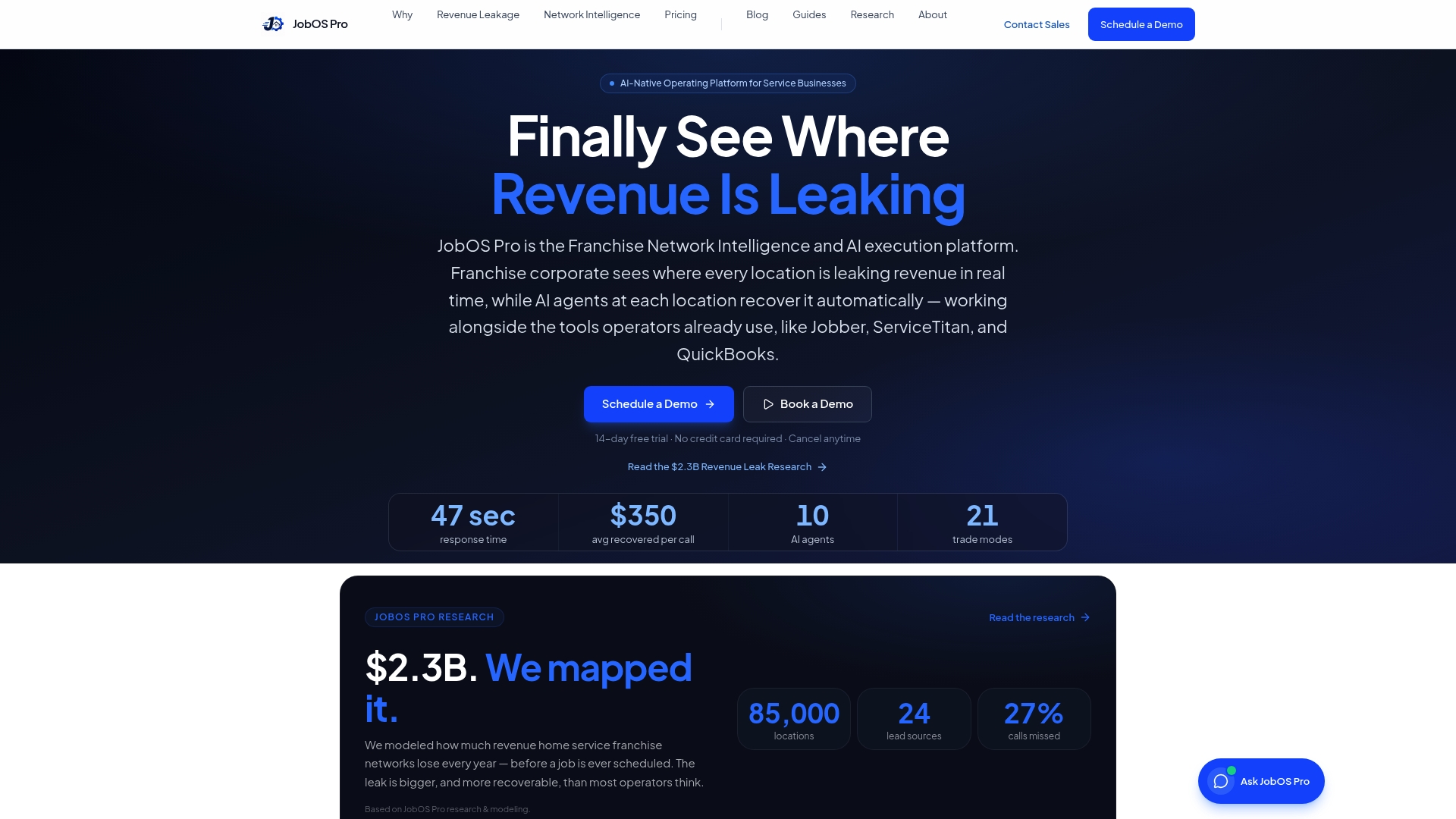
It’s built for owners and operators at HVAC, plumbing, cleaning, and similar service businesses who are losing revenue to missed calls, delayed invoices, and unreconciled payments rather than poor customer behavior. Franchise leaders get an added layer: visibility across every location, so head office can see which teams collect fastest and push that behavior network-wide.
If your current process still depends on someone remembering to send a reminder, start by seeing what automated recovery would actually catch. Book a demo and walk through your own numbers, or check how JobOS Pro helps you get paid faster before you commit to anything.
Sources
FAQ
What Happens When a Payment Goes to Collections?
Once an account moves to collections, it’s typically handed to an internal recovery team or a third-party agency that contacts the customer under FDCPA and Regulation F rules, and the account may affect the customer’s credit standing depending on how it’s reported.
What Is a Service Payment?
A service payment is the amount a customer owes for labor or work performed rather than for a physical product, and it usually gets billed through an invoice tied to a completed job.
Can I Pay a Small Fixed Amount Each Month on a Collection Account?
Many collectors will accept a documented payment plan with smaller monthly installments, but the amount and schedule need mutual written agreement, since an unapproved partial payment doesn’t satisfy the full balance.
What Does “Payment Collection” Mean?
Payment collection means the full process of turning a completed job into cleared cash: invoicing, offering a way to pay, sending reminders, and reconciling the payment against the original invoice. A service payment collection system that automates this chain is what separates businesses with healthy cash flow from ones constantly chasing balances.
Does Automation Really Reduce Days Sales Outstanding?
Automated invoicing, payment links, and reconciliation remove the manual delays, forgotten reminders and unmatched payments, that are the most common causes of a stretched DSO, and platforms like JobOS Pro are built specifically to close those gaps.