ServiceTitan cost per technician is one of the first numbers home service owners try to pin down before they sign anything, and for good reason. Unlike flat-fee software, ServiceTitan bills per seat, so the price tag grows every time you add a truck. In particular, that structure can quietly turn a good software decision into a growth penalty. Below, we break down what operators actually pay, where the hidden costs hide, and what a flat-rate alternative looks like in practice.
Direct answer: ServiceTitan cost per technician typically falls between roughly $100 and $200 or more per user each month, plus a required onboarding fee, and the total climbs automatically with every technician you hire. Flat-rate platforms, by contrast, charge one price regardless of headcount.

Understanding servicetitan cost per technician starts with mapping every paid seat on the platform.
What Is ServiceTitan's Cost Per Technician?
ServiceTitan cost per technician is the per-seat licensing fee ServiceTitan charges for each user who logs into the platform, including technicians, dispatchers, and office staff. In other words, the software is priced by headcount rather than by a single flat rate. As a result, the total monthly bill scales up automatically as a company hires.
Published pricing for ServiceTitan is not fully public, so most operators receive a custom quote through a sales call. However, industry discussions and reseller estimates commonly place per-seat fees somewhere between $100 and $200 or more monthly, alongside a substantial one-time onboarding charge that can run into the thousands of dollars. Therefore, the advertised "starting" figure rarely reflects the true monthly cost once a full crew is added.
How ServiceTitan Pricing Actually Works
ServiceTitan's pricing model bundles a base platform fee with a per-user charge, and it separates certain capabilities into paid add-on modules. Consequently, two businesses with the same number of trucks can end up paying very different totals depending on which modules they enable.
In particular, features like marketing attribution, advanced fleet tracking, or certain payment integrations are frequently sold as separate line items rather than included in the base license. For a deeper look at how this stacks up against everyday operating costs, see this breakdown of why ServiceTitan gets expensive fast for growing crews.
Base License, Add-Ons, and Onboarding
Most quotes include three layers of cost: the base platform license, per-technician seat fees, and a mandatory onboarding or implementation fee that covers data migration and staff training. Because the onboarding fee is one-time, it can be easy to overlook when comparing monthly costs. Still, it materially affects the first-year total, so it belongs in any honest cost comparison.
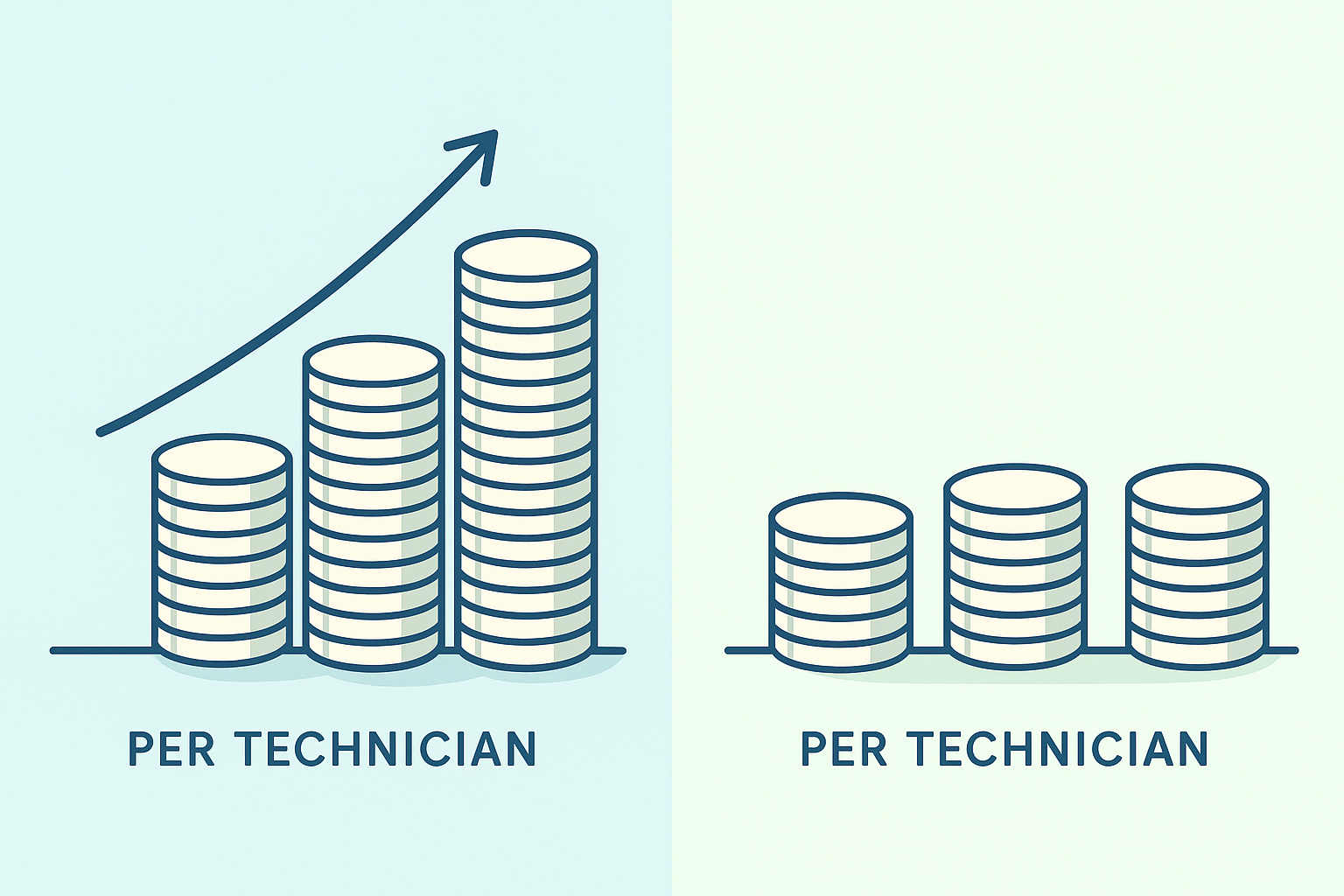
Per-seat pricing rises with headcount, while flat-rate pricing stays level as crews grow.
Hidden Costs That Inflate the Per-Seat Rate
Beyond the base per-technician fee, several recurring charges can push the effective cost meaningfully higher. Payment processing fees, for example, are often billed as a percentage of transactions rather than a flat rate, which adds up quickly for a high-volume HVAC or plumbing operation. Similarly, some support tiers and premium features require an additional monthly add-on.
According to general software-as-a-service pricing conventions, per-seat billing is one of the most common enterprise SaaS models precisely because it scales revenue with customer growth. That benefits the software vendor, but it works against the operator who is trying to keep margins steady while expanding headcount. For context on how these operational costs interact with technician output, this guide on technician profitability is worth reviewing alongside your software budget.
Per-Technician Pricing vs. Flat-Rate Software
A per-technician software cost model charges more as a business hires, while a flat-rate model holds the bill steady regardless of headcount. For a growth-minded operator running 3 to 15 trucks, this distinction determines whether hiring the next technician improves margin or simply funds a bigger software invoice.
JobOS Pro, for instance, publishes flat tiers at $199, $349, and $549 per month, each with unlimited technicians, dispatchers, and office staff. As a result, adding a fourth or fifth truck does not trigger a new seat charge. You can review the full comparison in this ServiceTitan alternatives breakdown or explore how leading HVAC software platforms compare side by side.
Step-by-Step: Calculating Your True Software Cost as You Scale
Before signing a multi-year contract, it helps to model total cost at both current and future headcount. Follow these steps to get an accurate picture.
- List every current paid seat, including technicians, dispatchers, and office staff who will need platform access.
- Add mandatory onboarding fees and any required add-on modules that are not part of the base license.
- Project your headcount 12 to 24 months forward based on realistic growth and seasonal hiring plans.
- Multiply that projected headcount by the current per-technician rate to see what the bill looks like at future scale.
- Compare that projected total against flat-rate tiers that include unlimited users, then pick whichever produces the lower, more predictable cost.
Why Per-Seat Billing Can Penalize Growth
Home service operators generally do not lose revenue to competitors as often as they think. Internal analysis from JobOS Pro suggests operators typically lose 20 to 30 percent of potential revenue to internal handoffs, such as missed calls, slow estimate follow-up, and unbilled completed jobs, rather than to the competition down the street. A software cost structure that punishes hiring makes it harder to fix those leaks, because every added technician also adds a new line item to the software bill.
Consequently, some operators delay hiring or avoid adding office staff simply to keep the software invoice manageable. That tradeoff can hurt technician utilization and response times. This resource on technician utilization and revenue leakage explains how staffing decisions and software cost structures interact.
Is There a Better Option Than Per-Technician Billing?
Yes, flat-rate all-in-one platforms exist specifically to remove the per-seat penalty. JobOS Pro, for example, is built for HVAC, plumbing, electrical, and adjacent trades running roughly 3 to 15 trucks, and it bundles lead intake, an AI receptionist, scheduling, estimates with financing options, payments, reviews, and a CEO dashboard into one flat bill. Unlike ServiceTitan, it does not require a per-technician fee on any of its three published tiers.
Importantly, switching platforms does not require abandoning existing tools like QuickBooks overnight. JobOS Pro is designed to run alongside systems such as Jobber, ServiceTitan, or QuickBooks during a transition, with a 30-day free trial and no credit card required. Operators can review pricing directly at jobospro.com before committing to a longer contract.

Flat-rate platforms let technicians use the full app without adding a new per-seat charge.
Frequently Asked Questions
What is ServiceTitan's cost per technician?
ServiceTitan cost per technician refers to the per-seat licensing fee charged for every technician, dispatcher, or office staff member on the platform. Estimates typically place this in the range of $100 to $200 or more per user monthly, plus a required onboarding fee.
Why does ServiceTitan charge per technician instead of a flat fee?
Per-seat billing is a common enterprise SaaS pricing model because it scales vendor revenue with a customer's headcount growth. The tradeoff is that software costs rise every time an operator hires.
How much does ServiceTitan cost for a 10-technician company?
For roughly 10 technicians, per-seat fees alone can total well over $1,000 to $2,000 per month before onboarding or add-on modules. Actual quotes vary, so a full itemized quote is recommended.
Does ServiceTitan have hidden fees beyond the per-technician rate?
Many operators report onboarding fees, add-on module charges, and payment processing fees on top of the base per-seat rate. These extras can meaningfully raise the effective total cost.
Is ServiceTitan worth the cost for small home service businesses?
ServiceTitan is generally built for larger operations with dedicated administrative staff. Smaller crews running 3 to 15 trucks often find per-technician pricing disproportionately expensive for the features they actually use.
How does ServiceTitan pricing compare to Jobber and Housecall Pro?
Jobber and Housecall Pro also use per-user or tiered pricing but generally start lower than ServiceTitan. However, both can still require paid add-ons for advanced dispatching or payments as a business grows.
What is a flat-rate alternative to ServiceTitan's per-technician pricing?
A flat-rate alternative charges one fixed monthly price no matter how many technicians use the platform. JobOS Pro publishes flat tiers at $199, $349, and $549 per month with unlimited users included.
How long does it take to migrate off ServiceTitan?
Migration timelines vary, but most platforms allow a business to run in parallel with ServiceTitan during a transition rather than requiring an immediate cutover. This reduces the risk of losing job history or customer records.
What mistakes do operators make when evaluating ServiceTitan cost per technician?
The most common mistake is calculating cost at current headcount without projecting forward as the business hires. Operators also frequently overlook onboarding fees and add-on modules excluded from the base price.
Can ServiceTitan costs increase after signing a contract?
Yes, costs typically rise whenever a business adds technicians, dispatchers, or office staff, since each new user needs a seat license. Contract renewals may also introduce rate changes.
What is the best practice for comparing field service software pricing?
Best practice is modeling total software cost at current headcount and again at projected headcount 12 to 24 months out. This reveals whether per-technician or flat-rate pricing wins as the business scales.
Does switching away from ServiceTitan mean losing existing tools like QuickBooks?
Not necessarily. Many all-in-one platforms, including JobOS Pro, are designed to run alongside existing accounting tools such as QuickBooks without forcing an immediate migration.
Final Takeaway
ServiceTitan cost per technician is manageable at a small headcount, but it compounds quickly as a home service business grows its crew. In particular, the combination of per-seat fees, onboarding charges, and add-on modules can push total software spend far past the advertised starting price. Above all, operators running 3 to 15 trucks should model costs at their projected future headcount, not just today's, before signing a multi-year contract.
For businesses that want predictable software costs while they scale, a flat-rate platform such as JobOS Pro removes the per-technician penalty entirely, bundling missed-call capture, scheduling, estimates, payments, and reporting into one bill that does not move with headcount. Ultimately, comparing the true multi-year cost, not just the sticker price, is the clearest way to protect margin while growing the business.
