
The End of Manual Dispatch: How AI Electrical Service Scheduling Software Reclaims 15% of Lost Revenue
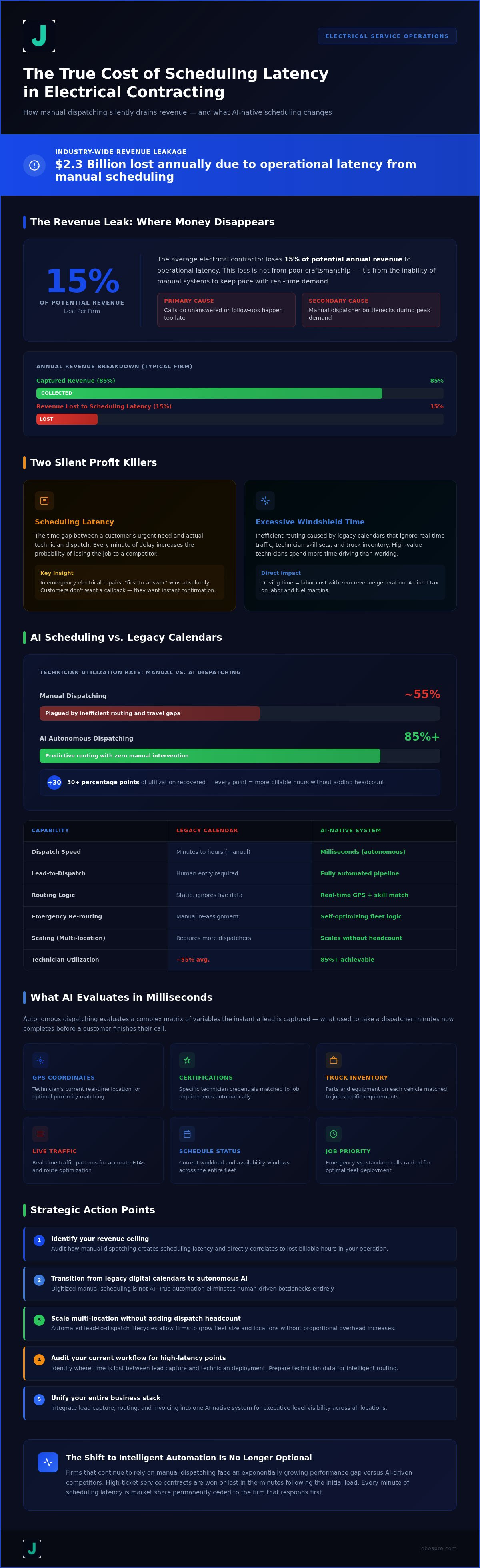
Research indicates that the average electrical contractor loses 15% of their potential annual revenue to operational latency, contributing to a staggering $2.3 billion in industry-wide leakage. This systemic drain isn't a result of poor craftsmanship; it's the inevitable byproduct of relying on manual drag-and-drop calendars that cannot keep pace with real-time demand. You likely feel this friction every day through technician idle time and missed service calls. While most legacy electrical service scheduling software acts as a basic digital whiteboard, it fails to solve the underlying human-driven bottlenecks that stifle your growth.
This article demonstrates how transitioning to an AI-native operating system transforms scheduling from a logistical burden into a high-performance revenue engine. You'll discover how autonomous dispatching eliminates the gap between lead capture and technician assignment to ensure zero-latency operations. We will examine the technical architecture required to maximize technician billable hours and provide executive-level visibility across multi-location enterprises. By the end of this guide, you'll understand why the shift to intelligent automation is no longer optional for firms aiming to reclaim their share of the market.
Key Takeaways
- Identify the "revenue ceiling" created by manual dispatching and how scheduling latency directly correlates to lost billable hours.
- Transition from legacy digitized manual calendars to autonomous AI electrical service scheduling software to eliminate human-driven bottlenecks.
- Understand the operational shift required to scale multi-location firms without increasing dispatch headcount through automated lead-to-dispatch lifecycles.
- Execute a systematic audit of your current workflow to identify high-latency points and prepare technician data for intelligent routing.
- Discover how an AI-native operating system unifies lead capture, routing, and invoicing into a single, high-visibility business stack.
The High Cost of Scheduling Latency in Electrical Contracting
Scheduling latency is the silent killer of operational profitability. It is defined as the time gap between a customer's urgent need and the actual dispatch of a technician. For many growing firms, this latency is not just a nuisance; it is a permanent revenue ceiling. Manual dispatching creates a bottleneck that cannot be solved by simply hiring more office staff. As call volume increases, the complexity of managing a dynamic board grows exponentially, leading to missed opportunities and technician idle time. High-ticket service contracts are won or lost in the minutes following the initial lead. If your electrical service scheduling software requires a human to manually drag and drop a tile before a job is confirmed, you are already losing to faster, AI-driven competitors.
The $2.3B Revenue Leak: Why Calls Don't Become Jobs
The electrical industry faces a collective $2.3B revenue leak due to systemic inefficiencies in lead recovery. Research identifies that 15% of potential revenue is lost simply because calls go unanswered or follow-ups happen too late. Traditional answering services often fail to bridge this gap. They function as expensive message-takers rather than active closers. In emergency electrical repairs, the psychological impact of "first-to-answer" is absolute. Customers in the dark do not want a callback; they want a confirmation. When a dispatcher is overwhelmed, that confirmation is delayed. This operational lag forces prospects to move down the search results until they find a firm that provides an instant response.
Windshield Time vs. Billable Time
Inefficient routing is a direct tax on your labor and fuel margins. Legacy calendars are static tools. They fail to account for real-time traffic patterns, technician skill sets, or the specific inventory on a truck. This lack of oversight results in excessive windshield time, where high-value technicians spend more time behind the wheel than at the service panel. Modern Field service management (FSM) requires a foundational shift toward automation. Strategic leaders are now adopting intelligent technician dispatching to reclaim these lost hours. By utilizing advanced electrical service scheduling software, firms can ensure that the right technician is routed to the right job with zero human intervention, maximizing billable hours and protecting the bottom line.
AI vs. Legacy Calendars: A Foundational Shift in Field Operations
Most field service platforms on the market today are deceptive. They market themselves as advanced solutions while merely providing digitized manual scheduling. This is essentially a digital whiteboard that still requires a human dispatcher to move tiles, resolve conflicts, and hunt for available technicians. It is a reactive model that inevitably breaks down during peak demand. When your electrical service scheduling software relies on rigid, rules-based logic, it cannot adapt to the fluid nature of field work. It lacks the cognitive capacity to re-route an entire fleet when an emergency call overrides a standard inspection. True operational excellence requires a shift to autonomous AI dispatching, a system that thinks, predicts, and acts without human prompting.
The impact of this shift is visible in technician utilization rates. Industry averages for manual dispatching often hover around 55%, plagued by inefficient routing and travel gaps. Research from the MIT Sloan School of Management has highlighted how advanced automation has boosted firm productivity by allowing companies to deploy their human capital with surgical precision. By implementing predictive routing, electrical firms can push technician utilization to 85% or higher. This is achieved by feeding AI call answering data directly into the scheduling engine. The moment a lead is captured, the system is already calculating the optimal path to dispatch, removing the friction of manual entry entirely.
The Mechanism of Autonomous Scheduling
Autonomous dispatching is a self-optimizing ecosystem that requires zero manual drag-and-drop. In milliseconds, the AI evaluates a complex matrix of variables: the technician's current GPS coordinates, their specific certifications, and the live inventory on their truck. It doesn't just look at who is "free"; it looks at who is best positioned to complete the job profitably. Predictive analytics play a critical role here by anticipating job durations based on historical data. This prevents the common trap of overbooking or leaving massive gaps in the schedule, ensuring the board remains fluid and optimized throughout the day.
Removing the Dispatcher Bottleneck
When you automate the 80% of routine service calls, you fundamentally change the role of your office staff. Dispatchers stop acting as data entry clerks and start functioning as operations strategists. They are freed to handle complex project management and high-stakes client relationships that require a human touch. Integrating AI business management for home services allows you to unify the front and back office into a single source of truth. If you want to see how this level of oversight can transform your bottom line, consider reviewing your current AI-driven dispatch capabilities to identify where manual processes are costing you money.
Case Study: Scaling a 20-Truck Operation with AI Precision
A regional electrical powerhouse with 20 trucks across three locations faced a critical bottleneck. Despite high lead volume, 20% of service requests remained unassigned at the end of each day. Their legacy CRM was a passive repository of data, not an active driver of revenue. By migrating to a modern electrical service scheduling software, they replaced human-led guesswork with autonomous precision. The results were immediate. Within 90 days, the firm realized a 15% increase in total revenue. More importantly, they reduced the critical "Time-to-Schedule" metric from a sluggish 4 hours to a near-instant 4 seconds.
Standardizing Quality Across Multi-Location Networks
Executive leadership gained total visibility through real-time dashboards. This allowed them to identify performance gaps between branches that were previously hidden in fragmented spreadsheets. They utilized franchise network benchmarking to elevate underperforming locations to the high standards of their top-tier units. This consistency is essential for scaling an enterprise. Similar to the real impact of AI in construction, where automation drives massive productivity gains, this electrical firm used AI to unify its disparate operations. To close the operational loop, they implemented automated invoicing for home services, ensuring that revenue was captured the moment a job was completed.
Technician Feedback and Adoption
Technicians are often the harshest critics of new technology. However, the move to optimized routing was met with overwhelming approval from the field. By reducing unnecessary windshield time, technicians spent more hours earning and less time navigating traffic. The mobile app became an indispensable tool for every truck. It provided instant access to job histories and AI-driven estimates, allowing for higher precision on-site without constant calls to the back office. This level of support directly impacts technician retention. When the electrical service scheduling software works as a silent partner, technicians feel more productive and less frustrated by administrative friction. Accurate scheduling means they aren't rushed or idle; they are fully utilized.
Implementing AI Scheduling Without Operational Friction
Adopting advanced electrical service scheduling software is a strategic deployment, not a simple software installation. Success requires a comprehensive audit of your current lead-to-dispatch lifecycle to identify exactly where latency resides. You must scrutinize every manual touchpoint where a service request sits idle before a technician is assigned. Effective implementation also demands rigorous data hygiene. Your technician profiles must include precise skill sets, current certifications, and primary service areas. Without this granular data, the AI cannot execute the surgical routing required to maximize your margins.
Once your data is refined, the next step is deploying AI call answering to capture after-hours and overflow demand. This ensures that no lead is left to a voicemail or a passive answering service. These captured leads feed directly into the autonomous engine, enabling a shift toward exception-based dispatching. In this high-performance model, the software handles the vast majority of routine assignments without human prompting. Your dispatchers only intervene when the system flags a specific conflict or a complex project requirement, allowing them to function as high-level operations managers rather than data entry clerks.
Managing the Human Element
Internal resistance is the primary barrier to digital transformation. You must position the AI as a sophisticated tool that empowers your dispatch team rather than one that replaces them. They need to understand that the system is designed to handle the repetitive "noise" of daily scheduling so they can focus on strategic growth. Similarly, field crews must see the tangible benefits of optimized routes. AI scheduling reduces technician burnout by eliminating unnecessary travel and the frustration of emergency backtracking across service zones. When the field team sees their billable hours increase without a corresponding increase in stress, adoption becomes organic.
Integrating with Your Existing Stack
A unified platform approach is fundamentally superior to a collection of bolted-on applications. Your electrical service scheduling software must maintain a seamless data flow with your accounting infrastructure to ensure real-time financial oversight. Fragmented systems lead to data decay and operational silos that stifle scaling. Leveraging recurring service membership software further optimizes the board by pre-filling the schedule with predictable, high-margin maintenance work. This creates a stable revenue baseline that the AI can build upon during peak demand periods. To see how a unified AI operating system can eliminate your operational friction, analyze your current dispatch efficiency with a professional audit.
JobOS Pro: The Strategic Operating System for Modern Electricians
JobOS Pro isn't a peripheral tool. It's the foundational layer of a modern electrical enterprise. While legacy platforms focus solely on the technician's arrival, JobOS Pro manages the entire customer lifecycle through an AI-native architecture. This system unifies lead capture, intelligent dispatching, and automated follow-ups into a single, high-performance stack. It effectively eliminates the "Intelligence Gap" that plagues traditional electrical service scheduling software. By removing manual latency at every stage of the workflow, high-growth franchises are finally reclaiming the 15% of revenue previously lost to operational friction. They're turning the $2.3B industry-wide revenue leak into a competitive advantage.
Leadership requires absolute clarity. Managing multi-location growth without real-time, unified data is a significant liability in 2026. JobOS Pro provides executive dashboards that transform raw field data into actionable strategic intelligence. You can observe performance trends across hundreds of trucks and multiple regions with total confidence. This isn't just about oversight; it's about providing the strategic foundation necessary to scale a franchise network. The platform identifies hidden patterns in technician utilization and lead conversion that human operators simply cannot see. It allows you to move from a state of constant reaction to a posture of decisive, data-driven action.
Future-Proofing Your Field Operations
The roadmap for the trades is shifting rapidly toward predictive maintenance. JobOS Pro is engineered to lead this transition. It moves beyond reactive scheduling to analyze historical data, allowing you to anticipate customer needs before they become emergencies. This forward-looking approach ensures your firm stays ahead of competitors who are still anchored by a manual mindset. You aren't just buying a calendar; you're investing in an evolving intelligence. Discover the JobOS Pro AI Operating System to secure your position at the forefront of the industry.
Unlocking Predictable Revenue
Operational efficiency is the primary driver of enterprise valuation. A business that runs on zero-latency scheduling is fundamentally more valuable than one weighed down by manual bottlenecks. Automated scheduling doesn't just fill the board. It drives customer retention and membership growth by providing a frictionless service experience. When you eliminate the wait time between a lead and a dispatch, you build a level of trust that translates directly into recurring revenue. High-performing firms don't just manage their schedule. They optimize their entire revenue engine to ensure every truck is a profit center. Stop settling for legacy limitations and start operating at the speed of AI.
Securing the Future of Electrical Enterprise Operations
The transition from manual drag-and-drop calendars to an AI-native operating system isn't merely a software upgrade; it's a foundational shift in how profitable firms operate. By eliminating the time gap between a customer's need and a technician's dispatch, you reclaim the 15% of revenue lost to systemic latency. Modern electrical service scheduling software must do more than organize a board; it must actively drive growth by capturing and scheduling leads instantly through AI call answering. This level of automation ensures your technicians spend more time on billable tasks and less time navigating inefficient routes.
Executive dashboards now provide the total visibility required to manage multi-location networks with data-driven confidence. You can observe performance gaps, standardize quality, and scale your franchise without the bottleneck of manual oversight. The competitive landscape of 2026 demands a zero-latency approach to field service management. It's time to move beyond the revenue ceiling of legacy tools and embrace a self-optimizing ecosystem that works as hard as your field crew does. Stop the revenue leak and see JobOS Pro in action. Your path to reclaiming lost margins starts with a smarter dispatch engine.
Frequently Asked Questions
How does AI electrical service scheduling software differ from a standard CRM?
AI electrical service scheduling software functions as an active revenue engine, whereas a standard CRM is merely a passive database. While a CRM records customer history and contact details, AI scheduling autonomously evaluates live variables to dispatch technicians. It moves beyond simple data storage to execute real-time operational decisions that eliminate human-driven bottlenecks and scheduling latency.
Can AI scheduling software really handle complex electrical jobs that require specific certifications?
Autonomous systems are specifically engineered to manage complex technical requirements and certifications with surgical precision. The software cross-references every service request with your technicians' verified credentials and specialized skill sets in milliseconds. This ensures that a high-voltage industrial repair is never assigned to a residential wireman. The system maintains a rigorous compliance layer that human dispatchers often overlook during high-volume periods.
What happens if the AI makes a scheduling mistake or overlap?
Advanced AI operates on an exception-based logic that identifies potential conflicts before they manifest on the board. If the system detects a logistical overlap or a job duration anomaly, it immediately flags the event for manual review. This approach allows your team to focus on resolving rare complexities while the software handles the vast majority of routine dispatching with mathematical precision.
How much time does it typically take to implement AI dispatching for a 10-truck team?
Implementation for a 10-truck operation usually requires a two to four week migration period. This timeframe focuses on cleaning your technician data and mapping specific service zones to ensure the AI has a high-fidelity environment to operate within. Most firms see immediate improvements in technician utilization and a reduction in unassigned leads within the first 30 days of full deployment.
Does AI scheduling work for residential, commercial, and industrial electrical projects?
The platform is highly adaptable across residential, commercial, and industrial sectors. It uses predictive analytics to account for the vastly different job durations and material requirements inherent in each project type. Whether you're managing rapid-response residential calls or multi-day industrial installations, the software optimizes the schedule based on the unique profitability profiles and priority levels of each sector.
Will my technicians find the automated scheduling app difficult to use in the field?
Field crews typically experience a significant reduction in administrative frustration. The mobile interface is designed for high-stakes environments, providing technicians with optimized routes and instant access to job histories. By eliminating the need for constant radio check-ins or manual time-tracking, the software allows your team to focus on the technical work they were hired to perform.
How does AI call answering integrate with the scheduling calendar?
AI call answering functions as the primary intake valve for the scheduling engine. When a lead is captured, the system retrieves customer data and job requirements, injecting them directly into the dispatch board without human intervention. This creates a zero-latency workflow where an emergency call can move from an initial ring to a dispatched technician in seconds, preventing revenue leakage.
What is the typical ROI for switching from manual dispatch to AI-driven scheduling?
Switching to AI-driven electrical service scheduling software typically yields a 15% increase in reclaimed revenue through the elimination of missed calls and idle technician time. Firms often see technician billable hours rise significantly toward 85% utilization. This ROI is realized by reducing windshield time and ensuring that every high-value lead is captured and scheduled during peak demand hours.