
Wasting Revenue? Unify Disconnected Tools for Home Services in 90 Days
Wasting Revenue? Unify Disconnected Tools for Home Services in 90 Days
The fastest path to unify disconnected tools is an AI-native operations platform or, if you need to move in stages, a disciplined phased consolidation of your highest-risk workflows first. Either path done right recovers missed calls, automates overdue payments, and closes the scheduling gaps that quietly drain revenue every week. We developed a platform designed to address this problem for home service businesses.
TL;DR:
- Connecting your tools reduces revenue leaks caused by missed calls, unpaid invoices, and scheduling delays, which can significantly impact cash flow and customer satisfaction.
- Prioritize fixing high-value, high-risk workflows first, such as missed-call capture and invoicing, to quickly recover lost revenue within 30 days of implementation.
- Use a phased approach, starting with simple connectors or middleware for small teams, and consider a hybrid or full platform for multi-location or franchise businesses to scale efficiently.
- Secure your system with multi-factor authentication, least-privilege access, and proper backups to minimize security risks during integration projects.
- Track key performance indicators like recovered revenue, call answer rate, and days sales outstanding to measure financial gains and operational improvements over time.
Table of Contents
- Why consolidate your stack now: the AI-native opportunity
- Inventory and prioritize: the list to build first
- Integration approaches and trade-offs
- Implementation checklist with security and governance built in
- Measure success: KPIs, ROI, and realistic timelines
- Common pitfalls and three priorities for the first 90 days
- How JobOS Pro helps you unify your stack
- FAQ
- Sources
Why consolidate your stack now: the AI-native opportunity
Every disconnected tool is a place where revenue can slip through. A missed call during a busy dispatch window, an invoice that never gets followed up, a lead that sits in a separate app nobody checks: these are not small annoyances, they are ongoing losses.
- Missed or unanswered calls during peak hours often mean a lost job to a competitor.
- Invoices that sit uncollected stretch out your days sales outstanding and tie up cash you’ve already earned.
- Scheduling delays caused by apps that don’t talk to each other create idle technician time and frustrated customers.
A significant revenue leak study found losses of this scale across the home service industry, underscoring how common and costly these gaps are. An AI-native platform shortens the distance between spotting a leak and fixing it, because detection and automated action live in the same system, instead of being stitched together after the fact.
Inventory and prioritize: the list to build first

Before you fix anything, you need a complete picture of what you’re working with. NIST’s small business cybersecurity guidance recommends starting with a clear inventory of every application, integration, and cloud service you rely on, along with who owns the data and how access is controlled.
Your inventory should capture:
- Every app in use, from scheduling and dispatch to accounting and marketing.
- Which systems talk to each other today, and which ones don’t.
- Who owns each data set and who can access or change it.
- How each tool handles authentication, including whether multi-factor login is enabled.
- How critical each tool is to daily revenue, on a simple high, medium, or low scale.
Once you have the list, rank items by value times risk: a tool that touches a lot of revenue and currently has no safeguards ranks above a low-traffic app with minor gaps.
| Tool | Business criticality | Current risk | Priority |
|---|---|---|---|
| Call answering / lead capture | High | High (no after-hours coverage) | Fix first |
| Invoicing and payments | High | Medium (manual follow-up only) | Fix second |
| Scheduling and dispatch | High | Medium (double entry across apps) | Fix third |
| Marketing / review requests | Medium | Low | Monitor |
This exercise alone usually surfaces the missed-call patterns, unpaid invoice piles, and duplicated data entry that are costing you the most.
Integration approaches and trade-offs
Once you know what you’re dealing with, you have four realistic paths, and the right one depends on your size, your timeline, and whether you run a single location or a franchise network.
- Quick connectors link two apps for a narrow task, like syncing leads to your CRM. They’re fast and cheap but multiply over time and each one is a point of failure.
- Automation middleware sits between your tools and moves data on rules you define. It scales further than point connectors but adds another vendor to manage and another system to secure.
- Hybrid platform replaces your weakest links with an AI-native system while keeping proven best-of-breed apps like Jobber or QuickBooks in place. This gives you faster time-to-value without a forced migration.
- Full replacement consolidates everything into one platform. It offers the cleanest long-term operations picture but demands the most upfront change management.
Single-location operators with modest transaction volume often do fine starting with connectors or middleware. Franchise networks that need standardized reporting and multi-location benchmarking usually outgrow that setup quickly and move toward a hybrid or full platform approach instead.
Implementation checklist with security and governance built in
A unification project succeeds or stalls based on the discipline you bring to the rollout. Follow this sequence:
- Define the specific outcomes you want (fewer missed calls, faster collections) and name one owner accountable for the whole project.
- Complete your asset inventory and prioritize using the value times risk method above.
- Pick one high-value flow, such as missed-call capture or payment automation, for a pilot rather than migrating everything at once.
- Set up multi-factor authentication and least-privilege access for every connected tool, following the access control practices NIST recommends for small businesses.
- Turn on logging and automated backups before you move live data between systems.
- Document vendor service level agreements and responsibilities in writing, including who handles outages and who owns data exports.
- Test the pilot flow for two to four weeks, measure results, then expand to the next priority item.
- For franchise networks, build a rollout communication plan that gives local operators a clear timeline and a channel to flag exceptions.
Pro Tip: Keep your pilot narrow enough to finish in under a month. A fast, visible win builds the internal support you’ll need for the harder integrations later.
Review your security setup against JobOS Pro’s own security practices as a benchmark for what a connected stack should look like.
Measure success: KPIs, ROI, and realistic timelines
You can’t manage what you don’t track, and unification projects need a short list of numbers everyone watches.
- Recovered revenue: dollars tied directly to previously missed calls or abandoned leads.
- Call answer rate: the share of inbound calls picked up live or by an automated system.
- Estimate-to-job conversion: how many quotes turn into booked work.
- Days sales outstanding (DSO): how long it takes to collect payment after a job closes.
- Technician utilization and average ticket size: operational efficiency indicators that move once scheduling and upsell prompts are automated.
Check operational numbers weekly, review financial KPIs monthly, and hold a quarterly strategic review to decide what to unify next. Small operators often see measurable results from a single pilot flow within 30 days, based on how quickly a focused fix like missed-call capture changes behavior, while franchise-wide rollouts typically take several months to standardize across locations. AI-native detection shortens the gap between spotting a leak and acting on it, because the alert and the fix live in the same workflow instead of waiting on a manual review.
Common pitfalls and three priorities for the first 90 days
Most unification efforts stall for the same three reasons: nobody owns the project end to end, teams stack up one-off connectors instead of a plan, and security gets treated as an afterthought until something breaks.

If you’re starting from scratch, focus on three things in your first 90 days. Build the complete inventory first, because you can’t prioritize what you haven’t mapped. Second, fix your missed-call and payment capture flows immediately since they tend to be the fastest-bleeding leaks. Third, pick one pilot flow and prove it works before expanding further.
The owners who get this right treat unification as an operating discipline, not a one-time project. The ones who struggle usually try to fix everything simultaneously and lose momentum within weeks.
— Tarun
How JobOS Pro helps you unify your stack
Our platform is designed as an AI-native system built from the ground up. It connects the disconnected pieces of your operation, automates revenue recovery moments like missed calls and overdue invoices, and gives you real-time visibility into where money is leaking.
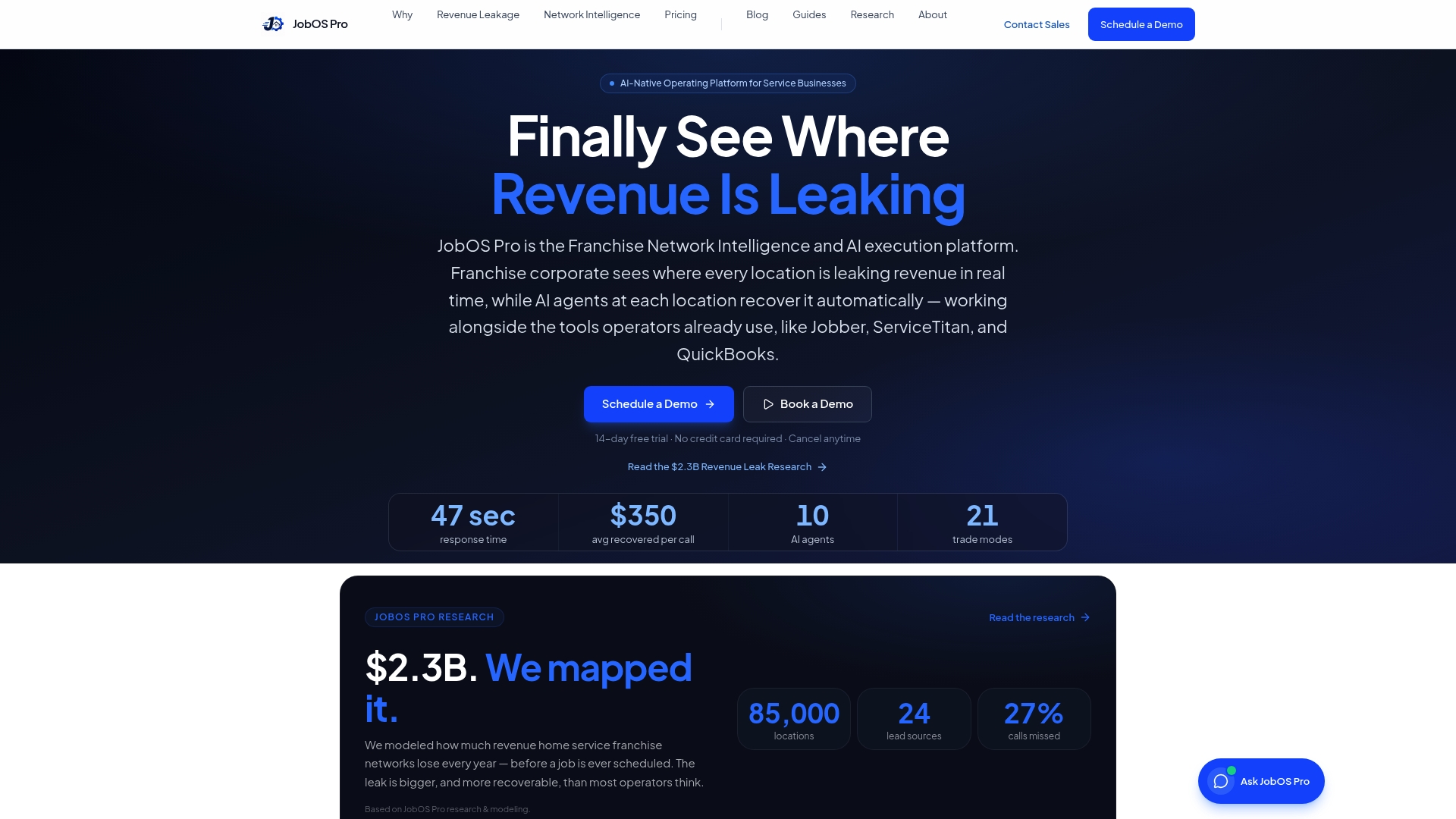
- Integrates with existing tools without requiring a disruptive migration.
- Supports multi-location benchmarking and performance monitoring for franchise operators.
- Automates revenue recovery processes such as missed calls, unpaid invoices, and scheduling gaps.
Plans start at $199 a month with the Starter tier, scaling through Growth at $349 and Pro at $549, with custom Enterprise pricing for franchise networks. If you want to see it against your own numbers, book a demo and walk through your specific revenue leaks with the team.
FAQ
What does it mean to unify disconnected tools?
It means connecting the separate apps your business relies on, like scheduling, invoicing, CRM, and payments, so they share data automatically instead of requiring manual entry in each one. The goal is a single operational view instead of scattered, disconnected systems.
How long does a tool unification project take?
A focused pilot, such as fixing missed-call capture, can show results within about 30 days once the fix is live. Full-stack unification across a franchise network typically takes several months because it involves staged rollouts and local change management.
Should I replace my existing software or integrate it?
That depends on your size and timeline: a hybrid approach that connects an AI-native platform to proven tools like Jobber or QuickBooks usually delivers faster value than a full replacement. Full replacement makes more sense once your current stack has too many point connectors to maintain safely.
What security steps matter most when connecting business systems?
Multi-factor authentication, least-privilege access, and documented data backups are foundational steps recommended in NIST’s small business cybersecurity guidance. Logging activity and setting clear vendor responsibilities in writing also reduce risk during and after the transition.
Does JobOS Pro work with the tools I already use?
Yes, JobOS Pro is designed to run alongside existing systems such as Jobber and QuickBooks rather than requiring a forced migration. It layers AI-native revenue recovery and operational intelligence on top of your current stack.