AI Dispatch for Pest Control: Optimizing Route Density
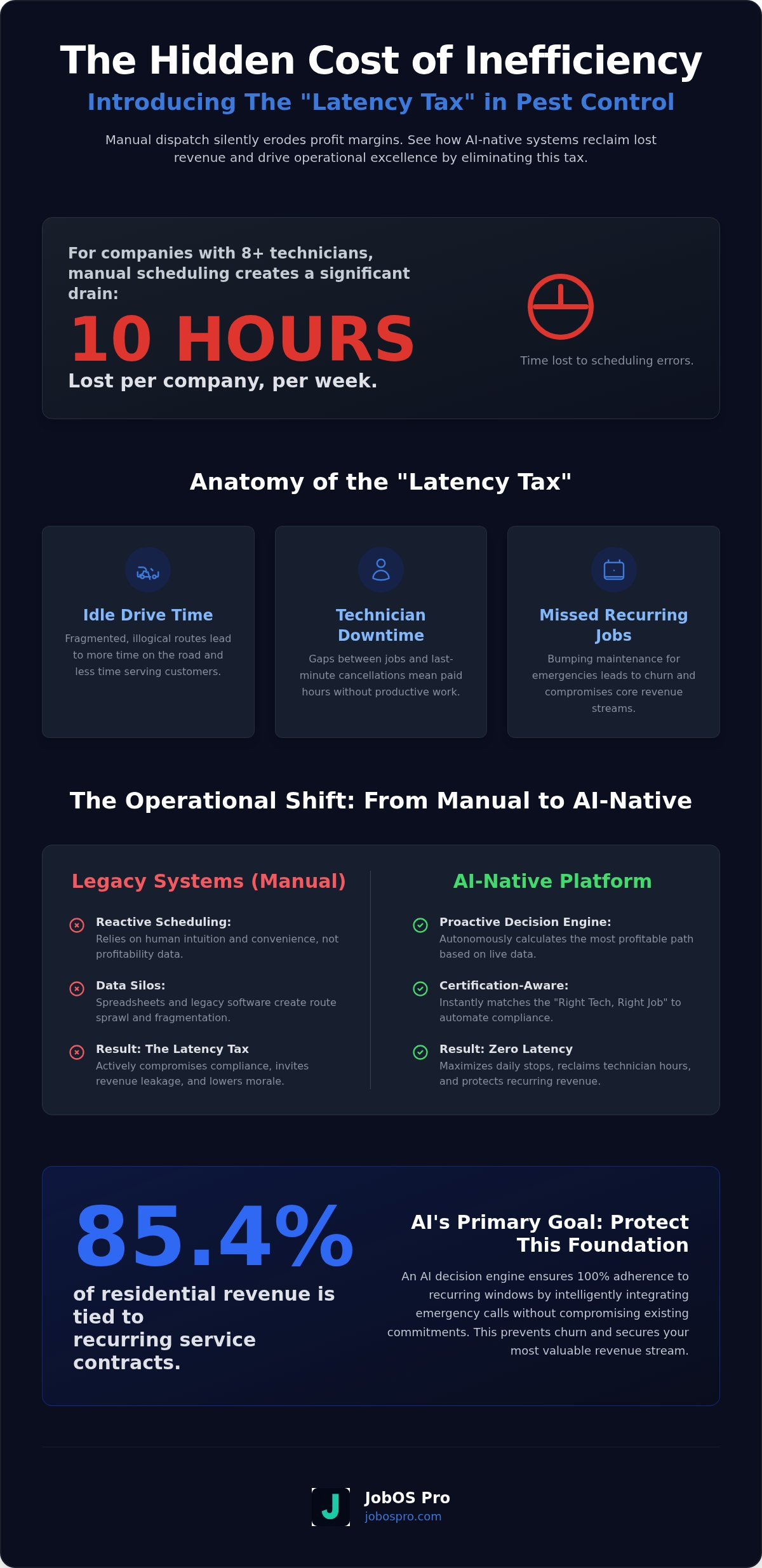
85.4% of residential pest control revenue is tied to recurring contracts, yet companies with eight or more technicians still lose an average of 10 hours per week to manual scheduling errors. This isn't just an administrative hurdle. It's a systematic erosion of your profit margins that we define as the Latency Tax. Implementing AI dispatch for pest control is no longer a luxury; it's a strategic necessity for firms that refuse to let technician utilization lag. You understand that density is the primary driver of your scale. When routes are fragmented or an uncertified technician is mistakenly assigned to a specialty termite job, you aren't just losing time; you're actively compromising your compliance and inviting revenue leakage.
This article demonstrates how AI-native dispatching transforms your operations into a high-density, zero-latency engine built to protect your recurring revenue. We'll examine the transition from manual oversight to automated, certification-aware scheduling and real-time route optimization that ensures zero missed service windows. Discover how to maximize stops per day and eliminate the operational gaps that threaten your long-term growth.
Key Takeaways
- Identify the systematic drain of the "Latency Tax" and how transitioning to a real-time decision engine recovers lost technician hours and missed service windows.
- Implement a "Right Tech, Right Truck, Right Job" framework that automates compliance by instantly matching technician license tiers to specialty service requirements.
- Evaluate your current infrastructure using the AI Readiness Checklist to distinguish between superficial "bolt-on" features and truly integrated AI-native architecture.
- Maximize daily stops and eliminate schedule fragmentation by leveraging AI dispatch for pest control to fill last-minute cancellations in real-time.
- Learn how a unified operating system connects every stage of the technician lifecycle-from automated lead capture to intelligent dispatching-to ensure zero-latency growth.
The Latency Tax: Why Manual Pest Control Dispatching Limits Your Growth
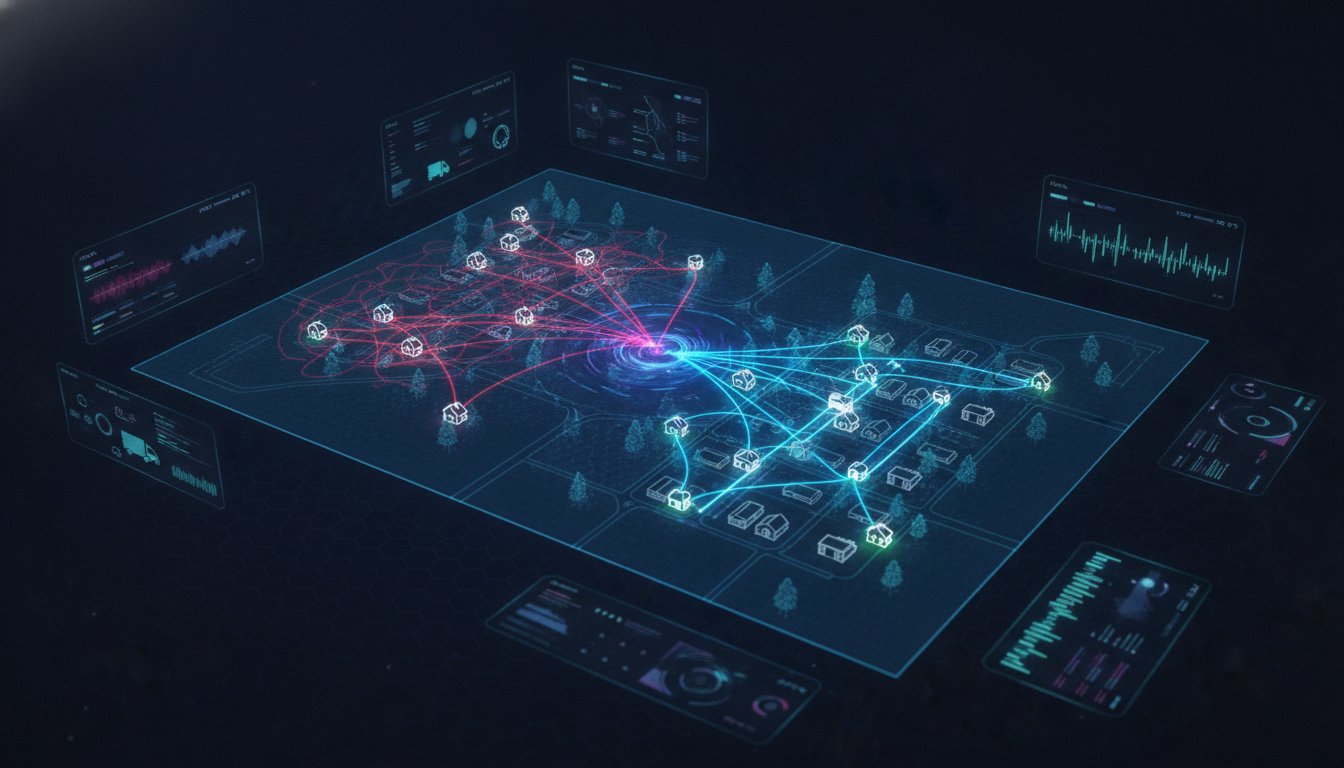
Manual dispatching is a structural liability. In an industry where route density dictates the bottom line, relying on human intuition to manage hundreds of moving parts is no longer sustainable. Most operators view their dispatch board as a digital calendar. This is a fundamental misunderstanding of operational excellence. True AI dispatch for pest control is not a passive record of appointments; it is a real-time decision engine that autonomously calculates the most profitable path forward based on live field data.
When your dispatch process relies on manual oversight, you pay what we call the Latency Tax. This is the cumulative cost of idle drive time, technician downtime, and missed service windows. It is a silent, persistent drain on your EBITDA. To eliminate this tax, your system must simultaneously solve for three critical pillars: Geography, Certification, and Urgency. Legacy field service software merely records where a technician went. AI-native operational systems, conversely, dictate where they should go next to maximize revenue per man-hour.
The Fragmentation of Manual Scheduling
Spreadsheets and legacy CRMs create data silos that inevitably lead to route sprawl. When dispatchers cannot see the interplay between technician location and job requirements, they make decisions based on convenience rather than profitability. This fragmentation is a classic example of the Vehicle Routing Problem, a mathematical complexity that human operators simply cannot solve at scale. This inefficiency doesn't just hurt your margins; it erodes technician morale and increases turnover as crews battle illogical, exhausting routes. The Dispatch Gap is the difference between planned routes and actual technician performance.
The Cost of Missed Recurring Windows
Quarterly service agreements are the foundation of your business, yet they are often the first to suffer under manual dispatching. When a high-priority termite call or an emergency infestation report comes in, manual systems often bump scheduled maintenance to accommodate the crisis. This creates a backlog that eventually leads to customer churn and lost recurring revenue. Implementing intelligent technician dispatching ensures that emergency calls are integrated into the schedule without compromising your existing commitments. Using AI dispatch for pest control allows you to maintain 100% adherence to recurring windows while still capturing high-margin reactive work. You stop choosing between service quality and growth; the system optimizes for both.
Beyond Routing: The Architecture of Certification-Aware AI
Effective AI dispatch for pest control requires more than a simple proximity check. It demands a sophisticated understanding of your workforce technical capabilities and legal boundaries. Most legacy systems treat every technician as a generic unit of labor. This oversight creates massive liability. Strategic operations rely on a "Right Tech, Right Truck, Right Job" framework. This architecture ensures the system never assigns a general pest technician to a structural termite job that requires specific state-level certifications. It observes the nuances of your team credentials in real time, retrieving data from central databases to prevent compliance failures before they occur.
Advanced machine learning models go deeper than license tracking. They analyze historical data to predict job duration with surgical precision. The system doesn't just guess that a quarterly service takes 45 minutes. It calculates time based on pest type, property square footage, and even weather patterns. When an emergency call interrupts a 15-stop route, the AI doesn't just fit it in. It re-sequences the entire day to protect route density while maintaining service level agreements. This level of oversight is only possible when you modernize your dispatch architecture to handle complex, multi-variable decision making.
Automating Regulatory Compliance
Regulatory adherence is the backbone of a defensible pest control business. AI-native systems monitor license tiers and state reciprocity agreements autonomously. If a technician certification is nearing expiration, the system flags the risk and adjusts scheduling priorities to ensure every on-site visit is legally sound. This isn't just about avoiding fines; it's about protecting your brand integrity. By integrating these compliance filters into a broader AI business management for home services stack, you create a unified layer of operational security. You gain total visibility into who is in the field and what they are legally permitted to apply.
Intelligent Route Density vs. Basic Proximity
The "closest technician" logic is a trap that leads to fragmented routes and high fuel costs. Strategic AI dispatch for pest control prioritizes route density over simple proximity. It clusters jobs to minimize vehicle wear and drive-time latency. This density-first approach ensures that technicians spend more time on properties and less time on the highway. Additionally, the system employs Predictive Arrival modeling. It communicates accurate service windows to customers based on live traffic and technician progress. This transparency reduces no-shows and enhances the customer experience, turning your dispatch efficiency into a competitive advantage.
The Executive Framework: Evaluating AI Dispatch Platforms
Selecting an automation partner is a high-stakes capital allocation decision. You are not simply buying a tool; you are installing a strategic asset that will either accelerate your growth or anchor you to legacy inefficiencies. To determine if your organization is prepared for this shift, use the Pest Control AI Readiness checklist. Your infrastructure must possess three foundational elements: centralized digital job records, real-time field connectivity, and a unified certification database. Without these, even the most advanced AI dispatch for pest control will struggle to retrieve the clean data required for precise optimization.
Executives must distinguish between "Bolt-on AI" and "AI-Native" architectures. Bolt-on systems are legacy CRMs that have layered basic algorithms on top of rigid, older codebases. These often fail when faced with the high-velocity changes of a modern pest control route. Conversely, AI-native platforms are built for automation from day one. They treat every data point, from chemical application rates to technician drive patterns, as a continuous stream for real-time processing. A truly integrated system unifies your CRM, invoicing, and certification tracking into a single, cohesive operating layer.
Technical Requirements for Scaling
Scalability depends on API flexibility. Your dispatch engine must communicate seamlessly with existing chemical tracking tools to ensure regulatory data remains accurate across all touchpoints. Mobile accessibility is equally non-negotiable. Technicians require an interface that facilitates real-time route updates without manual intervention, allowing them to focus on the property rather than the screen. For leadership, executive oversight is provided through centralized dashboards. These tools allow you to monitor network-wide technician utilization and identify performance gaps across multiple branches or franchise locations instantly.
The ROI of Automation
The payback period for AI-native dispatching is typically measured in months, not years. This rapid return is driven by the immediate reduction of the Latency Tax and the stabilization of recurring service windows. When evaluating success, treat technician utilization as your primary KPI. This metric reveals the true efficiency of your field operations by measuring the ratio of billable time to total shift length. To understand the specific data points that drive these gains, consult our guide on improving technician utilization software. By focusing on utilization, you transform dispatching from a back-office expense into a proactive engine for margin expansion.
Operationalizing Efficiency: Reclaiming Technician Utilization
Operational excellence is measured by the consistency of your field execution. While previous sections focused on the mathematical logic of density, we must also address the human element of your workforce. Chaotic, unpredictable routes are the primary driver of technician burnout and high turnover. By implementing AI dispatch for pest control, you provide your team with predictable, achievable schedules that respect their time and effort. This stability doesn't just improve morale; it stabilizes your production capacity. When technicians feel empowered by a system that understands the realities of the field, they perform at a higher level, leading to a measurable increase in billable stops per day.
The "Zero Gap" schedule is the ultimate manifestation of this efficiency. In a manual environment, a last-minute cancellation typically results in an hour of lost revenue. An AI-native system observes these openings in real-time and autonomously retrieves the next best job based on proximity and urgency. It fills the void before your dispatcher even notices the change. This proactive management allows you to use dispatch data to identify your highest-performing technicians. By tracking completion speed and customer feedback alongside route adherence, you can create data-driven incentive programs that reward actual production. High-velocity AI dispatch for pest control directly correlates with customer satisfaction scores, as clients value the punctuality and responsiveness that only an automated system can provide.
Protecting Recurring Revenue
Your quarterly "autopilot" accounts are the financial engine of your business. Manual systems often allow these appointments to slip, leading to "churn by neglect" as customers feel forgotten. AI-native dispatching automates the scheduling of these recurring windows, ensuring that maintenance never takes a backseat to reactive calls. This systematic approach preserves your long-term contracts and protects your valuation. Utilizing recurring service membership software provides the financial foundation for these optimized routes, allowing for seamless billing and plan management. You can schedule a demonstration of JobOS Pro to see how we unify these recurring windows into a high-density dispatch strategy.
Dynamic Resource Allocation
A route is only viable if the technician has the necessary tools on board. Dynamic resource allocation integrates equipment and inventory tracking directly into the dispatch decision. For instance, the system ensures that the truck assigned to a bedbug heat treatment actually has the specialized heaters and sensors required for the job. AI eliminates the return trip cost by verifying equipment availability and technician certification before the dispatch is finalized. This prevents the operational embarrassment of arriving on-site without the means to solve the problem, further tightening your margins and reinforcing your professional reputation in the market.
The JobOS Pro Advantage: Unifying Dispatch with the Operating System
JobOS Pro is not a peripheral scheduling tool. It is the only AI-native operating system that treats AI dispatch for pest control as a core strategic asset. While legacy platforms offer dispatching as a siloed function, our architecture unifies the entire technician lifecycle. This integration creates a continuous data loop from the initial lead capture to final payment collection. By removing human hand-offs, you eliminate the friction that leads to systemic revenue leakage. Most manual operations suffer from a 15% revenue leak due to poor oversight; our platform provides the total operational visibility required to recapture those margins. It acts as a silent, tireless worker that monitors every route, retrieving live field data to ensure your business stays on the path to maximum profitability.
The intelligence of JobOS Pro begins long before a technician starts their truck. It starts with an AI call answering system that identifies customer needs and instantly triggers the dispatch engine. This seamless flow ensures that high-priority leads are booked and routed within seconds, not hours. You aren't just improving your response time; you're fundamentally shifting your business toward a state of zero latency. This unified approach transforms dispatching from a back-office chore into a proactive engine for growth that human operators simply cannot match at scale.
Enterprise Oversight for Multi-Unit Growth
Scaling a pest control operation requires standardized excellence across every territory. JobOS Pro provides executive dashboards that allow regional managers to compare route density and technician utilization across disparate branches. You can identify exactly which locations are struggling with drive-time inefficiencies and deploy automated dispatch protocols to correct the drift. This level of oversight is essential for maintaining brand consistency as you expand into new markets. For those managing complex networks, our home service franchise management software offers the benchmarking tools needed to drive performance across the entire organization. You gain the ability to observe hidden patterns and unify disparate elements of your business under a single technical standard.
The Future of Autonomous Operations
We are entering an era of autonomous operations where calls are answered, jobs are booked, and technicians are dispatched without a single manual touchpoint. This isn't just a technological milestone; it's a strategic defense against chronic labor shortages. Implementing AI dispatch for pest control reduces the administrative burden on your office staff, allowing your team to focus on high-value customer interactions rather than logistical puzzles. The system provides constant oversight, ensuring that every route is optimized for density and every technician is assigned to a job they are legally qualified to perform. You stop managing your schedule and start leading your market. Schedule a demo with JobOS Pro to reclaim your operational efficiency.
Reclaiming Your Operational Edge
Manual dispatching is a legacy bottleneck that actively erodes your profit margins. To achieve true scale, you must eliminate the fragmented logic of spreadsheets and embrace a real-time decision engine. We have explored how AI dispatch for pest control solves the complex vehicle routing problem while maintaining strict regulatory compliance through automated certification tracking. This transition transforms your field operations from a cost center into a high-density revenue engine that human operators simply cannot replicate at scale.
JobOS Pro provides the AI-native architecture required to stop revenue leakage and unify your entire technician lifecycle. With executive-level reporting for multi-location performance, you gain total visibility into the metrics that drive sustainable growth. It's time to move beyond proximity-based scheduling and operationalize true efficiency across your entire network. Book a Strategy Session to Optimize Your Pest Control Dispatching and secure your position as a dominant market leader. Your path to a zero-latency future starts with this single strategic shift.
Frequently Asked Questions
Can AI dispatching handle different pest control certifications?
AI-native dispatch systems autonomously monitor technician license tiers to ensure legal compliance. The system retrieves certification data in real time; it prevents a general pest technician from being assigned to specialized structural or termite jobs. This automated oversight eliminates the risk of regulatory fines and protects your brand integrity. By integrating certification databases directly into the dispatch engine, the system ensures that only qualified personnel handle specific chemical applications.
How does AI dispatching improve technician utilization?
AI dispatch for pest control maximizes technician utilization by solving the complex vehicle routing problem. It clusters appointments to minimize drive-time latency and increase billable stops per day. The system continuously observes field progress and adjusts schedules to eliminate idle time. This strategic optimization turns your workforce into a high-density engine, ensuring technicians spend more time on properties and less time navigating fragmented routes.
Will AI dispatching integrate with my existing pest control CRM?
Integration is achieved through robust API flexibility that allows the dispatch engine to communicate with your existing CRM and invoicing tools. A sophisticated AI-native platform acts as an intelligent operating layer, retrieving customer data and syncing service records across your entire tech stack. This connectivity ensures that dispatch decisions are informed by historical job data, creating a unified environment where information flows without manual intervention.
What happens to the schedule when a customer cancels at the last minute?
The system employs a Zero Gap protocol to handle last-minute cancellations autonomously. When an opening appears, the AI instantly retrieves the next most logical job based on proximity and technician certification. It re-sequences the day to fill the void before your office staff even notices the change. This real-time re-optimization protects your revenue and prevents the 10 hours per week typically lost to manual scheduling errors.
Is AI dispatching suitable for small pest control businesses or only large franchises?
AI-native dispatching is essential for any pest control business looking to eliminate the Latency Tax, regardless of its size. While large franchises benefit from multi-location benchmarking, smaller operators use the technology to compete on response speed and route density. The software provides a sophisticated layer of operational intelligence that allows smaller teams to maximize current resources and achieve utilization levels typically reserved for enterprise-level competitors.
How does AI handle emergency termite or bedbug calls mid-route?
When an emergency call hits the board, the AI performs a dynamic re-sequencing of the entire route. It doesn't just fit the job in; it re-calculates the most efficient path while protecting existing service windows. The system verifies that the dispatched truck has the necessary equipment, such as heaters for bedbug treatments, before finalizing the update. This ensures emergency response doesn't compromise the density of your recurring service foundation.
Can I customize the logic the AI uses to prioritize certain jobs?
Executives can define the strategic priorities that govern the AI decision engine. You can prioritize high-margin specialty jobs, urgent emergency calls, or high-density recurring maintenance windows depending on your current business objectives. The system provides total visibility into these logic sets, allowing leadership to adjust parameters based on seasonal demand. This level of control ensures the technology remains a practical partner that aligns with your specific growth strategy.
How much revenue can a pest control company save by switching to AI dispatch?
Companies typically recapture significant margins by eliminating the 15% revenue leak caused by manual oversight and missed service windows. By increasing technician stops per day and reducing fuel costs through optimized route density, the ROI is realized rapidly. The automation of core functions like scheduling and chemical tracking further reduces administrative overhead, allowing you to reallocate resources toward growth while the system maintains a zero-latency operational standard.