
Improving Technician Utilization: AI Field Operations Guide
Technician utilization is not a scheduling challenge; it is a data-processing latency problem that human dispatchers are no longer equipped to solve. In a high-stakes service environment, the delta between a profitable day and a missed margin often comes down to minutes lost in transit or idle gaps between work orders. You likely recognize the frustration of watching skilled labor sit stagnant while your overhead continues to climb. This systemic inefficiency is the primary driver of revenue leakage, yet it remains invisible to those relying on legacy tools. The need for dedicated improve technician utilization software is no longer an optional upgrade; it is a strategic necessity for maintaining a competitive edge.
We understand that achieving peak performance requires more than just better oversight. It requires a foundational shift in how you orchestrate your field team. This guide reveals how to leverage AI-native management architecture to eliminate operational friction and secure a predictable 80% technician utilization rate. We will detail the technical roadmap to reducing fuel costs, automating complex logistics, and reclaiming the lost capacity within your existing workforce. Discover how to transition from reactive manual dispatching to a fully autonomous system that maximizes billable hours through intelligent, real-time optimization.
Key Takeaways
- Quantify the hidden costs of operational latency, specifically the 15% revenue leakage caused by inefficient manual dispatching and excessive drive time.
- Discover how to improve technician utilization software by shifting from reactive scheduling to autonomous, AI-native dispatching that accounts for real-time variables.
- Bridge the "Intelligence Gap" by replacing static digital filing cabinets with an integrated operating system that unifies the entire customer lifecycle.
- Execute a high-performance roadmap that leverages automated lead capture and executive reporting to secure predictable 80%+ technician utilization rates.
The Economics of Technician Utilization: Why Inefficiency Costs You 15% of Annual Revenue
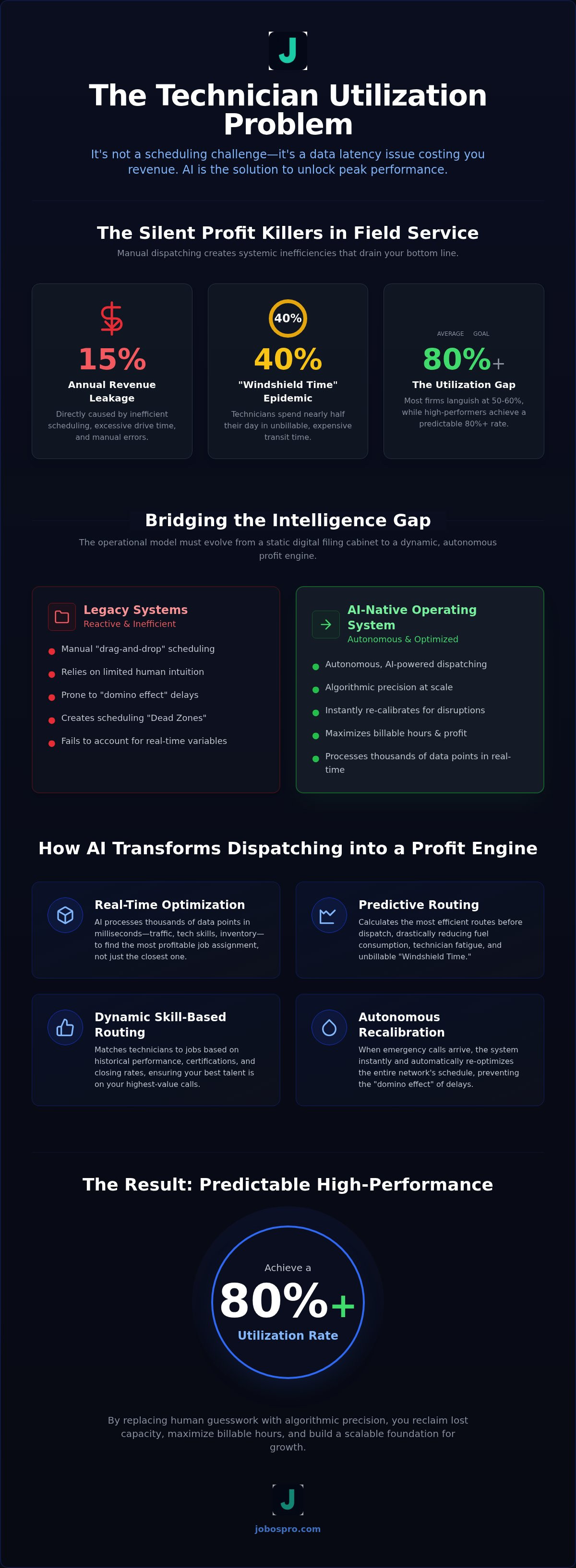
Utilization is the pulse of a field service organization. It represents the ratio of billable hours to total clocked-in hours. While many owners mistake activity for progress, the "Windshield Time" epidemic is a silent profit killer. Technicians often spend up to 40% of their day in transit, yet this time remains unbillable and expensive. High-growth firms aim for a predictable 80% utilization rate. Most businesses, however, languish between 50% and 60%. This 20% gap directly erodes EBITDA and leads to technician burnout. High-performers grow frustrated with idle gaps and poor route planning, eventually seeking employment at more organized firms. It's a cycle of waste that stalls scaling efforts.
Utilization vs. Productivity: Clearing the Confusion
A "productive" technician completes every assigned task with technical excellence. However, that same technician can still have poor utilization if the dispatching logic is flawed. True efficiency is found in the "Revenue Per Hour" metric, which serves as the ultimate truth for operational health. Modern Field Service Management strategies focus on identifying "Dead Zones" in the daily schedule. These are the 15 to 30 minute gaps where a technician is neither driving nor working. If your dispatchers lack the visibility to fill these pockets with high-value tasks, you are essentially subsidizing inactivity. You don't just need busy techs; you need utilized ones.
The $2.3B Revenue Leak: Where the Money Goes
The industry loses billions annually to operational latency. Revenue leakage often starts at the first touchpoint through missed calls and slow dispatch response times. When a manual dispatcher makes a scheduling error, it triggers a chain reaction of no-shows and wasted fuel. For multi-location operations, this inefficiency makes franchise network benchmarking nearly impossible. To solve this, executives are turning to improve technician utilization software to replace human guesswork with algorithmic precision. This shift ensures every lead is captured and every technician is placed on the most profitable route possible. By automating the dispatching layer, you eliminate the manual errors that lead to "No-Shows" and compounding financial loss. It's about securing the foundation of your business through tech-driven oversight and total visibility.
How AI Software Transforms Dispatching into a Profit Engine
Manual "drag-and-drop" scheduling belongs to a bygone era of field operations. It relies on human intuition, which is inherently limited by cognitive load and emotional bias. To truly scale, leadership must pivot toward autonomous intelligent technician dispatching. This technology functions as a high-frequency trading engine for service calls. It processes thousands of data points, including real-time traffic patterns, individual technician skill sets, and truck-level parts inventory, in mere milliseconds. This level of oversight ensures that the schedule is not just filled, but optimized for maximum yield.
Predictive routing plays a critical role in this transformation. By calculating the most efficient pathing before the technician even starts their engine, the system significantly reduces fuel consumption and physical fatigue. When emergency calls disrupt the flow, the software re-calibrates the entire network instantly. It prevents the "domino effect" of delays that typically plagues manual dispatchers. Understanding AI's role in FSM is essential for executives who view their field team as a profit center rather than a cost center. Implementing such improve technician utilization software allows your team to handle higher volume without increasing headcount.
Dynamic Skill-Based Routing
Efficiency is not just about speed; it's about accuracy. AI-native systems match technicians to jobs based on historical performance data and specific certifications. This ensures that your top-tier closers are prioritized for high-value leads, maximizing the revenue potential of every site visit. By verifying that the assigned tech has the exact tools and expertise required, you drastically reduce recall rates. This precision protects your brand reputation and ensures that billable hours are spent on new progress rather than fixing past errors. This transition is a core component for those looking to improve technician utilization software stacks within their enterprise.
Eliminating Dispatcher Latency
Human dispatchers often become the primary bottleneck in high-volume environments. They are forced to juggle phone lines, map software, and technician complaints simultaneously. This chaos creates latency. When AI call answering feeds directly into the dispatch engine, bookings happen instantly without human intervention. This shift allows your dispatchers to transition from reactive "schedulers" to strategic operations managers who focus on long-term performance trends. If you want to see how this architecture functions in practice, you can explore our AI-driven dispatching platform to witness the transformation of your field operations.
Legacy Field Service Management vs. AI-Native Operating Systems
Most field service companies operate with an "Intelligence Gap" that they mistakenly attribute to human error. Your current CRM is likely little more than a digital filing cabinet. It stores data, but it doesn't process it to drive action. This distinction is critical for leadership to understand. Legacy systems require manual intervention at every stage, creating friction that prevents scaling. To truly modernize, firms must move beyond these passive tools and invest in improve technician utilization software that functions as a foundational operating layer rather than a peripheral add-on. Bolted-on AI features often fail because they lack the deep integration required to eliminate data silos between your estimators and dispatchers.
When your disparate departments don't communicate in real time, utilization suffers. A dispatcher cannot optimize a route if they don't know the specific parts required for a job or the exact skill level of the technician. This is where AI electrical service scheduling software changes the equation. It retrieves data from across the entire business stack to make informed, autonomous decisions. It unifies the front office and the field team, ensuring that every operational choice is backed by comprehensive data rather than a dispatcher's "best guess."
The Failure of Manual Entry
Manual data entry is a relic of the past that creates a systemic 20-minute lag between job completion and the next assignment. In a high-volume service environment, these 20-minute windows aggregate into hours of lost billable time every week. This "dead time" is the direct result of technicians waiting for a dispatcher to update a status or close out a ticket. Implementing automated invoicing for home services removes this bottleneck. It triggers the next job assignment the moment the current invoice is generated. Legacy systems simply cannot provide this level of executive-level visibility into true field performance, leaving leadership to manage by intuition rather than hard metrics.
AI-Powered Business Management
The transition to an AI-native operating system allows for the total unification of lead capture, AI estimating software for HVAC, and dispatching. This creates a "Zero Latency" model where downtime is virtually eliminated. Technicians move from job to job with seamless transitions, guided by an intelligent system that has already verified parts availability and customer readiness. Beyond the immediate financial gains, positioning your business as a tech-forward leader is a powerful recruiting tool. High-tier talent is drawn to organizations that respect their time and provide the modern improve technician utilization software needed to succeed. You aren't just buying software; you're building a smarter, more resilient workforce.
A Strategic Roadmap to Maximizing Field Performance with Automation
High-performance field operations do not happen by accident. They are the result of a deliberate, data-driven roadmap designed to extract maximum value from every clocked-in hour. The first step involves auditing your current "Wasted Time" through detailed executive reporting. This phase identifies exactly where the 15% revenue leakage occurs within your specific workflow. Next, implement automated lead capture to ensure your pipeline remains saturated. You cannot utilize technicians without a constant flow of jobs. A saturated pipeline provides the raw material for optimization.
The third stage requires deploying AI-driven dispatching to handle the complex variables of skill matching and route optimization. This is where you truly improve technician utilization software ROI by eliminating human latency and ensuring every tech is on the most profitable path. Finally, leverage recurring service membership software to fill remaining schedule gaps. Preventative maintenance jobs act as a buffer. They ensure your team stays billable during seasonal lulls or mid-day cancellations. This layered approach transforms your workforce into a high-yield asset.
Setting Utilization KPIs That Matter
Executive leadership must distinguish between activity and efficiency. "Hours Clocked" is a vanity metric that hides systemic waste. "Billable Efficiency" is the gold standard. It measures the actual revenue-generating time against the total paid day. For organizations managing multiple territories, home service franchise management software allows you to benchmark these KPIs across locations. This visibility reveals which branches are optimizing their teams and which are allowing drive-time to eat their margins. Clear communication of these metrics is vital to secure buy-in from the field. When everyone understands the target, performance naturally aligns with your strategic goals.
Overcoming Technician Resistance
Field teams often view new technology with skepticism. You must frame the transition as a benefit to their personal productivity. Position the software as a tool for "Less Driving, More Earning." When technicians spend less time fighting traffic and more time on-site, their earning potential increases. Use automated performance dashboards to gamify these outcomes. Providing total transparency in invoicing and payment collection ensures technicians see the direct link between their utilization rates and their bonuses. This trust is the foundation of a high-performance culture. To begin your transition to an automated field, request a strategic walkthrough of our AI-native architecture.
JobOS Pro: The AI-Powered Architecture for Scalable Technician Utilization
JobOS Pro represents the first true AI-native operating system designed specifically for the home service industry. It isn't a simple CRM; it's a foundational architecture that unifies disparate operational layers into a single, cohesive engine. While legacy platforms focus on passive record-keeping, JobOS Pro prioritizes automated action. It eliminates the structural friction that typically exists between lead capture and job completion. By integrating the entire customer lifecycle, you remove the manual hand-offs that cause utilization to plummet. This is the definitive way to improve technician utilization software performance across large-scale franchise networks.
Executive oversight is no longer about reviewing yesterday's reports. Our performance dashboards provide total visibility into network-wide utilization in real-time. You can observe exactly how drive-time, skill-matching, and scheduling efficiency impact your bottom line. This level of transparency allows you to grow your revenue without the traditional burden of adding administrative overhead. You're no longer scaling through headcount. You're scaling through technological leverage. The system identifies hidden patterns of waste that human operators missed for decades.
The Strategic Advantage of Total Automation
AI call answering and instant lead capture function as the primary intake valve for the utilization engine. Every missed call is a missed billable hour. By capturing every lead instantly, the system ensures a constant supply of work for the field. Automated estimating further accelerates this cycle. It allows technicians to close more jobs on-site with zero office intervention. This significantly reduces the "Administrative Tax" that typically drains the productivity of both your field and office staff. Efficiency is reclaimed at every touchpoint, from the first ring to the final payment.
Next Steps for Executive Leadership
Your path to 80% utilization begins with an honest assessment of your current tech stack. Look for "Intelligence Gaps" where manual entry still dictates the pace of work. Implementing the right improve technician utilization software is a requirement for modern growth. Consider the financial impact of a 10% increase in technician utilization across your entire network. For most enterprise-level operations, this shift represents millions in reclaimed EBITDA. The transition to an AI-native architecture is a strategic imperative for those who intend to lead the market. To begin this transformation, you should schedule a strategic briefing with JobOS Pro today.
Transitioning to a High-Yield Service Model
The era of accepting 50-60% utilization as an industry standard is over. You've seen how operational latency and the "Windshield Time" epidemic directly erode your EBITDA. By shifting from legacy digital filing cabinets to an AI-native architecture, you reclaim the revenue typically lost to manual dispatching errors. Utilization is fundamentally a data-processing challenge that requires high-frequency precision. Implementing improve technician utilization software is the definitive step toward achieving predictable 80% efficiency across your entire network. This shift unifies your lifecycle from the first missed-call recovery to the final automated payment.
JobOS Pro provides the executive-grade reporting and multi-location intelligence required for 2026 performance standards. It's the only platform built to automate the entire customer lifecycle while providing total visibility into field performance. It's time to eliminate operational latency and scale your home service business with JobOS Pro. Your team is ready for a smarter, more efficient way to work. Secure your competitive edge and lead the market today.
Frequently Asked Questions
How does software specifically improve technician utilization?
Software improves utilization by automating the complex logistics of route optimization and skill-matching. It eliminates the 20-minute lag between job completions by triggering new assignments the moment an invoice is closed. By centralizing lead capture and dispatching, the system ensures technicians spend less time fighting traffic and more time performing billable work. This foundational shift allows you to improve technician utilization software outcomes through real-time, data-driven orchestration of your entire field team.
Is AI dispatching better than a human dispatcher who knows the area?
AI dispatching outperforms human intuition by processing thousands of variables in milliseconds. While a local dispatcher might know certain shortcuts, they cannot simultaneously calculate live traffic, parts inventory, and technician skill sets across an entire network. AI-native systems operate without cognitive load or emotional bias. This ensures that every routing decision is mathematically optimized for maximum yield, allowing your human staff to focus on high-level strategic management rather than reactive scheduling.
What is a good utilization rate for an HVAC or plumbing company?
A healthy technician utilization rate falls between 75% and 85% for high-growth service firms. Rates below 70% typically indicate systemic inefficiencies in dispatching or route planning. Conversely, rates exceeding 90% often signal a high risk of technician burnout and operational fatigue. Maintaining this balance requires sophisticated oversight. AI-powered platforms provide the executive-grade reporting necessary to monitor these KPIs across multiple locations, ensuring your business stays within the optimal performance corridor.
Can utilization software help with technician retention?
High-tier talent is attracted to organizations that respect their time and provide modern tools. Utilization software reduces the physical and mental fatigue associated with inefficient routing and repetitive manual paperwork. By maximizing billable hours and minimizing unbillable drive time, technicians often see an increase in their performance-based bonuses. This transparency creates a culture of accountability and professional respect, which are critical components for long-term retention in a competitive labor market.
Does improving utilization mean my technicians will be overworked?
Improving utilization is about eliminating waste, not increasing the workload. The goal is to convert unbillable "Windshield Time" into productive, revenue-generating hours within the standard workday. By reducing drive times and administrative friction, technicians can complete more jobs without extending their shifts. This approach protects your team from burnout while simultaneously increasing the profitability of every hour they're on the clock. It's about optimizing existing time, not demanding more of it.
How long does it take to see results after implementing AI-driven software?
Most organizations observe immediate improvements in visibility and lead capture within the first 30 days. As the AI engine gathers historical performance data, the dispatching logic becomes increasingly precise. Significant gains in billable efficiency typically materialize within the first full quarter of operation. Implementing improve technician utilization software allows leadership to identify and close revenue leaks rapidly. This creates a compounding effect on EBITDA as the system unifies the entire customer lifecycle.
Will this software integrate with my existing accounting tools like QuickBooks?
JobOS Pro is designed to function as a strategic operating layer that unifies your existing business stack. It integrates seamlessly with industry-standard accounting tools like QuickBooks to ensure financial data remains synchronized. This connectivity prevents the formation of data silos between your field operations and your back office. By automating the flow of invoicing and payment data, you eliminate the need for manual entry and reduce the risk of accounting errors that stall your cash flow.