
Beyond the Marketplace: Top Home Service Lead Generation Tools for 2026
The traditional model of purchasing shared leads from third-party marketplaces has become a race to the bottom that systematically erodes your profit margins. In 2026, relying on these generic home service lead generation tools is no longer a viable growth strategy for high-performance firms. You're likely frustrated by paying for the same homeowner contact info as five other competitors, only to lose the contract because your office couldn't answer the phone fast enough. This creates massive revenue leakage during your peak demand periods and leaves you with an untraceable return on investment across your marketing spend.
You already understand that capturing demand is only half the battle. The real victory lies in the technological speed of your response. This article will show you how to move beyond expensive, low-intent leads and build a high-conversion engine that captures every opportunity with zero latency. We'll examine the essential tech stack required to lower your cost per acquisition, outpace your competitors through instant automation, and gain unified visibility into the entire lead-to-invoice lifecycle.
Key Takeaways
- Transition from high-volume lead acquisition to high-velocity conversion to capitalize on existing market demand.
- Differentiate between top-of-funnel acquisition and the essential home service lead generation tools designed for immediate lead capture and retention.
- Replace passive "leave a message" systems with AI-driven call answering that acts as a proactive, 24/7 sales agent.
- Audit your current lead-to-booking ratio to identify systemic revenue leakage before integrating new tools with your dispatch and financial systems.
- Move beyond fragmented CRM software to an AI-native operating system that unifies the entire lead-to-invoice lifecycle.
The Evolution of Lead Generation: From Volume to Velocity
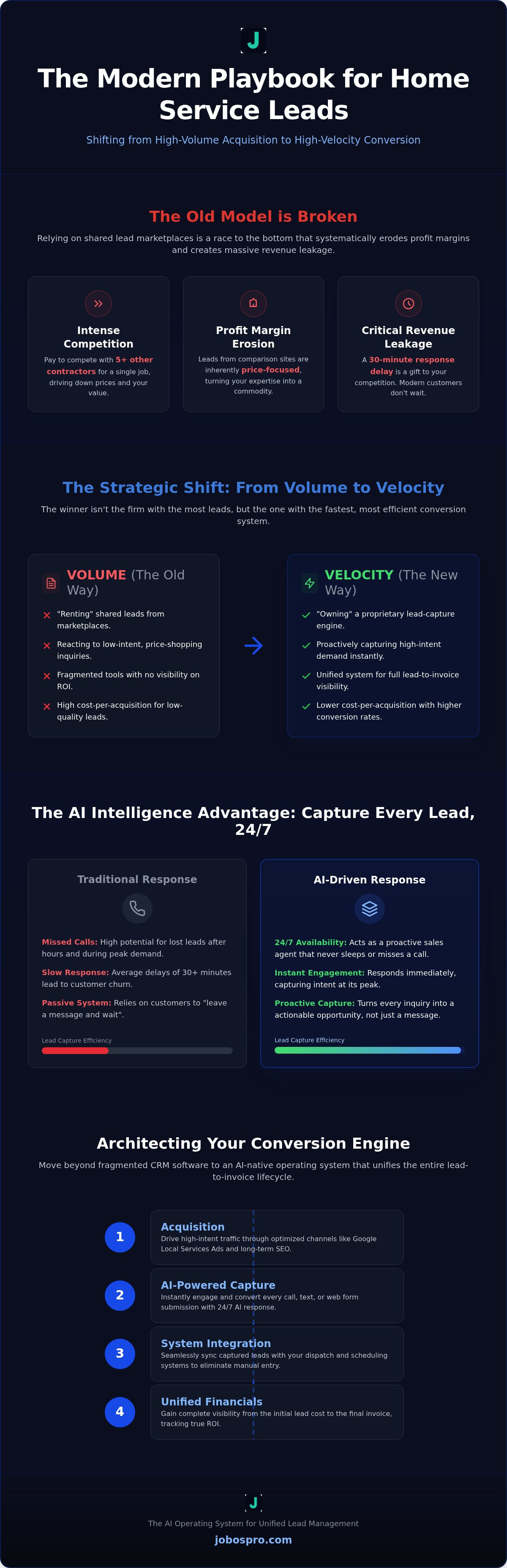
Lead generation in 2026 is no longer a game of volume. High-performance companies have stopped treating "buying names" as a sustainable growth strategy. Instead, the strategic focus has shifted toward velocity. A sophisticated understanding lead generation reveals that the modern battle isn't won by the firm with the most leads, but by the one with the fastest conversion systems. If your current home service lead generation tools only provide a static list of names, you're already operating at a disadvantage.
The industry has reached a tipping point where raw acquisition is secondary to the technical architecture of your response. Traditional lead generation websites often facilitate a race to the bottom on price, forcing you to compete in a commoditized environment. To escape this, you must own the customer relationship from the very first digital touchpoint. This requires a transition from being a passive recipient of data to an active controller of the lead lifecycle.
The Problem with Shared Lead Marketplaces
Relying on shared lead marketplaces is a terminal strategy for margins. These platforms force you into a high-stakes auction where you pay to compete with five other contractors for a single job. This model systematically erodes your profitability. When a lead originates from a comparison site, the customer's psychological state is transactional; they're looking for the cheapest quote rather than the most qualified expert. To build a resilient business, you must move from "renting" leads to "owning" a proprietary lead engine. This shift allows you to control the narrative and the price point before a competitor even sees the opportunity.
Understanding Revenue Leakage in the Lead Cycle
Revenue leakage is the financial gap that occurs between an initial customer inquiry and a successfully booked job. Most firms suffer from massive leakage because their response times are too slow to meet modern consumer expectations. A 30-minute delay in responding to a plumbing or HVAC emergency is effectively a gift to your competitors. In 2026, customers don't wait; they move to the next search result if they don't get an immediate answer. Implementing automated lead capture for contractors solves this systemic inefficiency by ensuring no call or message goes ignored. This technology functions as the essential conversion layer for your business, turning a leaky bucket into a high-performance funnel. By prioritizing velocity over raw volume, you can lower your cost per acquisition while increasing total revenue. High-velocity systems ensure that your home service lead generation tools result in profit rather than just busywork.
Evaluating the Lead Generation Ecosystem: Marketplaces vs. Systems
The modern landscape of home service lead generation tools is divided into three distinct layers: acquisition, aggregation, and capture. Acquisition involves driving high-intent traffic through search engines. Aggregation refers to third-party marketplaces where you bid for visibility. Capture represents the internal systems that transform interest into revenue. While many contractors rely heavily on aggregation, top-tier firms treat marketplaces like Angi or Thumbtack as tactical fillers rather than foundational infrastructure. In 2026, your foundation must be an AI-powered operating system that unifies these disparate channels into a single, high-performance engine.
Marketplaces often create a dependency that limits your brand's growth. They own the customer data, they control the platform, and they dictate the price of the lead. A truly resilient business builds its own proprietary capture layer to reclaim this control. This shift allows you to move from a defensive posture, where you react to marketplace leads, to a proactive one where you dictate the terms of engagement. Integrating these layers into a cohesive tech stack is the only way to achieve a competitive edge in a saturated market.
Acquisition Tools: Driving High-Intent Traffic
Google Local Services Ads (LSAs) remain the gold standard for capturing "emergency" searchers who need immediate assistance. These ads place your brand at the very top of search results when intent is highest. However, relying solely on paid ads is an expensive strategy that can lead to diminishing returns. Strategic leadership balances immediate PPC wins with long-term SEO to drive consistent, low-cost organic demand. To maximize ROI, your marketing spend must be synchronized with HVAC sales automation software. This integration ensures that every dollar spent on acquisition is tracked directly to a closed invoice, providing total visibility into your marketing performance across all home service lead generation tools.
Capture Systems: Turning Traffic into Revenue
Your website is your most powerful lead generation tool, provided it functions as an active conversion engine rather than a static digital brochure. In a market where response time dictates win rates, instant booking and AI-driven chat are mandatory. Legacy field service management tools often fail at this stage. They act as passive databases that require manual input, creating bottlenecks during peak demand. Modern AI-native platforms proactively engage visitors, qualify leads, and secure appointments without human intervention. By deploying a unified AI operating system, you eliminate the friction that kills conversions in traditional funnels and ensure that no opportunity is lost to latency.
The Intelligence Advantage: Why AI Lead Capture Outperforms Traditional Methods
The era of "leave a message" is effectively dead. In a market defined by instant gratification, silence is interpreted as incompetence. If your office fails to answer a call within three rings, the customer has already moved to the next search result. While traditional home service lead generation tools focus on the quantity of inquiries, the intelligence advantage lies in the quality of the capture. AI call answering doesn't just record data; it acts as a proactive, 24/7 sales agent that qualifies leads, identifies high-intent customers, and filters out tire kickers before they ever reach your dispatchers. This ensures your human talent spends their time on high-value jobs rather than administrative sorting.
Beyond simple answering, an AI-native system provides a strategic data layer that legacy tools lack. It observes patterns in lead sources and conversion rates that human operators often miss. For example, the software might identify that leads from a specific zip code close at a 40% higher rate, allowing you to reallocate your marketing spend in real-time. This level of oversight transforms your lead funnel from a guessing game into a predictable revenue engine. By centralizing this intelligence, you gain total visibility into which home service lead generation tools are actually driving your bottom line.
Missed-Call Recovery: Capturing Lost Revenue
Missed calls represent the most significant source of revenue leakage in the home service industry. Industry data suggests that up to 25% of calls to contractors go unanswered during peak hours or after-hours. An AI-powered system eliminates this gap through instant text-back and automated recovery sequences. When a call is missed, the system immediately engages the homeowner via SMS to acknowledge the inquiry and initiate the booking process. Recovering just two missed HVAC calls per month can generate enough additional revenue to cover your entire technology stack's annual cost. This rapid response prevents the customer from calling a competitor and secures the job before the lead goes cold.
AI Estimating and Instant Quoting
Winning the lead race requires more than just a fast answer; it requires a fast quote. Reducing your time-to-quote from several days to a few minutes dramatically increases your closing rates. Customers view an instant, professional estimate as a sign of reliability and technical superiority. By leveraging automated lead management for contractors, you can provide preliminary pricing based on AI-analyzed customer inputs. This streamlines the sales pipeline and builds immediate trust. It allows your team to focus on technical execution while the software handles the foundational sales architecture, ensuring that your business remains the first and final choice for the customer.
Architecting Your Conversion Engine: A Strategic Selection Framework
Your technology stack is either a force multiplier or a bottleneck. Selecting home service lead generation tools requires a rigorous, executive-level framework that prioritizes system architecture over individual features. It's not enough to acquire more leads; you must build a conversion engine capable of processing them with clinical efficiency. This framework demands a shift from reactive purchasing to strategic orchestration, ensuring every tool serves the ultimate goal of profitable growth.
The first step in this architecture is a ruthless audit of your current lead-to-booking ratio. You must identify exactly where revenue is escaping, whether it's through missed calls, slow follow-ups, or poor qualification. Once the leaks are identified, prioritize tools that integrate natively with your dispatch and financial systems. A standalone tool is a liability that creates data silos and obscures your true performance. Finally, focus on achieving "Zero Latency." In 2026, the ability to respond to a lead in under 60 seconds is the baseline for survival. If your system can't maintain this speed, you're merely subsidizing your competitors' growth.
Integration: The Key to Operational Intelligence
Fragmented data is the enemy of oversight. Standalone lead generation tools often fail because they lack the context of your field operations. To achieve total visibility, you must sync your lead data with intelligent technician dispatching. This connection allows you to track a lead from the initial digital touchpoint through to the final invoice. When your marketing spend is tied directly to real-world revenue data, you can calculate your true ROI with absolute certainty. This level of operational intelligence ensures that you're investing in the channels that actually move the needle for your bottom line.
Scalability for Multi-Location Businesses
For franchise networks and multi-location enterprises, standardization is the only path to sustainable scaling. You cannot manage what you cannot measure across your entire footprint. An AI-native operating system allows you to standardize lead capture protocols across every territory, ensuring a consistent customer experience regardless of location. Executive dashboards provide the oversight needed to monitor network-wide lead performance in real-time. By benchmarking your top-performing locations, you can identify winning patterns and deploy them across the entire organization. This systemic approach turns local successes into a blueprint for national dominance. To begin unifying your network, you should centralize your operations with an AI-powered platform that scales with your ambition.
JobOS Pro: The AI Operating System for Unified Lead Management
JobOS Pro represents a fundamental shift in technical architecture. It isn't merely another entry in the crowded market of home service lead generation tools; it is a comprehensive AI operating system designed for total business oversight. Legacy CRMs act as passive databases that require manual effort to maintain. In contrast, JobOS Pro functions as an active participant in your growth, observing every customer touchpoint and correcting inefficiencies in real-time. By unifying lead capture, call answering, and dispatching into a single layer, you eliminate the data fragmentation that plagues traditional field operations.
This unified approach effectively ends your dependency on expensive third-party lead marketplaces. When your system captures and qualifies every organic inquiry with zero latency, the need to rent low-intent leads from aggregators disappears. You reclaim your profit margins and your brand identity simultaneously. The platform leverages automated follow-ups and reputation management to turn every completed job into a generator of new organic leads. Executive reporting then provides the final layer of clarity, offering total visibility into every dollar of marketing spend and its direct impact on your bottom line.
Transforming the Customer Lifecycle
The transition from a lead to a loyal customer must be frictionless. JobOS Pro automates this entire progression, moving from instant AI lead capture directly into automated invoicing and billing. This speed doesn't just improve cash flow; it drives the five-star reviews that fuel your organic search rankings. By removing human error from the administrative process, you ensure a professional experience that encourages long-term retention. Building predictable revenue becomes a systematic outcome rather than a lucky break, especially when utilizing recurring service membership software to lock in future demand. This creates a self-sustaining ecosystem where your existing customer base becomes your most efficient lead source.
The Future of Your Business Stack
To remain competitive in 2026, your business stack must be AI-native. Legacy software that has simply bolted on AI features cannot match the speed or intelligence of a platform built from the ground up for automation. You must move from reactive management, where you address problems after they occur, to a proactive model driven by real-time data. JobOS Pro provides the infrastructure for this transformation, allowing you to scale with confidence and precision. It is the essential conversion layer that turns your home service lead generation tools into a high-performance engine. Discover how JobOS Pro can transform your lead generation strategy.
Reclaiming Your Market Dominance in 2026
The landscape of home service lead generation tools has shifted from simple acquisition to high-velocity conversion. You can no longer afford to rent leads from third-party marketplaces that prioritize price over your expertise. The future belongs to firms that own their capture layer and eliminate revenue leakage through AI-native response systems. By centralizing your operations, you move from reactive management to a state of proactive, data-driven growth.
Implementing an AI-powered operating system provides the foundation for this evolution. It offers total oversight through executive dashboards for multi-location intelligence and ensures seamless execution with automated customer lifecycle management. From AI-native lead capture to call recovery, every component of your stack must focus on zero latency. It's time to stop chasing volume and start engineering velocity. Schedule a Strategic Consultation with JobOS Pro today to secure your competitive edge. Your business is ready for the next level of operational intelligence.
Frequently Asked Questions
What are the most effective lead generation tools for contractors in 2026?
The most effective tools prioritize conversion velocity over raw acquisition volume. Google Local Services Ads (LSAs) paired with AI-native capture systems represent the pinnacle of modern strategy. These systems ensure that high-intent traffic is engaged immediately, preventing the revenue leakage common in legacy models. By integrating these home service lead generation tools into a unified operating system, contractors maintain total visibility into their marketing performance while maximizing their profit margins.
How can I generate home service leads without using Angi or Thumbtack?
You can generate proprietary leads by investing in organic SEO, targeted PPC campaigns, and localized Google Services Ads. This approach allows you to own the customer relationship from the first digital touchpoint rather than renting it from a marketplace. By building a high-conversion engine on your own website, you eliminate the need to compete on price in shared environments. This strategy builds long-term brand equity and ensures your margins remain protected.
Why is instant response time so critical for home service lead generation?
Instant response time is the primary factor that dictates win rates in a saturated market. Modern consumers interpret a delayed response as a lack of professionalism and will immediately move to the next search result. In 2026, the standard for survival is "Zero Latency," which means responding to an inquiry in under 60 seconds. Systems that achieve this speed capture the job before a competitor even realizes the lead exists.
Can AI really handle my customer calls and book appointments?
AI-native call answering systems function as 24/7 sales agents capable of qualifying leads and securing appointments directly in your dispatch software. These systems recognize high-intent inquiries and filter out tire kickers with clinical precision. Unlike traditional answering services, AI provides an instant, consistent experience that eliminates human error. This automation ensures your office remains open at all times, capturing every opportunity during peak demand periods without increasing your fixed overhead costs.
How do I track the ROI of my home service marketing tools?
Accurate ROI tracking requires a unified data layer that connects your marketing spend directly to final invoice data. You must utilize software that bridges the gap between lead acquisition and the financial lifecycle of the job. This integration provides total visibility into which channels are driving revenue versus which are merely generating noise. Executive dashboards allow you to monitor these patterns in real-time, enabling you to reallocate your budget toward the highest-performing home service lead generation tools.
What is the difference between lead acquisition and lead capture?
Lead acquisition is the process of driving traffic to your business, while lead capture is the technical architecture used to secure that demand. Acquisition involves tools like SEO and paid ads to put your brand in front of homeowners. Capture involves the systems, such as AI chat or instant booking, that transform that interest into a booked appointment. Focusing on acquisition alone results in a leaky bucket; a strong capture layer ensures marketing spend translates into profit.
Is it better to buy exclusive leads or shared leads?
Exclusive leads are always superior because they prevent the race to the bottom on price that defines shared marketplaces. When you buy shared leads, you pay for the privilege of competing with multiple contractors for a single job; this systematically erodes your margins. Exclusive leads allow you to control the narrative and establish value before a competitor enters the conversation. Transitioning to a proprietary lead engine ensures every inquiry you receive is yours alone to close.
How does an AI operating system improve lead generation for franchises?
An AI operating system standardizes lead capture protocols across the entire franchise network to ensure consistent performance in every territory. It provides executive leadership with the multi-location intelligence needed to benchmark top-performing locations and identify systemic inefficiencies. By unifying disparate data points into a single dashboard, the system allows for network-wide optimization of marketing spend. This architectural oversight ensures every franchise location adheres to the high-velocity response standards required to dominate local markets.