
AI Landscaping Business Software: Beyond Design to Autonomous Operations (2026 Guide)
The most profitable landscaping enterprises in 2026 will not be defined by the quality of their hardscapes, but by the speed of their autonomous nervous systems. Your firm is likely leaking revenue through every manual touchpoint, from missed calls to fragmented data silos. It's a systemic inefficiency that traditional management tools simply cannot solve.
You understand the high stakes of a missed inquiry. When a high-value lead calls and reaches a voicemail, they've already moved on to your competitor. You've also dealt with the operational drag of inefficient crew routing and the headache of syncing design apps with accounting tools. This guide explores why the industry is moving toward AI landscaping business software that functions as a self-correcting operating system. We'll show you how to achieve full operational visibility, capture every lead with zero latency, and maximize daily job completion through automated scheduling. We're moving beyond design tools into the era of autonomous business growth.
Key Takeaways
- Shift your operational focus from visual design tools to an autonomous nervous system that manages the entire customer lifecycle without human intervention.
- Eliminate revenue leakage by deploying zero-latency AI call answering to capture high-intent landscaping leads during peak seasonal demand.
- Leverage modern AI landscaping business software to unify dispatching and route optimization, ensuring maximum job completion with minimal labor overhead.
- Replace the passive database mindset of legacy CRMs with an active, agentic operating system that provides executive oversight across multiple regions.
Defining the AI Business Operating System for Landscaping Enterprises
Landscaping enterprises have historically mistaken visual rendering for technological maturity. While 3D design tools provide aesthetic value, they fail to address the systemic inefficiencies that erode profit margins. True scale requires more than a drawing app; it requires a foundational shift toward an integrated AI Business Operating System. This isn't just a software upgrade. It's a structural overhaul of how your business observes and reacts to market demand.
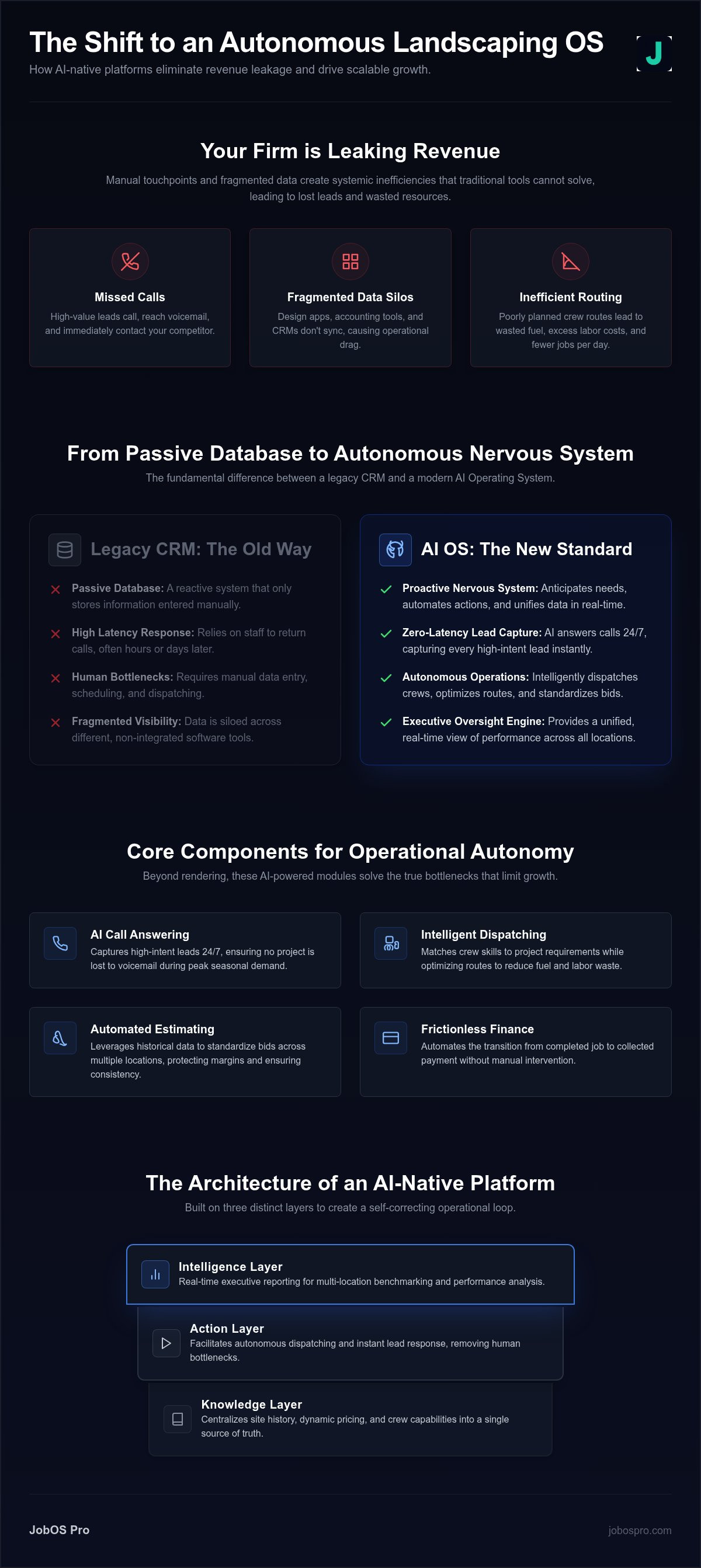
This shift is defined by Intelligent Automation (IA), a framework that unifies artificial intelligence with business process automation to create a self-sustaining operational loop. Unlike a legacy CRM, which serves as a passive, reactive database, modern AI landscaping business software functions as an autonomous nervous system. It doesn't wait for human input to record a lead or update a schedule. Instead, it retrieves data from every interaction and unifies it into a proactive oversight engine that anticipates needs before they become crises.
Zero latency has become the new standard for landscaping customer service. In a market where the first company to respond wins the contract, waiting for a human to return a voicemail is a recipe for revenue leakage. An AI-native system ensures that every inquiry receives an immediate, intelligent response, capturing high-value leads while your competitors are still checking their messages. This level of responsiveness is the hallmark of a modern, tech-forward enterprise.
The Architecture of an AI-Native Landscaping Platform
A sophisticated platform is built on three distinct pillars. The Knowledge Layer centralizes site history, dynamic pricing, and crew capabilities into a single source of truth. This prevents data fragmentation and ensures that every decision is grounded in accurate, real-time information. The Action Layer facilitates autonomous dispatching and instant lead response, effectively removing the human bottleneck from your core operations. Finally, the Intelligence Layer provides real-time executive reporting for multi-location benchmarking. This allows leadership to identify performance gaps across disparate regions and implement corrective actions with surgical precision.
Why 2026 is the Tipping Point for Landscaping Automation
Rising labor costs have rendered manual office tasks unsustainable. Your back office can no longer afford to spend hours on manual data entry, route planning, or scheduling adjustments. Simultaneously, customer expectations have undergone a fundamental shift. Homeowners now demand 24/7 digital interaction and immediate booking. AI landscaping business software bridges this gap by empowering novice estimators to generate precise quotes in the field, leveraging historical data to maintain accuracy. By automating the mundane, you free your human talent to focus on high-stakes strategy and customer relationships.
Beyond Rendering: Core AI Components for Landscaping Operations
While competitors focus on photorealistic renders that look good on a screen, enterprise leaders know that profit is won in the field. High-growth firms are deploying AI landscaping business software to solve the actual bottlenecks: missed calls, erratic scheduling, and inconsistent bidding. It's time to move beyond the drawing board and into the era of operational autonomy. True scale isn't achieved through better pictures; it's achieved through a system that observes, retrieves, and unifies every moving part of your business.
The modern landscaping stack requires four critical components to eliminate revenue leakage and maximize performance:
- AI Call Answering: Captures high-intent leads 24/7, ensuring no project is lost to a voicemail or an busy office line.
- Intelligent Dispatching: Matches crew skills to project requirements while optimizing routes to reduce fuel and labor waste.
- Automated Estimating: Standardizes bids across multiple locations to protect margins and ensure consistency.
- Frictionless Finance: Automates the transition from completed job to collected payment without manual intervention.
AI Call Answering and Instant Lead Capture
Peak season represents a high-stakes race where human office staff often fail to keep pace. When a prospect calls for a high-value hardscaping project, they won't wait for a callback. AI call answering provides a zero-latency response, identifying project intent and capturing data immediately. This reduces your cost-per-lead by ensuring every marketing dollar results in a captured opportunity rather than a missed connection. If your current tools lack this capability, you'll likely find that your residential service business software is failing your growth by allowing revenue to leak through your phone lines during your busiest months.
Precision Dispatch and Crew Utilization
Efficiency in the field requires more than just a digital map. It requires an intelligent match between crew expertise and project complexity. An AI-native system retrieves data on crew skills and historical performance to ensure the right team is on the right job, whether it's a complex masonry project or routine turf maintenance. Autonomous routing then optimizes travel paths to reduce fuel consumption and maximize actual "shovel time." You can explore these strategies further in our executive guide to intelligent technician dispatching.
Standardizing bids across multiple regions is a common pain point for scaling enterprises. AI estimating tools retrieve historical pricing data and material costs to generate accurate, consistent quotes, even when used by novice field staff. Once the job is done, the system initiates automated invoicing and payment collection. This transition from manual billing to frictionless finance ensures your cash flow remains as healthy as your project pipeline. Firms looking to unify these disparate elements should consider an autonomous partner for landscaping operations to maintain a definitive competitive edge.
AI Operating System vs. Legacy Landscaping CRM
The fundamental flaw in traditional landscaping management is the database mindset. For decades, firms have relied on CRMs that function as passive receptacles for information. These systems wait for a human to input a lead, wait for a dispatcher to assign a crew, and wait for an accountant to send an invoice. This reactive model is a bottleneck. In contrast, AI landscaping business software utilizes an agentic mindset. It doesn't just store data; it acts upon it. It observes patterns, retrieves necessary resources, and unifies disparate operations into a single, proactive stream.
Manual data entry is the enemy of enterprise growth. When information is trapped in individual spreadsheets or fragmented design apps, you create data silos that hinder multi-location oversight. Scaling a landscaping firm 10x shouldn't require 10x the office staff. It requires an autonomous data capture layer that retrieves information directly from the field, eliminating the need for manual transcription and the human errors that inevitably follow. This transition from manual record-keeping to autonomous data capture is the defining characteristic of a market leader.
Legacy FSM: The Digital File Cabinet
Most existing field service management (FSM) tools are essentially digital file cabinets. They excel at record-keeping but fail at active business management. The hidden cost of this passivity is staggering. Every manual office follow-up and every uncaptured lead represents revenue leakage that your current stack is powerless to stop. To understand why this outdated infrastructure has become a strategic liability, consult our executive guide to field service management AI in 2026.
AI Operating System: The Autonomous Partner
An AI-native operating system serves as an autonomous partner rather than a peripheral tool. It provides proactive alerts for revenue leakage and identifies technician performance gaps before they impact your bottom line. For enterprises managing multiple branches, the system facilitates dynamic load balancing. It moves resources where demand is highest without requiring a single phone call or manual schedule adjustment. This level of oversight is essential for modern operations. Explore how this architecture supports high-growth firms in our 2026 executive guide to enterprise home service software.
Strategic Implementation: Transitioning to Autonomous Landscaping
Modernizing your enterprise requires a tactical shift from manual oversight to algorithmic precision. It's a phased decommissioning of inefficient habits. You cannot simply flip a switch to achieve full autonomy; you must methodically replace human bottlenecks with intelligent systems. Adopting AI landscaping business software is a strategic maneuver that demands a clear implementation framework to ensure zero disruption to your current project pipeline.
The first priority is a comprehensive audit of your revenue leakage points. Identify the exact volume of missed calls during peak hours and the number of bids that go unquoted due to estimator fatigue. Once these gaps are identified, you must centralize your operational knowledge. This involves retrieving and unifying site history, dynamic pricing models, and crew skill matrices into a single source of truth. Without this centralized intelligence, your AI agents will lack the context required to make high-stakes decisions.
Financial synchronization is non-negotiable. Your new operating system must integrate seamlessly with existing financial stacks, such as QuickBooks, to ensure unified billing and payment collection. Finally, deploy your AI dispatch and call answering capabilities to high-volume regions first. This targeted rollout allows you to observe performance gains in the most demanding environments before scaling across your entire franchise network. Leaders ready to eliminate operational drag should deploy an autonomous partner for landscaping growth today.
The 'Crawl-Walk-Run' Approach to AI Adoption
Immediate ROI is achieved by starting with lead capture. By automating missed-call recovery, you instantly increase the conversion rate of your existing marketing spend. The second stage involves introducing AI estimating to standardize field bids and material takeoffs. This ensures that every quote is grounded in data rather than estimator intuition. The final stage of maturation is full autonomous dispatching, where the system manages the entire crew lifecycle without human intervention.
Managing the Human Element in Landscaping
Transitioning to an AI-native model changes the role of your office staff. You are training office managers to oversee AI agents rather than performing repetitive manual tasks. This shifts their focus toward high-level strategy and complex problem-solving. Simultaneously, help your landscaping crews embrace automated invoicing. Faster job completion records lead to faster payments and improved cash flow. Use executive dashboards to monitor this "AI labor" performance across branches, ensuring that every region meets your enterprise standards for efficiency.
Why JobOS Pro is the Definitive AI-Native OS for Landscaping Growth
JobOS Pro isn't a peripheral tool; it's the foundational infrastructure for enterprise dominance. It's specifically engineered for high-growth landscaping, HVAC, and plumbing enterprises that have outgrown the limitations of legacy tools. We don't offer a suite of disconnected apps. Instead, we provide a unified, AI-native operating stack that observes your entire business in real time. This is the only AI landscaping business software designed to function as an autonomous partner, retrieving lost revenue from missed calls and unifying disparate data points into a single, high-performance engine.
The core power of the platform lies in its ability to eliminate the friction that kills growth. Instant missed-call recovery ensures that high-intent leads are never lost to a competitor's voicemail, while automated reputation management retrieves positive feedback from satisfied clients to build brand authority. This isn't just about efficiency. It's about creating a self-sustaining growth loop that operates 24/7, regardless of your office staff's capacity. By automating these high-stakes touchpoints, you ensure your enterprise remains the most responsive entity in your market.
Unifying the Landscaping Customer Lifecycle
True operational maturity is achieved when every stage of the customer journey is connected. From the first AI-answered inquiry to the final automated payment collection via QuickBooks integration, JobOS Pro maintains a zero-latency experience. This seamless transition prevents the data fragmentation that often plagues scaling firms. For a deeper look at this architecture, explore our guide on AI business management for home services: the strategic operating system. By unifying the lifecycle, you remove the human bottlenecks that typically lead to revenue leakage and customer frustration.
The Executive Advantage: Intelligence and Visibility
Leadership requires clarity. JobOS Pro provides multi-location benchmarking that allows you to identify top-performing regions and corrective needs across your entire franchise or enterprise network. You gain real-time visibility into technician utilization and revenue per landscaping job, allowing for surgical adjustments to your strategy. This level of executive reporting unifies your operations across multiple branches, ensuring consistent performance at every level of the organization. JobOS Pro is the definitive autonomous operating system for landscaping enterprises looking to secure their market position in 2026 and beyond.
Secure Your Market Dominance Through Operational Autonomy
The transition from manual record-keeping to an AI-native operating system is no longer optional for enterprises seeking scale. You've seen how legacy CRMs act as passive digital file cabinets, while modern AI landscaping business software functions as a proactive, agentic partner. By unifying lead capture, dispatching, and invoicing into a single autonomous nervous system, you eliminate the human bottlenecks that stifle growth and erode margins.
True leadership in 2026 requires total visibility and zero-latency response. Whether it's recovering leaked revenue through an automated missed-call engine or benchmarking performance across a multi-location franchise network, the technology exists to provide a definitive competitive edge. It's time to stop managing disparate tools and start leading an integrated enterprise.
Take the first step toward a self-sustaining business model. Schedule an Executive Briefing on the JobOS Pro AI Operating System to see how our AI-native architecture and enterprise-grade dashboards can transform your operations. Your future as a market leader starts with the right foundation.
Frequently Asked Questions
What is the difference between landscaping design software and an AI OS?
Landscaping design software is a specialized tool for creating visuals; an AI OS is the foundational infrastructure for your entire enterprise. While design apps focus on aesthetics and sales presentations, AI landscaping business software manages the autonomous nervous system of the firm. It retrieves data from every interaction to automate lead capture, dispatching, and financial workflows. It moves your business beyond simple rendering into the era of total operational oversight and algorithmic efficiency.
Can an AI operating system really answer my landscaping customer calls?
Yes, an AI-native system provides zero-latency response to every inquiry. When your office staff is unavailable or overwhelmed during peak season, the AI answers calls to recover high-intent leads immediately. It retrieves project requirements and captures customer data, ensuring you don't leak revenue to competitors. This autonomous lead capture engine functions 24/7, transforming your phone lines from a bottleneck into a high-performance sales channel.
Does JobOS Pro replace my accounting software like QuickBooks?
No, JobOS Pro is designed to unify with your existing financial stack rather than replace it. The platform integrates seamlessly with QuickBooks to ensure that all field data and invoicing details flow directly into your accounting records. This synergy eliminates the need for manual data entry and prevents the fragmentation of your financial intelligence. It serves as an essential layer that connects your field operations to your core accounting infrastructure.
How does AI help with landscaping crew dispatching and routing?
AI optimizes your field operations by matching specific crew competencies with the technical requirements of each project. The system retrieves real-time traffic data and historical performance metrics to generate autonomous routing that minimizes fuel waste and travel time. This ensures your teams spend more time on site and less time in transit. It effectively removes the human error from scheduling, allowing you to maximize daily job completion across multiple service regions.
What is the typical ROI for a landscaping business switching to AI?
ROI is primarily driven by the elimination of revenue leakage and the reduction of administrative labor costs. By capturing missed calls and automating repetitive office tasks, firms can significantly increase their capacity without hiring additional staff. Most enterprises see a rapid return through improved lead conversion and increased "shovel time" for crews. This software allows you to scale your landscaping enterprise 10x while maintaining a lean, high-efficiency back office.
How does AI-native software help with multi-location landscaping management?
AI-native software provides a centralized intelligence layer for multi-location benchmarking and oversight. Executive dashboards retrieve real-time performance data from every branch, allowing leadership to compare revenue per job and technician utilization across the entire franchise network. This visibility identifies hidden patterns and performance gaps that manual reporting might miss. It enables strategic consultants and executives to maintain strict quality standards and operational consistency across disparate geographic regions.
Will my field crews find it difficult to use an AI-powered system?
Field crews typically embrace AI-powered systems because they remove the administrative friction from their daily routines. The software automates complex tasks like invoicing and status reporting, allowing technicians to focus on their specialized skills. By providing optimized routes and clear project data, the system reduces frustration and improves job satisfaction. It's designed to be a silent, reliable partner that supports the crew's efficiency rather than a tool that requires constant manual input.
Can I automate my landscaping invoicing and payment collection?
Invoicing and payment collection are fully automated within the AI-native operating stack. Once a job is marked as complete in the field, the system retrieves the relevant pricing data and generates an invoice immediately. It then manages the entire collection lifecycle, including automated follow-ups and payment processing through integrated gateways. This transition to frictionless finance ensures that your cash flow remains steady and your administrative team is freed from manual billing cycles.