Enterprise Home Service Software: The 2026 Executive Guide to AI-Native Operations
Your multi-location expansion isn't failing because of poor talent. It's failing because your legacy tech stack can't move as fast as your market. In 2026, enterprise growth is no longer a human-scaling problem; it's a latency-elimination problem that only an AI-native operating system can solve. You've likely felt the friction of manual dispatching and the quiet drain of missed calls, knowing that every minute of technician under-utilization is capital left on the table.
The reality is that maintaining standardized service quality across a fragmented network is impossible without total visibility. This guide explores how a sophisticated enterprise home service software architecture eliminates the 15% revenue leak common in manual operations by automating the entire customer lifecycle. We'll examine the transition from legacy field tools to AI-native autonomy. You'll discover how to retrieve lost margins through automated executive reporting and intelligent scheduling that finally aligns with your high-level strategic goals.
Key Takeaways
- Identify the transition from legacy CRM systems to AI-native operational layers that automate field service management across national networks.
- Eliminate the hidden 15% revenue leak by implementing zero-latency lead capture and autonomous customer lifecycle management.
- Unify fragmented multi-unit operations using enterprise home service software to ensure consistent service quality and real-time executive oversight.
- Assess platform scalability and integration depth to support networks of 1,000+ technicians without sacrificing operational performance or financial accuracy.
- Leverage franchise benchmarking and intelligent reporting to transform disparate data into a single pane of glass for predictable revenue growth.
What is Enterprise Home Service Software in 2026?
By 2026, the definition of enterprise home service software has undergone a fundamental shift. It's no longer a digital filing cabinet for customer contacts or a glorified calendar. Instead, it's an AI-native operational layer that unifies sales, dispatch, and finance across complex, multi-location networks. While legacy systems were built to store data, modern enterprise architecture is built to act upon it. This shift represents the transition from a passive Customer Relationship Manager (CRM) to an active, autonomous intelligence layer that drives the entire business lifecycle without constant manual intervention.
Enterprise organizations face unique pressures that smaller operations don't. Scaling to hundreds or thousands of technicians creates a visibility gap that manual processes cannot bridge. True enterprise software provides the executive oversight necessary to identify systemic inefficiencies before they erode quarterly margins. It's about moving from reactive management to predictive command. This is the core philosophy of AI business management for home services, where the software functions as a strategic operating system rather than a peripheral utility.
The Evolution from CRM to AI Operating System
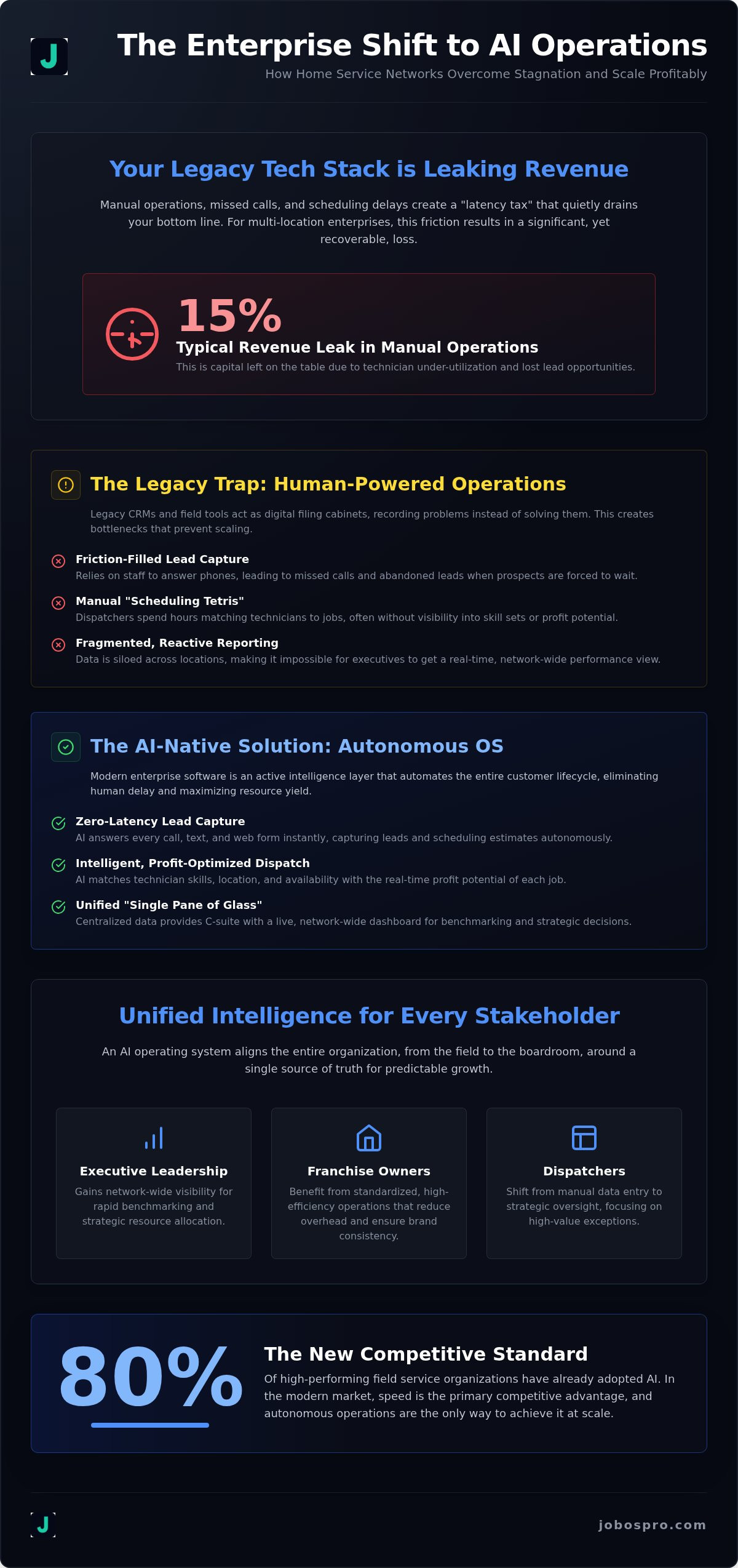
The industry is moving away from traditional "residential service business software" that relies on human input for every decision. Legacy systems record that a call was missed; AI-native systems capture the lead, answer the inquiry, and schedule the estimate instantly. This eliminates the "latency tax" that plagues manual operations. In a market where nearly 80% of high-performing field service organizations have adopted AI, speed is the primary competitive advantage. If your software isn't executing actions in real time, it's merely a ledger of lost opportunities.
Key Stakeholders: Who Benefits from Enterprise Integration?
A unified intelligence layer creates a ripple effect across the entire organization, transforming how different tiers of leadership interact with data.
- Executive Leadership: Gains a "single pane of glass" view into network-wide performance, allowing for rapid benchmarking and strategic resource allocation.
- Franchise Owners: Benefit from standardized operations that reduce local overhead and ensure brand consistency across every service call.
- Dispatchers: Pivot from manual "scheduling Tetris" to oversight of AI-optimized routing, focusing on high-value exceptions rather than routine data entry.
This integration ensures that every location, regardless of its geographic footprint, adheres to the same high-performance benchmarks. It's the only way to maintain a predictable revenue trajectory in a tightening labor market where efficiency is the only lever for growth.
Core Capabilities of a Strategic Enterprise Platform
A strategic enterprise platform isn't a mere collection of tools; it's a unified engine for growth. While smaller shops manage individual tasks, large-scale operations must manage outcomes. This requires an enterprise home service software architecture capable of autonomous customer lifecycle management. From the initial digital ping to the conversion of a one-time lead into a recurring membership, the system must maintain momentum without human friction. Every touchpoint is an opportunity to either capture value or concede it to a more agile competitor.
Speed defines the winners in 2026. Zero-latency lead capture is the first line of defense against the "missed call tax." By utilizing AI call answering, organizations can recover the 15% revenue leak that occurs when prospects are forced to wait. Once captured, intelligent dispatching takes over. It doesn't just look for the closest truck; it matches technician skill sets and location with the specific profit potential of the job in real-time. This level of precision ensures that your highest-margin opportunities are always handled by your most capable field assets, maximizing the yield of every billable hour.
AI-Driven Operational Intelligence
Efficiency at scale depends on removing human decision-making from repetitive tasks. AI estimating and quoting tools reduce the time-to-bid from hours to mere seconds, capturing intent while the customer's interest is at its peak. Beyond the initial sale, automated follow-ups manage the long-tail of retention, ensuring no lead or service contract expires quietly. With nearly 80% of high-performing field service organizations already using AI, the transition to autonomous operations is the only path to sustainable scaling in a saturated market.
Financial Synchronization and Automated Billing
Data integrity is non-negotiable for multi-location networks. Strategic platforms function as a QuickBooks integrator, ensuring every transaction flows into accounting standards without manual entry errors. This synchronization is critical when managing automated invoicing for home services across diverse tax jurisdictions. By embedding financing triggers through Wisetack integrations, the software identifies and presents payment options that increase average ticket sizes at the point of sale. These automated workflows collectively reduce Days Sales Outstanding (DSO), keeping capital fluid and ready for reinvestment. To see how these capabilities unify a national network, you can explore the JobOS Pro architecture.
Solving the "Latency Tax": Why Scaling Fails Without AI
Scaling a multi-location enterprise isn't just about adding more trucks to the fleet. It's about reducing the time between a customer's problem and your solution. This gap is what we call the "Latency Tax." It's a quiet, systemic drain that erodes profitability before a technician even arrives. In large-scale operations, this tax often manifests as a 15% revenue loss occurring during the initial lead capture phase. If your office staff is manually handling every ping, you aren't scaling; you're just increasing your overhead and your exposure to human error.
Executives often ask why their current teams can't simply work harder to close these gaps. The answer is simple: human bandwidth doesn't scale linearly. A sophisticated enterprise home service software must act as an intelligence layer that removes the ceiling on location expansion. By adopting a contractor growth platform AI, you replace manual bottlenecks with autonomous workflows that operate with zero fatigue. Margin is the casualty of delay. Systems that require human intervention for every booking are inherently capped by the limits of their operators.
The High Cost of Missed Opportunities
In the modern market, the first company to respond wins the job the vast majority of the time. Legacy CRMs are passive; they wait for a human to log a call or respond to a form. AI-native systems are proactive. They utilize missed-call recovery to engage prospects instantly, transforming a potential bounce into a booked appointment. Across a 50-location network, the ROI of reducing response time from minutes to seconds is transformative. It's the difference between capturing a market and merely participating in it. You cannot afford to let leads cool while your staff handles administrative busywork.
Technician Utilization and Dispatch Latency
Manual scheduling in high-density service areas is a recipe for inefficiency. Human dispatchers, no matter how experienced, cannot calculate the optimal route for hundreds of trucks in real-time while accounting for skill sets and profit potential. Dispatch latency leads to technician under-utilization and excessive travel time. AI-driven dispatching increases jobs-per-day without adding a single person to your payroll. It optimizes routes based on real-time variables, significantly reducing fuel costs and vehicle wear-and-tear. This is how you reclaim your margins from the friction of human latency.
Evaluation Framework: Choosing the Right Enterprise Solution
Selecting enterprise home service software requires a fundamental shift in perspective. You aren't just purchasing a tool for your technicians; you're investing in an infrastructure that must support a national footprint. The primary filter for any executive should be scalability. Many platforms that claim to be "enterprise-ready" excel at managing 50 technicians but buckle under the data load of 1,000 or more field units. Performance degradation during peak hours is a non-starter. You need a system where the architecture is built for high-concurrency environments, ensuring that dispatching logic and real-time tracking remain fluid regardless of your network's size.
Integration depth serves as the second pillar of your evaluation. A strategic platform must act as a sophisticated layer within your existing stack, functioning specifically as a QuickBooks integrator to maintain financial data integrity. It should bridge the gap between your marketing efforts and your bottom line. Data sovereignty is equally critical. You must retain absolute ownership of your customer data and performance benchmarks. If a provider treats your network's intelligence as their proprietary training data without granting you full oversight, you've compromised your long-term competitive advantage.
The most vital technical distinction in 2026 is whether the intelligence is AI-native or an AI add-on. Add-ons are typically brittle wrappers around generic models, leading to high latency and fragmented workflows. In contrast, AI-native platforms bake intelligence into the core database level. This allows for the zero-latency actions and autonomous lead recovery discussed in previous sections. Without this foundational integration, your AI will always be a secondary feature rather than a primary driver of efficiency.
Total Cost of Ownership (TCO) vs. Sticker Price
Executive leadership often falls into the trap of comparing per-user monthly fees. This is a false economy. A "cheap" solution that lacks missed-call recovery or AI-optimized dispatching carries a massive hidden cost in lost revenue and technician downtime. The value of consolidated reporting alone justifies a premium, as it eliminates the need for manual data aggregation across multiple disparate software subscriptions. When the software pays for itself by capturing the 15% revenue leak that legacy systems ignore, the sticker price becomes secondary to the recovered margin.
Security and Enterprise-Grade Reliability
For national home service brands, security is a non-negotiable requirement. Any platform you evaluate must demonstrate SOC2 compliance and rigorous data encryption standards to protect customer information. Reliability is equally paramount. With 24/7 AI call answering and autonomous dispatching, system downtime isn't just an inconvenience; it's a total operational halt. Look for enterprise-level SLAs that guarantee high uptime and provide dedicated support structures rather than generic customer support tickets. To see how a truly resilient architecture operates at scale, schedule a technical deep dive with JobOS Pro.
JobOS Pro: The Intelligence Layer for Multi-Location Success
JobOS Pro functions as the definitive intelligence layer for organizations that have outgrown traditional management tools. It provides the "Single Pane of Glass" that executives require to maintain oversight of national operations without getting lost in the technical minutiae of individual tickets. By unifying disparate data streams into a cohesive operational view, this enterprise home service software transforms fragmented locations into a synchronized network. This architecture enables sophisticated franchise benchmarking. You can compare location performance in real time to identify the specific drivers of network-wide growth, turning local successes into global standards.
The platform is designed to automate the routine. By letting AI handle approximately 90% of administrative tasks, your team can pivot from data entry to high-level strategy. This shift is essential for maintaining a competitive edge in a market where efficiency is the primary differentiator. It's not just about saving time; it's about eliminating the human error that scales alongside your business. The transition to home service franchise management software that's AI-native ensures that your expansion is limited only by your ambition, not your administrative bandwidth.
Executive Performance Dashboards
Clarity is the foundation of effective leadership. JobOS Pro delivers real-time reporting on technician efficiency, lead conversion rates, and revenue per job across every unit in your network. These dashboards provide customizable KPIs for regional managers, ensuring that corporate oversight remains sharp at every level of the hierarchy. You can see exactly which technicians are over-performing and which locations are struggling with lead follow-up. By identifying underperforming locations in real time, executives can deploy corrective measures before operational slippage impacts the broader brand reputation. You don't have to wait for end-of-month reports to see where your margins are thinning.
Standardizing Excellence Across the Franchise
Standardizing excellence across a vast network requires more than just training manuals. JobOS Pro uses AI to enforce standard operating procedures (SOPs) during every customer interaction. This ensures service quality remains consistent across disparate geographies. Automated membership management is a core component of this strategy, capturing recurring revenue at every location without manual oversight. The platform also integrates reputation management to protect the national brand while simultaneously boosting local search visibility for individual franchises. This dual-layered approach ensures that your network's growth is both rapid and resilient.
Securing the Future of the Multi-Location Enterprise
The transition from legacy field software to AI-native autonomy is no longer a strategic option; it's a foundational requirement for survival in 2026. You've seen how human latency acts as a silent tax on your margins, siphoning away 15% of your potential revenue through missed leads and inefficient dispatching. By implementing a sophisticated enterprise home service software architecture, you reclaim that lost capital and unify your multi-location operations under a single, intelligent operating system. This is the only path to standardized excellence and predictable growth across a national network.
JobOS Pro provides the intelligence layer needed to observe, retrieve, and unify disparate elements of your business into a high-performance engine. Trusted by national enterprise home service brands, our platform is built to handle the complexity of 1,000+ technicians without compromising on data integrity or speed. Don't let systemic inefficiencies dictate your revenue ceiling. It's time to eliminate the latency tax today and position your brand as a leader in the autonomous trades. Schedule an Executive Demo of JobOS Pro to see the future of enterprise operations in action. We look forward to helping you modernize your stack.
Frequently Asked Questions
What is the difference between a standard CRM and enterprise home service software?
Standard CRMs function as passive databases that record history, while enterprise home service software serves as an active intelligence layer that executes operational decisions. Legacy systems require human input for every booking and dispatch choice. In contrast, an enterprise-grade AI operating system automates the customer lifecycle from lead capture to final invoicing. This shift from record-keeping to autonomous execution is what allows national networks to scale without a proportional increase in administrative headcount.
Can enterprise software integrate with my existing accounting tools like QuickBooks?
Data integrity is non-negotiable for large-scale operations, which is why our platform functions as a sophisticated QuickBooks integrator. It doesn't replace your accounting stack; it synchronizes with it to ensure that every field transaction flows into your ledger without manual entry errors. This connection allows for automated invoicing and payment collection across multiple tax jurisdictions. By maintaining a clean link between field operations and financial reporting, executives gain a real-time view of the company's fiscal health.
How does AI call answering handle complex technical questions from customers?
AI call answering utilizes deep-learning models trained on industry-specific knowledge to resolve common inquiries and capture lead data instantly. When a customer presents a complex technical problem, the system triages the request based on urgency and skill requirements. It then routes the details to the appropriate specialist or schedules a diagnostic visit. This ensures that technical nuances aren't lost in translation, while the "missed call tax" is eliminated through immediate, intelligent engagement.
Is enterprise software suitable for franchises with different owners?
Strategic enterprise platforms are specifically engineered to unify fragmented franchise networks under a single intelligence layer. The software allows corporate leadership to enforce standard operating procedures across all locations while respecting individual ownership boundaries. Franchisees benefit from reduced overhead through automated dispatching and lead capture, while executives gain the benchmarking tools needed to compare regional performance. This structure ensures brand consistency and operational excellence, regardless of the geographic distance between service units.
What is revenue leakage, and how does AI software stop it?
Revenue leakage refers to the capital lost through systemic inefficiencies like missed calls, slow lead follow-ups, and technician under-utilization. In the home service industry, these gaps often account for a 15% loss in potential earnings. AI-native enterprise home service software stops this drain by providing zero-latency lead capture and autonomous scheduling. By removing human delay from the booking process, the system ensures that every high-intent prospect is converted into a billable job before they reach a competitor.
How long does it typically take to implement an enterprise-grade AI operating system?
Implementation timelines vary based on network complexity, but most enterprise organizations complete the transition within 60 to 90 days. The process involves a phased rollout that includes deep data migration from legacy systems and the configuration of AI dispatching logic. Dedicated implementation teams work alongside your leadership to ensure that SOPs are correctly mapped into the autonomous layer. This methodical approach minimizes operational disruption while quickly establishing the new intelligence baseline for the entire organization.
Does AI dispatching actually improve technician satisfaction?
Technician satisfaction increases when manual dispatching errors and inefficient routing are removed from their daily workflow. AI-optimized scheduling ensures that field staff spend more time on billable jobs and less time fighting traffic or handling misaligned service calls. By matching technicians with jobs that fit their specific skill sets and proximity, the software reduces burnout and increases earning potential. Field units feel more supported by a system that provides clear oversight and predictable, well-organized schedules.
How does the software handle multi-location reporting and benchmarking?
The platform provides a "Single Pane of Glass" view that aggregates data from every location into standardized executive dashboards. Leadership can drill down into specific regional metrics or roll up performance data to see network-wide trends in real time. This capability allows for precise benchmarking, where underperforming units are identified through direct comparison with top-tier locations. These insights enable corporate teams to deploy targeted support and replicate successful operational patterns across the entire national footprint.