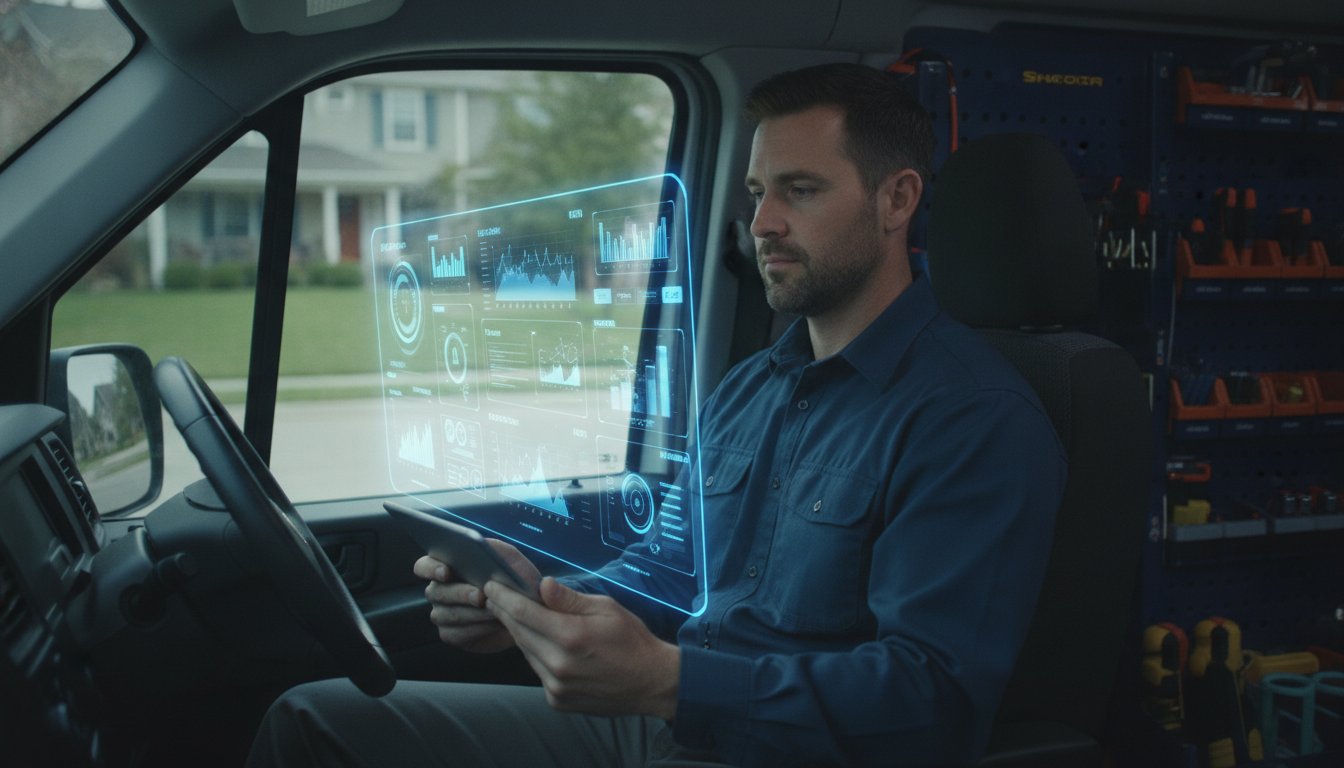
Automated Quoting for Plumbers: 2026 Instant Bidding Guide
Every minute your technician spends calculating a manual estimate in their truck is a minute your competitor uses to close the deal. In a 2026 market defined by zero-latency expectations, transitioning to automated quoting for plumbers is no longer a luxury; it's the baseline for survival. Industry data indicates that manual delays and inconsistent bidding lead to a 15% revenue leak that most firms simply accept as the cost of doing business. You know the frustration of losing a high-value contract because the follow-up arrived two hours too late. You see the margin erosion caused by technicians guessing at prices rather than following a standardized, data-driven model.
It's time to stop the bleeding. This guide will show you how to eliminate these systemic inefficiencies by deploying an AI-powered bidding system that secures the job before your technician even leaves the driveway. We will examine the architecture of instant bidding, the strategic impact of standardized price books on your bottom line, and the automated follow-up sequences that turn cold leads into recurring revenue. By the end of this guide, you'll have a roadmap to transform your quoting process from a bottleneck into your most powerful competitive advantage.
Key Takeaways
- Eliminate the 15% revenue leakage caused by manual delays by adopting automated quoting for plumbers that delivers professional bids before the technician leaves the driveway.
- Leverage AI-native architecture to capture lead data instantly, ensuring your firm is the first to quote and securing the high win rates associated with rapid response.
- Prioritize essential enterprise features including offline mobile access and seamless QuickBooks synchronization to maintain operational continuity and data integrity.
- Execute a high-performance transition by auditing your service pricebook and configuring AI workflows to match your specific field requirements.
- Shift from fragmented software silos to a unified AI operating system to connect lead capture, quoting, and payments into a single, high-visibility stack.
The Revenue Leak: Why Manual Quoting is Costing Your Plumbing Business 15% in Growth
Manual quoting is a systemic failure that compromises your bottom line. In 2026, automated quoting for plumbers represents an AI-driven architecture that generates precise, professional bids in real-time. This technology utilizes pre-set pricebooks and site-specific data to remove human error from the equation entirely. While legacy methods rely on paper forms or basic spreadsheets, modern systems provide operational intelligence that unifies the entire sales cycle. The shift from traditional construction estimating software to AI-native platforms is now a requirement for firms looking to scale.
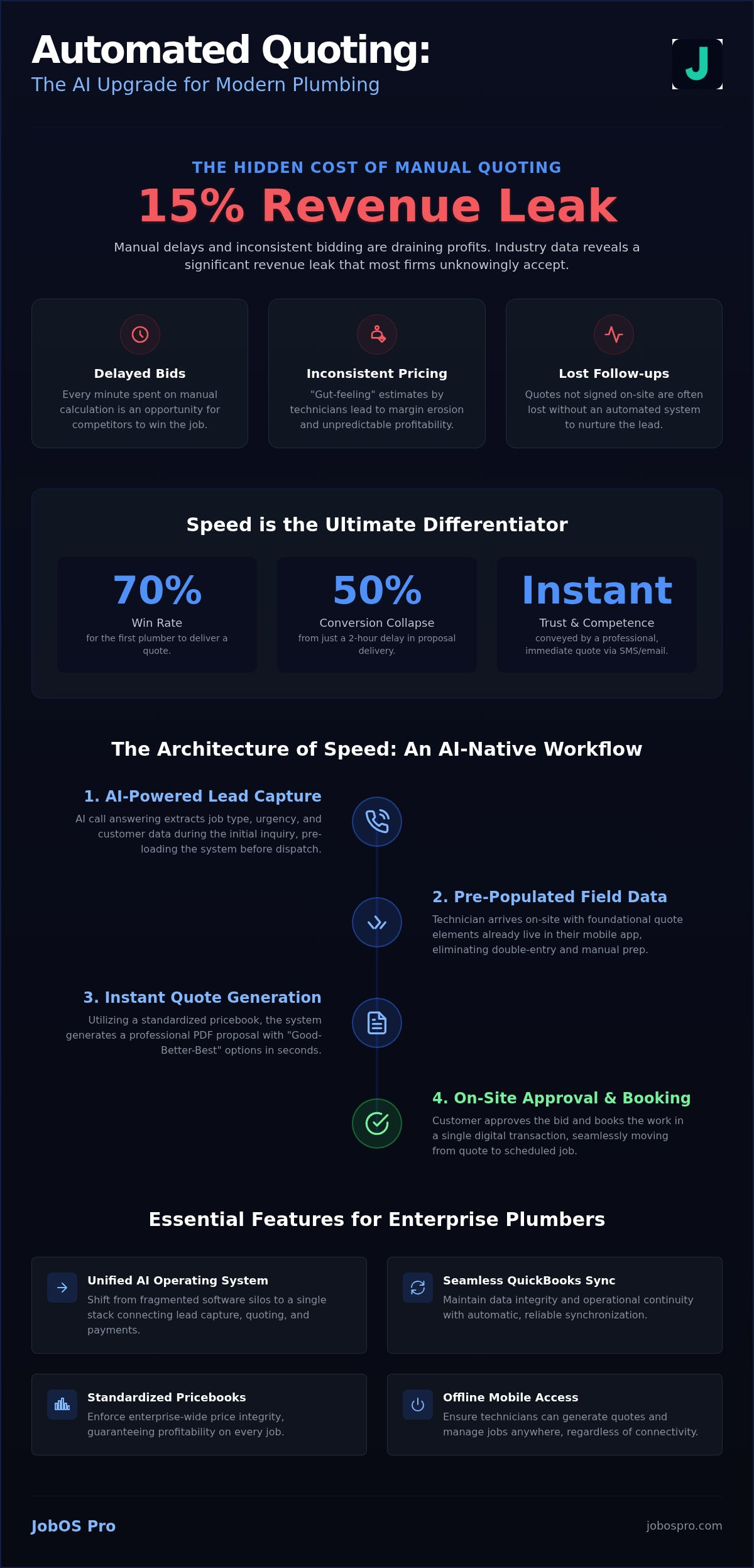
Industry data confirms a harsh reality: the first plumber to deliver a quote wins the contract 70% of the time. Revenue leakage occurs when this speed is sacrificed for manual processing. It typically manifests in three primary areas. First, delayed bids allow competitors to intercept the lead. Second, math errors in the field lead to underpriced jobs and margin erosion. Finally, the absence of automated follow-ups ensures that any quote not signed on the spot is effectively lost to the void. Transitioning to a digital, automated workflow is the only way to plug these holes.
The Cost of Latency in Residential Service
Speed is the ultimate differentiator in a high-stakes market. Data shows that a mere 2-hour delay in delivering a proposal can result in a 50% collapse in conversion rates. Modern customers equate digital speed with professional competence. An instant, professional quote sent via SMS or email builds immediate trust that a verbal estimate simply cannot match. Revenue Leakage is the cumulative loss of uncaptured leads and underpriced jobs due to manual friction.
Standardization vs. Technician Intuition
Gut-feeling pricing is a liability for your enterprise. When technicians estimate based on intuition, gross margins fluctuate wildly across different job sites. This inconsistency leads to systemic margin erosion that is difficult to track without centralized oversight. Automated quoting for plumbers enforces a standardized pricebook across all locations. This ensures that every technician quotes the exact same price for a water heater installation or a repipe project every single time. By removing the burden of pricing strategy from the field staff, you guarantee enterprise-wide profitability and total price integrity.
The Architecture of Speed: How AI-Native Quoting Engines Automate the Estimate Lifecycle
Operational speed is the byproduct of a unified technical architecture. In 2026, automated quoting for plumbers begins long before the technician arrives at the job site. AI call answering systems now serve as the first touchpoint, extracting critical intent data during the initial inquiry. This is not a simple recording; it's an active data retrieval process. The system identifies specific job types, such as a high-efficiency water heater replacement or a complex slab leak, and immediately prepares the technician's mobile environment with pre-populated field data. By the time the truck pulls into the driveway, the foundational elements of the quote are already live in the system.
The data flow is seamless and unidirectional. Information moves from the customer's voice to the technician's mobile app, and finally into an instant, professional PDF proposal. This eliminates the "double-entry" errors that plague manual systems. Furthermore, these automated proposals incorporate "Good-Better-Best" (GBB) options as a standard feature. By presenting tiered solutions, such as a standard repair versus a full system upgrade with smart leak detection, businesses can increase average ticket sizes without additional sales pressure. Integration with field service scheduling ensures that the quote reflects real-time technician availability, allowing the customer to approve the bid and book the work in a single digital transaction.
Instant Lead Capture and Pre-Estimation
AI-driven lead capture identifies job categories with surgical precision. If a customer mentions a "hybrid heat pump water heater," the system recognizes the 18% market growth in this sector and adjusts the estimator's prompts accordingly. It retrieves customer-provided details and pre-fills the technician’s form, ensuring that the office and the field are always in lockstep. This high-visibility approach reduces the administrative friction that typically delays the quoting process by hours or even days.
Dynamic Pricebooks and Material Logic
Maintaining margins in 2026 requires a dynamic response to volatile material costs. With 50% tariffs on steel and copper impacting the supply chain, static spreadsheets are a liability. AI-native engines automate material takeoffs for complex installations, adjusting for the 60% industry shift toward PEX tubing or the latest DOE efficiency standards for commercial units. These systems link directly to intelligent technician dispatching to ensure total operational oversight. To see how this level of automation can stabilize your gross margins, consider how a unified AI operating system eliminates the silos between your pricebook and your field operations.
Strategic Selection: Evaluating Automated Quoting Features for Enterprise Plumbing
Enterprise selection requires a focus on foundational architecture rather than surface-level bells and whistles. Automated quoting for plumbers is only effective if the underlying technology supports the high-stakes environment of field service. Legacy providers often offer "AI-added" features, which are merely superficial layers bolted onto outdated code. In contrast, AI-native platforms are built with machine learning at the core, allowing for predictive pricing and real-time data synthesis. Non-negotiable features include full mobile responsiveness and a robust offline mode. Plumbing technicians often work in environments where connectivity is non-existent; a quoting tool that fails in a basement or a remote mechanical room is a liability, not an asset.
Data integrity depends on seamless synchronization with your existing financial stack. Direct integration with QuickBooks ensures that every bid, once accepted, flows into your records without manual intervention. This eliminates the reconciliation errors that typically plague multi-location operations. For plumbing franchises, the ability to perform multi-location benchmarking is critical. You must be able to observe which regions are over-performing and which are experiencing margin erosion due to localized supply chain shifts or labor shortages. Without this visibility, you're managing by guesswork.
The 'Good-Better-Best' Proposal Engine
Providing three distinct options is the most effective psychological lever to increase average ticket size. Automated quoting engines should visually present these tiers instantly. For example, a quote for a water heater should automatically generate a standard electric tank option, a high-efficiency hybrid model, and a premium tankless system. This structure reduces the "I need to think about it" objection by shifting the customer's mindset from "Should I do this?" to "Which version do I want?" It transforms the technician from a high-pressure salesperson into a professional consultant offering tailored solutions.
Executive Oversight and Reporting
Visibility is the cornerstone of performance management. Strategic leaders require real-time data on closing rates per technician to identify training gaps or pricing inconsistencies immediately. Automated follow-up sequences are essential to re-engage customers who have "stalled" on a quote, ensuring no lead is abandoned due to office oversight. Utilizing executive dashboards for home services allows you to unify these disparate data points into a single source of truth. This level of oversight is what differentiates a local shop from a scalable plumbing empire capable of sustained, data-driven growth.
How to Implement Automated Quoting: A 5-Step Transition for Plumbing Teams
Deploying automated quoting for plumbers is a foundational shift. It's not a mere software update; it's a structural realignment of your field operations. Success requires a methodical, five-step deployment strategy designed to eliminate manual friction and secure technician buy-in. Transitioning from legacy spreadsheets to an AI-native environment ensures that your pricing remains consistent across every truck in your fleet.
The implementation process follows a logical progression from data preparation to full-scale operational oversight:
- Step 1: Perform a comprehensive audit of your current pricebook. You must digitize every line item for both service calls and complex installations to ensure the AI has a clean data foundation.
- Step 2: Configure your AI-native platform to reflect your specific plumbing workflows. This includes setting your unique labor rates and overhead margins.
- Step 3: Initiate a pilot program with your most tech-forward lead technicians. Their feedback is critical for refining the user interface before a wider rollout.
- Step 4: Connect your quoting engine to automated invoicing for home services. This closes the loop between the initial bid and the final payment.
- Step 5: Execute a full-fleet rollout. Use your executive dashboards to monitor closing rate performance in real-time and identify areas for further training.
Digitizing the Pricebook
Technicians shouldn't struggle to find a specific PVC fitting or valve replacement in the field. Structure your line items for rapid lookup and include high-quality images within your automated templates. This visual clarity builds immediate customer confidence. Setting up "bundles" for common repairs, such as a full toilet rebuild or a standard drain cleaning package, allows your team to generate comprehensive bids in seconds. This standardization protects your gross margins against the "gut-feeling" pricing that often leads to revenue leakage.
Training and Adoption Strategies
Change resistance is a predictable obstacle. Overcome this by demonstrating how the software removes the administrative burden of manual math and handwritten paperwork. Set clear KPIs focused on quote turnaround times and closing percentages. By leveraging improve technician utilization software, you can show your staff that automation directly correlates to more billable hours and less time spent idling in the truck. If you are ready to modernize your entire service stack, book a strategy session to deploy an AI-native operating system today.
Beyond the Bid: Unifying Quoting with the JobOS Pro AI Operating System
Standalone software is a strategic liability. Implementing a disconnected tool for automated quoting for plumbers creates a data silo that forces manual reconciliation and increases administrative overhead. JobOS Pro functions as a unified AI-native operating system that eliminates the friction between lead capture, estimating, dispatching, and final payment collection. By integrating these disparate elements into a single technical layer, you achieve a "Zero Latency" lifecycle. Every data point retrieved during the initial call flows directly into the quote, the dispatch ticket, and the final invoice without human intervention.
The impact of this architecture extends far beyond the initial transaction. Once a quote is accepted and fulfilled, the platform automatically triggers recurring service membership software to secure long-term customer retention. This shift from a one-off repair to a predictable, recurring revenue stream happens instantly. Strategic leaders are invited to a professional demo to observe how this unified architecture stabilizes growth and maximizes the lifetime value of every lead generated by your marketing efforts.
Total Visibility for the Plumbing Executive
Plumbing executives require a single source of truth to maintain operational control. JobOS Pro provides high-level dashboards that aggregate performance data across all departments in real-time. The system uses AI to observe patterns and identify hidden revenue leaks that human operators often miss, such as inconsistent material markups or stalled follow-ups. For growth-minded owners, multi-location benchmarking provides the clarity needed to scale. You can compare the efficiency of different regions instantly, ensuring that every branch adheres to your enterprise performance standards.
The Future of AI-Driven Plumbing Operations
The next evolution of plumbing operations is predictive. JobOS Pro can pre-stage quotes and predict service demand based on local environmental data, such as impending freeze warnings or heatwaves. The system automates the entire journey from a missed call recovery to a paid invoice, ensuring that your business remains responsive 24/7. This level of automated quoting for plumbers is no longer a peripheral advantage; it is the foundational requirement for any firm looking to dominate the 2026 market. In this high-stakes environment, automation is the only way to remain competitive.
Dominating the 2026 Plumbing Market with AI-Native Precision
The shift toward a zero-latency operational model is no longer optional for growth-minded plumbing enterprises. By integrating automated quoting for plumbers, you eliminate the manual friction that leads to revenue leakage and inconsistent field pricing. We have explored how a unified technical architecture connects the initial customer inquiry to an instant, professional proposal and a recurring service membership. This level of synchronization provides the executive oversight necessary to scale across multiple locations with total visibility. Transitioning to an AI-native operating system is proven to recover up to 15% of revenue typically lost to manual delays and administrative oversight.
Legacy systems that bolt AI onto outdated code cannot compete with a platform built for modern performance. JobOS Pro offers an AI-native architecture designed for the high-stakes environment of 2026 home services, providing the executive-level reporting required for multi-location plumbing franchises. It's time to replace gut-feeling estimates with data-driven accuracy and secure your position as a market leader.
Schedule your strategic JobOS Pro demo and stop your revenue leaks today.
The future of the plumbing industry belongs to those who embrace automation to deliver a superior customer experience.
Frequently Asked Questions
How long does it take to set up automated quoting for a plumbing business?
Implementation typically spans two to four weeks depending on the complexity of your existing pricebook. This timeframe includes the digital audit of your service items and the initial pilot program with lead technicians. It's a methodical transition designed to ensure data integrity before a full fleet rollout. Strategic leaders prioritize this setup period to establish a foundational technical layer that stabilizes long-term growth and eliminates manual friction.
Will automated quoting work for both residential service and commercial plumbing?
The architecture is engineered to support both high-volume residential service and complex commercial contracting. Residential workflows prioritize speed-to-lead and tiered options to maximize conversion. Commercial modules utilize sophisticated material logic for large-scale installs, including re-piping and commercial water heater standards. This versatility allows plumbing owners to maintain total visibility across diverse service lines through a single, unified AI operating system that adaptively manages different job requirements.
Can AI really price complex plumbing jobs like re-piping or sewer line replacements?
AI-native engines automate complex material takeoffs for high-stakes installs with surgical precision. By utilizing standardized labor units and real-time material logic, the system removes the margin erosion caused by technician guesswork. It accounts for current material costs, such as the 2026 tariffs on copper and steel, ensuring every bid remains profitable. This standardization guarantees enterprise-wide price integrity even on the most intricate projects where manual errors typically occur.
Does automated quoting software integrate with QuickBooks or other accounting tools?
Direct synchronization with QuickBooks is a non-negotiable feature of a professional business stack. When a customer approves a bid generated via automated quoting for plumbers, the data flows into your accounting tool instantly. This eliminates the "double-entry" errors that plague manual systems and ensures your financial records reflect real-time field operations. It provides the executive team with a single source of truth for total business health and financial oversight.
How does automated quoting help increase the average ticket size for plumbers?
Automated quoting for plumbers utilizes "Good-Better-Best" tiers to drive consistent upsells. Instead of offering a single repair price, the system presents three distinct solutions ranging from standard fixes to premium upgrades. This psychological framework encourages customers to select higher-value options, such as smart leak detection or high-efficiency fixtures. It effectively turns every service call into a consulting opportunity without requiring additional sales training for your field technicians.
Is it difficult for older, less tech-savvy technicians to learn automated quoting?
Resistance from less tech-savvy staff is mitigated through a focus on intuitive user experience and operational efficiency. The software is built to replace cumbersome paperwork with a streamlined digital interface that requires fewer steps than manual estimation. Once technicians realize the system handles the complex math and follow-ups for them, adoption becomes a matter of professional convenience. Ease-of-use is a core pillar of the platform's architecture to ensure rapid fleet-wide adoption.
What happens if the internet goes out while a technician is creating a quote?
Operational continuity is maintained through a robust offline mode that functions without an active internet connection. Technicians can generate professional bids in basements or remote mechanical rooms where cellular signals are often unavailable. The system saves all intent data locally and synchronizes with the central office once the device re-enters a service area. This ensures that field operations never stall due to external technical constraints or localized connectivity gaps.
How do automated follow-ups work for quotes that haven't been signed yet?
Unsigned quotes trigger intelligent, automated re-engagement sequences designed to recover stalled revenue. If a prospect hasn't approved a bid within a specific timeframe, the system sends professional follow-ups via SMS or email. These touchpoints are personalized and timed to maximize conversion without manual intervention from your office staff. This automation ensures that no lead is abandoned, directly addressing the systemic revenue leaks common in manual plumbing operations.