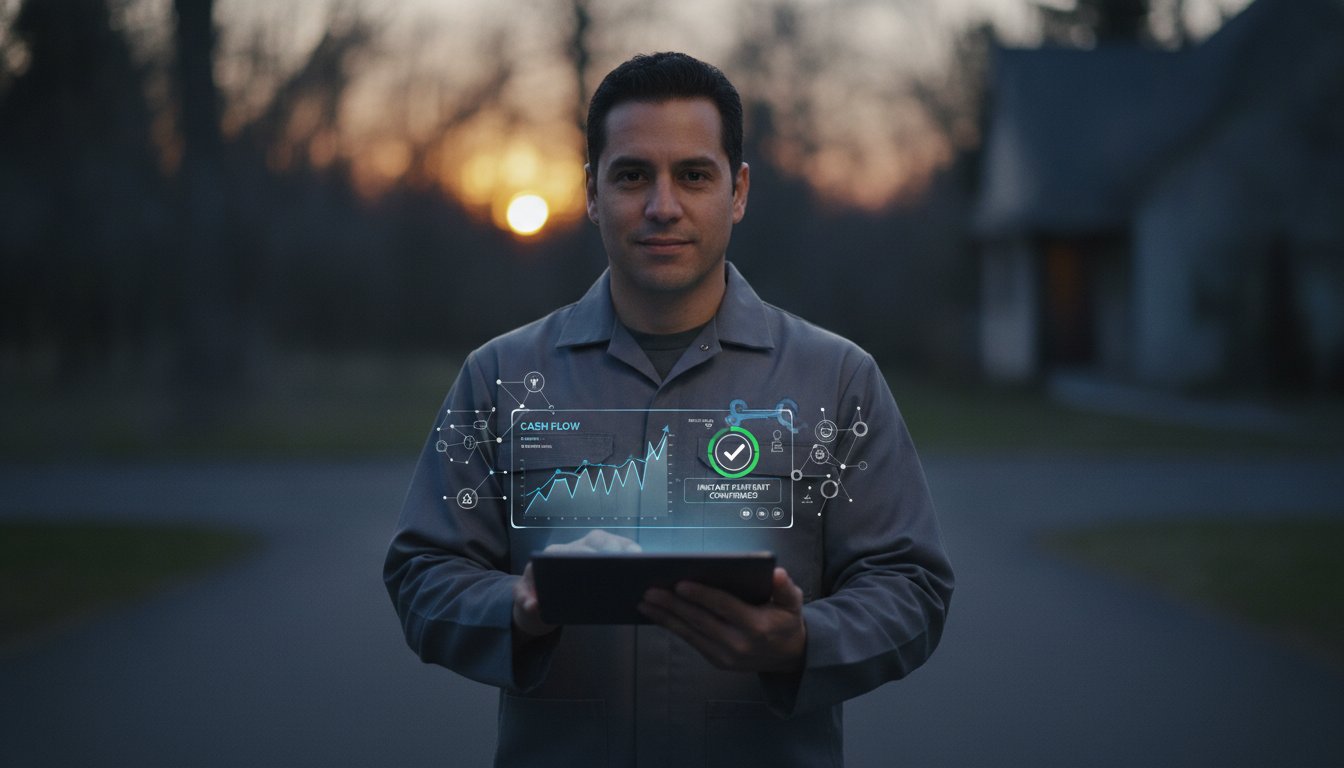
Best Contractor Invoicing Apps for 2026: Scaling Home Service Revenue
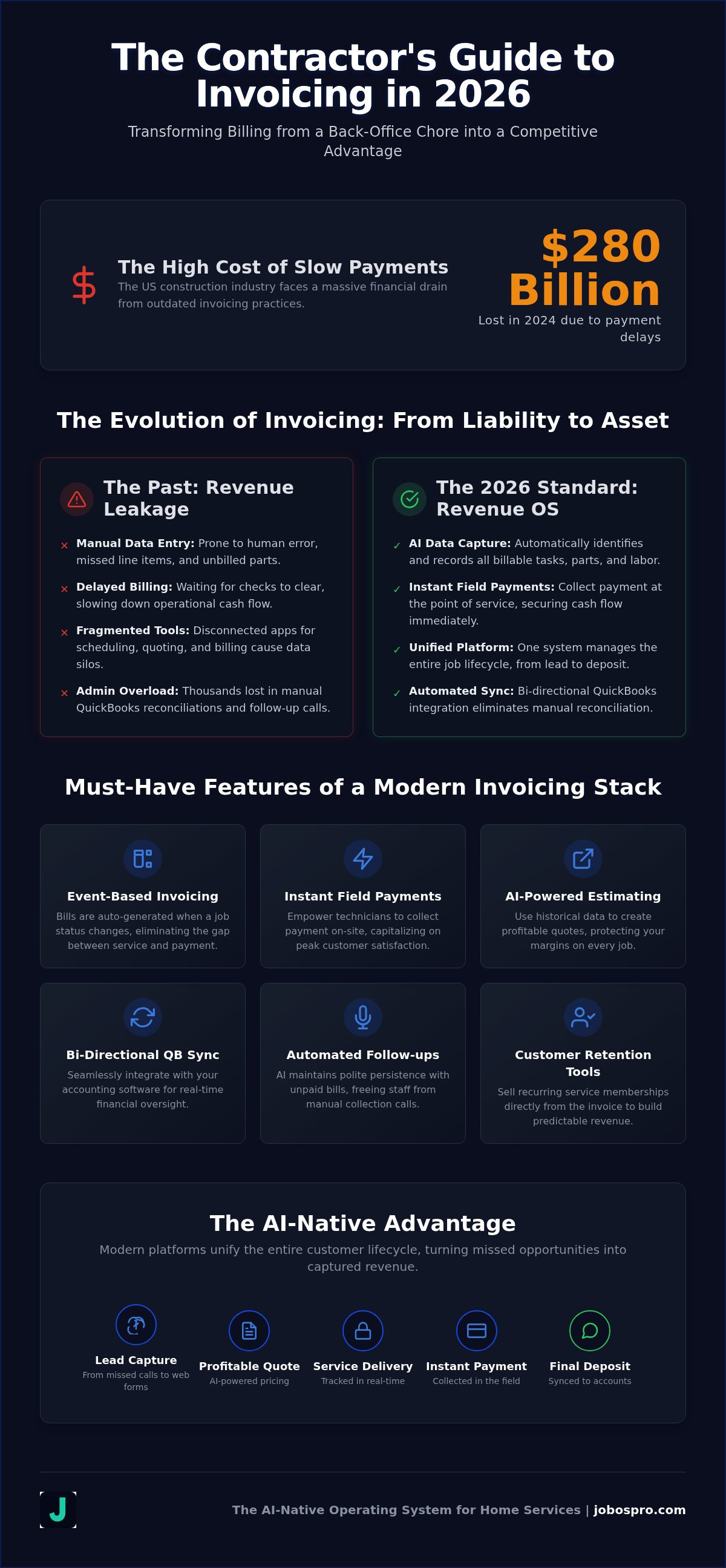
Slow payments cost the US construction industry $280 billion in 2024, according to SolvPro. For the modern home service leader, this isn't just a statistic; it's a direct threat to your operational liquidity. If you're still relying on manual data entry or waiting weeks for checks to clear, you aren't just losing time. You're suffering from revenue leakage that prevents you from reinvesting in your fleet and your people. Choosing a high-performance contractor invoicing app is the first step toward reclaiming your executive oversight and securing your cash flow.
We understand the frustration of technicians struggling with clunky mobile interfaces and the administrative burden of unbilled items. You deserve a system that works as hard as your crews do. This guide reveals the top-rated invoicing platforms for 2026 that go beyond basic billing. We'll explore how modern tools automate your entire cash flow cycle, provide instant payment collection in the field, and sync seamlessly with QuickBooks to eliminate manual errors. Discover the technology that will turn your invoicing from a back-office chore into a competitive advantage that wins higher-ticket jobs.
Key Takeaways
- Understand the shift from passive billing tools to active revenue operating systems that secure your firm's financial foundation.
- Evaluate the technical architecture of a modern contractor invoicing app to ensure it supports instant field payments and automated accounting sync.
- Compare various contractor invoicing apps to determine which solution aligns with your current growth trajectory and crew size.
- Identify and eliminate the "Silent Killer" of revenue leakage by implementing event-based triggers that capture every billable line item.
- Learn how AI-native platforms like JobOS Pro unify the entire customer lifecycle from the initial missed call to the final deposit.
Beyond Digital Paper: The 2026 Standard for Contractor Invoicing
In 2026, a standalone contractor invoicing app is no longer a utility. It is a liability. The industry has shifted away from "digital paper" toward integrated revenue operating systems. Traditional manual invoicing is the primary driver of revenue leakage in trade businesses. When technicians rely on memory or fragmented notes, line items disappear. Parts aren't billed. Labor hours are rounded down. This systemic failure doesn't just slow down your cash flow; it actively erodes your profit margins.
Modern standards demand total visibility. High-performance platforms now utilize AI to observe field activity and retrieve billable data automatically. Instead of waiting for a technician to "remember" to send a bill, the system identifies completed tasks and generates documentation in real time. This technology serves as the connective tissue between your dispatch board and your accounting software. While basic electronic invoicing standards provide a framework for data transmission, a true operating system ensures that every cent of value created in the field is captured and collected.
The High Cost of Fragmented Tools
Fragmented tech stacks are a silent killer of operational efficiency. When your team uses disparate tools for scheduling, quoting, and billing, they suffer from app fatigue. This friction leads to data silos and human error. The hidden expense of manual QuickBooks reconciliations can cost a growing firm thousands in administrative overhead. You can't scale a home service business on a foundation of disconnected spreadsheets and manual triggers. A unified architecture is the only way to maintain oversight as you add more crews and locations.
Invoicing as a Customer Retention Strategy
Your invoice is often the final touchpoint of the customer experience. It should reinforce your brand's authority. High-fidelity, professional invoices build trust and justify premium pricing for high-ticket jobs. Reducing payment friction is equally vital. By providing instant, one-click payment options, you capitalize on the moment of highest customer satisfaction. You don't just want a one-time payment; you want a lifetime relationship. Your invoicing platform should facilitate this by allowing technicians to sell a recurring service membership directly through the billing interface. This turns a single repair into a predictable, high-margin revenue stream.
Strategic Features: How to Evaluate a Modern Invoicing Stack
Evaluating a contractor invoicing app requires looking beyond the user interface. You must analyze the underlying technical architecture to ensure it supports rapid scaling. Static billing triggers are obsolete. The 2026 standard is event-based invoicing. This means the system observes a job status change in the field and retrieves the necessary data to generate a bill without human intervention. By removing the manual trigger, you eliminate the gap between service delivery and revenue recognition.
AI-powered estimating is the next pillar of a high-performance stack. Many contractors lose margin because they rely on guesswork or outdated pricing sheets. Modern systems use historical performance data to ensure every quote is profitable from the start. This isn't just about sending a bill. It's about ensuring the bill you send covers your actual overhead and your target profit. Integrated field payments complete this cycle. If your technicians aren't collecting at the point of service, you're essentially providing customers with an interest-free loan.
The AI-Native Advantage
True automation handles the friction points that human operators often avoid. This includes effective invoice collection through automated follow-ups. AI maintains a level of polite persistence with unpaid bills, freeing your office staff from the burden of manual collection calls. The billing cycle actually begins well before the technician arrives. Utilizing automated lead capture for contractors ensures that every prospect is logged and ready for conversion into a billable job. Predictive reporting then identifies which technicians are consistently under-billing, allowing for corrective training before revenue leaks become catastrophic.
Integration and Scalability
Your invoicing stack must unify with your existing financial ecosystem. A bi-directional QuickBooks sync is non-negotiable for executive-level oversight. It eliminates the end-of-month reconciliation nightmare by ensuring your field data and accounting ledgers are always in harmony. For multi-location businesses or franchises, this standardization is the only way to maintain brand quality and financial transparency across territories. If you're ready to move beyond basic tools, you should explore a unified revenue operating system designed for enterprise growth. High-fidelity customization ensures your invoices reflect the professional brand image required to win and retain high-ticket contracts.
Top Contractor Invoicing Apps for 2026: A Comparative Analysis
Selecting a contractor invoicing app requires an objective assessment of your company's current maturity and future revenue targets. The market is divided into three distinct tiers. Joist remains the specialist for solo operators, focusing on speed and basic on-site quotes. It's an excellent tool for the "one-man-show" but lacks the architectural depth to manage complex multi-crew workflows. Housecall Pro serves as the mid-market standard, offering a robust suite of field service management features. While it handles scheduling and billing effectively, it often requires manual intervention to bridge the gap between field activity and final payment.
JobOS Pro represents the shift toward AI-native operating systems. It's designed for growth-focused enterprises that have outgrown traditional tools. Unlike legacy apps, JobOS Pro unifies the entire lifecycle, using AI missed-call recovery to feed the invoicing pipeline directly. When comparing these platforms, the primary differentiators are payment velocity and automation depth. A basic tool might help you send a PDF, but an operating system ensures that the funds are captured and reconciled without administrative friction.
Choosing Based on Business Maturity
The "Growth Ceiling" is a tangible barrier where your billing tool begins to hold you back. If your office staff spends significant time on manual QuickBooks reconciliations or chasing unpaid bills, you've reached this limit. Transitioning from a basic app to a comprehensive OS is a strategic necessity for scaling. Beyond simple invoicing, you must consider compliance and management standards, as outlined in the SBA business management guide. Total cost of ownership shouldn't be measured by subscription fees alone. You must calculate the value of recovered revenue that was previously lost to manual errors and forgotten line items.
Critical Comparison Metrics
In 2024, 82% of contractors waited more than 30 days to get paid, according to SolvPro. This delay is the primary cause of cash flow instability. High-performance systems reduce the average 83-day collection cycle by enabling instant payment collection in the field. Ease of technician adoption is equally critical. If the mobile interface is clunky, your field crews won't use it, leading to data silos. Finally, evaluate the depth of automated customer retention tools. A bill shouldn't just be a request for money; it should be a vehicle for recurring service memberships and long-term brand loyalty.
Eliminating Revenue Leakage: From Field Quote to Final Payment
Revenue leakage is the silent killer of home service profitability. Industry benchmarks suggest that trade businesses can lose up to 15% of their potential earnings simply because billable items never make it onto the final invoice. This systemic failure occurs when technicians, focused on the technical repair, neglect to log a specific part or an extra hour of labor. A modern contractor invoicing app must do more than record data. It must actively observe field activity to ensure every cent of value is captured before the technician leaves the driveway.
Implementing automated billing for contractors ensures that the system retrieves every logged activity from the field without human intervention. By utilizing advanced contractor payment collection tools, you compress your payment cycle and drastically reduce your Days Sales Outstanding (DSO). With the average contractor waiting 83 days to collect payment according to CreditPulse, automation is no longer optional. Automated reminders handle the persistence required to collect outstanding balances, freeing your office staff from the burden of manual follow-ups.
Closing the Loop on Field Operations
True operational efficiency requires linking intelligent technician dispatching directly to the job-site invoicing process. When your dispatch system communicates with the billing engine, the invoice is pre-populated based on the job type and parts assigned. This integration eliminates the "I forgot to write that down" excuse. Capturing digital signatures and approvals instantly prevents payment disputes before they can delay your cash flow. Additionally, AI-native platforms can observe the job context to cross-sell service memberships during the invoicing process, turning a single repair into a predictable, high-margin revenue stream.
Data-Driven Financial Decisions
Revenue leakage is defined as the delta between work performed and work successfully billed. To eliminate this gap, you need executive-level benchmarking that provides total visibility into your operations. Your invoicing data should reveal profitability by technician, service type, or location. This visibility allows you to optimize marketing spend, focusing lead generation on the high-margin jobs that your best crews handle most efficiently. If you are ready to secure your cash flow, book a JobOS Pro demo to see how a unified revenue operating system eliminates leakage at the source.
JobOS Pro: The AI-Native Operating System for Home Services
JobOS Pro represents the definitive strategic shift for the modern home service enterprise. It is the first AI-native operating system designed to replace the fragmented patchwork of legacy tools that currently stifle growth. While a standard contractor invoicing app focuses strictly on the transaction, JobOS Pro manages the entire revenue lifecycle. Our unified architecture ensures that every customer interaction is observed and optimized. This process starts with AI missed-call recovery and lead capture, feeding directly into a pipeline that culminates in an automated, high-fidelity invoice.
Executive leadership requires more than just a list of paid bills. You need total visibility into multi-location performance and franchise network benchmarking. JobOS Pro provides this oversight through sophisticated business performance dashboards that identify hidden patterns in your cash flow. By unifying disparate elements into a single, cohesive operating layer, we provide the intelligence necessary to make high-stakes financial decisions with absolute confidence. This is the foundation of a future-proof business model that thrives on operational clarity.
Transforming Invoicing into Oversight
Our AI does not wait for a technician to manually input data. It retrieves billable opportunities by observing field activity and customer communications in real time. This corrective oversight ensures that your field activity always matches your financial records, eliminating the revenue leakage discussed previously. We maintain deep, bi-directional integration with QuickBooks and other essential business stacks. We do not replace your accounting software; we make it more accurate. By reducing friction for both technicians and management, we enable your team to focus on performance and high-ticket job execution rather than administrative reconciliation.
Ready to Scale?
Transitioning from a legacy app like Joist or Housecall Pro is a foundational step toward enterprise maturity. Our migration process is designed to be seamless, preserving your historical data while immediately deploying AI-driven operational intelligence across your organization. The 2026 roadmap for JobOS Pro includes advanced predictive modeling and automated retention tools that identify market shifts before they impact your bottom line. You are not just buying software. You are investing in a silent, tireless partner that provides constant oversight of your multi-location or franchise network.
The era of manual billing is over. It is time to future-proof your business with a platform that scales as fast as your ambition. Schedule your strategic executive briefing with JobOS Pro today.
Securing Your Scalable Revenue Future
The transition from a passive contractor invoicing app to a unified revenue operating system is the defining move for home service enterprises in 2026. Passive billing tools are no longer sufficient to protect your margins against the systemic inefficiencies of manual data entry and forgotten line items. By implementing a tech-forward architecture, you ensure that every field action is observed, retrieved, and converted into liquid capital without administrative friction. You've seen how the right stack eliminates the revenue leakage that plagues traditional trade businesses.
JobOS Pro provides the foundational oversight required to unify your entire organization. Our platform delivers AI-native lead-to-invoice automation and executive dashboards for multi-location oversight, ensuring total visibility from the initial missed call to the final deposit. With a seamless QuickBooks bi-directional sync, your financial records remain in constant harmony with your field operations. It's time to stop chasing payments and start accelerating your growth trajectory. Automate your revenue cycle with JobOS Pro and build the high-performance business your leadership deserves.
Frequently Asked Questions
What is the best invoice app for contractors who use QuickBooks?
JobOS Pro provides the most robust bi-directional sync for QuickBooks users. Unlike basic tools that only push data one way, a high-performance system ensures that field activity and accounting ledgers remain in constant harmony. This eliminates manual reconciliation and provides leadership with a real-time view of financial health. It is the strategic choice for firms that have outgrown simple export functions and require deep architectural integration.
How does an AI invoicing app help with revenue leakage?
An AI-native contractor invoicing app identifies the delta between work performed and work successfully billed. By observing job-site activity and retrieving data from technician logs, the system catches forgotten line items before the invoice is sent. This corrective oversight prevents the revenue loss common in trade businesses. It transforms billing from a manual memory exercise into a precise, automated process that secures every billable cent of profit.
Can my technicians collect payments on-site with an invoicing app?
Technicians can and should collect payments at the point of service to compress the cash flow cycle. Modern platforms provide mobile-first interfaces that allow for instant credit card or ACH processing in the field. This immediate collection removes the administrative burden of chasing checks later. It also capitalizes on the moment of highest customer satisfaction, ensuring your business maintains high liquidity and reduced administrative overhead.
Is it worth paying for a full business operating system vs. a standalone invoicing app?
Scaling a home service business requires a unified operating system rather than a collection of fragmented tools. Standalone apps often create data silos and reach a growth ceiling as your team expands. An AI-native operating system unifies lead capture, dispatching, and billing into one cohesive layer. While the initial investment may be higher, the recovered revenue from eliminated leakage and reduced administrative hours provides a superior long-term return.
How do automated payment reminders affect customer relationships?
Automated reminders improve relationships by maintaining a professional standard of polite persistence. Customers often appreciate the clarity of digital notifications and one-click payment options. By removing the awkwardness of manual collection calls, your office staff can focus on high-value interactions. This consistency builds brand trust and reinforces the image of a sophisticated, reliable service provider that values both its time and the customer's convenience.
What are the security standards for collecting payments via a mobile app in 2026?
Modern payment collection relies on end-to-end encryption and PCI DSS compliance to protect sensitive financial data. In 2026, high-performance systems utilize tokenization and biometric authentication to ensure secure transactions in the field. This technical architecture prevents data breaches and builds customer confidence. Your contractor invoicing app must meet these rigorous standards to safeguard your firm's reputation and financial integrity in an increasingly digital marketplace.
Can I manage multiple business locations within one invoicing platform?
Executive reporting and multi-location benchmarking are foundational features of an enterprise-grade platform. You can monitor performance across different territories and franchise networks from a single dashboard. This visibility allows leadership to identify high-performing crews and optimize resource allocation. Standardizing your billing processes across all locations ensures a consistent brand image and provides the intelligence needed for national or regional expansion.
What happens if a technician forgets to bill for a specific part or service?
AI-native systems act as a silent worker that catches these omissions in real time. The software observes the technician's activity and compares it against the generated invoice to flag discrepancies. This automated retrieval process ensures that every part used and every hour worked is accounted for. Instead of relying on human memory, the system provides a safety net that captures billable opportunities that would otherwise be lost to oversight.