
Electrical Contractor Quoting Software: The 2026 Strategic Guide to AI-Driven Bidding
In 2026, the speed of your bid is the only metric that dictates your survival. If you're still relying on manual spreadsheets or disconnected legacy tools, you aren't just slow; you're invisible to the highest-margin clients. Modern electrical contractor quoting software has evolved from a simple calculator into an autonomous engine that eliminates the friction between a site visit and a signed contract. The industry has reached a tipping point where firms using dedicated estimating tools report 28% higher bid-win rates than those stuck in the past.
You know the frustration of losing a six-figure job because a competitor's quote landed in the inbox while your technician was still driving back to the office. It's a systemic failure that erodes your bottom line and exhausts your best talent. This guide will show you how to master the transition to AI-driven bidding to eliminate bid lag and capture 20% more revenue. We'll explore the technical architecture of instant field quoting, the necessity of seamless accounting integration, and how to gain total visibility into your profit margins before a single wire is pulled.
Key Takeaways
- Eliminate bid lag by recognizing it as a systemic revenue leak that decreases contract probability with every hour of delay.
- Replace fragmented legacy tools with a modern electrical contractor quoting software that serves as an AI-native operating system for your entire field operation.
- Protect your bottom line with dynamic material pricing and visual takeoff tools that provide total margin visibility before any work begins.
- Follow a structured implementation strategy to audit current quoting latency and standardize complex assemblies for automated bidding.
- Shift from manual data entry to an intelligent workflow where AI-driven estimating engines learn and apply your specific business logic.
The High Cost of Bid Lag: Why Traditional Quoting is Leaking Revenue
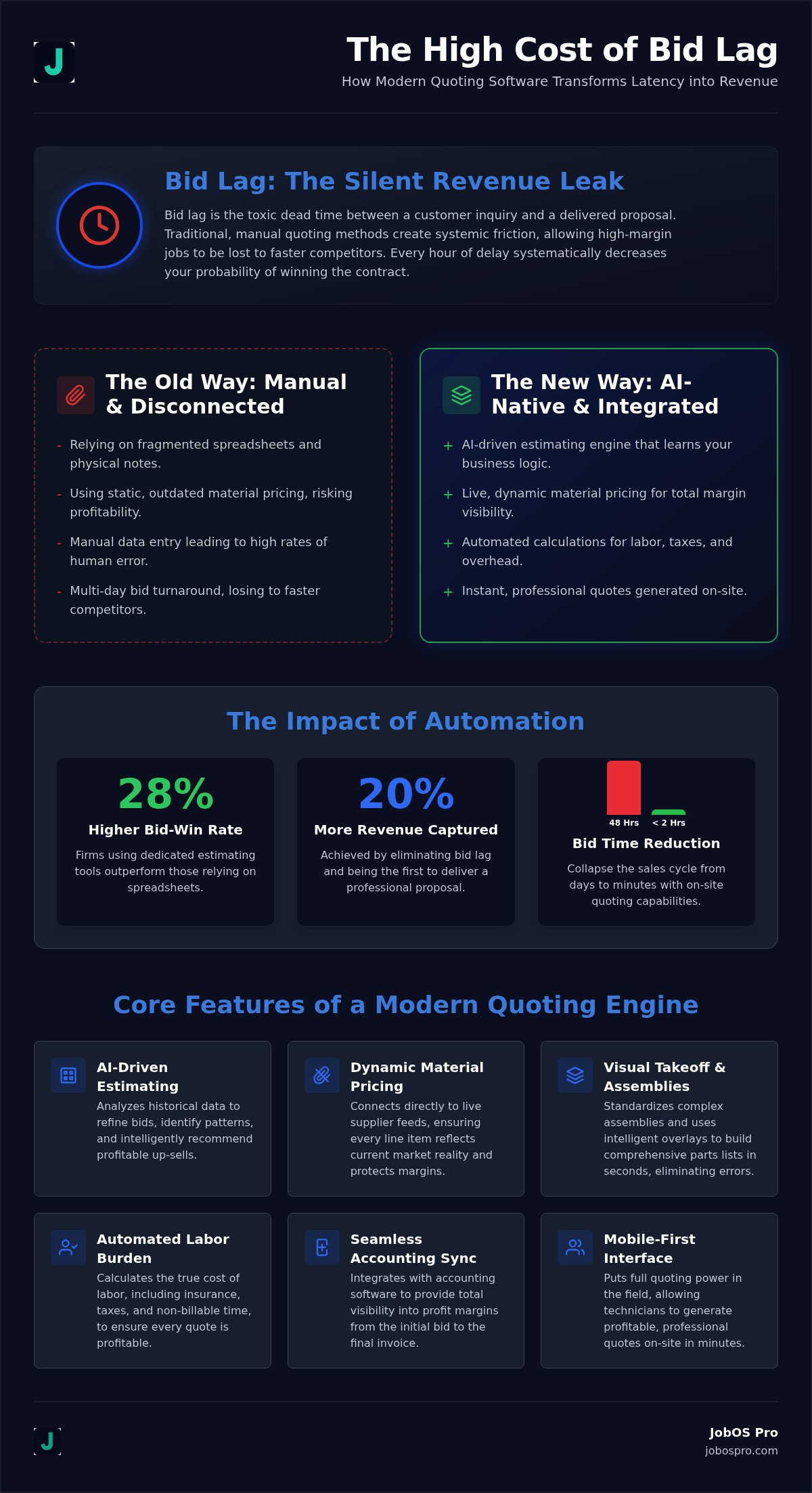
In 2026, efficiency isn't just a competitive advantage; it's a prerequisite for survival. Bid lag is the silent killer of electrical contractor margins. It represents the toxic dead time between a prospect's initial inquiry and the delivery of a finalized proposal. Every hour of delay decreases your probability of winning the contract by double digits. While your team is manually calculating labor burdens on a spreadsheet, your competitor has already delivered a professional, AI-generated quote. This latency is where revenue leaks out of your business.
Traditional manual approaches, whether they involve physical notes or fragmented Excel files, create systemic friction. While foundational construction estimating software provided a necessary digital upgrade years ago, it's no longer sufficient for the high-stakes electrical trade. Modern electrical contractor quoting software must be AI-native to capture and convert leads instantly. Revenue leakage occurs at multiple points: missed calls that never get a callback, lost leads buried in an inbox, and slow follow-ups that allow the customer's interest to cool. Automation doesn't just speed up the process; it seals these gaps permanently.
The Psychology of the Modern Electrical Customer
Customers in 2026 equate responsiveness with technical competence. If you can't provide an accurate digital quote during the initial site visit, you've already signaled a lack of operational maturity. Zero latency response times build immediate trust. It proves your firm possesses the technological stack required to handle complex electrical projects without administrative delays. When a quote is delivered instantly, the customer perceives your business as the most reliable and professional option available.
Calculating the Real ROI of Quoting Automation
Stop evaluating software based solely on its monthly subscription fee. Instead, perform a rigorous opportunity cost analysis. Reducing your average bid time from 48 hours to under 2 hours doesn't just save time. It fundamentally shifts your win rate. Firms using dedicated estimating tools report 28% higher bid-win rates than those relying on spreadsheets. Recapturing estimator hours allows your leadership to focus on high-level strategy and complex project oversight rather than clerical data entry. This transition typically enables contractors to capture 20% more revenue by simply being the first to the table with a professional bid.
Essential Features of Modern Electrical Contractor Quoting Software
Static pricing is a liability. In a market where material costs fluctuate weekly, relying on last month's data is financial suicide. Advanced electrical contractor quoting software connects directly to live supplier feeds. It ensures every line item reflects current market reality. Visual takeoff tools further refine this by standardizing complex assemblies. Instead of manual counting, technicians use intelligent overlays to build comprehensive parts lists in seconds. This eliminates the human error that typically erodes margins before the first wire is pulled.
Labor burden calculation is where most contractors fail. It's not just an hourly rate; it's the invisible weight of insurance, taxes, and non-billable time. Modern software wizards automate these calculations. They ensure that every quote protects your target margin before it reaches the client's screen. Mobile-first interfaces put this power in the field. When a technician can generate a profitable quote on-site, the sales cycle collapses from days to minutes. This real-time capability is why choosing the right electrical contractor quoting software is a foundational strategic decision.
AI-Driven Estimating vs. Traditional Templates
Templates are rigid and often inaccurate. AI-driven systems analyze your firm's historical performance to refine current bids. They identify patterns in labor overruns or material waste that a human estimator might overlook. This shifts the process from guessing to data-backed prediction. These systems also automate the up-sell. By analyzing the job scope, the AI recommends intelligent service additions that increase the average ticket size without additional sales effort. This represents a significant leap in AI's impact on the construction industry, turning quoting into a revenue-generation engine.
Cloud-Based Collaboration for Hybrid Teams
Fragmentation is the enemy of accuracy. Cloud-native platforms ensure real-time synchronization between field technicians and back-office estimators. Version control is absolute. You'll never risk working from outdated blueprints or stale pricing again. Secure digital signatures and instant payment capture upon approval finalize the transaction. This seamless flow from quote to cash is exactly why forward-thinking firms choose to modernize their operating stack today. It transforms the administrative burden into a streamlined, high-velocity workflow that secures your competitive edge.
Legacy Field Software vs. AI-Native Operating Systems
Legacy software is a fragmented liability. Most contractors currently operate within a "Software Silo" framework. They utilize one tool for estimating, another for dispatch, and a third for accounting. This creates a friction-heavy environment where data must be manually moved between platforms. Every manual transfer is a point of failure. Modern electrical contractor quoting software should not exist as an isolated island. It must function as a core component of an AI-native operating system. This philosophy creates a single source of truth that spans the entire customer lifecycle, from the initial lead capture to the final payment collection.
AI-native platforms offer more than mere data storage. They provide active oversight. These systems observe operational patterns and retrieve insights that human operators often miss. For instance, if a specific technician consistently under-quotes certain assemblies, the system identifies the margin erosion autonomously. It corrects the inefficiency in real-time. Legacy tools function as static digital filing cabinets, but an AI-native system acts as a silent, tireless worker that ensures every bid is optimized for maximum profitability. This shift from passive tool to active partner is the foundational requirement for scaling in 2026.
Breaking the Silos: Quoting-to-Dispatch Integration
The moment a customer approves a quote, the administrative burden typically spikes. In a siloed environment, an office manager must manually re-enter job details into a scheduling tool. This is a primary source of data entry errors that lead to missed appointments or incorrect material orders. An AI-native system eliminates this redundancy. The accepted quote automatically generates the job order and populates the technician's schedule. By leveraging intelligent technician dispatching, the platform assigns the right crew based on live location and specific expertise. This synchronization ensures that the "sold" materials match the "ordered" materials, preventing costly site delays.
The Role of AI Call Answering in Lead-to-Quote Conversion
The quoting process starts long before a technician arrives on-site. AI call answering provides the critical entry point for instant lead-to-quote conversion. When a prospect calls, the system retrieves essential data and qualifies the lead through natural dialogue. This information feeds directly into the electrical contractor quoting software engine. You recover opportunities that would otherwise be lost to competitors who answer the phone faster. By automating the initial lead qualification, your team focuses only on high-value, ready-to-quote jobs. It turns every incoming call into a structured data point that fuels the estimating engine and accelerates the entire sales cycle.
Implementation Strategy: Moving to an AI-Powered Workflow
Transitioning to an AI-powered workflow is a high-stakes executive maneuver. It's not a mere software update; it's a foundational restructuring of your revenue engine. The first step involves a rigorous audit of your current quoting latency. You must identify exactly where bids stall, whether it's at the initial site visit or during back-office review. Once these bottlenecks are identified, you must standardize your price book and assemblies within the platform. This ensures that your electrical contractor quoting software applies consistent logic to every bid, shielding your profit margins from human error.
The next phase focuses on field execution and financial integration. You must train your technicians to leverage mobile quoting interfaces to close sales on-site. This collapses the sales cycle and prevents competitors from entering the conversation. Simultaneously, you must integrate the system with your financial stack, such as QuickBooks. This enables automated invoicing for home services, allowing the system to retrieve job data and initiate the billing cycle the moment a project is marked complete. Finally, use executive dashboards to benchmark performance across all locations, providing total visibility into your operational health.
Standardizing Quality Across Multi-Location Enterprises
Scaling a multi-location electrical firm requires absolute quote consistency. Without it, you risk localized margin erosion that can destabilize the entire enterprise. By deploying home service franchise management software, you establish a unified standard for every branch. This allows you to benchmark your top-performing estimators and replicate their success across your entire network. You gain the power of centralized oversight without sacrificing the agility of your local branch managers. This is how you build a scalable, predictable revenue machine.
Overcoming Technician Resistance to New Technology
Technicians often resist new tools because they fear increased administrative burdens. You must reframe the narrative around ease of use and performance. Modern electrical contractor quoting software is designed to reduce data entry, not increase it. When technicians see that instant quoting leads directly to higher win rates and increased commissions, their resistance evaporates. Providing real-time support ensures they feel confident using the technology in front of clients. It's about empowering them to be high-performers, not just laborers.
Schedule a strategic consultation to modernize your quoting workflow today.
The JobOS Pro Advantage: Beyond Simple Quoting
JobOS Pro is not a peripheral utility. It represents the definitive AI business management for home services leader. While basic electrical contractor quoting software provides a digital calculator, our platform functions as a strategic partner. The AI estimating engine observes your specific business logic. It retrieves historical data to refine every bid. It understands your labor burdens and material preferences at a granular level. This ensures that your firm's unique competitive advantages are baked into every proposal automatically. Accuracy becomes a byproduct of the system rather than a manual effort.
Winning the initial quote is merely the first step in a larger revenue cycle. JobOS Pro integrates recurring service membership software to transform one-off repairs into predictable, long-term contracts. This builds enterprise value. The platform also deploys automated reputation management. It captures reviews the moment a job is completed. This fuels the lead generation engine with social proof. It creates a self-sustaining loop where high-quality quotes lead to high-quality reviews. These reviews then attract higher-value leads. You're not just closing a job; you're securing a client for life.
Unified Operations: The Single Pane of Glass
Oversight is the foundation of performance. JobOS Pro provides total visibility into technician utilization and project profitability. You no longer need to guess which crews are generating the most margin. The system identifies revenue leakage in real-time, allowing for immediate corrective action. Once a quote is won, automated customer retention workflows trigger to ensure long-term loyalty. This "single pane of glass" approach eliminates the blind spots that plague traditional electrical firms. It unifies disparate data points into a single, actionable dashboard.
Future-Proofing Your Electrical Business for 2026 and Beyond
The industry is undergoing a foundational shift. In 2026, the firms that dominate will be those that have transitioned from managing people to managing systems. AI-native software provides the only way to maintain a competitive edge in a high-velocity market. It acts as a tireless worker that provides constant oversight. It ensures your operational standards are met without constant manual intervention. Your business becomes a scalable, intelligent entity. It's no longer a collection of disparate tasks.
The transition to an AI-native operating system is a strategic imperative. Don't wait for your competitors to close the gap. Contact us today for an executive consultation and secure your firm's future in the digital age.
Securing Your Strategic Edge in the Autonomous Era
The window for manual intervention in the electrical trade is rapidly closing. By 2026, the distinction between market leaders and struggling contractors will be defined by their ability to eliminate bid lag through intelligent automation. Transitioning to an AI-native operating system is a foundational shift that ensures every quote is both instant and profitable. You've seen how modern electrical contractor quoting software unifies field operations with back-office intelligence to capture 20% more revenue while protecting your bottom line from margin erosion.
JobOS Pro provides the total oversight required to scale in this high-stakes environment. With enterprise-grade reporting and seamless QuickBooks integration, you gain absolute clarity into your project margins before the first wire is pulled. This marks the end of the "Software Silo" and the beginning of a unified, autonomous revenue engine. It's time to stop managing fragmented tools and start managing a high-performance system that works as hard as your best technicians. Your firm's growth is no longer a matter of luck; it's a matter of technical architecture.
Request an Executive Demo of JobOS Pro today to modernize your bidding workflow and secure your competitive advantage.
Frequently Asked Questions
How does AI quoting software ensure accuracy for custom electrical jobs?
AI ensures accuracy by analyzing your firm's specific historical data and applying it to current site variables. Unlike static templates, the system learns from past project performance to identify patterns in material waste or labor overruns. It retrieves real-time supplier pricing to ensure every line item is current. This data-driven approach transforms the quoting process from a series of educated guesses into a precise, predictive science that protects your target margins.
Can electrical quoting software integrate with my existing QuickBooks account?
Yes, JobOS Pro provides a seamless integration with your existing QuickBooks account to unify your field operations and financial stack. This ensures that every accepted bid in your electrical contractor quoting software triggers an automated invoicing cycle without manual data entry. It maintains your financial source of truth while providing the field team with real-time visibility into project profitability. This synchronization eliminates the friction typically found between the job site and the back office.
What is the typical learning curve for field technicians using AI software?
Most field technicians achieve operational proficiency within a few days due to the mobile-first, intuitive design of modern platforms. The transition focuses on reducing administrative burdens rather than increasing data entry requirements. When technicians see that instant quoting leads to higher win rates and increased commissions, their adoption accelerates rapidly. Real-time support and automated follow-ups ensure they feel empowered to close sales on-site without technical friction or office intervention.
Does quoting software handle complex labor burden and overhead calculations?
Modern software utilizes automated wizards to calculate complex labor burdens, including payroll taxes, insurance, and non-billable time. It moves beyond simple hourly rates to provide total visibility into the true cost of every man-hour. These calculations are applied consistently across every bid to ensure that overhead is fully recovered. This prevents the margin erosion that often occurs when manual estimators overlook the invisible costs of maintaining a professional field crew.
How much time can I expect to save by automating my electrical bids?
Automating your electrical bids can collapse your quoting cycle from an average of 48 hours to under 2 hours. This massive reduction in latency allows your team to deliver professional proposals while the customer's interest is at its peak. Recapturing these administrative hours enables your leadership to focus on high-level strategy and project oversight. Speed is a primary competitive differentiator in 2026, directly impacting your ability to secure high-margin contracts before competitors respond.
Is AI-native software better than specialized legacy electrical tools?
AI-native electrical contractor quoting software is superior because it functions as a core component of a unified operating system rather than an isolated silo. Legacy tools often require manual data transfer between dispatch, estimating, and billing platforms, which introduces human error. An AI-native system provides active oversight, observing operational patterns and correcting inefficiencies autonomously. It unifies your entire business lifecycle into a single source of truth for maximum performance.
How does automated quoting impact my lead-to-win conversion rate?
Automated quoting increases your lead-to-win conversion rate by eliminating the bid lag that often kills prospect interest. Industry data shows that firms using dedicated estimating tools report 28% higher win rates than those relying on manual spreadsheets. Speed and professional presentation build immediate trust with modern customers who equate responsiveness with competence. By being the first to deliver a profitable, accurate quote, you effectively remove competitors from the decision-making process.
Can I manage multiple branch locations from a single quoting dashboard?
You can manage and benchmark multiple branch locations from a single executive dashboard to ensure enterprise-wide consistency. The software provides total visibility into branch-level performance, identifying which locations are meeting margin targets and which require operational correction. This centralized oversight allows for the standardization of price books and assemblies across your entire network. It provides the agility of a local branch with the strategic intelligence and control of a national enterprise.