
Home Service Membership Management: The 2026 AI-Native Strategy
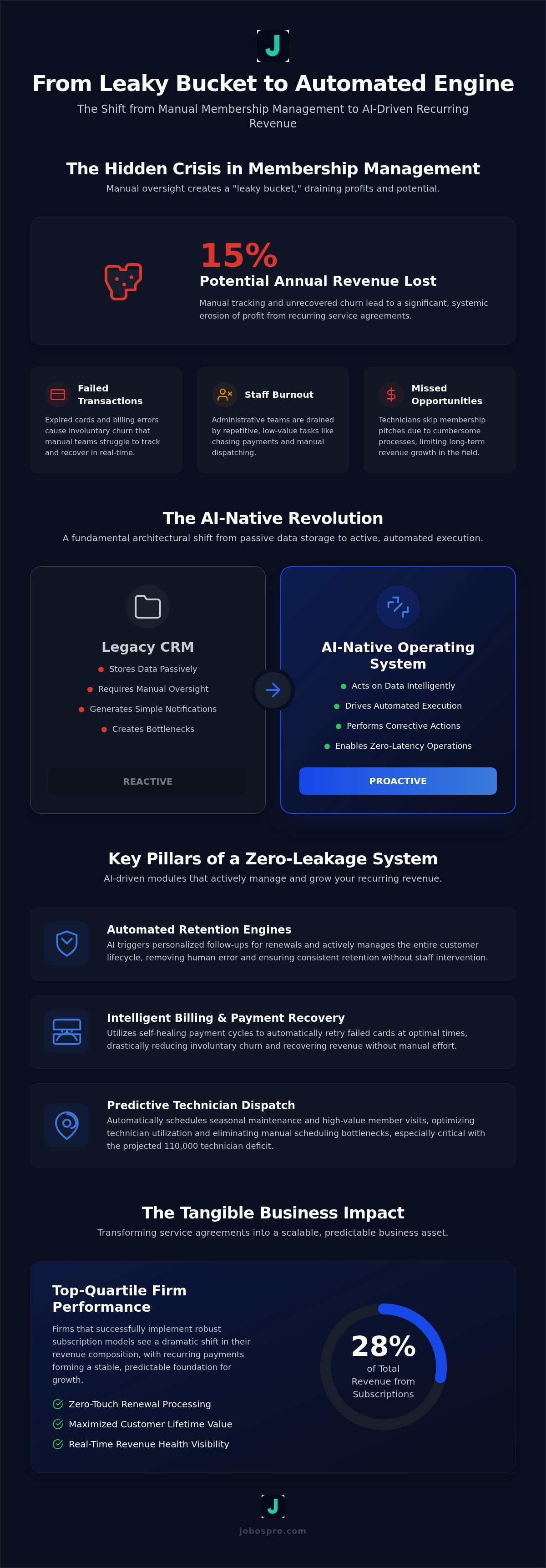
Subscription models now account for nearly 28% of total revenue for top-quartile firms. Most contractors are still bleeding profit through manual oversight. It's a systemic failure when a home service membership management system allows a plan to expire simply because a credit card was replaced or a technician forgot to mention a renewal in the field. You've likely felt the sting of these operational gaps while trying to scale your recurring revenue.
This guide provides the strategy to master the transition from manual service agreements to AI-driven systems that eliminate leakage and maximize customer lifetime value. We'll move beyond legacy workflows into a world of zero-touch renewal processing and automated technician dispatch for seasonal visits. You'll gain a clear roadmap for deploying intelligent systems that provide real-time visibility into your revenue health. The shift from a manual 'leaky' bucket to a zero-latency operation starts here.
Key Takeaways
- Eliminate revenue leakage by replacing manual tracking with AI-driven systems that manage failed payments and expirations automatically.
- Understand the architectural shift from legacy CRMs to active operating systems that prioritize automated execution over simple notifications.
- Optimize your home service membership management by integrating AI call answering to identify and log recurring revenue opportunities instantly.
- Secure consistent technician utilization through automated dispatching for seasonal maintenance visits, removing the burden from your office staff.
- Transform your service agreements into a scalable business asset using real-time data visibility to monitor the health of your recurring revenue.
The Hidden Crisis in Home Service Membership Management
The current state of home service membership management is defined by a silent, systemic erosion of profit. Most contractors treat their recurring revenue as a passive asset. It isn't. Without active oversight, the very systems designed to provide stability become "leaky buckets" that drain resources through administrative friction and technical failure. Industry analysis indicates that manual tracking and unrecovered churn can result in a 15% loss of potential revenue annually. This represents a fundamental breakdown of the subscription business model within the trades.
The High Cost of Revenue Leakage
Expired credit cards and missed renewal windows are the silent killers of scaling. Manual follow-ups are not a solution; they are a productivity drain. Your office staff spends hours chasing failed payments instead of securing new leads. When the burden of retention falls on human operators, the result is inevitable inconsistency. This problem is compounded when technicians in the field fail to pitch memberships because the process is cumbersome. Effective home service membership management requires a system that removes these hurdles. Without it, your membership base remains flat while your overhead continues to climb.
- Failed Transactions: Credit card data degrades constantly, leading to involuntary churn that human teams can't track in real-time.
- Staff Burnout: Administrative teams lose hours to repetitive billing tasks, reducing their capacity for high-value customer service.
- Missed Opportunities: Technicians often ignore membership pitches to save time on site, limiting your long-term revenue potential.
Operational Latency in Service Agreements
Traditional field software is built for one-off reactive jobs. It lacks the architectural depth to handle the velocity of modern recurring plans. When a seasonal maintenance window opens, manual dispatching creates a massive bottleneck that legacy systems cannot resolve. Operational latency is the delay between a membership trigger and a completed service call. This delay erodes customer trust and devalues your brand. High-value members must be moved to the front of the queue without human intervention. The "set it and forget it" approach to billing is a dangerous myth. You need an AI layer to observe and correct payment failures in real-time. Passive systems only notify you after the damage is done. Active systems prevent the damage from occurring.
The AI-Native Architecture for Recurring Revenue
The transition from a static database to an AI-native operating system represents a fundamental pivot in how firms scale. Legacy systems store data. AI-native architectures act upon it. This shift moves your business from a reactive stance to a state of constant, automated oversight. Modern home service membership management requires a system that doesn't just record a membership status but actively manages the customer lifecycle. AI call answering systems now identify membership opportunities during initial lead capture, logging requests before a human dispatcher even views the ticket. It's about total visibility and zero-latency response.
Efficiency is no longer optional. The home service industry faces a deficit of 110,000 licensed technicians in 2026. You cannot afford to waste your best talent on low-priority calls or inefficient routes. Predictive dispatching ensures that high-value member visits are matched with the most proficient technicians, optimizing both customer satisfaction and technical utilization. When the system understands the technical requirements of a member visit, it eliminates the guesswork that typically plagues manual scheduling.
Automated Retention Engines
Retention is no longer a manual task for the office manager. AI engines trigger personalized follow-ups based on specific data points like equipment age or previous service history. This ensures that the right message reaches the right member at the exact moment they need it. Effective recurring service membership software integrates these triggers directly into the workflow, turning passive members into active brand advocates through automated reputation management. By removing human error from the follow-up cycle, you solidify the foundation of your recurring revenue and protect your market share.
Intelligent Billing and Payment Collection
Failed payments are the primary driver of involuntary churn in subscription models. AI-native platforms utilize self-healing payment cycles to retry cards at optimal times and automate the recovery process without staff intervention. This level of automated invoicing for home services significantly reduces Days Sales Outstanding (DSO) while handling complex multi-tier pricing structures with precision. Eliminating billing friction is critical for modern operations. When the system corrects its own errors, your leadership team can focus on strategic growth rather than chasing small-dollar debts. For firms looking to modernize, implementing an AI-powered management layer is the only way to achieve truly scalable recurring revenue.
Legacy CRM vs. AI-Native Membership Management
Legacy CRMs were designed as digital filing cabinets. They prioritize data entry, requiring your staff to manually record every interaction, update, and billing change. This creates a fundamental bottleneck. In contrast, AI-native platforms function as active operating systems. They prioritize data action. The distinction is stark. A legacy system might send a notification that a membership has expired, alerting a human to take action. An AI-native system executes the renewal sequence automatically. It observes the expiration, retrieves the updated payment method, and confirms the new service window without human intervention. This is the difference between a passive record and an active revenue engine.
Scalability exposes the limitations of traditional tools. Managing 100 members on a spreadsheet or a basic CRM is tedious but possible. Managing 10,000 members across multiple territories is a different category of challenge. Visibility remains the primary obstacle. Legacy reports are static, often outdated by the time they reach executive leadership. Modern home service membership management requires real-time dashboards that provide instant clarity on recurring revenue health, churn rates, and technician performance. You need oversight that scales as fast as your ambition.
The Intelligence Gap in Field Operations
Legacy tools inevitably create data silos. Information regarding a member's equipment age, previous service history, and billing status often lives in separate, disconnected modules. These silos hide revenue leaks. Implementing AI business management for home services unifies the entire customer lifecycle into a single source of truth. This integration allows for a pivot from reactive scheduling to intelligent technician dispatching. Instead of simply filling a calendar, the system prioritizes high-value member visits based on technical urgency and technician proficiency, ensuring every truck roll maximizes long-term value.
Franchise and Multi-Location Benchmarking
Standardizing membership value across a fragmented network is notoriously difficult. Without a unified technology layer, different locations often apply different standards, leading to inconsistent customer experiences and diluted brand equity. Utilizing home service franchise management software allows for network-wide intelligence. AI monitors performance across all locations, identifying underperforming branches by comparing their membership conversion rates against the network average. This high-level reporting provides executive leadership with the corrective insights needed to maintain operational excellence across the entire brand. It's about moving from local guesswork to global precision.
Strategic Implementation: Building a Membership Plan That Scales
Scaling a subscription model requires a structural pivot. You cannot manage 10,000 members with the manual workflows used for 100 without facing systemic collapse. Strategic home service membership management demands a phased deployment of AI-native tools to ensure that growth doesn't overwhelm your operational capacity. The transition from a manual "leaky" bucket to a zero-latency operation starts with a clear implementation roadmap. This isn't just about software; it's about re-engineering your business for predictable, recurring revenue.
- Step 1: Audit your current service agreement conversion rates to identify where prospects are dropping out of the funnel.
- Step 2: Configure AI call answering to identify and log membership inquiries instantly, ensuring no lead is missed.
- Step 3: Automate the technician incentive structure to trigger field sign-up commissions directly within your payroll system.
- Step 4: Deploy automated billing cycles to eliminate manual invoicing and staff-heavy payment chasing.
- Step 5: Monitor the health of your recurring revenue through executive performance dashboards that provide real-time visibility.
Technician Buy-in and Field Automation
Technicians are your primary sales force, yet they often resist high-pressure sales tactics. You must remove the burden of "selling" and replace it with data-driven value. AI estimating software for HVAC increases membership attachment rates by presenting clear, data-backed value propositions directly on the technician's tablet. By automating the customer follow-up process, the system maintains contact without requiring the technician to act as a salesperson. This reduces field stress while consistently growing your membership base. To see how these tools integrate with your current operations, you can schedule an AI-native strategy audit today.
Optimizing the Renewal Cycle
Renewals should be invisible to the customer until the moment of value. Setting up "Zero-Latency" renewal triggers 30 days before expiration ensures that payment failures are corrected before they result in churn. You should utilize home service reputation management software to gather reviews and positive sentiment in the months leading up to a renewal. This validates the membership's worth through the customer's own experiences. The psychology of an automated membership "check-in" is far more effective than a traditional sales call. It positions your brand as a silent, reliable partner rather than a vendor seeking a transaction.
Scaling Predictable Revenue with JobOS Pro
JobOS Pro is not a peripheral utility. It is the foundational operating system for the modern trade enterprise. Forward-thinking contractors are rapidly abandoning legacy CRMs because these outdated platforms cannot support the velocity of an AI-native business. By centralizing home service membership management within a single, cohesive architecture, you eliminate the fragmentation that typically kills growth. The journey from a missed call to a loyal, recurring member is now fully automated. Complexity is the enemy of scale. JobOS Pro removes it.
Unifying dispatch, billing, and retention into one strategic layer provides a level of control that was previously impossible. Legacy systems require human intervention at every stage of the customer lifecycle. JobOS Pro operates with zero-latency, observing patterns and executing corrections in real-time. This shift allows your leadership team to move away from day-to-day firefighting. You can finally focus on the high-level strategic decisions that drive market dominance. The platform doesn't just record your business activity; it actively drives your revenue health.
The Executive Advantage
Executive leadership requires total visibility to make informed decisions. JobOS Pro provides real-time dashboards that benchmark your membership growth against industry leaders, identifying exactly where your network is excelling or falling behind. This intelligence is particularly critical for high-volume sectors. AI dispatch for pest control and HVAC optimizes technician routes specifically for member visits, ensuring that your most valuable customers receive priority service without manual oversight. You gain the ability to monitor the health of your entire recurring revenue stream from a single, authoritative source of truth. It's about oversight without the overhead.
Future-Proofing Your Home Service Business
The residential service sector is moving toward a subscription economy. Homeowners now expect the same seamless, tech-forward experience from their plumber or HVAC tech that they receive from global enterprise brands. Positioning your company as a sophisticated partner is no longer a luxury; it is a requirement for survival. By adopting an AI-native strategy, you protect your business against labor shortages and market volatility. You create a resilient, predictable revenue engine that compounds in value over time. The transition is inevitable. The only question is how quickly you will adapt. You can schedule a demo with JobOS Pro to automate your membership management and secure your position at the top of your market.
Mastering the AI-Native Revenue Shift
The transition from manual service agreements to an AI-native operating system is the defining move for contractors seeking market dominance. You must move beyond the administrative friction of legacy CRMs to secure your long-term growth. By unifying billing, dispatch, and retention into a single strategic layer, you eliminate the systemic revenue leakage that plagues traditional firms. Modern home service membership management requires an architecture built for enterprise scale, ensuring that your most valuable customer relationships are preserved through automated oversight.
JobOS Pro provides the tech-forward infrastructure needed to transform your recurring revenue from a passive record into an active asset. Trusted by multi-location HVAC and plumbing franchises, this platform corrects payment failures and optimizes technician utilization in real-time. It's time to replace operational latency with precision execution. Your path to a resilient, scalable business starts with a single technological shift.
Request a Strategic Consultation with JobOS Pro to automate your membership management and lead your market with confidence.
Frequently Asked Questions
What is home service membership management software?
It is a specialized operating system designed to automate the lifecycle of recurring service agreements. Unlike standard CRMs, this software handles automated billing, renewal tracking, and service scheduling specifically for the trades. It ensures that membership programs provide predictable revenue by eliminating manual data entry. High-performance home service membership management relies on AI to observe payment health and technician attachment rates in real-time, providing total visibility into your recurring revenue.
How does AI help in managing service agreements?
AI transforms passive service agreements into active revenue engines by automating oversight. It identifies failed payment patterns and initiates self-healing billing cycles without human intervention. Additionally, AI analyzes customer equipment data to trigger personalized renewal offers at the optimal moment. This technology removes the administrative burden from your office staff, allowing them to focus on high-level growth rather than chasing expired credit card information or manual follow-up tasks.
Can I integrate membership management with QuickBooks?
Yes, JobOS Pro unifies your operational data with your financial records by integrating directly with QuickBooks. This ensures that your membership revenue is accurately reflected in your accounting software without manual reconciliation. While we are not an accounting platform ourselves, our AI-powered system provides the necessary data flow to maintain a clean general ledger. This integration allows for total visibility into your company's financial health across all locations and franchises.
How do I reduce churn in my HVAC membership plans?
Reducing churn requires eliminating involuntary cancellations caused by technical failures like expired cards. Implementing automated billing recovery ensures that payment issues are resolved before they result in a lost member. Beyond billing, you can use automated reputation management to consistently validate your value through positive customer interactions. Proactive, AI-driven communication keeps your brand top-of-mind, turning passive subscribers into long-term advocates for your residential HVAC business.
What features should I look for in membership software for contractors?
Look for an AI-native architecture that prioritizes automated execution over simple notifications. Essential features include self-healing payment processing, automated technician incentive tracking, and predictive dispatching for seasonal visits. You also need executive dashboards that provide real-time visibility into network-wide performance. Avoid legacy tools that rely on manual data entry, as they cannot scale with the demands of a modern, high-volume recurring service business or multi-location operation.
How does automated billing work for multi-location home services?
Automated billing unifies the payment lifecycle across your entire franchise or multi-location network. The system observes the billing cycle for every member and executes transactions based on predefined multi-tier pricing structures. If a payment fails in one location, the AI-native platform initiates a recovery sequence automatically. This standardization ensures consistent cash flow and reduces Days Sales Outstanding (DSO) without requiring additional administrative headcount at individual branches or headquarters.
Will AI call answering help sell more memberships?
AI call answering identifies membership opportunities during the initial lead capture phase. The system is programmed to recognize keywords related to service agreements and can log membership requests before a dispatcher even views the ticket. By providing instant, 24/7 responses to inquiries, you capture leads that would otherwise be lost to competitors. This technology ensures that every inbound call is treated as a strategic opportunity to grow your recurring revenue base.
How do I automate technician dispatching for membership visits?
Automation is achieved by integrating your membership database with an intelligent technician dispatching engine. The system observes upcoming seasonal maintenance triggers and automatically matches the visit with the most proficient technician available in that zone. This eliminates the manual bottleneck of scheduling hundreds of member visits during peak seasons. By prioritizing high-value members through predictive routing, you maximize technician utilization and ensure consistent service quality across your entire network.