
Home Service Reputation Management Software: The 2026 Executive Guide
Can your executive team pinpoint exactly which technician's performance is driving your highest-value referrals, or are you still flying blind through a haze of unmanaged reviews? In 2026, 88% of homeowners consult digital feedback before hiring a contractor. For the modern enterprise, home service reputation management software is no longer a peripheral marketing tool. It's a critical intelligence layer required to close the loop on revenue recovery. You've likely felt the friction of manual feedback requests and the lack of visibility across fragmented service territories. These systemic inefficiencies don't just hurt your brand. They create a measurable leak in your bottom line.
This guide reveals how AI-native platforms transform passive sentiment into a scalable engine for growth. You'll discover how to implement automated, context-aware review generation that links directly to job completion. We'll analyze the transition from legacy aggregation to centralized dashboards that provide total oversight of multi-location performance. By the end of this article, you'll understand how to correlate real-time reputation data with technician utilization to ensure your most trusted experts are always on the front lines of your business.
Key Takeaways
- Shift your operational perspective from passive review collection to active sentiment intelligence that drives enterprise-level growth.
- Leverage AI-native home service reputation management software to deploy contextual review requests triggered by specific job outcomes and technician performance.
- Eliminate systemic intelligence gaps by unifying reputation data with your dispatch and billing systems to stop revenue leakage.
- Execute a multi-location roadmap that maintains national brand consistency through automated feedback loops at the moment of invoice payment.
- Gain total oversight of the customer lifecycle by correlating technician utilization directly with real-time customer sentiment.
The Evolution of Trust: Why Home Service Reputation Management Matters in 2026
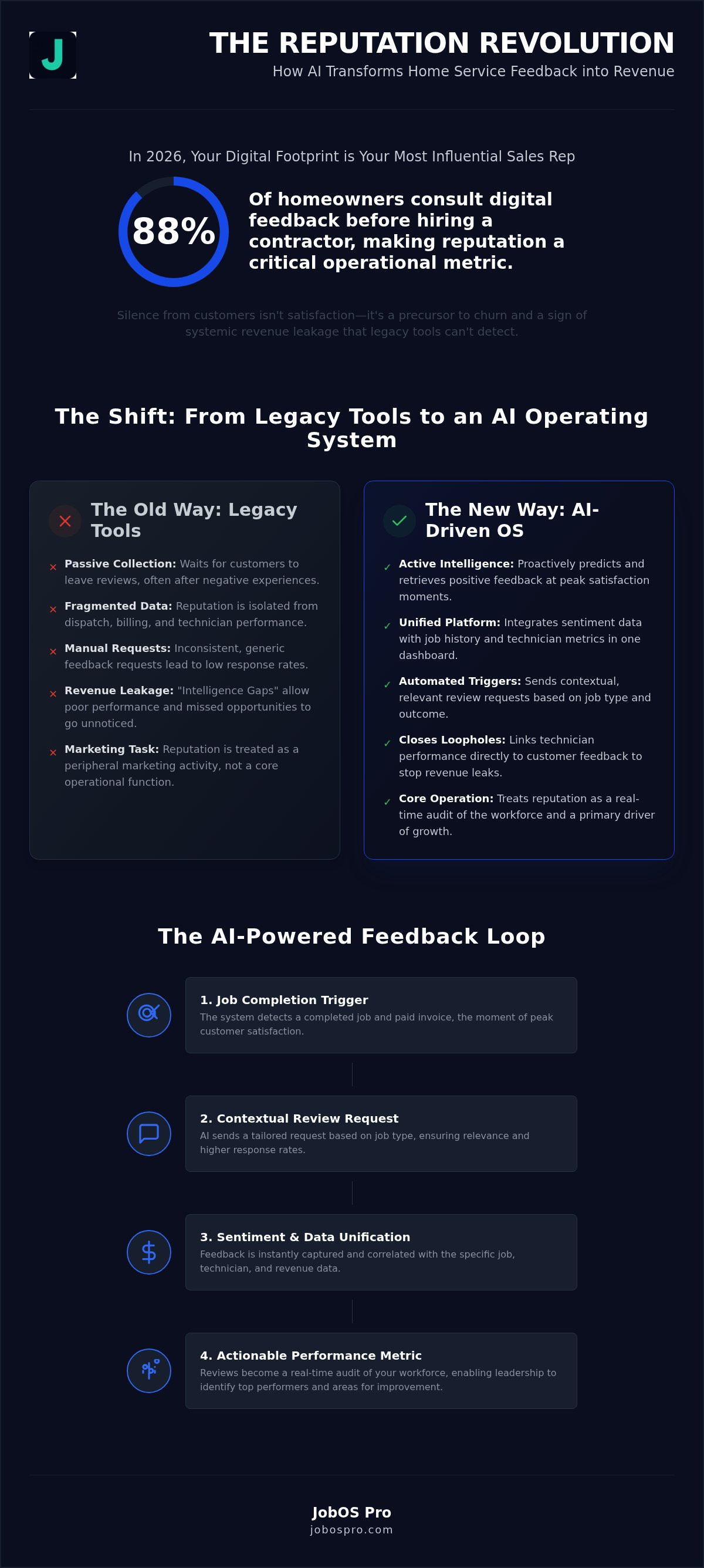
Trust is the primary currency of the modern home service enterprise. In a market where 88% of homeowners consult digital feedback before booking a technician, your public rating is your most influential sales representative. Yet, many high-growth organizations still treat reputation management as a peripheral marketing task rather than a core operational function. This is a strategic failure. Modern home service reputation management software serves as a vital layer of your business operating system. It bridges the gap between technician performance and customer sentiment, ensuring that your brand's digital footprint reflects its operational reality.
Legacy systems focus on passive review collection. They wait for the customer to speak, often after a negative experience has already solidified. In 2026, this approach is insufficient. High-performance firms have shifted to active sentiment intelligence. This involves observing every interaction to predict and retrieve positive feedback before the technician even leaves the driveway. The stakes are immense. In a saturated market, a 0.5-star difference on a primary review platform can be the deciding factor between a conversion and a bounce. Organizations that fail to bridge this "Intelligence Gap" in their legacy field service management tools will find themselves outpaced by competitors who treat sentiment as a real-time data point.
The High Cost of Operational Silence
Silence from your customers isn't a sign of satisfaction; it's often a precursor to churn. Unmanaged feedback leads to systemic revenue leakage that legacy tools simply cannot detect. Social proof acts as a psychological gatekeeper for modern consumers. If your digital footprint is stagnant or negative, you're effectively locking the door on new opportunities. Integrating your reputation strategy with automated lead management for contractors ensures that every positive interaction is amplified into a lead-generating asset. Automated systems capture the momentum of a successful job, turning a satisfied homeowner into a permanent advocate for your brand.
Reputation as a Performance Metric
Stop viewing reviews as marketing collateral and start viewing them as a real-time audit of your workforce. Reviews provide the most honest assessment of technician professionalism and technical competence available to leadership. When you treat reputation as a performance metric, you gain a level of oversight that traditional KPIs can't match. This integration is a cornerstone of AI business management for home services. It allows executives to see exactly which technicians are building your brand equity and which are eroding it. By unifying these disparate data points, you transform customer sentiment into a corrective tool for operational excellence.
Beyond the Star Rating: How AI-Native Software Transforms Customer Sentiment
Star ratings are a blunt instrument. While legacy tools focus on the volume of stars, high-growth enterprises in 2026 require precision. Modern home service reputation management software dissects the nuances of customer feedback to provide actionable insights. It's not just about the rating; it's about the velocity and context of the data. AI-native platforms move past simple aggregation to analyze the underlying sentiment of every review, identifying specific operational strengths and weaknesses that traditional metrics miss.
Precision begins with "Contextual Review Requests." Instead of sending generic feedback blasts, AI-native systems trigger tailored messages based on the specific job type and technician performance. A homeowner receiving an HVAC installation expects a different follow-up than one who had a routine drain cleaning. This relevance significantly increases response rates. Furthermore, maintaining a professional brand voice at scale is only possible through AI-generated responses. These systems ensure "Zero Latency" when addressing negative feedback, allowing leadership to intervene before a single bad experience damages the brand's national standing. Adhering to FTC guidelines on customer reviews ensures these automated processes remain transparent, ethical, and compliant with 2026 standards.
Automated Sentiment Intelligence
AI identifies hidden patterns that human operators often overlook. It distinguishes between a complaint about high pricing and a grievance regarding technician punctuality. This granular data allows leadership to refine intelligent technician dispatching strategies in real time. Sentiment intelligence is the ability of AI to categorize qualitative feedback into quantitative growth metrics. By observing these trends, you can pivot your service standards before a minor local issue becomes a systemic enterprise failure.
Closing the Revenue Loop
Reputation is the final stage of the customer lifecycle, but it's also the catalyst for the next one. Linking the final review back to the initial automated lead capture for contractors creates a self-sustaining growth cycle. Positive reviews act as high-octane fuel for your home service lead generation tools, lowering your cost per acquisition over time. Reducing friction is paramount. Mobile-first portals and SMS requests ensure providing feedback is effortless for the homeowner. For executives looking to unify these disparate stages into a single source of truth, adopting a comprehensive AI-native operating system is the only way to achieve total visibility and stop revenue leakage.
Evaluating the Stack: Legacy Review Tools vs. AI-Driven Operating Systems
Executives often mistake a review widget for a comprehensive strategy. This is a critical operational error. Standalone "Review Apps" act as isolated point solutions that fail to communicate with your core dispatch and billing engines. When your home service reputation management software exists in a vacuum, you create dangerous data silos. You might see a three-star rating, but without integrated dispatch data, you can't immediately identify which technician was on-site or what specific job type led to the friction. This "Technician Accountability" gap makes it impossible to implement systemic improvements across a multi-location enterprise.
Fragmented data is the enemy of scale. Implementing a robust Online Reputation Management (ORM) strategy requires more than just monitoring; it demands an integrated operational response. In a franchise model, the ability to benchmark performance across territories is essential. Legacy tools lack the technical architecture to support enterprise home service software requirements, forcing your team into a cycle of manual data entry and cross-platform synchronization that drains resources and delays action.
The Problem with Point Solutions
Bolting on a third-party review tool creates a disjointed customer experience. These tools trigger requests based on arbitrary timers rather than real-time job status, often asking for feedback before a technician has even left the property. The hidden costs of these point solutions manifest in missed opportunities and delayed escalations. When customer sentiment is decoupled from the service record, your leadership loses the ability to perform a true audit of operational health. You aren't just losing data; you're losing the ability to move with the speed the 2026 market demands.
The AI-Native Advantage
AI-native operating systems unify call answering, dispatching, and reputation into a single, cohesive architecture. This allows for automated escalations where the system alerts management to negative sentiment before it ever reaches a public forum. Instead of generic templates, AI-contextual replies use job-specific data to maintain a sophisticated brand voice. This level of oversight ensures that every piece of feedback is categorized as a growth metric rather than a mere notification.
| Feature | Legacy Template Responses | AI-Contextual Replies |
|---|---|---|
| Relevance | Generic "Thank you for your business" scripts. | Mentions specific technicians and job outcomes. |
| Speed | Requires manual approval or delayed batching. | Instant, real-time generation and deployment. |
| Brand Voice | Static and often robotic or repetitive. | Dynamic, professional, and tailored to the situation. |
| Operational Link | None; the response is purely cosmetic. | Triggers internal workflows based on sentiment. |
The Implementation Roadmap: Scaling Reputation Across Multi-Location Enterprises
Scaling a multi-location home service enterprise requires a shift from manual oversight to automated architecture. Without a standardized roadmap, your brand's reputation becomes a collection of fragmented local stories rather than a unified national asset. High-growth firms use home service reputation management software to build a repeatable framework that ensures consistency across every territory. This is not about micromanagement. It's about deploying a system that observes, retrieves, and unifies data at scale.
- Step 1: Centralize Listing Management. Ensure national brand consistency by unifying all digital profiles under a single management layer.
- Step 2: Automate the Feedback Trigger. Eliminate human error by triggering review requests at the exact moment of invoice payment.
- Step 3: Deploy AI Sentiment Filters. Categorize incoming reviews by location and technician to identify systemic patterns.
- Step 4: Establish Executive Dashboards. Use franchise network benchmarking to gain total visibility into regional performance.
- Step 5: Integrate Reputation into KPIs. Link customer sentiment directly to technician incentive programs to drive accountability.
Standardizing Quality Across the Network
Maintaining a cohesive brand voice while respecting local nuances is a primary challenge for multi-location leadership. The integration of home service franchise management software allows you to scale reputation without losing the local touch. By benchmarking top-tier locations against underperformers, you can identify the qualitative behaviors that lead to success. This data-driven approach moves your organization away from anecdotal evidence and toward a model of operational excellence. To see how this architecture functions in real-time, explore our enterprise reputation solutions.
Proactive Crisis Mitigation
Waiting for a negative review to go public is a reactive failure. Modern home service reputation management software acts as an early warning system, identifying dissatisfied customers before they hit "publish." AI analyzes the sentiment of internal feedback and suggests immediate service recovery actions. Proactive mitigation reduces negative review volume by up to 40% when handled within the first 60 minutes of service completion. This zero-latency response protects your brand equity and turns potential detractors into loyal advocates. By the time a customer considers leaving a public complaint, your leadership team should already have a resolution in motion.
JobOS Pro: Unifying Reputation Management with Operational Intelligence
JobOS Pro represents a fundamental shift in how high-growth enterprises manage their digital standing. It's the only AI-native operating system that refuses to treat sentiment as an afterthought. While traditional home service reputation management software acts as a mirror, JobOS Pro acts as an engine. It unifies every touchpoint into a single "Call-to-Review" timeline. This allows leadership to observe the exact trajectory of a customer journey, from the initial missed-call recovery to the final five-star submission. You don't just see a rating. You see the specific operational efficiency that produced it. Our franchise benchmarking tools provide total visibility, allowing you to identify top-tier performers and correct regional inconsistencies before they impact your national brand equity.
The Intelligence Layer for Modern Contractors
The "Intelligence Gap" found in legacy field service management tools is a structural liability. JobOS Pro eliminates this by housing call answering, dispatch, and reputation within a unified AI architecture. This connectivity is particularly impactful when integrated with HVAC sales automation software. When sales processes are automated and optimized, the resulting customer sentiment reflects a frictionless experience. Switching from a legacy CRM to an AI-powered operating system isn't just an upgrade. It's a corrective action that provides the executive reporting required for national dominance. The platform identifies hidden patterns that human operators might miss, ensuring your dispatching strategy aligns with actual customer satisfaction metrics.
Strategic Growth and Retention
Reputation data is your most potent tool for driving long-term loyalty and strategic growth. By analyzing sentiment trends in real-time, JobOS Pro identifies the perfect candidates for renewals. This data directly fuels recurring service membership software sales, turning one-time service calls into predictable revenue streams. The strategic advantage of JobOS Pro lies in its ability to retrieve actionable insights from qualitative feedback and deploy them instantly across your entire network. It's a tireless worker that ensures your brand remains the smartest entity in the room. For high-stakes leaders ready to modernize their operations and secure their market position in 2026, the path forward is clear. Contact us today for an executive consultation and discover how to transform your reputation into a scalable revenue engine.
Consolidate Your Competitive Advantage
The transition from passive star counting to active sentiment intelligence is the defining shift for home service leaders in 2026. Legacy silos that separate customer feedback from dispatch data are no longer just inefficient. They're a structural liability. By deploying a unified architecture, you eliminate the intelligence gap and ensure every technician interaction contributes to a measurable revenue engine. Modernizing your home service reputation management software isn't merely a marketing upgrade. It's the installation of a strategic oversight layer that protects your brand equity across every territory.
JobOS Pro provides the total visibility required to dominate saturated markets. You gain AI-driven sentiment analysis for multi-location growth and strategic benchmarking for franchise networks. This platform unifies the entire customer lifecycle, offering unprecedented visibility from the initial call to the final review. Stop reacting to the market and start engineering your growth through data-driven precision. It's time to optimize your enterprise reputation with JobOS Pro. Your path to zero-latency operational excellence begins here.
Frequently Asked Questions
How does home service reputation management software improve local SEO?
High-quality home service reputation management software boosts local SEO by increasing review velocity and diversifying keywords within customer feedback. Search engines interpret consistent, positive sentiment as a signal of geographic authority and service reliability. By automating the request process, you ensure a steady stream of fresh content that keeps your business at the top of local map packs. This visibility is essential for capturing the 85% of homeowners who choose the first contractor who responds.
Can AI really respond to my customer reviews accurately?
Modern AI-native platforms generate context-aware responses by analyzing specific job data, such as the service type and the technician assigned. This ensures every reply is accurate and professional rather than a generic template. These systems maintain your brand voice at scale, allowing you to address feedback instantly. This zero-latency response is critical for meeting 2026 customer expectations and protecting your brand's digital standing without requiring manual intervention from your management team.
What is the difference between a standalone review tool and an integrated OS?
Standalone tools operate in isolation, creating dangerous data silos that decouple customer sentiment from operational reality. An integrated operating system unifies reputation with dispatching, billing, and call answering. This architecture provides total visibility into the customer journey, allowing you to see exactly which service interactions produced specific ratings. While standalone apps are mere mirrors of past events, an integrated OS serves as a strategic engine for real-time performance oversight and revenue recovery.
How do I handle negative reviews in a multi-location franchise?
Managing a franchise network requires centralized oversight combined with automated local alerts. You should deploy AI sentiment filters that categorize incoming feedback by territory and technician. This early warning system identifies negative sentiment before it goes public, allowing for immediate remediation. By benchmarking locations against national standards, you can identify systemic issues and implement corrective training. This approach ensures brand consistency while providing local managers with the tools needed for proactive service recovery.
Is it worth investing in reputation software if I already have a CRM?
Traditional CRMs are often record-keeping tools that lack the specialized AI architecture required for active sentiment intelligence. Investing in dedicated home service reputation management software provides the automated triggers and context-aware requests that most CRMs miss. These platforms close the loop between service completion and public social proof. Without this specialized layer, you risk revenue leakage through unmanaged feedback and a stagnant digital footprint that fails to convert high-value modern homeowners.
How does JobOS Pro link reviews to technician performance?
JobOS Pro unifies the service record with customer feedback to create a definitive audit of technician performance. Every review is automatically linked to the specific job ID, allowing leadership to see the direct impact of individual technicians on brand equity. This data allows you to integrate reputation scores into your KPI and incentive programs. It transforms qualitative feedback into a quantitative metric for workforce management, ensuring your most trusted experts are always assigned to your highest-stakes jobs.
Can I automate review requests for HVAC and plumbing jobs specifically?
Automation is most effective when it's trade-specific. You can configure the system to trigger tailored review requests based on whether the job was an HVAC installation or a plumbing repair. This contextual relevance increases homeowner engagement and ensures the feedback reflects the specific technical expertise provided. By automating these triggers at the moment of invoice payment, you capture the customer's sentiment when it's most potent, reducing the friction that often prevents positive review generation.
What metrics should an executive look for in a reputation dashboard?
Executives must look beyond simple star ratings to focus on review velocity and sentiment trends across all territories. Your dashboard should provide technician-specific performance audits and a direct correlation between reputation and lead conversion rates. Monitor the early warning alerts to identify locations that are underperforming relative to the national average. These metrics provide the visibility required to make data-driven decisions about resource allocation, technician training, and enterprise-level growth strategies.