HVAC Reputation Management Tool: The 2026 Executive Guide to AI-Driven Growth
What if your most expensive marketing asset is being sabotaged by a technician's simple forgetfulness at the doorstep? You already know that 91% of HVAC consumers rely on online reviews before they ever pick up the phone. Yet, most firms still treat their digital presence as a passive scoreboard rather than an active engine for growth. Relying on manual requests or delayed emails results in stagnant response rates and leaves you vulnerable to public negativity before your team can intervene. In a market shifting toward mandatory low-GWP refrigerants and stricter leak reporting, your brand's reliability is your only true currency.
Implementing a sophisticated hvac reputation management tool is no longer an optional upgrade; it's a structural necessity for 2026. This executive guide provides the strategic framework to automate review acquisition and transform customer sentiment into operational intelligence. You'll learn how to deploy AI-native systems that capture feedback in real-time, ensuring your reputation drives revenue instead of leaking it. We will examine the architecture of zero-latency feedback loops and how they integrate directly into your technician's daily workflow to secure market dominance.
Key Takeaways
- Learn why treating reputation as an automated operational layer is critical for capturing high-intent leads in the 2026 HVAC market.
- Discover how a sophisticated hvac reputation management tool leverages real-time job completion signals to eliminate the "Trust Gap" at the doorstep.
- Understand the competitive advantage of AI-native unification over fragmented standalone apps to stop revenue leakage and data latency.
- Master a strategic implementation framework for mapping high-impact feedback touchpoints across the entire customer journey.
- Implement "Zero Latency" feedback loops that trigger automated outreach the second a technician completes a service call.
The Strategic Stakes of HVAC Reputation Management in 2026
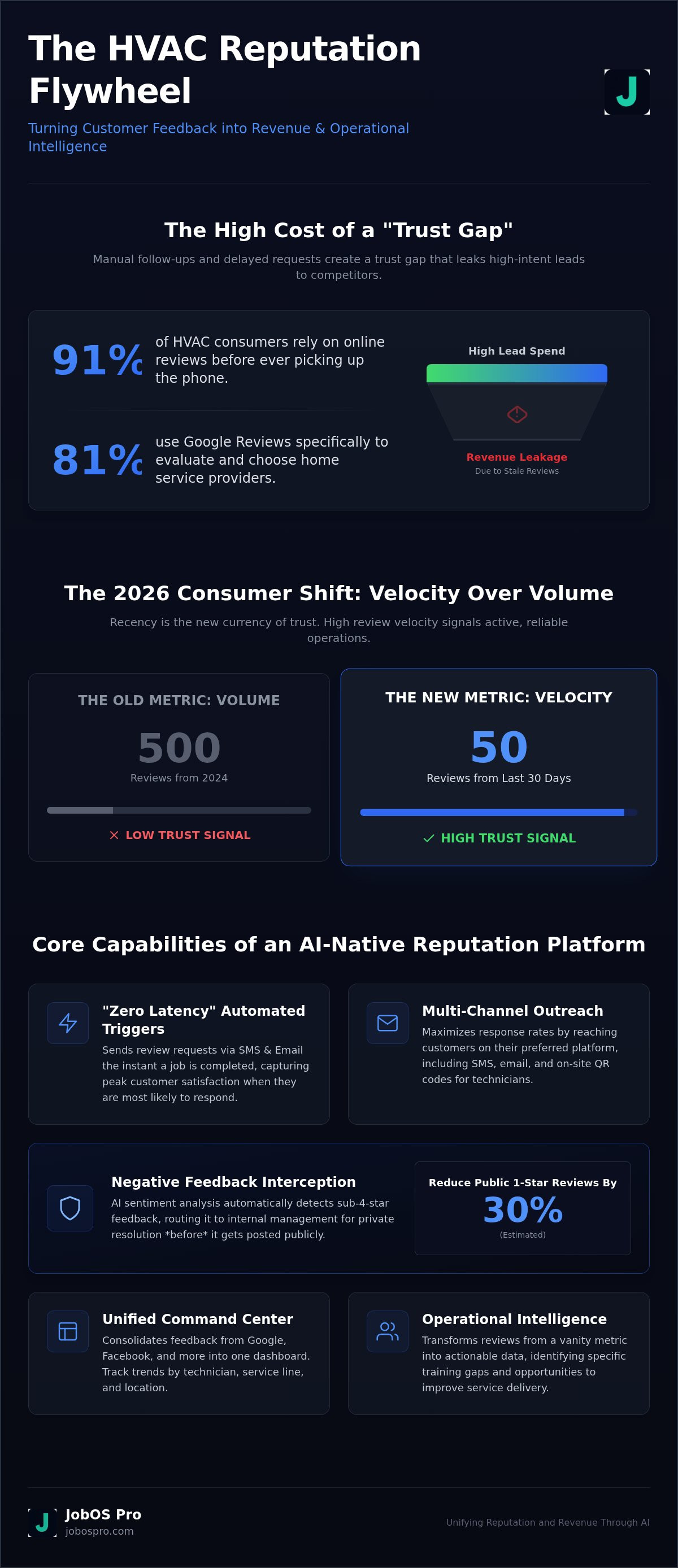
Reputation is not a marketing vanity project. It is the bedrock of your operational infrastructure. In the high-stakes environment of 2026, where regulatory shifts toward A2L refrigerants have increased technical complexity, your digital standing serves as the primary filter for high-intent emergency leads. Traditional Reputation Management often relied on manual, inconsistent outreach. Modern enterprise growth requires an automated layer built directly into your trade stack. Without a dedicated hvac reputation management tool, your firm likely suffers from systemic revenue leakage. High lead spend is wasted if your star rating creates a "Trust Gap" that sends prospects straight to a competitor with more recent social proof. You've moved past the era of asking for favors; you're now in the business of systematizing feedback.
The 2026 Consumer Psychology of Home Services
Modern consumers prioritize recency over total volume. A company with 500 reviews from 2024 is less trustworthy than one with 50 reviews from the last month. This shift is codified in Google Search algorithms and Local Services Ads (LSA) auctions, where performance is increasingly tied to real-time signals. Review Velocity is the rate of new feedback acquisition over a 30-day period. High velocity signals active, reliable operations. Low velocity suggests a stagnant or declining service standard. Research indicates 81% of consumers use Google reviews to evaluate home service companies, making your velocity a critical factor in winning the click.
Reputation as an Operational Performance Metric
Feedback loops provide total visibility into your field operations. When you link technician dispatch efficiency to final customer satisfaction scores, you move beyond guesswork. An enterprise-grade hvac reputation management tool retrieves data that identifies specific training gaps in your service team. If a specific technician consistently receives high marks for technical skill but low marks for communication, you have a clear corrective path. This transforms reputation from a peripheral marketing concern into a foundational metric for performance oversight. You aren't just collecting stars; you're harvesting the data needed to refine your entire service delivery model.
Core Capabilities of an Enterprise HVAC Reputation Tool
Modern HVAC enterprises require more than a simple review solicitor. They need a sophisticated layer of Online Reputation Management For Brands that operates with zero latency. An effective hvac reputation management tool unifies disparate feedback channels into a single, actionable stream. It eliminates the manual burden of checking individual directories and replaces it with a centralized command center. This technology allows leadership to observe, retrieve, and act on customer sentiment across Google, Facebook, and industry-specific directories without the friction of multiple logins.
Automated triggering is the most critical technical capability of a high-performance stack. By syncing the "ask" with real-time job completion signals from the field, the software ensures the request arrives when customer satisfaction is at its peak. Multi-channel outreach leverages SMS, email, and QR codes to maximize response rates across different demographics. This systematic approach ensures no customer interaction goes unmonitored. If your technicians are still manually asking for reviews, you're losing valuable social proof to human error and operational fatigue.
The Mechanism of Negative Feedback Interception
AI sentiment analysis provides a corrective layer that protects your public brand. The system automatically scans incoming feedback for keywords related to service quality, technician professionalism, or pricing disputes. If a sub-4-star sentiment is detected, the AI routes the response to internal management immediately rather than allowing it to post publicly. This "Private Resolution" framework creates a high-stakes opportunity to solve problems before they cause permanent damage. Implementing this proactive intercept can reduce public one-star reviews by an estimated 30%, preserving your LSA performance and customer trust.
Advanced Reporting and Executive Oversight
Executive dashboards provide total visibility into how different service lines are performing. You can visualize reputation trends by distinguishing between installation and repair work, revealing hidden patterns in service quality. Technician-level leaderboards foster a culture of performance by driving internal competition based on verified customer feedback. This data shouldn't exist in a vacuum; integrating it with your AI business management for home services ensures reputation is a core driver of your strategic decisions. If you're looking to eliminate revenue leakage, modernizing your feedback systems is the definitive next step.
The Intelligence Gap: Standalone Apps vs. AI-Native Operating Systems
Fragmentation is the enemy of operational efficiency. Most HVAC businesses still operate under a "tool tax," paying for a stack of disparate software that refuses to communicate. Using a standalone hvac reputation management tool creates a dangerous data silo. This separation between your core CRM and your reputation engine causes systemic latency. Information must be observed, retrieved, and unified in real-time to be effective. An AI-native operating system eliminates these gaps by treating reputation as a foundational layer rather than a peripheral add-on.
Strategic growth requires total visibility. When your systems are unified, you gain access to predictive insights that standalone apps simply cannot provide. You can use historical sentiment data to forecast customer lifetime value (LTV). This allows leadership to prioritize high-value maintenance members over one-off repair calls. According to this Wharton guide to online reputation, managing digital standing is a foundational requirement for growth. However, doing so through fragmented apps introduces unnecessary risk and operational friction.
The Hidden Cost of Standalone Tool Latency
Manual data exports are a relic of a legacy mindset. If your office manager has to download a CSV from your CRM to upload it into a review tool, you've already lost the window of customer satisfaction. This delay leads to missed opportunities and lower response rates. Worse, disconnected systems often cause "Review Fatigue." A customer might receive a generic request for a review while they're still waiting for a follow-up on a pending estimate. For maximum impact, home service reputation management software must be native to the operating system. This ensures every communication is aware of the customer's full history.
Leveraging AI for Contextual Review Requests
Generic requests are easily ignored. Sophisticated hvac reputation management tool capabilities allow for deep customization based on the specific job performed. The AI identifies the equipment serviced, whether it's a high-efficiency heat pump or a standard AC unit, and tailors the outreach message accordingly. It triggers the request at the exact moment of "Peak Relief," the second the technician closes the job in the field. This precision drives significantly higher engagement. Additionally, AI suggests response templates for your office staff. This speeds up review engagement and ensures your brand voice remains consistent across all public platforms. Unification isn't just about saving money; it's about maximizing operational intelligence.
Operationalizing the Ask: A Strategic Implementation Framework
Implementation is the bridge between strategic intent and realized revenue. To maximize the impact of your hvac reputation management tool, you must move beyond generic automation and toward a precision-engineered framework. This process begins with mapping the customer journey to identify high-impact feedback touchpoints where sentiment is most volatile. An enterprise-grade hvac reputation management tool provides the visibility needed to identify these operational gaps before they become public liabilities.
First, automate the trigger by linking requests to "Job Complete" status in your field software. This ensures the outreach occurs during the window of peak satisfaction. Second, implement internal sentiment gates to protect your public rating; these filters route dissatisfied clients to a resolution desk before they post publicly. Third, train your technicians on the "Soft Ask." This simple verbal cue sets expectations for the automated text and increases response rates. Finally, use centralized dashboards to monitor and benchmark performance across the entire organization to replicate top-tier results.
Standardizing Quality Across Multi-Location HVAC Enterprises
Maintaining brand integrity across dozens of locations is a high-stakes challenge. By utilizing home service franchise management software, leadership can benchmark individual branches against network-wide KPIs. Automated reputation auditing identifies underperforming locations that are dragging down your aggregate score. Establish a non-negotiable 24-hour Rule for all review responses. This standard ensures that every customer, regardless of location, receives the same level of professional oversight and corrective action when necessary.
Turning Reviews into Recurring Revenue
A five-star review is the ultimate signal of customer loyalty. It shouldn't be the end of the transaction. Use positive feedback as an automated trigger for recurring service membership software offers. When a customer expresses satisfaction, the system should immediately present the benefits of a maintenance plan. This turns a one-time repair into a predictable, recurring revenue stream. Leveraging these reviews in your automated marketing follow-ups further solidifies your position as the market leader. If you are ready to stop revenue leakage and scale your operations, modernize your trade stack today.
JobOS Pro: Unifying Reputation and Revenue through AI
JobOS Pro represents a fundamental shift in how trade businesses manage their digital standing. It's not merely an hvac reputation management tool; it is an AI-native operating system that unifies every customer touchpoint. Fragmentation is expensive. Total visibility is profitable. By deploying JobOS Pro as your primary hvac reputation management tool, you remove the latency and data fragmentation that plague traditional models. Leadership gains the ability to manage reputation for 100+ locations from a single, unified dashboard. This provides total visibility into brand health across the entire enterprise, allowing for real-time benchmarking and corrective action.
The power of this architecture lies in its "Zero Latency" feedback loop. Requests are sent the second the technician leaves the driveway, capturing feedback while the experience is fresh and the customer's relief is at its peak. This data doesn't just sit in a static report. It feeds back into the system, directly informing intelligent technician dispatching. High-performing technicians are automatically prioritized for high-stakes calls, ensuring your most capable people are always in front of your most important prospects. This closed-loop system ensures that your reputation drives your operations, rather than just reflecting them.
The AI-Native Advantage for HVAC Operations
Automated sentiment routing provides 24/7 protection for your Google Business Profile. The AI identifies potential issues and alerts management before a negative review can damage your LSA standing. This system integrates deeply with AI call answering to capture the leads that your high ratings generate. You aren't just managing reviews; you're building a lead-capture engine that converts social proof into revenue in real-time. Performance dashboards link these reviews directly to revenue growth, giving you a clear window into service quality across different service lines and locations.
Scaling Your HVAC Brand with JobOS Pro
Standardization is the key to scaling a multi-location brand. JobOS Pro ensures a consistent customer experience from the first AI-answered call to the final review request. Consolidating your tech stack into a single, intelligent OS reduces overhead and eliminates the "tool tax" that erodes margins. JobOS Pro is the essential layer for modern trade businesses aiming for 10x growth. By unifying reputation and revenue, you position your firm to dominate the 2026 market with unmatched operational intelligence and a brand that is fundamentally reliable.
Mastering the 2026 Reputation Economy
The 2026 HVAC market leaves no room for operational latency or fragmented data silos. You've seen how a unified hvac reputation management tool transforms customer sentiment from a passive metric into a core driver of revenue and technician performance. By closing the "Trust Gap" through automated, real-time feedback loops, you eliminate the revenue leakage that sabotages legacy businesses. Moving forward, your digital standing must be viewed as a foundational layer of your enterprise trade stack rather than a peripheral marketing effort.
JobOS Pro provides the only AI-Native Operating System specifically Built for HVAC Enterprises. It replaces disconnected apps with a Zero Latency Operational Model that unifies 100+ locations under a single dashboard. This is the definitive path to standardizing quality and capturing high-intent leads before your competitors can react. The future of the trades belongs to those who operationalize their reputation with surgical precision.
Schedule a Strategic Demo of JobOS Pro to secure your market dominance. Your organization is ready for the next level of intelligent growth.
Frequently Asked Questions
What is the best reputation software for a large-scale HVAC company?
The best solution for a large-scale enterprise is an AI-native operating system. Standalone apps introduce data silos that lead to communication gaps. For enterprise-level oversight, you need a system that observes, retrieves, and unifies sentiment data across all branches. JobOS Pro provides this by integrating reputation management into the core technician workflow. This eliminates the latency inherent in fragmented stacks; it ensures that your reputation is a direct reflection of your real-time field performance.
How does an HVAC reputation tool improve my local SEO rankings?
An hvac reputation management tool boosts SEO by increasing both review volume and velocity. Since 81% of consumers use Google reviews to evaluate contractors, search engines prioritize businesses with fresh, frequent feedback. By automating the request process, you ensure that new signals are consistently posted to your profile. This tells search algorithms that your firm is the most reliable choice in your service area, which directly improves your ranking in the LSA auction and local map packs.
Can reputation management software actually stop negative Google reviews?
You cannot technically stop a customer from posting, but you can intercept dissatisfaction. Sophisticated reputation systems use AI sentiment analysis to route sub-4-star feedback to internal management for private resolution. This creates a high-stakes recovery window where you can solve the customer's problem before they go public. Proactive intervention can reduce public one-star reviews by an estimated 30%, preserving your brand's integrity and your competitive edge in a crowded market.
How fast will I see an increase in my star rating after automating requests?
Enterprises typically see a measurable increase in their star rating within the first 30 to 45 days. The results are driven by capturing the "silent majority" of satisfied customers who previously forgot to leave feedback. By increasing your review velocity, you quickly bury older, negative reviews under a mountain of fresh, five-star social proof. This rapid improvement is essential for maintaining visibility in high-intent search environments where consumers demand recent validation.
Is it better to use a standalone review app or an integrated CRM feature?
Integrated features are definitively better for large-scale operations. Standalone apps create data silos that lead to communication latency and review fatigue. When your hvac reputation management tool is native to your operating system, it knows the exact status of every job and invoice. This allows for conditional automation; you only ask for feedback when the customer experience is optimal. Unification reduces your tech stack overhead while maximizing operational intelligence.
What is the "1-hour rule" for HVAC review requests?
The "1-hour rule" is an industry standard suggesting that requests sent within an hour of service have the highest conversion rates. However, modern AI-native systems have evolved beyond this. JobOS Pro triggers requests the moment a technician completes a job in the field. This "Zero Latency" approach captures the customer at the peak of their relief. Waiting even an hour allows the emotional impact of the successful repair to fade, decreasing your overall response rate.
How do I manage reviews for multiple HVAC franchise locations?
Franchise management requires a centralized dashboard that offers total visibility into every branch's performance. You need to benchmark locations against one another to identify hidden patterns of service failure. An enterprise tool allows you to observe, retrieve, and act on sentiment data across the entire network simultaneously. This ensures that every franchise location adheres to the same high standards of customer care and review engagement, protecting the aggregate value of your national HVAC brand.
Does reputation software integrate with my existing QuickBooks accounting?
JobOS Pro integrates with QuickBooks to ensure that review requests are triggered only after a job is marked paid. This prevents requests from being sent during active billing disputes or before a technician has finalized the work order. By linking your reputation engine to your accounting data, you gain total oversight of the customer lifecycle. This strategic synchronization ensures that every outreach is contextually appropriate, protecting your brand while automating the growth of your digital standing.