
Smart Dispatch: AI-Native Guide for Electrical Companies
The manual dispatch desk is no longer a logistical hub; it's a bottleneck that actively drains your enterprise's profit margins. You know that every minute a high-value technician spends idling in traffic or waiting for a job assignment is capital lost. You also understand the liability of sending an unlicensed tech to a complex panel upgrade because your current system lacks real-time license-level awareness. Implementing smart dispatch for electrical companies isn't about adopting a digital calendar; it's about installing an autonomous operational layer that eliminates human latency. Relying on human intuition to manage a fleet is a high-risk strategy in an industry where response time determines market share.
This guide reveals how AI-native dispatching autonomously matches technicians by license level, optimizes routes in real-time, and stops revenue leakage before it starts. We'll examine the technical architecture required to achieve total operational visibility and reduce fuel costs while removing the high overhead of a 24/7 human dispatch team. You'll discover how to transition from reactive scheduling to a predictive, self-correcting system that operates with surgical precision. The result is a streamlined operation that retrieves lost opportunities and unifies your field operations under one intelligent command center.
Key Takeaways
- Manual dispatching creates a systemic "latency tax" that erodes enterprise margins. Learn to eliminate the operational gap between lead capture and technician arrival.
- Implementing smart dispatch for electrical companies enables autonomous job assignment based on real-time location and technician availability. This shift removes the high overhead of 24/7 dispatch teams.
- Automate compliance by matching complex panel upgrades or commercial repairs to specific license tiers like Journeyman or Master levels. This eliminates the risk of failed inspections and manual scheduling errors.
- Follow a rigorous 4-step implementation framework to identify hidden leakage points in your current workflow. You'll gain a roadmap for transitioning to a self-correcting, AI-native operational layer.
- Unify your entire service lifecycle from AI-driven lead capture to automated billing through a single strategic platform. This architecture provides total visibility and benchmarks performance across multi-location networks.
The Latency Tax: Why Manual Dispatching Fails Modern Electrical Enterprises
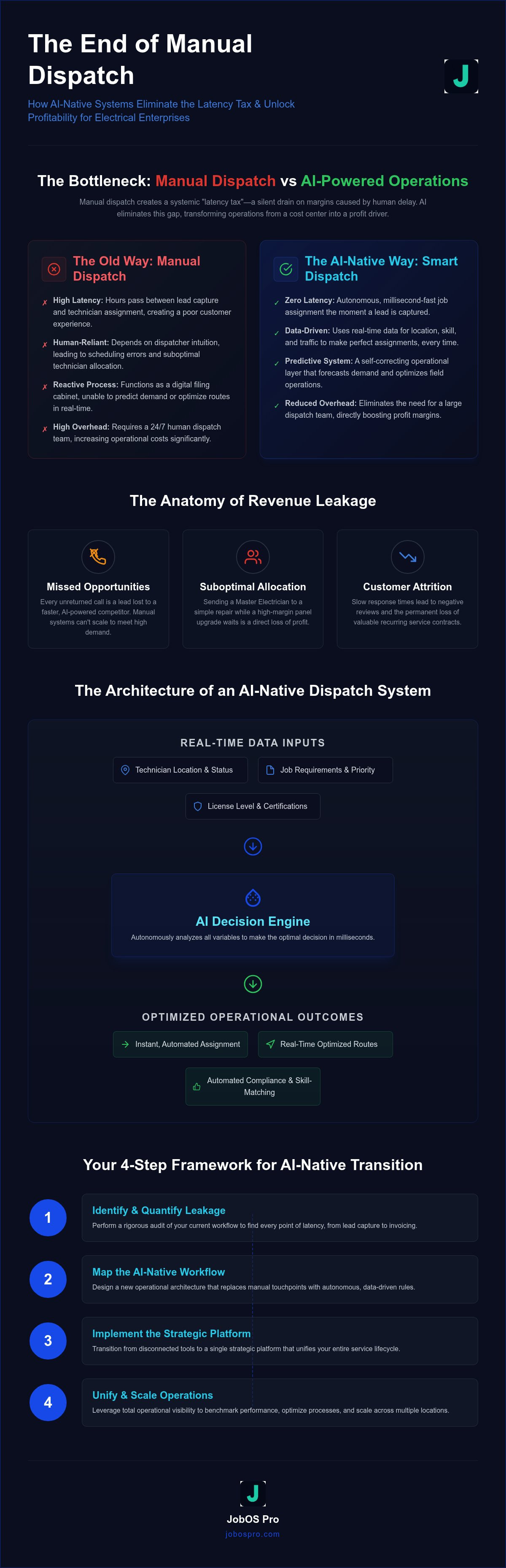
The "Latency Tax" is the silent drain on your profit margins. It represents the measurable financial loss incurred during every second that passes between a customer’s initial lead capture and the final technician assignment. In a manual environment, this gap is often measured in minutes or hours; in a competitive 2026 market, it must be measured in milliseconds. Manual dispatching relies on human cognition to process complex variables like traffic, technician skill, and job priority. This creates systemic bottlenecks, especially during high-demand emergency cycles where a human dispatcher simply cannot scale to meet the volume of incoming requests.
While traditional Computer-aided dispatch (CAD) systems provided a basic digital framework for organizing calls, they lacked the autonomous intelligence required to eliminate this tax. Today, "good enough" routing results in excessive fuel consumption and unnecessary vehicle wear. More importantly, it wastes billable hours. If your technicians spend a portion of their day navigating inefficient routes, you aren't just losing fuel; you're losing the capacity to take on more high-margin panel upgrades or commercial repairs. Relying on legacy CRMs to manage these logistics is a high-risk strategy that fails to keep pace with modern consumer expectations.
The Anatomy of Revenue Leakage in Electrical Operations
Revenue leakage is rarely a single catastrophic event. Instead, it is a series of small, unobserved failures. It starts with the gap between a missed call and a scheduled troubleshoot. When a dispatcher is overwhelmed, they inadvertently prioritize the wrong jobs, often sending a master electrician to a simple outlet repair while a lucrative emergency service call sits in the queue. This lack of strategic oversight costs your enterprise in three specific ways:
- Missed Opportunities: Every unreturned call is a lead captured by a faster, more responsive competitor.
- Suboptimal Allocation: High-skill technicians assigned to low-margin tasks reduce your average ticket value and stall growth.
- Customer Attrition: Slow response times lead to negative digital reviews and a permanent loss of recurring service revenue.
Legacy Software vs. AI-Native Operating Systems
Most electrical enterprises still operate on legacy CRMs that function as little more than digital filing cabinets. They require a human to "drag and drop" jobs onto a schedule, a process that is fundamentally reactive. This manual intervention is no longer a competitive advantage; it's a liability. True smart dispatch for electrical companies requires a real-time decision engine that observes patterns and retrieves data autonomously. By shifting to an AI business management for home services model, you replace human guesswork with a strategic operating system. This transition ensures that your dispatching logic evolves as fast as the market does, providing total visibility into your field operations.
The Architecture of Smart Dispatch for Electrical Companies
Smart dispatch for electrical companies is not a peripheral tool; it's the core architectural layer of a modern enterprise. It unifies disparate data points into a single, cohesive technician lifecycle. By integrating predictive analytics, the system forecasts service demand based on historical patterns and real-time environmental factors. This transformation reflects the broader shift in the future of work, where autonomous agents handle high-frequency decisions. The goal is "Zero Latency." This means the moment a call is captured, the system has already analyzed technician location, license status, and current traffic to provide an immediate solution. It eliminates the friction of manual entry and the risk of human oversight during the assignment phase.
Autonomous Lead Capture and Job Routing
The architecture does not just record leads; it evaluates them with strategic intent. AI identifies high-value opportunities, such as whole-home generator installs or complex panel upgrades, and prioritizes them over routine maintenance when demand spikes. Route awareness ensures that technicians are assigned jobs that minimize drive time, effectively retrieving billable hours that were previously lost to traffic congestion. Autonomous dispatch is a self-correcting system that updates every 30 seconds to account for job overruns or new emergencies. This persistent optimization ensures that your fleet remains in motion and your revenue remains protected from the entropy of manual scheduling.
Real-Time Oversight and Executive Visibility
Moving to an AI-native model provides executive leadership with a "God-view" of the entire operation. You no longer need to check in with individual managers to understand fleet status or project progress. Executive dashboards present a unified view of all active electrical projects, highlighting potential delays or licensing mismatches before they impact the bottom line. This visibility extends directly to the customer experience. The system automates ETA updates, providing clients with real-time tracking that eliminates the need for "Where is my tech?" calls. By unifying lead capture, scheduling, and customer communication, the JobOS Pro platform ensures that every operational move is backed by data-driven logic rather than human intuition. This is the new standard for enterprise-level electrical service.
Skill-Based Assignment: Automating Licensing and Compliance
Electrical work is binary: it's either compliant or it's a liability. Manual dispatching often treats technicians as interchangeable units, ignoring the critical legal distinctions between Master, Journeyman, and Apprentice tiers. This is a systemic failure. When a dispatcher sends an unlicensed technician to handle a 400-amp service upgrade because they were the closest available, they aren't just being efficient; they're gambling with the company's operating license. Smart dispatch for electrical companies removes this human error by enforcing licensing rules at the point of assignment. The system retrieves technician credentials and cross-references them with job requirements before the notification ever hits a mobile device. This ensures only qualified professionals handle high-voltage work, drastically reducing corporate liability.
Automating the Master-to-Apprentice Ratio
State regulations often mandate strict supervision ratios that are difficult to track in real-time. Maintaining these ratios across a multi-location enterprise is a logistical nightmare for human operators. AI-native systems automate this balance, ensuring that every apprentice in the field is paired with the appropriate level of supervision autonomously. This isn't just about compliance; it's about workload optimization. By leveraging intelligent technician dispatching, leadership can ensure high-skill experts are reserved for complex diagnostics while junior staff are assigned to tasks that build their skill sets without exceeding their legal scope.
Permit and Inspection Tracking Integration
The lifecycle of an electrical project doesn't end when the wire is pulled. It ends when the municipal inspector signs off. Manual tracking leads to orphaned jobs where the permit remains open, creating long-term legal and financial risks. AI-driven dispatching integrates directly with permit and inspection windows to close these gaps. It observes the status of every filing and automatically schedules follow-up inspections the moment a job is marked complete. This closed-loop workflow ensures total visibility and guarantees that every project meets the 2026 National Electrical Code standards. For example, with the GFCI protection exception for outdoor HVAC units set to expire on September 1, 2026, the system can autonomously ensure that technicians are dispatched with the correct parts and training to meet the new requirement.
Strategic Implementation: Transitioning to AI-Native Dispatching
Transitioning to an AI-native system is a strategic imperative. It begins with a cold assessment of your current leakage points. You must identify where revenue is slipping through the cracks. Is it the three-hour gap between an emergency call and a technician arrival? Is it the portion of fuel spend wasted on backtracking? Implementing smart dispatch for electrical companies requires a 4-step framework: auditing existing workflows, integrating data streams, automating the technician lifecycle, and optimizing through real-time feedback loops. This shift redefines the role of your office staff. They are no longer manual schedulers; they are Strategic Operators who manage the system's exceptions rather than its routine.
The ROI of this transition is immediate and measurable. You'll observe a reduction in fuel costs and a sharp increase in billable hours per technician. By removing the overhead of a manual 24/7 dispatch team, you reclaim margin that was previously lost to administrative friction. This is about more than just efficiency; it's about building a scalable foundation for enterprise growth.
The Data Migration Strategy
Successful implementation hinges on the integrity of your data. You must unify customer histories, specific panel notes, and technician license levels into a single AI record. This ensures the decision engine has the context required to make high-stakes assignments autonomously. Seamless integration with your financial stack is non-negotiable. Connecting your dispatch logic to automated invoicing for home services ensures that the moment a job is completed, the billing cycle begins without human intervention. This unification retrieves time and capital that manual systems inevitably waste.
Scaling Through Franchise Benchmarking
For multi-location enterprises, smart dispatch provides the data necessary for network-wide benchmarking. You can compare location performance with absolute clarity, identifying which franchises are optimizing their routes and which are falling behind. Standardizing service quality becomes an automated process through unified SOPs and AI oversight. Top-performing franchises use this dispatch data to optimize their hiring, identifying specific skill gaps before they become operational liabilities. To begin your transition and eliminate operational latency, explore the JobOS Pro implementation roadmap today.
JobOS Pro: The Strategic Operating System for Electrical Growth
The manual era of service management is over. JobOS Pro provides the only AI-native operating system specifically engineered to handle the high-stakes requirements of modern electrical enterprises. While legacy platforms offer fragmented tools, JobOS Pro unifies your entire customer lifecycle into a single, predictive infrastructure. Implementing smart dispatch for electrical companies requires more than a digital calendar; it demands a system that observes hidden operational patterns and retrieves lost revenue autonomously. By positioning your business on a foundation of automated intelligence, you gain total visibility into every facet of your field operations. This isn't a peripheral upgrade. It's a foundational shift that ensures your enterprise remains the smartest entity in the room.
True operational growth requires closing the revenue loop. JobOS Pro achieves this by integrating AI call answering with instant lead capture and automated billing. This architecture eliminates the human friction that leads to missed calls and delayed invoices. As we move into 2026, the speed of your response determines your market share. Our platform ensures that your response is not only fast but strategically optimized for maximum billable value. You can finally stop managing systemic inefficiencies and start scaling your footprint with confidence.
The JobOS Pro Advantage
The JobOS Pro advantage lies in its zero-latency transition from lead capture to technician arrival. When a high-value lead is identified, the system bypasses the traditional dispatch bottleneck and assigns the job based on real-time location and license level. This lead recovery captures revenue that your competitors, bogged down by manual processes, inevitably miss. Furthermore, our AI estimating tool turns complex troubleshoot calls into signed proposals in minutes, rather than days. This speed unifies the customer experience and accelerates your cash flow. To maintain this momentum, the system integrates with recurring service membership software to ensure long-term retention and predictable recurring revenue.
Next Steps for Executive Leadership
Modernizing a multi-location enterprise requires a disciplined approach. We recommend starting with a comprehensive performance audit of your current dispatching workflow to identify specific leakage points. This data-driven assessment provides the clarity needed to justify a technological shift. From there, executive leadership can pilot JobOS Pro in a single location to observe the immediate impact on fuel costs and billable hour increases before a full network rollout. The transition is designed to be seamless, ensuring your team becomes a group of strategic operators rather than manual schedulers. The future of electrical service is autonomous. Book a Strategic Demo with JobOS Pro to secure your competitive edge.
Securing Operational Dominance in a High-Energy Future
The transition from manual coordination to autonomous execution is no longer optional for electrical contractors looking to scale. You've seen how the latency tax erodes margins and how manual scheduling compromises compliance with high-stakes licensing requirements. Implementing smart dispatch for electrical companies ensures that every technician assignment is a data-driven move rather than a reactive guess. This architecture provides the total visibility required to manage complex multi-location networks with surgical precision.
By unifying lead capture, skill-based routing, and automated invoicing, you transform your enterprise into a self-correcting decision engine. This is the only way to meet 2026 consumer expectations and maintain a competitive edge. Eliminate operational latency and scale your electrical enterprise with JobOS Pro. Our AI-native platform is designed specifically for high-stakes trade operations, providing executive reporting and franchise benchmarking to drive performance. Take command of your field operations and build a foundation for relentless growth.
Frequently Asked Questions
What is smart dispatch for electrical companies?
Smart dispatch for electrical companies is a real-time decision engine that replaces manual scheduling with autonomous job assignment. It uses predictive algorithms to match technicians to projects based on license level, geographic proximity, and current traffic. This system eliminates human latency by processing complex variables in milliseconds. It provides a unified operational layer that retrieves lost billable hours and unifies field operations under one intelligent command center.
How does AI dispatching handle emergency electrical calls?
AI dispatching prioritizes emergency calls by identifying high-risk keywords during the lead capture phase. The system immediately analyzes the fleet to find the nearest technician with the specific licensing required for high-voltage troubleshooting. This zero-latency transition ensures that emergency responses are handled with surgical precision. It removes the risk of a human dispatcher missing a critical call during peak demand periods or after-hours service cycles.
Can smart dispatching software verify technician licensing?
The software enforces licensing compliance at the point of assignment by cross-referencing technician credentials with specific job requirements. It identifies the legal distinction between Master, Journeyman, and Apprentice tiers to prevent unauthorized dispatch. This automated verification reduces corporate liability and ensures that every project meets municipal standards. It eliminates the risk of failed inspections caused by sending under-qualified staff to complex commercial or residential electrical upgrades.
Does smart dispatch integrate with QuickBooks for electrical billing?
Smart dispatch integrates directly with QuickBooks to automate the entire invoicing and payment collection cycle. The moment a technician marks a job complete, the system retrieves project data to generate an accurate invoice. This connection eliminates manual data entry and reduces the billing cycle from days to minutes. It ensures that financial records remain synchronized with field operations, providing executive leadership with real-time visibility into cash flow and revenue.
How much can an electrical company save with AI-driven dispatching?
Electrical enterprises achieve savings by eliminating the high overhead costs of a dedicated 24/7 human dispatch team. The system reduces fuel consumption and vehicle wear through optimized routing that minimizes backtracking. It also retrieves lost revenue by increasing technician utilization and stopping leakage from missed calls. While exact savings depend on fleet size, companies typically see a sharp reduction in operational latency and an immediate increase in billable capacity.
Will smart dispatch replace my human dispatching team?
Smart dispatch does not replace your team; it elevates them into the role of Strategic Operators. The AI handles the high-frequency, routine scheduling tasks that typically lead to burnout and human error. This shift allows your staff to focus on complex exception management and strategic growth initiatives. By automating the foundational logistics, your team can manage a larger fleet with greater oversight and less administrative friction.
How does smart dispatching improve technician utilization?
Smart dispatching improves technician utilization by minimizing idle time and optimizing travel routes in real-time. The system observes active project durations and retrieves data to predict when a technician will become available for their next assignment. It ensures that high-skill electricians are reserved for high-margin tasks, preventing them from being underutilized on routine maintenance. This persistent optimization maximizes the billable output of every member of your field force.
Is smart dispatching software suitable for multi-location electrical franchises?
The software is specifically engineered for multi-location electrical franchises and enterprise-level operations. It provides executive reporting and franchise benchmarking tools that allow leadership to compare performance across different regions with absolute clarity. The platform standardizes service quality through automated SOPs and unified dispatching logic. This architecture ensures that every location operates with the same strategic precision, regardless of its geographic distance from the corporate headquarters.