
Stop Revenue Leakage: Home Service Operations Guide
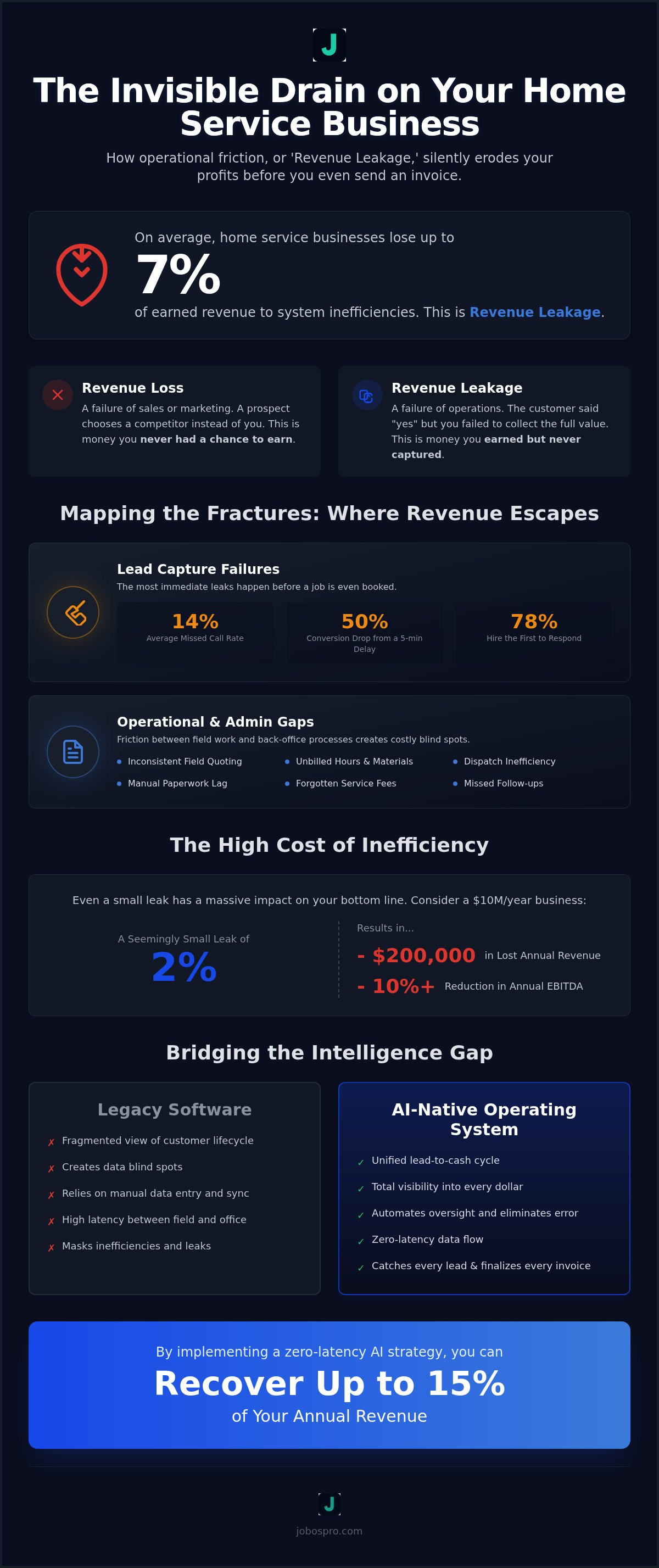
Did you know that the average home service business loses up to 7% of its earned revenue before a single invoice is even generated? This invisible drain, known as revenue leakage home services providers often overlook, is a systemic failure of manual operations rather than a simple accounting error. You likely feel the constant pressure of a high-volume pipeline that doesn't quite translate to the net profit you expected. When 14% of your incoming calls go unanswered and field technicians deliver inconsistent quotes, your margins are being eroded by operational latency. It's a common frustration for executive leadership to see a healthy top line while the bottom line remains stagnant due to uncollected payments and missed opportunities.
This guide will show you how to recover up to 15% of your annual revenue by implementing a zero-latency AI strategy that unifies your lead-to-cash cycle. We'll explore the specific gaps in your customer lifecycle, the necessity of automated oversight, and the technological architecture required to achieve total visibility into every dollar. By the end of this article, you'll understand how to transform your business into a high-performance engine that catches every lead and finalizes every invoice without human error.
Key Takeaways
- Distinguish between lost leads and the systemic revenue leakage home services companies face when earned income isn't captured.
- Identify critical operational fractures, such as missed calls and inconsistent field quoting, that erode your net profit margins.
- Evaluate the limitations of legacy software and why an AI-native business stack is required for total visibility into the customer lifecycle.
- Apply a two-step framework to audit your response times and automate the conversion of verbal quotes into signed digital agreements.
- Leverage zero-latency technology to recover up to 15% of annual revenue by eliminating human error in dispatching and invoicing.
The Invisible Drain: Why Revenue Leakage is a Strategic Crisis
Revenue leakage home services providers experience is a silent killer of profitability. It represents the delta between the work your team performs and the cash that actually settles in your account. While most owners focus on top-line growth, they often ignore the structural fractures where money slips away through unbilled hours, forgotten materials, or missed follow-ups. To solve this, you must first understand what revenue leakage is in a technical sense: it's the systemic failure to capture value that has already been earned.
There's a critical distinction between revenue loss and revenue leakage. Revenue loss occurs when a prospect chooses a competitor; it's a failure of sales or marketing. Revenue leakage is far more insidious because it happens after the customer has already said "yes." It's the result of friction within your internal systems. Traditional CRMs often exacerbate this issue by providing a fragmented view of the customer lifecycle. These legacy tools track basic interactions but fail to unify the field data with billing logic, creating blind spots that mask inefficiencies. For executive leadership, this lack of visibility is a psychological weight. It creates a persistent uncertainty that prevents aggressive scaling, as you can't confidently reinvest capital that you aren't certain you'll collect.
The High Cost of Latency in Field Operations
Speed is the primary currency of the modern home service market. Industry data suggests that a five-minute delay in responding to a lead can result in a 50% drop in conversion rates. This latency isn't limited to the front office. The information gap between a technician finishing a job at the kitchen table and the office sending an invoice creates a window for disputes and forgotten charges. Implementing AI business management for home services provides the real-time oversight needed to bridge this gap. It ensures that data flows instantly from the field to the ledger, eliminating the manual lag that invites error.
Quantifying the Impact on Your Bottom Line
In high-volume sectors like HVAC and plumbing, leakage is a death by a thousand cuts scenario. A forgotten 50 dollar service fee or a 2% discrepancy in material tracking might seem negligible on a single ticket. However, across a multi-location franchise, these micro-leaks compound. A mere 2% leak in a 10 million dollar operation doesn't just cost 200,000 dollars in revenue; it can slash annual EBITDA by 10% or more. Revenue leakage home services companies face is effectively a tax on your own inefficiency. Systemic revenue leakage functions like a leaky bucket, where the pressure of high-volume sales only accelerates the rate at which earned profit escapes through foundational operational gaps.
Mapping the Fractures: Where Home Service Businesses Lose Revenue
Operational fractures aren't always obvious. They exist in the silence of an unanswered phone and the ambiguity of a verbal quote. To stop the revenue leakage home services companies suffer from, you must map the specific points where data and dollars disconnect. These fractures represent a failure of oversight that compounds as your business scales. Identifying them is the first step toward reclaiming your lost margins.
The "Missed Call" Fracture is the most immediate point of failure. With an industry average missed call rate of 14%, many businesses effectively discard leads they've already paid to generate. If you don't answer, the customer moves to the next search result. Statistics show that 78% of customers hire the first company to respond to their inquiry. This is revenue lost before a human interaction even occurs. It's a front-end failure that no amount of back-end accounting can fix.
The "Dispatch Gap" and "Paperwork Lag" further erode your bottom line. Poor route density leads to technician idle time, where you pay for labor that isn't generating billable hours. Similarly, manual invoicing often results in unbilled parts and forgotten line items. If a part isn't on the digital record, it rarely makes it to the final invoice. This administrative friction is a direct drain on your EBITDA, functioning as a tax on your lack of technological integration.
Lead Capture and Call Answering Failures
Most emergency calls happen after-hours or during weekend peaks when your office staff is stretched thin. These missed opportunities create "dark data"-leads that exist in your phone logs but never enter your CRM. Recovering these lost opportunities requires more than just a voicemail; it requires an instant, intelligent response. By automating your front-end lead capture, you ensure that every inquiry is logged and processed with zero latency, regardless of when the customer calls.
Field Estimating and Technician Inconsistency
The "Kitchen Table" Fracture occurs when technicians provide verbal-only quotes. Verbal commitments are the primary source of quote-to-invoice leakage because they lack a verifiable audit trail. Technicians might offer unauthorized "on-the-spot" discounts or fail to record scope changes during the job. Standardizing these interactions with AI estimating and quoting tools eliminates this inconsistency. It ensures that every quote is a digital contract, protecting your profit margins from the variable whims of field operators and preventing the revenue leakage home services brands typically struggle to control.
Legacy Software vs. AI-Native Systems: Bridging the Intelligence Gap
Traditional Field Service Management (FSM) tools are often little more than glorified spreadsheets. They function as passive repositories that record what happened but do nothing to influence what should happen in real-time. This structural passivity is a primary driver of the revenue leakage home services providers face as they attempt to scale. While legacy systems store data, they lack the active intelligence required to identify and correct operational anomalies before they impact your cash flow.
The fundamental flaw in traditional software is its reliance on human intervention. You're forced to wait for a manager to run a report, identify a discrepancy, and then attempt to retroactively fix a problem that occurred days or weeks ago. AI-native operating systems invert this model. They provide a continuous layer of automated oversight that observes every transaction, dispatch, and invoice as it happens. This shift from reactive reporting to proactive intervention is the only way to achieve zero-latency growth.
Digital Paper vs. Active Oversight
A standard CRM acts as a digital filing cabinet for lost revenue. It holds your customer records and job history, but that information remains inert until an employee interacts with it. This creates a productivity gap that manual oversight can't bridge. By contrast, intelligent technician dispatching shifts your operations from a state of constant catch-up to one of predictive efficiency. Instead of reviewing poor route density at the end of the month, an AI-native system optimizes technician utilization in the moment, ensuring that every billable hour is maximized and every mile driven is necessary.
The Problem with Fragmented Tech Stacks
Many executive leaders believe that "integrating" multiple specialized tools-one for marketing, another for dispatch, and a third for billing-solves the visibility problem. In reality, these integrations often create more revenue leakage home services brands struggle to track. Data silos are formed at the connection points between these disparate systems, hiding the very gaps you're trying to close. A unified operational layer is essential for multi-location growth because it ensures that information remains consistent from the first call to the final payment. Without a unified data architecture, your business remains vulnerable to systemic errors where complex billing tiers are applied incorrectly across different service regions, leading to immediate and invisible margin erosion.
Real-time data isn't just a luxury; it's a foundational requirement for modern field operations. AI dispatch and scheduling tools don't just move technicians from point A to point B. They analyze historical performance and skill sets to match the right technician to the right job every time. This level of automated precision prevents errors from ever reaching your ledger, effectively turning your operating system into a silent, tireless worker that provides constant oversight of your profit margins.
The Instant Response Framework: A Strategic Plan to Recover Lost Income
Stopping the systemic revenue leakage home services companies face requires more than a software patch. It demands a fundamental shift in your operational architecture. To recover your margins, you must implement a framework that removes human error from the lead-to-cash cycle. This isn't a passive monitoring exercise. It's an active correction of the latency that currently drains your profitability. By following a structured five-step plan, you can unify your field operations and ensure that no earned dollar remains uncollected.
The first step is to audit the "First Five Minutes" of your customer journey. Research shows that 78% of customers hire the first company to respond to their inquiry. If your team isn't responding within this window, you've already lost the lead. Next, you must automate the transition from verbal quotes to signed digital contracts. Moving away from "handshake deals" ensures that every scope change is recorded and billable. Third, implement real-time technician tracking and automated dispatching to maximize route density. Fourth, you should deploy automated invoicing for home services to eliminate the lag between job completion and payment request. Finally, use executive reporting to identify leakage patterns across your multi-location operations, allowing you to benchmark performance and isolate outliers.
Deploying an Instant Response Strategy
Lead capture is the most vulnerable point in your funnel. Every missed call is a direct hit to your marketing ROI. Implementing AI call answering ensures 100% lead capture, even during peak hours or after midnight. This technology doesn't just record messages; it books appointments and triggers automated follow-ups to close the "quoted but not booked" gap. To see how these steps fit into your current workflow, you can review the Stopping Revenue Leakage Checklist for immediate action items. Speed is your primary competitive advantage. Don't let it be your greatest weakness.
Financial Automation and Payment Collection
Cash flow acceleration depends on the speed of your billing cycle. When you rely on technicians to turn in paperwork at the end of the week, you invite unbilled parts and forgotten fees. Systemic logic should handle your accounts receivable, not manual entry. This is particularly vital when managing recurring service memberships, where automated billing ensures that subscription revenue is captured without fail. By removing the technician from the billing process, you reduce human error and protect your EBITDA. To secure your margins and eliminate the revenue leakage home services providers often accept as a cost of doing business, you should schedule a strategic consultation to see these automated systems in action.
JobOS Pro: The Unified Operating System for Zero-Latency Growth
JobOS Pro isn't a peripheral tool. It's the foundational layer of the modern business stack. It provides a comprehensive technological remedy for the systemic revenue leakage home services brands face daily. By unifying lead capture, dispatch, and invoicing into a single AI-native engine, JobOS Pro eliminates the operational gaps that drain your profitability. This is the definitive solution for high-growth brands looking to scale without the friction of legacy systems.
Front-end leakage is corrected through AI call answering and lead capture. This system ensures 100% of your incoming inquiries are processed with zero latency, retrieving opportunities that would otherwise be lost to your competitors. Once a lead is captured, AI estimating tools standardize the kitchen-table experience. These tools provide active oversight, ensuring every job is quoted for maximum profit and that no scope changes go unrecorded. You're no longer reliant on the variable performance of individual technicians; you're relying on a system designed for precision.
Enterprise Intelligence for Multi-Unit Operations
For executive leadership, visibility is the primary driver of performance. Our home service franchise management software provides the benchmarking required to identify outliers across your entire network. If a specific location is experiencing higher rates of leakage, the system flags the pattern automatically. This automated oversight allows you to identify "leaky" franchises before they impact your brand overall EBITDA. Standardizing the customer experience across every unit protects your reputation and secures your recurring revenue streams.
The Future of Zero-Latency Operations
The industry is moving toward a state where human operators are supported by intelligent systems that identify hidden patterns. AI-native architecture prepares your business for 2026 by transitioning your focus from managing people to managing an intelligent operating system. This shift ensures your margins are protected by foundational technological shifts rather than manual audits. To reclaim your lost revenue and secure your path to scale, you must move toward total visibility. You can schedule a strategic audit of your operations with JobOS Pro to begin the transition today.
Securing Your Operational Foundation for 2026
Stop treating the revenue leakage home services providers face as an unavoidable cost of doing business. It's a systemic failure that requires a foundational technological shift rather than a simple management adjustment. By moving from passive legacy tools to an AI-native operating system, you gain total visibility into every dollar within the customer lifecycle. You've learned how identifying operational fractures and implementing an instant response framework can recover up to 15% of your annual revenue.
The path to zero-latency growth depends on active, automated oversight. Our platform provides the executive performance dashboards required for multi-location oversight, ensuring every unit meets your specific profitability standards. With AI-powered missed-call recovery and a robust automated invoicing infrastructure, you eliminate the gaps where earned income traditionally disappears. You now have the strategic roadmap to transform your business from a manual operation into a high-performance engine that captures every lead and secures every payment without fail.
Eliminate revenue leakage with the JobOS Pro AI Operating System. Your margins are ready for the next level of precision and scale.
Frequently Asked Questions
What are the most common signs of revenue leakage in an HVAC or plumbing business?
Discrepancies between technician hours and billable time, high missed call rates, and stagnant net profit despite rising sales are the primary indicators. You'll often see a high volume of uncollected invoices or inconsistent material costs across similar jobs. These are symptoms of systemic fractures. Identifying these patterns is the first step toward correcting the revenue leakage home services providers face when scaling their operations.
How does revenue leakage differ from standard operational expenses?
Operational expenses are the planned costs of doing business, while revenue leakage represents earned income that never reaches your bank account. Leakage is a failure of capture rather than a cost of production. It's the silent erosion of your EBITDA caused by administrative friction, manual errors, and information gaps. Unlike expenses, leakage can be recovered through better systems without cutting resources or labor.
Can AI call answering really recover lost sales opportunities?
Yes, by ensuring every lead is captured and processed within the critical first five minutes of inquiry. With an industry average missed call rate of 14%, many businesses lose thousands in potential revenue every week. AI call answering provides an instant, intelligent response that books appointments and logs data directly into your CRM. This eliminates the dark data leads that otherwise vanish into voicemail.
How much revenue does the average home service business lose to leakage?
Independent research estimates that between 3% and 7% of earned revenue is never fully captured due to systemic leakage. However, in high-volume HVAC and plumbing environments, this number can reach as high as 10% to 15% when factors like missed calls and unbilled parts are included. These micro-leaks compound over time, significantly reducing your annual net profit and hindering your ability to reinvest in growth.
Will automating my invoicing really speed up my cash flow?
Automation eliminates the paperwork lag that often keeps invoices stuck in a technician's truck for days. By generating and sending invoices immediately upon job completion, you reduce the time-to-payment gap and accelerate cash flow. Automated systems also ensure that every part and service fee is recorded accurately, preventing the unbilled line items that are a primary driver of revenue leakage home services companies struggle with.
Is revenue leakage a sign of employee fraud or just process error?
It's primarily a sign of process error and systemic operational gaps rather than intentional fraud. While unrecorded scope changes or handshake deals can look suspicious, they are usually the result of a lack of standardized tools. Process failure occurs when your system relies on human memory and manual entry. Transitioning to an AI-native operating system replaces these variable human elements with consistent, automated logic.
How does franchise benchmarking help stop revenue leakage across locations?
Benchmarking allows executive leadership to identify outliers in revenue performance by comparing data across multiple units. If one location shows significantly lower profit margins despite similar lead volume, it indicates a localized leakage problem. Automated reporting tools flag these discrepancies instantly, allowing you to implement corrective measures. This level of oversight ensures that brand standards and profitability are maintained across your entire franchise network.
What is the first step to auditing my business for revenue leakage?
The first step is to conduct a comprehensive audit of your lead-to-cash cycle, starting with your response time during the first five minutes of a lead. Analyze the gap between your incoming call logs and your booked appointments to find front-end leakage. Then, compare your material purchase records with your final invoices to identify unbilled parts. This data-driven approach reveals exactly where your systems are failing.