Contractor Profit Margin Software: The 2026 Checklist to Stop Revenue Leakage
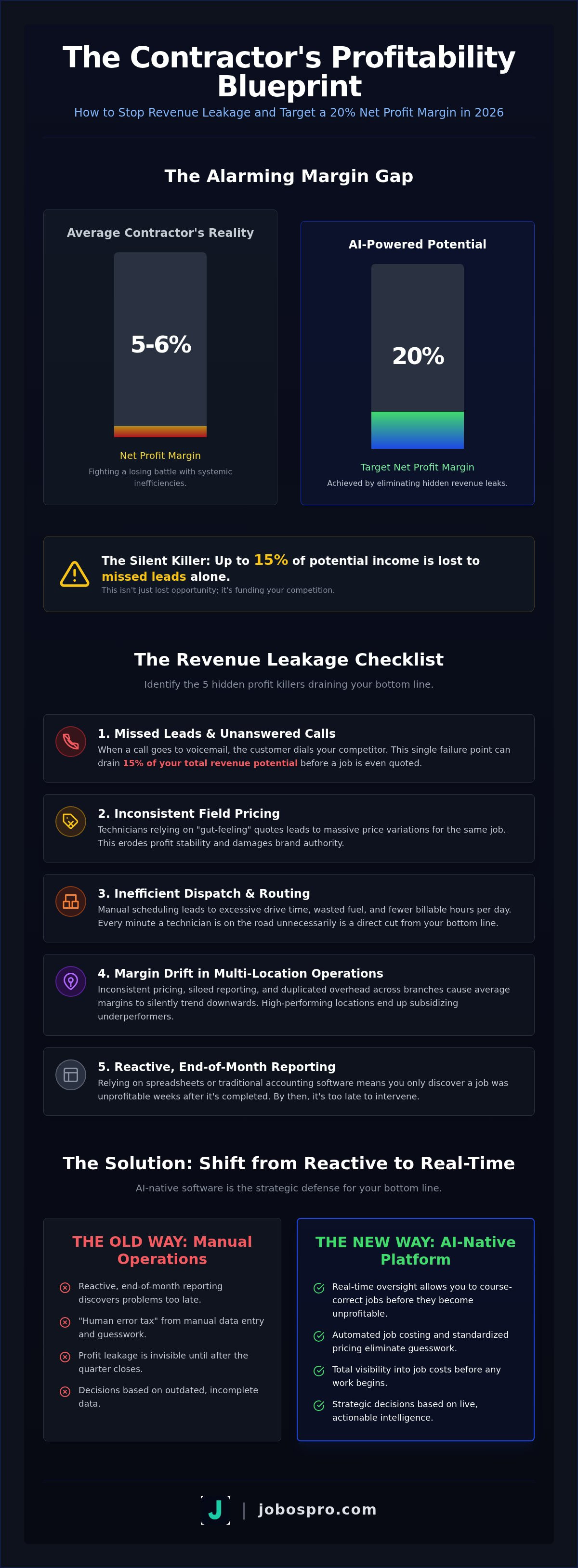
The average general contractor in 2026 is fighting a losing battle against a 5% to 6% net profit margin. While your top-line revenue might look impressive, systemic inefficiencies often mean you're losing up to 15% of your potential income to missed leads alone. Implementing the right contractor profit margin software isn't just an upgrade. It's a strategic necessity to stop the silent revenue leakage that occurs between the initial call and the final invoice.
You already know that high volume doesn't always equal high profit. You feel the constant pressure of inconsistent quotes and the chaos of manual dispatching, yet finding the "missing" cash remains a persistent challenge. We promise to help you reclaim that lost capital by providing total visibility into your job costs before any work begins. This article previews the essential 2026 checklist for building an automated defense around your bottom line. You'll learn how to transition from reactive accounting to a real-time strategy that targets a 20% net profit margin with surgical precision.
Key Takeaways
- Distinguish between gross and net profit margins to understand how 2026 market dynamics impact your actual take-home pay.
- Identify the five primary leakage points where your business is losing capital, from unanswered leads to inconsistent technician pricing.
- Implement AI-native contractor profit margin software to automate job costing and eliminate the human error tax that erodes your bottom line.
- Transition from reactive end-of-month reporting to real-time oversight, allowing you to course-correct jobs before they become unprofitable.
- Follow a structured implementation guide to reclaim a 20% net profit margin by unifying field operations with your financial stack.
Understanding Contractor Profit Margin in the AI Era
Most contractors track revenue. Fewer track profit with any real precision. And almost none track the gap between what they could have earned and what they actually collected. That gap is where businesses quietly fail, not in a single catastrophic loss, but through thousands of small, invisible erosions that compound across every job, every quarter, every fiscal year.
At its core, profit margin is a straightforward measure of financial efficiency: how much of each dollar earned actually stays in the business. But for home service trades, the standard definition barely scratches the surface of what's actually happening to your bottom line.
The Formula for Modern Profitability
The standard calculation is: (Total Revenue - Cost of Goods Sold) / Total Revenue. For a general contractor, COGS includes labor, materials, and subcontractor fees. That's where most operators stop. The problem is that this formula, applied in isolation, produces a dangerously incomplete picture.
Modern profitability accounting must factor in what the industry increasingly recognizes as "soft costs": unanswered calls that never convert to booked jobs, excessive technician drive time between poorly sequenced appointments, and inconsistent quote pricing that leaves money on the table before a wrench is ever turned. These aren't abstract losses. They're measurable, recoverable capital. Revenue Leakage is the delta between your potential job profit and what you actually realize after operational friction takes its cut.
Industry Benchmarks: What Is a 'Good' Margin?
General contractors typically operate within a 2% to 6% net profit margin. Specialty trades like HVAC and plumbing can reach 10% to 15% net when pricing and job costing are tightly controlled. The difference isn't always skill. It's often systems.
This is precisely where AI-native contractor profit margin software redefines the benchmark. By automating estimating, dispatch sequencing, and lead capture, platforms like JobOS Pro compress overhead costs that traditional operations absorb as unavoidable. The result is a structurally higher floor for net profitability, not because revenue increased, but because fewer dollars escape through process gaps.
Multi-location businesses face a compounding version of this challenge called margin drift, where inconsistent pricing, duplicated overhead, and siloed reporting across branches gradually pull average margins downward. A business that performs well at one location may be subsidizing underperformance at another without ever knowing it. Passive tracking, whether through spreadsheets or end-of-month accounting reviews, cannot detect this in time to intervene. Real-time visibility isn't a luxury at that scale. It's the only viable defense.
The Revenue Leakage Checklist: 5 Hidden Profit Killers
Revenue leakage isn't a single event. It's a systemic surrender of capital. Most contractors realize their margins are thin only after the job is closed and the bills are paid. By then, it's too late to intervene. To protect your bottom line, you must identify where the money is escaping before it leaves your ecosystem. Profit doesn't just disappear; it's surrendered through operational friction.
Quantifying the Front-End Leak
The first point of failure is often the most expensive. Data indicates that the average home service business loses 15% of its revenue to missed leads. When a call goes to voicemail, the customer simply dials your competitor. The true cost of a lost lead isn't just the marketing spend; it's the total lost lifetime value of that client relationship. Deploying automated lead capture for contractors ensures that every opportunity is captured and secured instantly. Without this, your marketing budget is effectively subsidizing your competition.
Field Operational Inefficiencies
Once a job is booked, the leakage shifts to the field. Technicians often rely on gut-feeling pricing, which leads to inconsistent quotes and eroded margins. If three different technicians quote three different prices for the same water heater installation, your brand loses authority and your profit loses stability. Implementing dedicated contractor profit margin software replaces this manual guesswork with standardized, checklist-driven estimating that protects your net income.
This inconsistency is often paired with the dispatch efficiency leak. Excessive travel time and fuel costs are direct results of manual scheduling. Transitioning to intelligent technician dispatching minimizes non-billable hours and ensures your highest-performing techs are on the highest-value jobs. Modern contractor profit margin software uses logic, not intuition, to sequence your day for maximum output.
The final killers are administrative. Many firms fail to bake their actual administrative costs into every bid, leading to unrecovered overhead. Adhering to rigorous financial management principles requires a standardized approach to job costing that accounts for every indirect expense. Finally, the manual billing leak causes delayed invoicing and uncollected payments. Every day an invoice sits unsent, your cash flow tightens and your real profit drops.
Stopping these leaks requires more than just awareness. It requires a silent, tireless system that monitors every touchpoint. If you're ready to stop the bleed, JobOS Pro provides the real-time oversight necessary to secure your 20% margin and eliminate human error from your financial equation.
Beyond Spreadsheets: Why AI-Native Software is Non-Negotiable
Spreadsheets are static. Your business is dynamic. Relying on manual data entry in 2026 is essentially paying a voluntary human error tax on every contract. When your financial oversight depends on a technician correctly remembering a part number or an office admin accurately transcribing a handwritten note, you aren't managing a business; you're managing a series of expensive accidents. Modern contractor profit margin software replaces this fragility with a hardwired operational standard.
The primary advantage of an AI-native system is the shift from retrospective reporting to real-time intervention. Traditional accounting methods offer what are effectively financial autopsies. They tell you why a job was unprofitable three weeks after the invoice was closed. AI-driven platforms provide immediate visibility, allowing leadership to course-correct while the technician is still on-site. This transition from reactive to proactive management is the only way to maintain a predictable bottom line in a high-inflation environment.
Protecting your margin begins before the service truck ever leaves the lot. By standardizing the front-end experience through HVAC sales automation software, you create a definitive ceiling for customer acquisition costs. This ensures that your marketing spend and sales commissions never cannibalize the net profit required for scale. You gain total control over the "Sales Stack," ensuring that every lead is handled with the same high-stakes precision.
The AI Difference in Estimating
Static price books are obsolete. They cannot keep pace with 2026 material price fluctuations or regional labor shifts. AI-optimized quoting moves beyond fixed lists to dynamic, logic-based templates. This ensures that every technician, regardless of their tenure or "gut feeling," produces a quote that is structurally sound and margin-protected. AI estimating software for HVAC prevents under-quoting by cross-referencing real-time material costs with historical labor data to ensure every bid maintains its structural integrity. This standardization eliminates the "technician discount" that often erodes profit in the field.
Financial Visibility and QuickBooks Integration
Field operations software that functions as a silo is a strategic liability. For true oversight, your field data must sync seamlessly with your accounting infrastructure. This creates a unified truth where job costs and payroll align perfectly with your bank balance. Integrating automated invoicing for home services shortens the cash cycle and ensures that realized profit isn't lost to administrative delays. Executive dashboards then aggregate this data, allowing you to identify margin drift across multiple franchise locations or service branches before it impacts your quarterly performance.
Implementation Guide: How to Reclaim Your 20% Margin
Reclaiming a 20% net profit margin is not a matter of working harder; it is a matter of architecting a system that refuses to fail. Transitioning from a high-revenue, low-cash-flow cycle to a high-performance operation requires a structured deployment of technology. You must move from human-dependent workflows to software-enforced standards. This five-step roadmap provides the blueprint for that transformation.
- Step 1: Audit your last 30 days of lead-to-invoice data. Identify exactly where your booking rate drops and where job costs exceeded estimates.
- Step 2: Deploy AI-driven lead capture. Stop the 15% revenue loss associated with missed calls by ensuring every inquiry is engaged instantly.
- Step 3: Standardize your price book. Upload your dynamic pricing into your contractor profit margin software to remove technician guesswork.
- Step 4: Train technicians on automated estimating. Shift the responsibility of margin protection from the office to the field through logic-based quoting.
- Step 5: Review weekly executive reports. Use real-time dashboards to isolate outlier jobs that fell below your margin floor before they become a trend.
Auditing Your Current Leaks
The audit phase is a cold, data-driven look at your operational reality. You must calculate your current booking rate by comparing total inbound inquiries against signed contracts. Most operators are surprised to find a massive gap between their estimated margin and the actual realized profit once non-billable labor and unrecovered overhead are factored in. Utilizing automated lead management for contractors allows you to track every dollar from the initial touchpoint to the final payment, exposing the friction points where capital is surrendered. If you cannot see the leak, you cannot fix it.
Standardizing for Scalability
For multi-location businesses and franchise networks, the challenge is margin drift. Standardization ensures that a branch in one region operates with the same fiscal discipline as your flagship location. By using franchise network benchmarking, you can identify which locations are underperforming and why. Your software should allow you to set "hard floors" for margins, preventing any quote from being sent if it does not meet your required profitability threshold. This systemic oversight allows you to incentivize technicians based on actual margin performance rather than just gross revenue. When your team is rewarded for profitability, their interests align perfectly with the health of the business.
Stop guessing about your profitability and start enforcing it. Secure your bottom line by integrating JobOS Pro as your strategic operating system today.
Protecting Your Bottom Line with JobOS Pro
JobOS Pro operates on a foundational philosophy of zero latency and total visibility. In the high-stakes environment of home services, delay is a form of debt. A lead that waits five minutes for a response is a lead that has already begun to evaporate. By unifying call capture, dispatch logic, and financial reporting into a single operative layer, JobOS Pro eliminates the blind spots where margins typically erode. This is not a peripheral tool; it is a strategic operating system designed to replace the disconnected software stacks that currently compromise your profitability.
The financial impact of this integration is immediate. Our AI call answering doesn't merely manage volume. It actively recovers the 15% revenue loss typical in missed leads by ensuring every inquiry is captured and converted instantly. This feature alone often pays for the entire platform by securing the first-call advantage that human operators frequently surrender. When this lead capture is paired with automated dispatching, technician utilization rates climb. Your team spends more time performing billable work and less time navigating inefficient routes, directly lowering your cost of goods sold.
Executive leadership requires data that is both accurate and actionable. Our reporting dashboards provide real-time benchmarking, allowing you to compare your performance against industry leaders and your own multi-location history. This level of oversight ensures that "margin drift" is identified and corrected before it impacts your quarterly earnings. You gain the power to see the true health of your business, not through the lens of end-of-month reports, but through live data that reflects the current state of every job in the field.
The AI-Native Advantage
JobOS Pro is a strategic partner in your growth. Most legacy platforms are simply digital versions of antiquated paper processes. We offer a sophisticated architecture that leverages home service lead generation tools within a unified environment. This integration future-proofs your business against the volatile shifts in labor costs and material inflation seen in 2026. By automating the data entry that usually plagues field operations, this contractor profit margin software removes the human error tax from your bottom line.
Next Steps for Executive Leadership
Transitioning from fragmented legacy software to an AI-native operating system is a decisive move toward operational excellence. Within the first 30 days of implementation, the automation of billing and payment collection typically results in a measurable acceleration of the cash cycle. You'll move from chasing invoices to observing a streamlined, automated flow of capital. This is the missing link between field operations and your QuickBooks accounting stack.
The era of passive margin tracking is over. It's time to deploy a system that actively defends your profit. Schedule a demo with JobOS Pro today to see the exact delta between your current performance and your potential margin recovery.
Secure Your Financial Future Through Operational Excellence
The 2026 market demands more than just high-volume sales; it requires a structural defense of every dollar earned. You've identified the silent killers of your bottom line, from the 15% revenue loss in missed leads to the inconsistent field estimates that erode your net profit. Transitioning your business from a collection of disconnected tools to a unified AI-native operating system is the only way to achieve a predictable 20% margin. By implementing sophisticated contractor profit margin software, you replace human error with automated precision.
The path to total visibility is clear. You can now leverage AI-native lead capture to secure every opportunity, use automated estimating and dispatching to optimize field performance, and utilize executive-level margin reporting to maintain oversight across your entire network. This isn't just about software; it's about reclaiming the capital your business already generates. You have the blueprint to stop the leakage and build a more resilient, profitable enterprise.
Stop the leaks and reclaim your margins with JobOS Pro. The future of your business is built on the data you control today.
Frequently Asked Questions
What is a typical net profit margin for a home service contractor?
Average general contractors in 2026 typically see net profit margins between 5% and 6%. Specialty trade contractors, such as those in HVAC or plumbing, often achieve slightly higher averages between 6.9% and 8.5%. Top-performing firms that leverage advanced operational systems can push these margins to 12% or higher. Understanding these benchmarks is essential for identifying underperformance within your own service network and setting aggressive targets for recovery.
How does contractor profit margin software differ from basic accounting tools?
Basic accounting tools like QuickBooks focus on retrospective financial recording and tax compliance. In contrast, contractor profit margin software acts as a proactive operating system that intervenes in real-time field operations. It unifies lead capture, dispatching, and estimating to prevent revenue leakage before it reaches your ledger. While accounting software tells you what happened last month, this technology ensures every job is structurally profitable before the technician leaves the site.
Can AI really stop revenue leakage in a plumbing or HVAC business?
AI stops revenue leakage by eliminating the human friction points where capital is surrendered. For instance, AI call answering prevents the 15% revenue loss common in the home service industry by capturing leads that would otherwise go to voicemail. By automating estimating and dispatching, the system removes technician guesswork and ensures consistent pricing. This structural oversight transforms your business from a series of manual processes into a high-precision, automated profit engine.
Why is my gross margin high but my net profit low?
High gross margins often mask systemic unrecovered overhead and operational inefficiencies. You might be pricing jobs with a 20% markup, but that only results in a 16.7% margin before indirect costs are deducted. Low net profit usually indicates soft cost leakage, such as excessive travel time, fuel waste, and administrative delays. Without real-time visibility into these non-billable expenses, your realized profit is consumed by the friction of running the business itself.
How much does contractor profit margin software usually cost?
Software costs vary significantly based on the depth of automation and the scale of your operation. Most enterprise-grade contractor profit margin software utilizes flat-rate monthly tiers or per-user subscription models. While basic tools might seem more affordable, they often lack the AI-native features required to capture leaked revenue. When evaluating cost, executive leadership should focus on the return on investment generated by higher technician utilization and the recovery of missed leads.
What are the most common hidden costs that contractors miss in their estimates?
Contractors frequently overlook indirect costs such as vehicle maintenance, insurance premiums, and the human error tax of manual data entry. Non-billable technician hours, specifically travel time and fuel consumption, are primary drivers of margin erosion. Additionally, failing to account for the true cost of customer acquisition can lead to bids that look profitable on paper but lose money once the marketing and administrative overhead are fully realized and applied.
Is it difficult to switch from spreadsheets to an AI-powered management system?
The transition from legacy spreadsheets to an AI-native operating system is a strategic shift that requires executive commitment but yields immediate results. Modern platforms are designed to integrate seamlessly with existing accounting infrastructure like QuickBooks, ensuring a unified flow of data. Most firms observe a measurable acceleration in the cash cycle within the first 30 days. The initial effort of standardizing your price book is offset by the permanent elimination of manual transcription errors.
How does automated dispatching improve my business's overall margin?
Automated dispatching improves margins by maximizing technician utilization and minimizing non-billable hours. The system uses logic to sequence jobs based on proximity and skill level, significantly reducing fuel costs and vehicle wear. By ensuring your highest-performing technicians are assigned to the highest-value jobs, you increase the billable output per shift. This logistical precision ensures that your field operations are optimized for profitability rather than just being managed for convenience.