
Plumbing Business Reporting Software: The 2026 Executive Guide to Data-Driven Growth
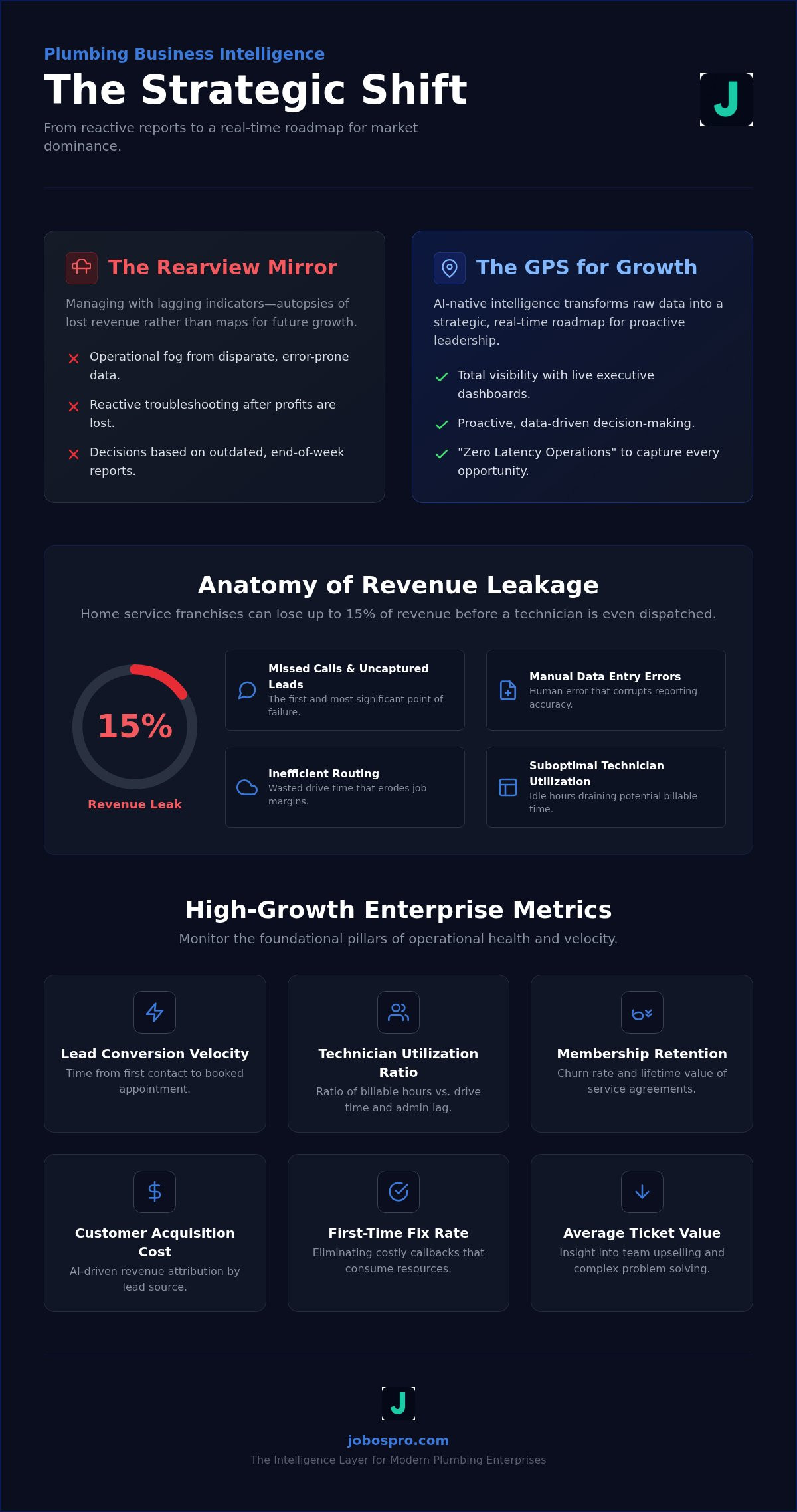
Most plumbing executives are managing their businesses through a rearview mirror; they view reports that are essentially autopsies of lost revenue rather than maps for future growth. You likely understand the frustration of watching uncaptured leads and idle technician hours drain your margins while disparate data across locations creates an operational fog. The traditional approach to management is no longer sufficient for an enterprise aiming for market dominance. Precision is the only variable that matters when you are looking to scale a multi-location organization.
This guide reveals how advanced plumbing business reporting software and AI-native intelligence transform raw data into a strategic roadmap for eliminating leakage. We will explore how to achieve total visibility into the customer lifecycle and automate data collection to remove the risk of human error. You will learn to implement clear benchmarking that drives consistency across every franchise or business unit. This is your blueprint for transitioning from reactive troubleshooting to proactive, data-driven leadership that secures your competitive edge through 2026 and beyond.
Key Takeaways
- Move beyond lagging indicators by transitioning from reactive reports to real-time maps for future growth.
- Optimize operational efficiency by mastering high-growth metrics such as lead conversion velocity and technician utilization ratios.
- Evaluate your tech stack to ensure your plumbing business reporting software functions as a proactive system of intelligence rather than a passive digital filing cabinet.
- Eliminate revenue leakage by standardizing field data collection and identifying hidden patterns in customer lifecycle management.
- Scale multi-location enterprises with confidence through automated benchmarking and centralized executive dashboards.
The Strategic Shift: Why Reactive Plumbing Reporting is Failing in 2026
Legacy CRMs have become liabilities. For years, these systems functioned as digital filing cabinets; they were designed to store customer names and job histories but lacked the architecture to interpret that data. Relying on last month’s revenue to drive current decisions is a strategic failure. It's a post-mortem of past performance rather than a blueprint for what’s next. Modern plumbing business reporting software must bridge this intelligence gap by moving from simple administrative oversight to proactive operational intelligence. If you're managing by looking at lagging indicators, you're already behind the market.
The Anatomy of Revenue Leakage
Revenue leakage typically occurs long before a technician arrives at a job site. The "2.3B Leak" narrative underscores the staggering cost of missed calls and uncaptured leads across the home services sector. Data suggests that home service franchises can experience up to 15% revenue leakage before a single conversation even concludes. These are the silent killers of enterprise growth. Inefficient routing and suboptimal technician utilization further erode margins. If your data flow relies on manual entry, it's inherently flawed. Human error remains the primary enemy of reporting accuracy. It transforms your financial statements into mere guesswork rather than actionable ground truth.
Real-Time Visibility as a Competitive Advantage
Static, end-of-week reports are relics of a slower, less competitive era. High-growth enterprises now demand live performance dashboards that reflect the heartbeat of the business in real time. This shift allows dispatchers to make intelligent, data-driven decisions that optimize fleet movement and job profitability instantly. By integrating advanced Business intelligence (BI), companies can identify hidden patterns that human operators inevitably miss. The transition to advanced plumbing business reporting software ensures that every lead is tracked and every technician is maximized. Zero Latency Operations is the new standard for plumbing enterprises, defined as the ability to capture, analyze, and act upon operational data at the exact moment it's generated. This is how you reclaim your margins and secure a dominant market position.
Essential Metrics for High-Growth Plumbing Enterprises
Scaling an enterprise requires more than a general sense of profitability. It demands a rigorous focus on specific key performance indicators that reveal the underlying health of your operations. While legacy systems focus on volume, modern plumbing business reporting software prioritizes velocity and efficiency. You must move beyond surface-level data to understand the friction points within your customer lifecycle. High-growth firms typically monitor four foundational pillars:
- Lead Conversion Velocity: The time elapsed from first contact to a booked appointment.
- Technician Utilization Rates: The ratio of billable hours versus drive time and administrative lag.
- Membership Retention Analytics: The churn rate and lifetime value of recurring service agreements.
- Customer Acquisition Cost (CAC): Revenue attribution identified by AI-driven lead sourcing.
Operational Efficiency Metrics
Average Ticket Value (ATV) provides a window into your team's ability to diagnose and solve complex issues rather than just performing basic repairs. Tracking ATV trends across different service types allows you to identify training gaps or pricing inconsistencies in real time. High-growth firms also prioritize first-time fix rates. A technician who returns to a job site for a callback is a technician who isn't generating new revenue. By integrating automated billing for contractors data directly into your operational reports, you eliminate the gap between work completion and cash flow. This ensures your financial health matches your operational output without manual reconciliation delays.
Marketing and Lead Intelligence
Data-driven growth requires precise revenue attribution. You can no longer afford to guess which marketing channels are driving your highest-value jobs. AI-native reporting identifies the source of every lead, allowing you to calculate your CAC with surgical precision. This intelligence layer also monitors your reputation management and review velocity in real time. High review counts and rapid response times signal reliability to prospective customers. Identifying high-intent leads that require an instant response ensures your team focuses their energy where the probability of conversion is highest. Implementing an AI-powered business management system alongside your plumbing business reporting software provides the total visibility needed to execute these strategies at scale.
AI vs. Legacy CRM: Choosing the Right Reporting Architecture
Legacy CRMs are passive repositories. They function as a System of Record, acting as a historical log that requires constant manual interpretation to be useful. This architecture forces executive teams to spend hours "cleaning" data before a report can even be presented. In contrast, modern plumbing business reporting software acts as a System of Intelligence. It doesn't just store data; it observes, retrieves, and unifies it in real time to provide a strategic roadmap for growth.
High-growth enterprises can't afford the latency inherent in traditional systems. AI-native architecture captures data at the point of lead inception, ensuring that every missed call and uncaptured lead is logged without human intervention. This shift removes the operational fog that plagues multi-location businesses. It transforms your software from a peripheral tool into a sophisticated layer of your business stack that identifies hidden patterns human operators miss.
The Problem with Fragmented Data
Fragmented data is the primary enemy of scale. When you utilize separate applications for invoicing, dispatch, and lead management, you create dangerous data silos. These silos prevent you from seeing the total customer lifecycle, leading to inconsistent performance across different franchise locations. Integrating automated invoicing for home services unifies your financial reporting and ensures that revenue data flows directly into your operational dashboards. This level of synchronization is the only way to achieve a single version of truth for your entire organization.
Evaluating AI-Native Capabilities
True scalability requires a platform that supports multi-unit oversight with minimal administrative friction. When selecting plumbing business reporting software, you must evaluate whether the system offers genuine AI-native capabilities. Does it provide AI call answering that prevents the 15% revenue leakage typical of home service franchises? Can it perform automated technician scheduling based on real-time performance data? These aren't luxury features; they're essential components of a modern operating system.
Executive-level dashboards must provide more than just raw numbers. They should offer benchmarking tools that allow you to compare performance across multiple locations instantly. This oversight enables you to identify which units are thriving and which require corrective action. By moving to an AI-powered intelligence layer, you replace manual oversight with automated precision. The result is a leaner, more responsive organization capable of rapid, sustainable expansion.
How to Implement a Data-Driven Culture in Your Field Operations
Culture is the silent engine of operational excellence. Without a commitment to data integrity at every level of the organization, even the most sophisticated plumbing business reporting software becomes a repository for noise rather than insight. You must enforce a fundamental shift in how your field staff perceives their role. They aren't just technicians; they're vital data points in a high-performance machine. Transitioning to a data-driven culture requires a methodical, four-step execution plan.
First, audit your current data flow to identify exactly where information is lost. This involves mapping the journey from the initial call to the final invoice to find the gaps. Second, standardize technician input via a centralized field app. Inconsistency is the primary enemy of benchmarking. Third, establish weekly "Intelligence Briefings" based on automated dashboards to review performance trends and adjust strategy. Finally, align technician incentives with key performance reporting. When rewards are tied to measurable data, behavior changes instantly.
Training for Transparency
Success in the field depends on removing friction. Onboarding your team to use a contractor invoicing app consistently ensures that every job detail is captured at the source. If the process is cumbersome, technicians will inevitably bypass it. You must reduce field-level friction to ensure 100% data capture across every service call. This transparency allows you to use performance data for constructive coaching rather than punitive oversight. It transforms the relationship between management and the field into a partnership focused on shared growth. To see how these tools integrate into your workflow, you can explore our AI-powered operating system.
Leveraging Financial Automation
Financial visibility is often the first casualty of rapid scaling. Streamlining your cash flow reporting with contractor payment collection tools eliminates the lag between service delivery and capital availability. Automating the "Quote-to-Cash" cycle provides real-time financial visibility that legacy systems cannot match. This automation reduces the administrative burden of month-end reconciliations, allowing your leadership team to focus on strategic expansion rather than chasing paper trails. By unifying your financial and operational data through advanced plumbing business reporting software, you create a frictionless environment where growth is predictable and sustainable.
JobOS Pro: The Intelligence Layer for Modern Plumbing Enterprises
JobOS Pro represents a foundational shift in technical architecture. It's not a mere peripheral tool; it is an AI-powered operating system designed specifically for high-growth trades. While traditional plumbing business reporting software struggles to bridge the gap between field activity and executive oversight, JobOS Pro unifies the entire customer lifecycle. It creates a seamless flow from the first AI-answered call to the final automated invoice. This integration ensures that no data is lost and no revenue is leaked during the handoff between departments.
The platform acts as the smartest entity in the room. It identifies hidden patterns in technician behavior and customer demand that human operators inevitably miss. By deploying AI call answering and instant lead capture, JobOS Pro prevents the 15% revenue leakage that typically cripples home service franchises before the first call even ends. This is corrective action at the point of inception, not an autopsy performed weeks later. It provides the tech-forward infrastructure required to turn raw plumbing data into a strategic roadmap for scaling.
Executive Oversight and Benchmarking
Multi-unit owners require a specific level of intelligence to maintain consistency across a diverse network. JobOS Pro provides the total visibility needed to identify top-performing locations and replicate their success across the entire enterprise. It standardizes operational excellence by removing the variability of human data entry. AI-native intelligence also enables predictive growth modeling, allowing executives to forecast revenue and resource needs with surgical precision. This level of oversight transforms a collection of disparate locations into a unified, high-performance network that operates with foundational reliability.
The Future of Plumbing Management
The industry is moving beyond the limitations of legacy field service management software. These older systems were built for administrative tracking, not strategic growth. The smartest plumbing businesses are switching to AI-native platforms that function as comprehensive Business Operating Systems. This transition allows leadership to focus on high-level strategy while the software handles the complexities of dispatch, lead recovery, and financial reconciliation. JobOS Pro serves as a tireless, 24/7 strategic partner that provides constant oversight and ensures your organization remains relentlessly focused on performance. By integrating this advanced plumbing business reporting software, you secure a competitive edge that is both scalable and sustainable through 2026.
Securing Your Market Dominance Through Predictive Intelligence
The era of manual oversight is over. Scaling a modern trade enterprise requires more than just field coordination; it requires a sophisticated architecture that interprets data in real time. We've established that reactive reporting is a liability that costs businesses up to 15% of their revenue before a lead even converts. Transitioning to a data-driven culture is the only way to eliminate these systemic inefficiencies and secure your market position. By deploying advanced plumbing business reporting software, you replace the operational fog of legacy systems with foundational clarity.
Success in 2026 belongs to the executives who treat data as their most valuable asset. JobOS Pro provides the executive dashboards needed for multi-location intelligence and AI-powered missed-call recovery. It unifies your entire operation through automated customer lifecycle management, ensuring every technician and every lead is maximized for profitability. Stop the leakage and start scaling with JobOS Pro. The roadmap for growth is now clear. It's time to lead your organization with the precision that only AI-native intelligence can provide.
Frequently Asked Questions
What is the most important report for a plumbing business owner to monitor daily?
The most critical daily report is the Lead Conversion Velocity dashboard. This metric tracks the speed at which a prospect moves from the initial call to a booked appointment. Monitoring this alongside technician utilization rates ensures your fleet is operating at peak capacity. High-growth enterprises use these real-time insights to identify bottlenecks before they impact daily revenue, allowing for immediate corrective action in dispatching and lead follow-up.
How does AI-driven reporting differ from a traditional plumbing CRM?
Traditional CRMs function as static systems of record that require manual data entry and cleaning to be useful. In contrast, AI-driven reporting acts as a system of intelligence that observes and retrieves data automatically. This advanced plumbing business reporting software identifies hidden patterns in customer behavior and operational leakage that human operators often miss, providing proactive strategic roadmaps rather than simple historical logs of past plumbing jobs.
Can reporting software help me identify which technicians are most profitable?
Yes, sophisticated reporting tools provide granular visibility into individual technician performance. You can track Average Ticket Value (ATV), first-time fix rates, and billable hour ratios across your entire team. This data allows you to identify top performers and pinpoint specific training needs for others. By aligning technician incentives with these measurable performance indicators, you drive consistent profitability and accountability across every service call your team completes each day.
How do I track revenue leakage in my plumbing service funnel?
Tracking revenue leakage requires monitoring the gap between total lead volume and booked jobs. AI-powered missed-call recovery tools provide specific data on how many opportunities are lost at the point of inception. By analyzing uncaptured leads and abandoned calls, you can quantify the financial impact of missed connections. This intelligence allows you to implement automated response systems that prevent the 15% revenue leakage common in home service franchises.
What is franchise network benchmarking, and why does it matter for growth?
Franchise network benchmarking is the process of comparing key performance indicators across multiple business units or locations. It's essential for growth because it establishes a standard of operational excellence for the entire organization. By identifying which locations are outperforming the network average in conversion rates or profit margins, executives can replicate successful strategies and standardize high-performance behaviors across every franchise unit in their expanding portfolio.
Will my office staff need extensive training to use an AI-powered reporting dashboard?
Modern AI-powered dashboards are designed to reduce administrative friction rather than increase it. While legacy systems often require complex manual reconciliation, an intelligent operating system automates data collection and visualization. Your staff will spend less time on manual entry and more time acting on the insights provided. The interface is built for executive-level oversight, offering clear, intuitive visualizations that don't require a background in data science to interpret.
How does automated invoicing improve the accuracy of my financial reports?
Automated invoicing eliminates the human error inherent in manual data entry and paper-based billing. When invoices are generated automatically from field data, the information flows directly into your financial dashboards with zero latency. This ensures your plumbing business reporting software reflects your actual cash position at all times. It removes the need for month-end reconciliations and provides a single version of truth for your organization's total financial health and stability.
Can I integrate my existing accounting software with JobOS Pro reporting?
JobOS Pro is designed to function as an intelligent layer that integrates seamlessly with your existing tech stack. It specifically integrates with QuickBooks to ensure your financial reporting remains unified and accurate. This prevents the creation of data silos and allows you to maintain your current accounting workflows while gaining the advanced predictive intelligence and executive oversight capabilities of an AI-native business operating system built for the trades.